
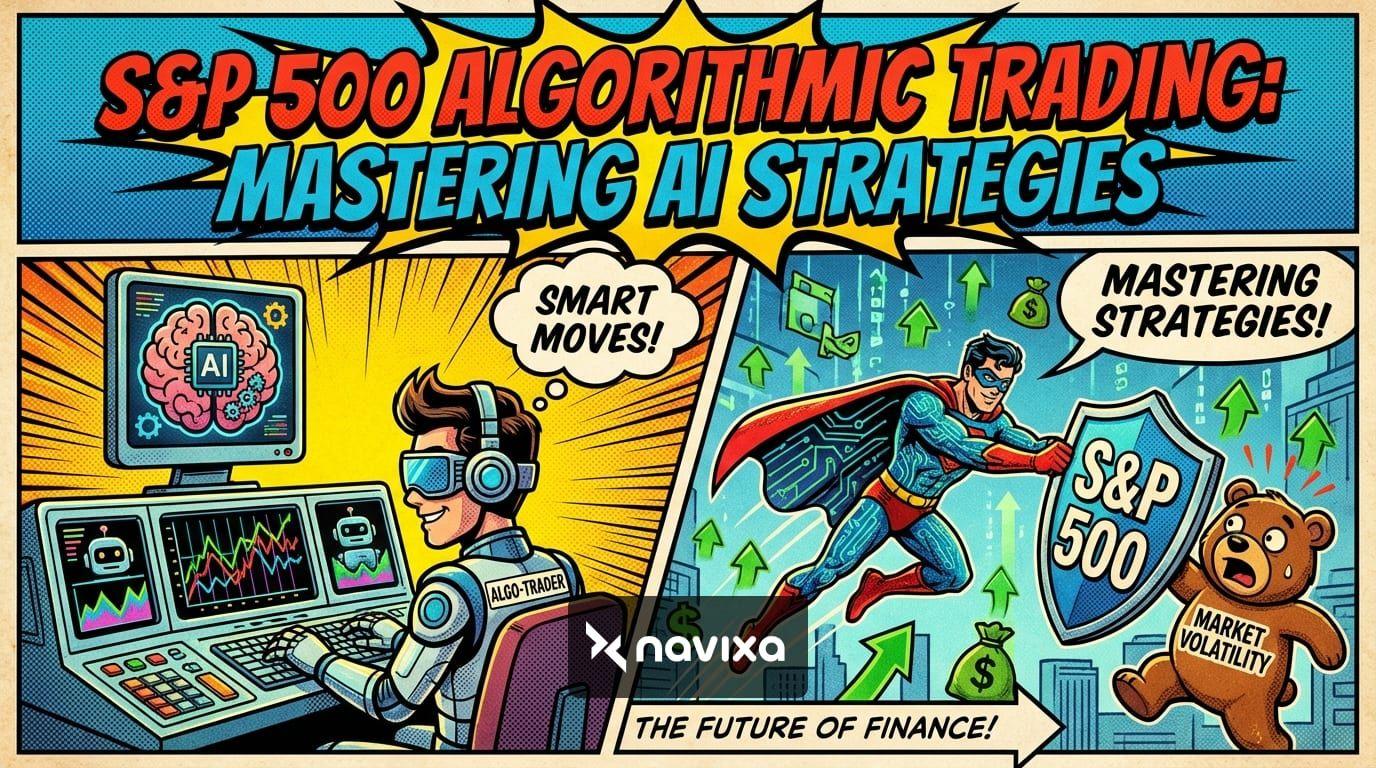
The financial markets have always been a battleground for technological supremacy, but the current era of S&P 500 algorithmic trading is entirely unprecedented. By acting as the premier benchmark for U.S. equity performance, the S&P 500 offers unmatched liquidity, institutional participation, and, most importantly, data. For decades, quantitative analysts have relied on rigid, rules-based algorithms to capture micro-inefficiencies in the market. Today, artificial intelligence (AI) and machine learning (ML) are not just optimizing these traditional methods—they are completely redefining how alpha is generated.
Whether you are an institutional quantitative researcher or a sophisticated retail trader, integrating AI into your strategy is no longer just an advantage; it is a necessity for survival. In this comprehensive guide, we will explore the core AI strategies driving modern S&P 500 algorithmic trading, analyze the role of technical analysis in these complex models, and provide actionable steps to build and protect your automated trading portfolio.
The Evolution of Automated Trading
Historically, algorithmic trading was built on strict "if-then" paradigms. A human programmer would code a specific set of rules—such as buying a stock when its 50-day moving average crossed above its 200-day moving average—and the computer would execute the orders. While this eliminated emotional bias and improved execution speed, it was fundamentally limited by human foresight.
As market dynamics became more complex, these static models often failed during periods of unprecedented volatility. The introduction of AI shifted the paradigm from *execution algorithms* to *learning algorithms*. Modern S&P 500 algorithmic trading systems can analyze millions of data points across historical price action, macroeconomic reports, and global news sentiment in milliseconds. Instead of executing a static rule, an AI model dynamically adapts its parameters to the current market regime, identifying non-linear patterns that are invisible to the human eye.
This evolution has contributed to a massive surge in automated trading volume. Recent market analyses indicate that algorithmic execution accounts for a vast majority of the daily liquidity in the S&P 500 index, with sophisticated AI models generating historically high profit margins by exploiting deep sector divergences.
Core AI Trading Strategies for the S&P 500
To succeed in S&P 500 algorithmic trading, developers are moving beyond simple momentum or mean-reversion tactics. Today's AI-driven systems employ multi-layered approaches.
1. Machine Learning & Predictive Analytics
Machine learning algorithms form the backbone of modern predictive trading. By utilizing Deep Neural Networks (DNNs) and Random Forests, trading systems can ingest decades of historical S&P 500 Index tick data to forecast future price movements. These models identify intricate correlations between the 500 constituent stocks, adjusting portfolio weights dynamically. For instance, if an AI detects a historical pattern of tech sector outperformance following a specific treasury yield curve inversion, it will preemptively allocate capital into high-beta technology constituents before the broader market reacts.
2. Natural Language Processing (NLP) & Sentiment Analysis
Markets move on information, and AI processes information faster than any human analyst. NLP models are now a staple in S&P 500 algorithmic trading. By scanning thousands of financial news articles, SEC filings, and live earnings call transcripts, algorithms quantify market sentiment in real-time. Specialized financial language models, such as FinBERT, have proven highly effective at scoring the tone of Federal Reserve minutes or corporate press releases. If a major S&P 500 constituent announces earnings with unexpectedly cautious forward guidance, an NLP-driven algorithm can short the asset or hedge the index ETF (SPY) within milliseconds of the transcript's publication.
3. Statistical Arbitrage and High-Frequency Trading (HFT)
Statistical arbitrage involves identifying pricing inefficiencies between correlated assets. In the context of the S&P 500, an AI algorithm might monitor the historical price spread between two major competitors, such as Coca-Cola and PepsiCo. If the spread deviates beyond a statistically significant threshold (measured by standard deviations), the algorithm automatically shorts the overvalued stock and buys the undervalued one, betting on mean reversion. AI enhances this strategy by monitoring hundreds of these pairs simultaneously and calculating dynamic risk thresholds based on real-time volatility.
Technical Analysis in AI Trading Models
A common misconception is that AI renders traditional technical analysis obsolete. In reality, AI enhances technical analysis by optimizing it.
Traditional technical indicators—such as the Relative Strength Index (RSI), Moving Average Convergence Divergence (MACD), and Bollinger Bands—are excellent ways to quantify price action. However, their default parameters (e.g., a 14-period RSI) are arbitrary and static. In an AI-driven S&P 500 algorithmic trading system, technical indicators serve as "features" (inputs) for the machine learning model.
The AI evaluates how these indicators perform under various market conditions. During a strong bull market, an AI might learn that an RSI of 80 is no longer "overbought" but rather a sign of persistent momentum, dynamically adjusting its trading thresholds. Furthermore, AI can combine technical data with order book depth and volume profiles, creating hybrid indicators that offer a much higher probability of success than traditional chart reading.
Traditional vs. AI-Driven Algorithmic Trading
Understanding the distinction between legacy systems and modern AI architectures is crucial for any quantitative developer.
| Feature | Traditional Algorithmic Trading | AI-Driven Algorithmic Trading |
|---|---|---|
| Core Logic | Static, rules-based (If X, then Y) | Dynamic, adaptive learning (Probability-based) |
| Data Processing | Primarily historical price and volume data | Price, volume, alternative data, and NLP sentiment |
| Adaptability | Low; requires manual re-coding for new market regimes | High; models self-optimize and learn from new data |
| Overfitting Risk | Moderate; curve-fitting historical data is common | High; requires strict out-of-sample testing |
| Execution Speed | Ultra-fast; optimized for minimal latency | Fast, though complex models may require high compute power |
Actionable Steps: Building an AI Algo-Trading System
Transitioning from theoretical concepts to a live S&P 500 algorithmic trading system requires a rigorous, systematic approach. Here is how quantitative traders build and deploy their models.
Step 1: Data Acquisition and Processing
The phrase "garbage in, garbage out" is the golden rule of machine learning. An AI model is only as good as the data it is trained on. Traders must source high-quality, survivorship-bias-free historical data for the S&P 500. This data must be meticulously cleaned to remove outliers, stock split anomalies, and missing ticks. Beyond price data, integrating alternative datasets—such as options chain imbalances, dark pool prints, and macroeconomic indicators—can give the model a unique edge.
Step 2: Backtesting and Optimization
Once the AI model is trained, it must be backtested against unseen historical data (out-of-sample testing). A critical mistake many developers make is "overfitting"—creating a model that performs perfectly on past data but fails miserably in live markets. To combat this, developers use techniques like Walk-Forward Optimization and K-Fold Cross-Validation. A robust S&P 500 algorithmic trading system must demonstrate consistent performance across different market regimes, including bull runs, recessions, and sudden crash events.
Step 3: Execution and Broker Integration
A theoretical edge is useless if it cannot be executed efficiently. Live deployment requires connecting the algorithm to a brokerage via an API (Application Programming Interface). The execution engine must account for real-world friction, including trading commissions, bid-ask spreads, and slippage. Advanced AI systems incorporate execution algorithms, such as TWAP (Time-Weighted Average Price) or VWAP (Volume-Weighted Average Price), to slowly feed large orders into the market, minimizing market impact and hiding institutional footprints.
Risk Management in Automated S&P 500 Trading
Algorithmic trading is inherently dangerous without institutional-grade risk management. Because computers execute trades at lightning speed, a minor coding error or unexpected data anomaly can drain an account in minutes—a phenomenon often referred to as a "flash crash."
Effective S&P 500 algorithmic trading requires multiple layers of defense: * Hard Stop-Losses and Kill Switches: Every system must have a hard-coded daily loss limit. If the algorithm hits this threshold, trading is immediately halted, and all open positions are liquidated. * Dynamic Position Sizing: AI should scale its position sizes based on the Kelly Criterion or real-time market volatility (VIX). In highly volatile environments, the algorithm should automatically reduce its exposure. * Redundancy and Monitoring: Professional quants never let algorithms run entirely unmonitored. Cloud server redundancies, backup data feeds, and real-time dashboard alerts are essential to ensure uninterrupted operations.
Practical Takeaways
* Adaptability is Key: Static rules eventually fail. Leverage machine learning to create algorithms that adapt to shifting S&P 500 market regimes. * Alternative Data Wins: Give your AI an edge by integrating non-traditional inputs, such as NLP-driven sentiment analysis and options market order flow. * Beware of Overfitting: Always test your AI models on out-of-sample data and use walk-forward optimization to ensure real-world viability. * Prioritize Risk Management: Code unbreachable kill switches and dynamic position sizing rules to protect your capital from algorithmic anomalies and flash crashes.
Conclusion
The landscape of S&P 500 algorithmic trading is evolving at a breakneck pace, driven by relentless advancements in artificial intelligence and machine learning. From NLP algorithms dissecting Federal Reserve speeches to deep learning networks uncovering hidden sector correlations, the tools available to quantitative traders have never been more powerful.
However, with great power comes the need for extreme precision. Success in AI trading is not just about writing the most complex code; it is about sourcing clean data, managing risk ruthlessly, and continuously adapting to the market. Whether you are building your first Python script or managing an institutional quantitative fund, the future belongs to those who embrace AI as a dynamic trading partner. Start small, test rigorously, and begin optimizing your automated strategy today.
Frequently Asked Questions
What is S&P 500 algorithmic trading?
S&P 500 algorithmic trading refers to the use of automated computer programs to buy and sell stocks within the S&P 500 index, or its associated ETFs (like SPY) and futures contracts. These programs execute trades based on pre-programmed instructions encompassing timing, price, and volume, eliminating human emotional interference and maximizing execution speed.
How does AI improve algorithmic trading strategies?
Traditional algorithms rely on static, human-coded rules. AI and machine learning improve upon this by analyzing vast datasets to identify complex, non-linear patterns. AI can dynamically adjust trading parameters in real-time, process natural language from financial news, and self-optimize based on changing market conditions.
Can retail traders use AI for S&P 500 algorithmic trading?
Yes. In recent years, the democratization of financial technology has given retail traders access to powerful API integrations, open-source machine learning libraries (like TensorFlow and PyTorch), and cloud computing. Various platforms now offer no-code or low-code environments that allow retail investors to build, backtest, and deploy AI-driven strategies.
What are the main risks of AI algorithmic trading?
The primary risks include overfitting (where a model performs well in testing but fails in live markets), technology failures (such as API disconnections or server outages), and unforeseen market anomalies. Without strict risk management and automated kill switches, an algorithmic system can execute hundreds of losing trades in a matter of seconds.