
Introduction
The financial markets have undergone a profound transformation, moving from manual, human-driven execution to highly sophisticated, machine-driven ecosystems. For mega-cap technology equities, GOOGL stock algorithmic trading represents the pinnacle of this evolution. Alphabet Inc. (the parent company of Google) is not just a digital advertising behemoth; it is a sprawling conglomerate deeply entrenched in cloud computing, quantum research, and artificial intelligence (AI). As Alphabet’s market capitalization firmly anchors in the multi-trillion-dollar range, trading its shares requires more than just basic technical analysis—it demands quantitative rigor.
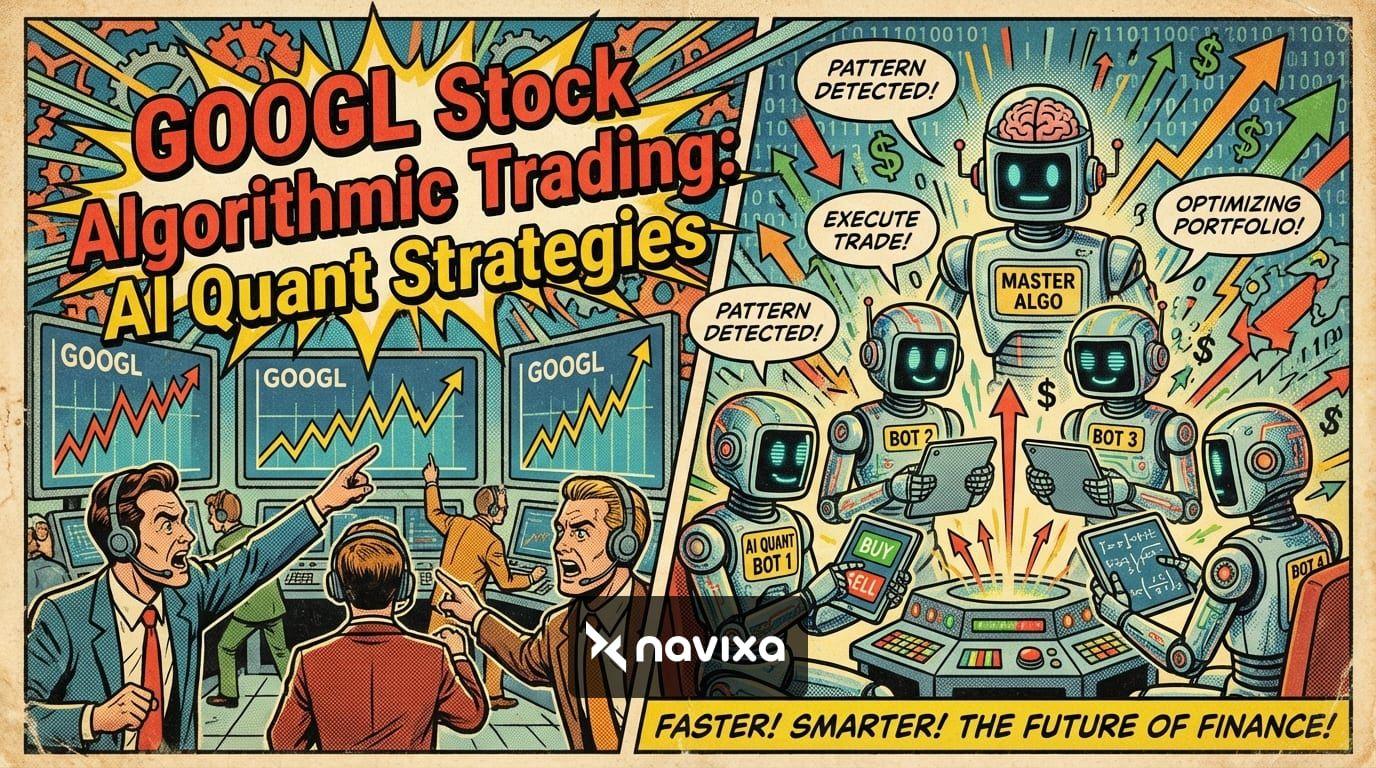
Algorithmic trading leverages computational power to execute orders at speeds and frequencies that are impossible for human traders. By deploying AI quant strategies, traders can capitalize on micro-inefficiencies, sentiment shifts, and statistical anomalies in GOOGL's price action. Whether you are an institutional quantitative analyst or a retail algorithmic trader, mastering the automated trading of Alphabet stock offers a unique pathway to generating alpha in today's highly competitive market environment.
In this comprehensive guide, we will explore the underlying mechanics of algorithmic trading tailored specifically for GOOGL. We will dissect core machine learning models, evaluate key technical indicators, and provide actionable frameworks to build, backtest, and deploy your own automated trading systems.
Why GOOGL is a Prime Target for Algorithmic Trading
When developing quantitative strategies, asset selection is just as critical as the algorithm itself. GOOGL possesses a unique combination of liquidity, volatility, and structural predictability that makes it highly attractive to algorithmic traders.
Unmatched Liquidity and Market Depth
Alphabet’s Class A shares (GOOGL) routinely trade tens of millions of shares daily. This massive volume translates to deep order books and incredibly tight bid-ask spreads. For algorithmic systems—especially high-frequency trading (HFT) and statistical arbitrage models—liquidity is the lifeblood that minimizes slippage. Algorithms can enter and exit multi-million dollar positions without drastically moving the market, preserving the mathematical edge of the strategy.
The AI and Regulatory Volatility Premium
While tech mega-caps are generally less volatile than small-cap stocks or cryptocurrencies, GOOGL frequently experiences localized volatility events. These are often driven by: 1. AI Infrastructure CapEx: Market reactions to Alphabet's massive capital expenditures (historically exceeding $180 billion) on AI infrastructure, Google DeepMind, and Gemini model development. 2. Regulatory Scrutiny: Antitrust lawsuits from the Department of Justice (DOJ) and European regulators create intraday sentiment shocks. 3. Cloud Revenue Growth: Quarterly earnings reports focusing on Google Cloud's profitability can trigger algorithmic buying or selling frenzies.
The Share Class Arbitrage
Alphabet famously maintains two primary publicly traded share classes: Class A (GOOGL), which carries voting rights, and Class C (GOOG), which has no voting rights. Historically, these two tickers move in near-perfect synchronization, but short-term supply and demand imbalances can create a temporary price divergence (typically between 1% and 2%). This structural anomaly is a textbook use case for pairs trading and statistical arbitrage algorithms.
"In the realm of algorithmic trading, liquidity and structural inefficiencies are the twin engines of profitability. Mega-cap tech stocks like Alphabet offer a vast playground for quantitative models to extract consistent alpha without the liquidity bottlenecks found in smaller equities."
Core AI Quant Strategies for Alphabet Stock
Building a successful automated system for GOOGL stock algorithmic trading requires moving beyond simple moving average crossovers. Modern quants rely on advanced statistical and machine learning models.
1. Statistical Arbitrage: The GOOGL vs. GOOG Spread
As mentioned, the dual-class share structure of Alphabet provides a fertile ground for statistical arbitrage (StatArb). A mean-reversion algorithm continuously monitors the spread between GOOGL and GOOG. * The Logic: If GOOGL historically trades at a 1% premium to GOOG, and institutional block selling suddenly pushes that premium to 2.5%, the algorithm automatically short-sells GOOGL and buys GOOG. * The Exit: Once the spread reverts to its historical mean of 1%, the algorithm closes both positions simultaneously, capturing a risk-free profit minus transaction costs. This strategy is highly scalable and relatively market-neutral.
2. Natural Language Processing (NLP) Sentiment Trading
Alphabet's stock price is highly sensitive to news. From AI product launches (like updates to the Gemini ecosystem) to DOJ antitrust rulings, headlines move the market. NLP algorithms can parse thousands of news articles, earnings call transcripts, and financial tweets in milliseconds. * Implementation: The algorithm uses models like FinBERT to assign a sentiment score (ranging from -1 to 1) to incoming news feeds. * Execution: If a sudden influx of highly positive sentiment regarding Google Cloud margins hits the wire, the algorithm can execute a long position fractions of a second before human traders even finish reading the headline.
3. Machine Learning Volatility Breakout Models
Traditional breakout strategies often suffer from false signals. By integrating machine learning—specifically Random Forest or Support Vector Machine (SVM) classifiers—algorithms can better predict whether a breakout in GOOGL's stock price is genuine. The AI model is trained on decades of historical minute-by-minute data, learning the specific volume profiles, order book imbalances, and options market activities that precede a sustained directional move.
Key Technical Indicators for GOOGL Algos
While AI models handle the complex pattern recognition, they still rely on robust, mathematically sound technical indicators as feature inputs. When engineering features for your GOOGL trading algorithm, consider the following metrics:
Volume Weighted Average Price (VWAP)
VWAP is the ultimate benchmark for algorithmic execution. It calculates the average price a security has traded at throughout the day, based on both volume and price. Many institutional algorithms use VWAP to ensure they are executing large orders without paying an excessive premium. For retail quants, a strategy might involve buying GOOGL when it crosses above the VWAP on high relative volume, signaling institutional accumulation.
Bollinger Bands and Mean Reversion
Because GOOGL is a highly traded, heavily institutionally owned stock, it rarely moves in a straight line forever. Bollinger Bands help algorithms identify standard deviation extremes. When GOOGL touches the upper or lower bands, an algorithm can calculate the probability of a mean reversion based on the prevailing macro-market trend (such as the performance of the Nasdaq 100).
Order Book Imbalance
Modern algos do not just look at historical price; they look at intent. By analyzing Level 2 market data, algorithms can detect an order book imbalance—for instance, when the volume of limit buy orders vastly outnumbers limit sell orders. This microstructure data is highly predictive of ultra-short-term price movements in GOOGL stock.
Traditional vs. AI Algorithmic Trading
Understanding the distinction between discretionary trading and algorithmic execution is crucial for modern investors. Here is how they compare when trading a mega-cap asset like Alphabet.
| Feature | Traditional Discretionary Trading | AI Algorithmic Trading |
|---|---|---|
| Execution Speed | Seconds to minutes (manual entry) | Milliseconds to microseconds |
| Data Processing | Limited to human cognitive capacity | Parses millions of data points, Level 2 data, and NLP feeds |
| Emotional Bias | High susceptibility to fear and greed | Purely mathematical, zero emotional interference |
| Backtesting | Manual, prone to hindsight bias | Automated, rigorous out-of-sample statistical validation |
| Scalability | Difficult to manage multiple complex strategies | Can run thousands of concurrent strategies effortlessly |
Actionable Steps: Building Your GOOGL Trading Algorithm
If you are ready to transition from manual trading to a systematic, automated approach, follow these structured phases to build your GOOGL stock algorithmic trading system.
1. Data Acquisition and Cleaning
No machine learning model can succeed with poor data. You need high-quality, tick-level or minute-level historical data for GOOGL. Furthermore, your data must be adjusted for stock splits (such as Alphabet's 20-for-1 split in 2022) and dividend distributions. Reliable data providers include Yahoo Finance for basic daily data, or more advanced institutional feeds for intraday tick data. Ensure you clean the data to remove anomalies and handle missing values before feeding it into your model.
2. Developing the Logic and Feature Engineering
Once your data is clean, you must engineer the features (the variables your AI will use to make decisions). For GOOGL, your features might include: * The spread between GOOGL and the QQQ ETF. * The rolling 14-day Average True Range (ATR). * NLP sentiment scores scraped from major financial news outlets. * The intraday volume profile. Using Python libraries like `pandas` and `scikit-learn`, structure these features so your algorithmic model can begin identifying predictive patterns.
3. Backtesting on Out-of-Sample Data
Backtesting is the process of testing your algorithmic logic against historical data to see how it would have performed. However, you must avoid "overfitting"—the process of tweaking your algorithm so perfectly to past data that it fails in live markets. Use platforms like QuantConnect or Backtrader to rigorously test your GOOGL strategy on data it has never seen before (out-of-sample testing). Focus on metrics like the Sharpe Ratio, Maximum Drawdown, and Win/Loss ratio rather than just total return.
4. Paper Trading and Live Execution
Before risking real capital, deploy your algorithm in a simulated environment (paper trading). Connect your Python script to a modern, developer-friendly brokerage such as Alpaca Trading API or Interactive Brokers. Monitor the paper trading results for at least one fiscal quarter. This allows you to observe how the algorithm handles GOOGL earnings reports, macroeconomic Federal Reserve announcements, and AI product releases in real-time. Only transition to live capital once the paper trading results statistically mirror your backtests.
Risk Management in Automated Systems
The greatest misconception about automated trading is that it runs risk-free. In reality, algorithms can lose money significantly faster than human traders if left unchecked. Robust risk management is the cornerstone of any sustainable quant strategy.
Hard Stop Losses and Circuit Breakers
Your code must include hard-coded stop losses that execute automatically at the exchange level, not just locally on your machine. If your internet connection drops while the algorithm is holding a massive GOOGL position during a flash crash, the exchange must know to liquidate the position. Furthermore, implement internal circuit breakers: if the algorithm loses more than X% of the portfolio in a single day, it should halt all trading and send an alert to your phone.
Position Sizing and Portfolio Beta
Never allocate your entire portfolio to a single GOOGL algorithm. Use the Kelly Criterion or a risk-parity model to determine the optimal position size. Since GOOGL is heavily correlated with the broader tech market (Nasdaq), ensure your algorithm hedges against systemic market downturns, potentially by shorting index futures when going long on Alphabet.
Handling Regulatory and Black Swan Events
Algorithms trained on the past decade of data may not know how to handle unprecedented black swan events, such as a surprise DOJ ruling forcibly breaking up Google's ad business. Your system should monitor the VIX (Volatility Index) and automatically reduce its position sizing in GOOGL when broader market uncertainty spikes.
Conclusion
The era of intuitive, manual stock picking is rapidly giving way to quantitative precision. Engaging in GOOGL stock algorithmic trading allows you to strip emotion from your investment process and leverage the immense computing power of AI quant strategies. Alphabet’s deep liquidity, regulatory news cycles, and dual-class share structure create a perfect ecosystem for automated models, from statistical arbitrage to machine learning sentiment analysis.
By meticulously engineering your features, rigorously backtesting against out-of-sample data, and implementing iron-clad risk management protocols, you can build algorithms that consistently identify and exploit micro-inefficiencies in the market. The barrier to entry for quant trading has never been lower—start writing your code, connect to an API, and take your trading strategy into the future.
Frequently Asked Questions
What programming language is best for algorithmic trading?
Python is widely considered the industry standard for algorithmic trading and quantitative finance. Its extensive ecosystem of data science and machine learning libraries—such as Pandas, NumPy, TensorFlow, and Scikit-learn—makes it incredibly efficient for building, backtesting, and deploying AI quant strategies for stocks like GOOGL. C++ is also used by high-frequency trading (HFT) firms for ultra-low latency execution.
How do I start backtesting a GOOGL trading strategy?
To begin backtesting, you need historical price and volume data for GOOGL, which can be sourced from API providers like Alpha Vantage or Polygon.io. Once you have the data, you can use open-source Python libraries like Backtrader or cloud-based quantitative platforms like QuantConnect to code your logic and test how it would have performed historically.
What is the difference between GOOG and GOOGL in algorithmic trading?
GOOGL represents Alphabet's Class A shares, which carry voting rights, while GOOG represents Class C shares, which have no voting rights. In algorithmic trading, the slight price divergence (spread) between these two near-identical assets is often exploited using a strategy called statistical arbitrage, where an algorithm goes long on the underperforming ticker and short on the overperforming one until the spread normalizes.
Is algorithmic trading profitable for retail investors?
Yes, algorithmic trading can be profitable for retail investors, but it requires a deep understanding of market mechanics, coding, and statistics. Retail quants cannot compete with institutional high-frequency trading firms on execution speed (microseconds). Instead, retail algorithms find profitability in mid-frequency strategies, sentiment analysis, swing trading automation, and managing risk mathematically without emotional bias.
Can AI predict GOOGL stock prices with 100% accuracy?
No. Financial markets are fundamentally stochastic (random) and influenced by unpredictable real-world events. While machine learning algorithms can identify high-probability setups and historical patterns, no AI can predict stock prices with perfect certainty. The goal of an AI quant strategy is not to be right every time, but to maintain a positive mathematical expectancy (edge) over thousands of trades.