
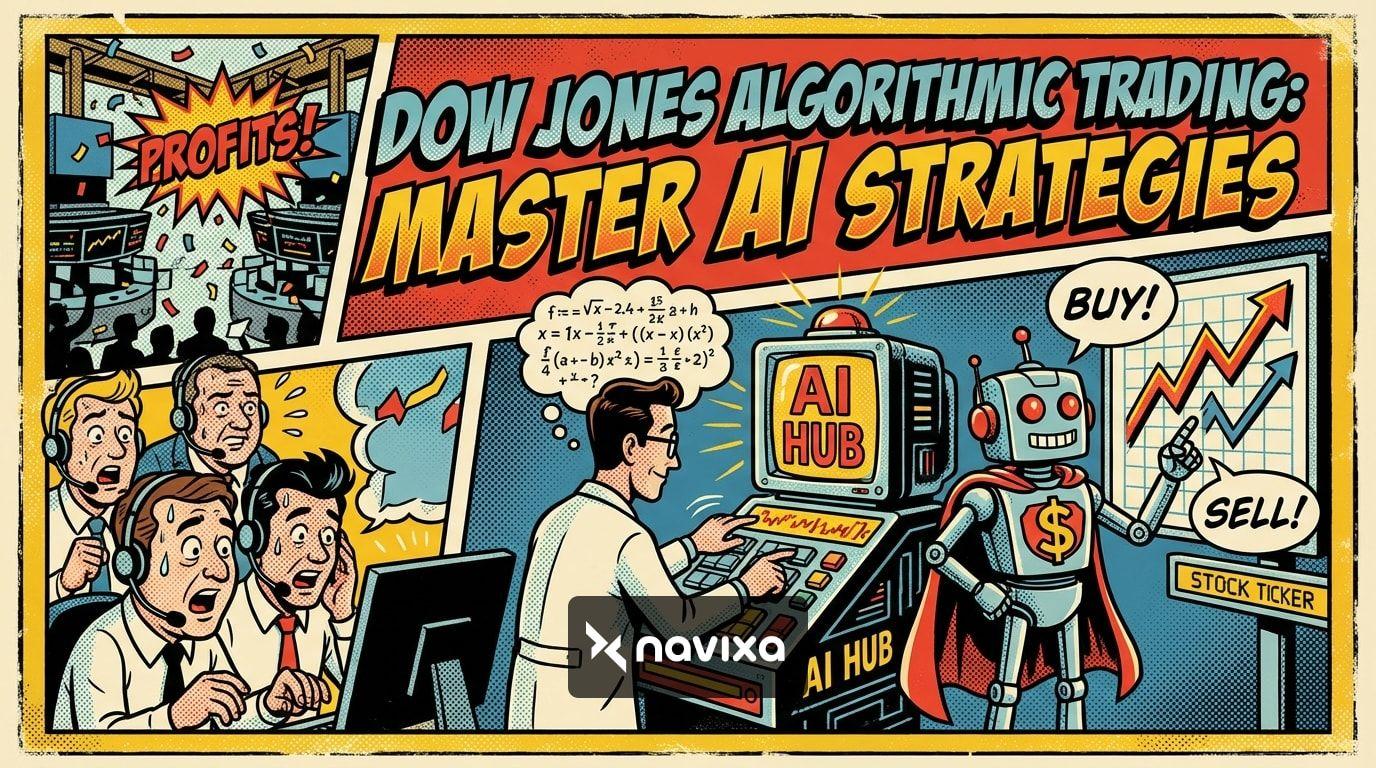
The financial landscape has undergone a monumental shift, and Dow Jones algorithmic trading sits at the epicenter of this transformation. As the trading world continuously evolves, investors and institutions are increasingly relying on sophisticated automated systems to navigate market complexities. Historically, the Dow Jones Industrial Average (DJIA) has served as a primary barometer for the health of the United States economy, tracking 30 prominent, large-cap companies. However, the methods used to trade this historic index have moved far beyond the traditional trading floor. Today, advanced artificial intelligence and machine learning models dominate the execution of trades, bringing unprecedented speed, efficiency, and analytical depth to the market.
In this comprehensive guide, we will explore the intricacies of Dow Jones algorithmic trading, delving into how cutting-edge AI strategies are redefining technical analysis, risk management, and portfolio optimization. Whether you are an institutional quantitative analyst or a retail trader looking to integrate intelligent automation into your strategy, mastering these AI-driven mechanisms is essential for staying competitive in today's rapid-fire financial markets.
The Evolution of Dow Jones Algorithmic Trading
From Basic Scripts to Agentic AI
Algorithmic trading is not a new concept. For decades, quantitative funds have utilized computer scripts to execute pre-defined trading instructions based on variables such as timing, price, and volume. These early systems were predominantly rule-based, strictly following explicit conditional logic. If the DJIA crossed a certain moving average, the system would automatically generate a buy or sell order.
However, the modern era of Dow Jones algorithmic trading is characterized by the transition toward autonomous, intelligent systems. We have moved past the initial phase of simply building raw computing power and are now fully immersed in the "Inference and Implementation Phase". This shift has popularized the use of "Agentic AI"—systems capable of making autonomous, multi-step decisions based on real-time market feedback rather than relying on static rules.
"In the modern market, the algorithmic trading landscape is evolving from passive data processing to the active deployment of Agentic AI, where autonomous systems dynamically manage portfolios through real-time inference."
These sophisticated AI models are no longer monolithic. They can process vast arrays of unstructured data, adapt to changing market regimes, and execute complex trading strategies that were previously impossible. As algorithmic trading markets continue to expand—projected to exceed $26 billion globally by the end of the decade—the reliance on these intelligent agents will only deepen.
Core Strategies in Dow Jones Algorithmic Trading
To successfully deploy AI in trading the Dow Jones, one must understand the core strategies that these algorithms utilize. The DJIA's unique price-weighted structure means that higher-priced stocks have a more significant impact on the index's movement. AI models must account for this structure when formulating strategies.
Mean Reversion and Trend Following
At the foundational level, AI algorithms enhance traditional technical strategies. Mean reversion algorithms operate on the statistical assumption that extreme price movements will eventually revert to their historical averages. By utilizing indicators such as Bollinger Bands and the Relative Strength Index (RSI), an AI system can identify overbought or oversold conditions within Dow components and automatically execute trades.
Conversely, trend-following strategies aim to capture directional momentum. Machine learning algorithms analyze Exponential Moving Averages (EMA) and the Moving Average Convergence Divergence (MACD) to detect the onset of a new trend. For instance, during recent market cycles, the DJIA tested critical support levels around the 46,000 mark. Algorithmic systems identified these technical floors and executed high-frequency buy orders, providing necessary support while simultaneously capitalizing on the subsequent rebounds,.
Multi-Modal AI and Sentiment Analysis
One of the most profound advancements in Dow Jones algorithmic trading is the integration of multi-modal AI systems. Traditional algorithms solely analyzed historical price data, but modern AI integrates natural language processing (NLP) to interpret market psychology and financial sentiment in real-time.
By leveraging advanced NLP models like FinBERT, AI trading systems can instantly analyze news articles, central bank statements, and geopolitical developments. When this sentiment data is combined with predictive machine learning algorithms such as XGBoost, the trading system can generate highly accurate directional signals. If a sudden geopolitical event occurs, the multi-modal AI can instantly assess the negative sentiment, calculate the potential impact on global supply chains, and adjust the portfolio's exposure before human traders even have time to react.
Comparison: Traditional vs. AI-Driven Algorithmic Trading
Understanding the fundamental differences between legacy systems and modern AI trading is crucial for developing a competitive edge. The following table highlights the key distinctions:
| Feature | Traditional Algorithmic Trading | AI-Driven Algorithmic Trading |
|---|---|---|
| Decision Logic | Rule-based, static thresholds | Dynamic, machine learning-based |
| Data Inputs | Historical price and market volume | Multi-modal (price, sentiment, macroeconomic) |
| Adaptability | Requires manual recalibration by developers | Self-optimizing via Agentic AI and continuous learning |
| Market Regime | Often struggles during sudden volatility | Adapts dynamically to regime shifts and anomalies |
Navigating Volatility and Risk Management
While AI offers immense advantages, Dow Jones algorithmic trading is not without its risks. The sheer speed at which these systems operate can sometimes exacerbate market volatility.
The Double-Edged Sword of Algorithmic Liquidity
Under normal market conditions, algorithmic market-making provides robust liquidity, narrowing bid-ask spreads and ensuring efficient trade execution. However, during times of severe macroeconomic stress or unexpected geopolitical shocks, these same algorithms are programmed with strict risk thresholds. If volatility exceeds a certain parameter, the algorithms may automatically withdraw from the market, leading to a rapid evaporation of liquidity and sharp "flash" price movements.
Utilizing the VIX in AI Trading
To mitigate these risks, advanced AI trading systems heavily incorporate volatility indexing into their risk management protocols. The CBOE Volatility Index (VIX) serves as a vital input for algorithmic regime filtering. In the current era of high-speed AI trading and complex geopolitical environments, analysts note that an elevated VIX floor—often ranging between 17 and 19—is becoming the new normal.
When an AI system detects a VIX spike crossing critical psychological thresholds, such as 20.00, it automatically triggers defensive mechanisms. These might include tightening stop-loss orders, reducing position sizes, or shifting capital into traditionally defensive Dow components like healthcare or consumer staples. This dynamic regime adaptation ensures that the trading system preserves capital during high-risk environments while remaining primed to capture upside momentum when stability returns.
Actionable Steps: Implementing Your Strategy
For those looking to build and deploy their own Dow Jones algorithmic trading systems, a systematic approach is essential. Here are the actionable steps required to transition from theory to live trading.
Choosing the Right Infrastructure
To process data and execute trades at algorithmic speeds, a robust, cloud-native architecture is required. Many developers utilize cloud services like AWS EC2 to host their models, ensuring high availability and low-latency execution. Furthermore, seamless integration with a reliable brokerage API is necessary. Platforms such as Alpaca provide developer-friendly APIs that allow algorithmic systems to execute live trades automatically without manual intervention.
Backtesting and Forward Testing
Before deploying real capital, any AI trading strategy must undergo rigorous backtesting against historical market data. It is vital to test the algorithm across various market regimes—bull markets, bear markets, sideways consolidations, and periods of high volatility—to ensure its robustness.
Traders must incorporate comprehensive macroeconomic data into their testing environments. Resources such as FRED (Federal Reserve Economic Data) are invaluable for sourcing historical financial and economic data. By testing how the AI model reacts to historical interest rate hikes or inflation spikes, developers can fine-tune the algorithm's hyperparameters to prevent overfitting.
Once backtesting is successful, the next phase is paper trading (forward testing), where the algorithm runs in a live market environment using simulated capital. Only after sustained, risk-adjusted performance is proven should the system be permitted to execute real trades.
Practical Takeaways
* Embrace Agentic AI: Shift your focus from rigid, rule-based scripts to autonomous AI models capable of multi-step reasoning and dynamic market inference. * Integrate Sentiment Analysis: Utilize NLP models like FinBERT alongside traditional technical indicators to capture market psychology and react instantly to news. * Prioritize Risk Management: Code strict volatility thresholds into your algorithms. Monitor the VIX and ensure your system can automatically reduce exposure during sudden market shocks. * Leverage Cloud Infrastructure: Build your automated strategies on reliable, low-latency cloud architectures and utilize dedicated trading APIs for seamless market access.
Conclusion
The landscape of Dow Jones algorithmic trading has been forever altered by the integration of advanced artificial intelligence. By moving beyond simple technical analysis and embracing multi-modal models, sentiment analysis, and autonomous Agentic AI, traders can unlock unprecedented levels of capital efficiency. However, success in this domain requires a profound respect for risk management and an understanding of how algorithms behave during extreme market volatility. As the technology continues to mature, those who master these AI-driven strategies will be best positioned to generate sustainable alpha in the world's most iconic equity index. Start researching reliable API integrations today, and begin backtesting your intelligent trading systems to capitalize on the future of finance.
Frequently Asked Questions
What is Dow Jones algorithmic trading?
Dow Jones algorithmic trading refers to the use of automated computer programs to execute buy and sell orders based on predefined rules, technical indicators, or artificial intelligence models, specifically focusing on the 30 large-cap stocks that comprise the Dow Jones Industrial Average.
How does Agentic AI impact algorithmic trading?
Agentic AI represents a shift from passive data processing to autonomous decision-making. Unlike traditional AI, which merely highlights patterns, Agentic AI can independently formulate multi-step trading strategies, adapt to real-time market feedback, and automatically optimize portfolios without human intervention.
What are the key indicators for Dow Jones algorithmic trading?
AI systems typically analyze a blend of traditional technical indicators—such as the Moving Average Convergence Divergence (MACD), Exponential Moving Averages (EMA), Bollinger Bands, and the Relative Strength Index (RSI)—combined with modern sentiment analysis tools powered by Natural Language Processing.
How do trading algorithms manage market volatility?
Advanced algorithmic systems monitor volatility metrics, particularly the CBOE Volatility Index (VIX). When volatility spikes above predetermined risk thresholds, these systems automatically deploy risk mitigation strategies, such as reducing position sizes, tightening stop-loss limits, or temporarily pausing trading to protect capital from flash crashes.
Is AI trading suitable for retail investors?
Yes, AI trading is becoming increasingly accessible to retail investors. With the proliferation of cloud computing, open-source machine learning libraries, and user-friendly brokerage APIs, individual traders can now build, backtest, and deploy sophisticated algorithmic trading systems that rival institutional setups.