
Introduction
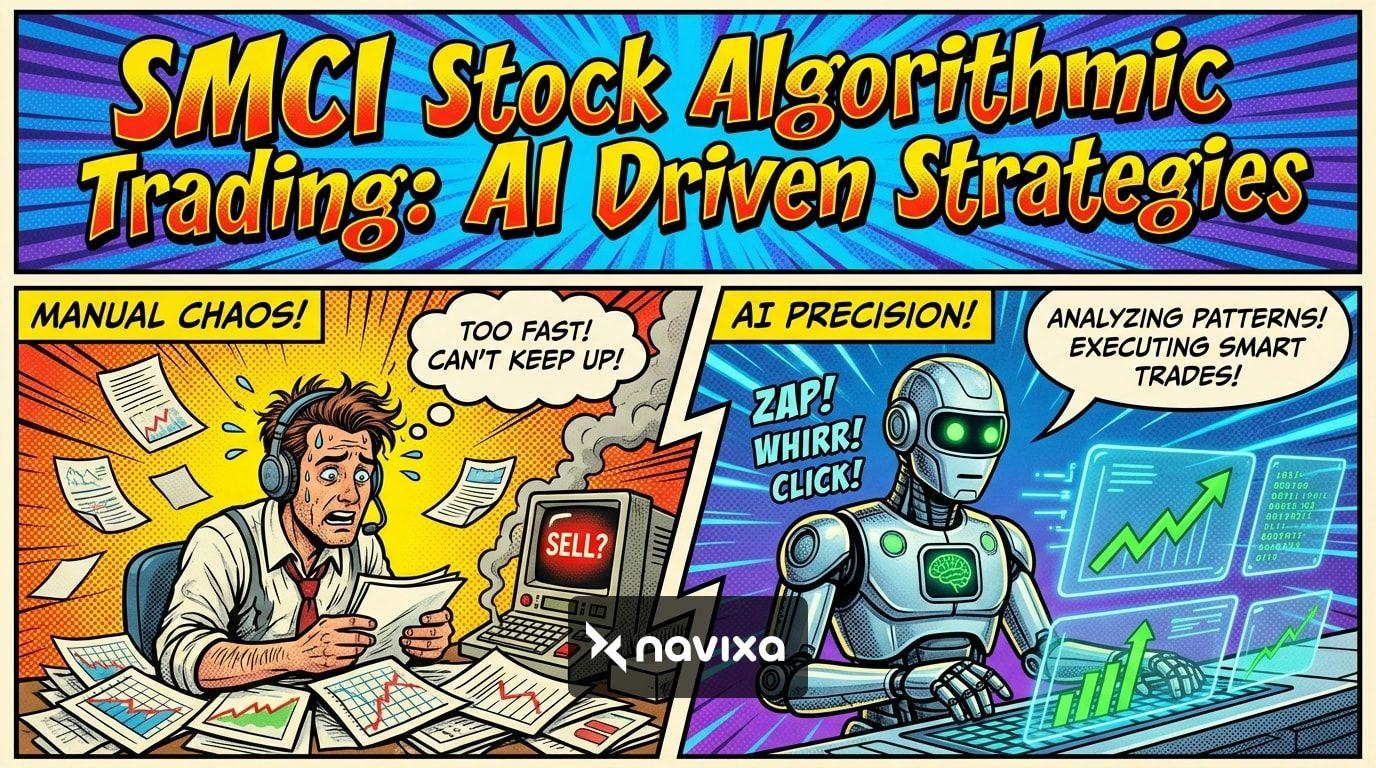
The intersection of artificial intelligence and financial markets has revolutionized how traders approach highly volatile assets. When it comes to SMCI stock algorithmic trading, the landscape is uniquely complex and rewarding. Super Micro Computer, Inc. (SMCI) has emerged as a focal point for institutional investors, retail day traders, and quantitative analysts alike. As a premier provider of high-performance server technology and advanced direct liquid cooling (DLC) infrastructure for modern data centers, SMCI finds itself at the very epicenter of the global artificial intelligence boom. However, with astronomical revenue growth juxtaposed against severe price swings and governance-related market shocks, trading SMCI manually has become increasingly perilous.
This is where AI-driven algorithmic trading strategies step in. By leveraging machine learning models, natural language processing (NLP), and high-frequency data analysis, traders can automate their market execution, eliminate emotional biases, and capitalize on the micro-trends that define SMCI's daily price action. In this comprehensive guide, we will explore the underlying mechanics of algorithmic trading for Super Micro Computer, examining how advanced AI models interpret market data, the most effective quantitative strategies to deploy, and the rigorous risk management protocols required to survive and thrive in this high-beta environment.
Understanding SMCI's Unique Market Dynamics
To successfully deploy an algorithmic trading strategy, a quantitative model must first be calibrated to the specific behavioral characteristics of the target asset. SMCI is not a traditional, slow-moving blue-chip stock; it is a high-beta, headline-driven technology equity that frequently experiences massive intraday volatility.
The AI Infrastructure Super-Cycle
Super Micro Computer's core fundamental driver is its dominant position in the manufacturing of custom, liquid-cooled server racks required by the world's largest cloud service providers. As top-tier graphics processing units (GPUs) from companies like NVIDIA and AMD consume increasingly massive amounts of power and generate unprecedented heat, SMCI's proprietary cooling architectures have become indispensable. Algorithmic models must therefore ingest alternative data streams, including supply chain metrics, semiconductor manufacturing yields, and global data center expansion reports, to forecast SMCI's long-term price trajectory.
Governance and Sentiment Shocks
Conversely, algorithmic strategies must account for sudden, extreme downside volatility. In recent market history, SMCI has navigated complex regulatory scrutiny, delayed financial filings, and governance disputes that have caused dramatic sell-offs, dropping the stock into the mid-$20 range despite billions in revenue. For an algorithm, these events represent "fat-tail" risks—highly improbable but severely impactful market events. Consequently, a robust SMCI stock algorithmic trading system cannot rely on price action alone; it must incorporate real-time news sentiment analysis to instantly halt trading or pivot to short positions when negative regulatory headlines hit the wire.
The Role of AI in Algorithmic Trading for SMCI
Artificial intelligence elevates traditional algorithmic trading from simple rule-based execution (e.g., "buy when the 50-day moving average crosses the 200-day moving average") to dynamic, self-optimizing systems capable of learning from new data.
Machine Learning and Predictive Analytics
Modern algorithmic trading systems heavily utilize supervised machine learning models, such as Random Forests and Support Vector Machines (SVMs), to classify market conditions. For SMCI, a machine learning model might analyze thousands of historical trading days to identify the specific price patterns that precede a breakout. More advanced models, like Long Short-Term Memory (LSTM) neural networks, are deployed to predict time-series data. LSTMs are particularly adept at recognizing sequential patterns in SMCI's volume and price movements, allowing the algorithm to anticipate short-term price movements with a higher degree of statistical probability.
Natural Language Processing (NLP) for Sentiment Analysis
Given SMCI's sensitivity to news, NLP is arguably the most critical AI component for trading this specific stock. NLP algorithms can parse millions of text documents—from SEC filings and earnings call transcripts to social media chatter and financial news sites—in milliseconds.
"In the modern era of algorithmic trading, an algorithm's ability to interpret market sentiment from unstructured data is often the differentiating factor between outsized alpha and catastrophic drawdowns."
If a major financial news outlet publishes an article regarding federal investigations or auditor changes at Super Micro Computer, an NLP-equipped algorithm will recognize the negative sentiment, quantify the potential impact based on historical precedents, and immediately liquidate long positions or execute short sales before manual traders even have time to read the headline.
Key AI-Driven Trading Strategies for Super Micro Computer
Deploying an algorithm requires selecting a core trading philosophy. Here are the most effective AI-driven strategies specifically tailored for SMCI's market profile.
Volatility Arbitrage and Mean Reversion
Mean reversion strategies operate on the statistical assumption that extreme price movements will eventually return to their historical average. Given SMCI's propensity for massive intraday spikes and dips, AI algorithms can identify when the stock is mathematically overbought or oversold. By calculating real-time Bollinger Bands and applying AI-driven probability distributions, the algorithm executes fade trades—shorting the stock after an irrational, news-less spike, or buying the dip after a sudden panic sell-off. The AI dynamically adjusts the parameters of "normal" volatility based on current market conditions, ensuring the strategy adapts if SMCI enters a sustained, directional trend.
Statistical Arbitrage and Pair Trading
Statistical arbitrage involves trading SMCI based on its historical price relationship with highly correlated assets, such as NVIDIA, AMD, or broad semiconductor ETFs. AI models continuously monitor the correlation coefficients between SMCI and its peers. If NVIDIA announces an earnings beat and surges, but SMCI lags behind despite their interconnected business models, the algorithm will instantly buy SMCI and short a corresponding semiconductor index to hedge out broader market risk. This strategy profits when the historical price relationship inevitably realigns.
Momentum and Trend Following in the AI Super-Cycle
During periods of sustained positive catalysts—such as a new product launch or massive cloud infrastructure orders—SMCI tends to trend powerfully. AI-driven momentum algorithms detect the early stages of these trends by analyzing order book imbalances, aggressive institutional block trades, and options market flow (such as high volume in out-of-the-money call options). Once a trend is confirmed, the algorithm scales into a position and uses trailing stop-loss orders optimized by machine learning to ride the trend for maximum profitability while protecting capital.
Technical Analysis: Traditional vs. AI-Driven Indicators
To better understand how artificial intelligence upgrades trading systems, we must compare traditional technical analysis with AI-driven indicator enhancement.
| Feature / Indicator | Traditional Approach | AI-Driven Algorithmic Approach |
|---|---|---|
| Moving Averages | Fixed periods (e.g., 50-day, 200-day SMA). | Dynamic periods optimized by machine learning based on current market volatility regimes. |
| Sentiment Analysis | Manual reading of news and analyst reports. | Real-time NLP parsing of global news feeds, SEC filings, and social media sentiment scores. |
| Support / Resistance | Static horizontal lines drawn manually on charts. | Heatmaps of order book liquidity and dynamic volume profile nodes updated in milliseconds. |
| Risk Management | Static percentage stop-loss (e.g., 5% below entry). | Adaptive Value at Risk (VaR) utilizing predictive volatility forecasting. |
| Pattern Recognition | Subjective visual identification (e.g., Head and Shoulders). | Deep learning models mathematically calculating the statistical probability of a pattern succeeding. |
Actionable Steps to Implement SMCI Algo Strategies
Transitioning from theoretical knowledge to active algorithmic trading requires a systematic approach to infrastructure and development. For those looking to build their own SMCI stock algorithmic trading bots, the following steps are essential.
1. Data Sourcing and Aggregation
The foundation of any quantitative model is high-quality data. You must source clean, tick-by-tick historical price data and real-time market feeds. Providers like Polygon.io or Alpaca offer excellent APIs for equity data. Additionally, alternative data sources—such as options flow data and sentiment feeds—should be integrated into your database.
2. Backtesting the Strategy
Before deploying capital, your algorithm must be rigorously backtested against years of SMCI's historical data. Use robust frameworks like Python's `Backtrader` or explore comprehensive platforms like the algorithmic trading documentation on QuantConnect. Backtesting reveals the expected win rate, maximum drawdown, and Sharpe ratio of your strategy. However, beware of "curve-fitting"—over-optimizing your algorithm to perform perfectly in the past, only for it to fail in live market conditions.
3. Execution and Routing
Latency is a critical factor in algorithmic trading. Your system must be capable of routing orders to exchanges with minimal delay. Utilizing advanced execution algorithms like Time-Weighted Average Price (TWAP) or Volume-Weighted Average Price (VWAP) ensures that your algorithm can enter and exit large positions in SMCI without suffering from excessive slippage or negatively impacting the market price.
4. Continuous Model Training
The stock market is a non-stationary environment; what worked yesterday may not work tomorrow. AI algorithms must be designed to continuously retrain themselves using recent market data. This process, often referred to as online learning, allows the algorithm to slowly adapt its parameters as SMCI's volatility profile evolves over time.
Risk Management in Highly Volatile AI Stocks
No algorithmic strategy is complete without an uncompromising risk management protocol. In the context of SMCI, where gaps of 10% to 20% can occur overnight due to earnings reports or regulatory news, risk management is the difference between long-term success and rapid account liquidation.
Position Sizing and Portfolio Allocation
Algorithms should utilize dynamic position sizing based on current market volatility. The Kelly Criterion is a popular mathematical formula used by quants to determine the optimal size of a series of bets. If SMCI's Average True Range (ATR) spikes, indicating extreme volatility, the algorithm must automatically reduce its position size to maintain a consistent risk profile.
Algorithmic Circuit Breakers
To protect against flash crashes or unforeseen software bugs, your trading architecture must include hard-coded "circuit breakers." If the algorithm experiences a predetermined sequence of losses, or if SMCI's price drops beyond a statistically normal threshold, the circuit breaker instantly halts all automated trading, cancels pending orders, and alerts the human operator.
Monitoring the Broader Market
SMCI does not trade in a vacuum. Its price action is heavily influenced by the broader semiconductor sector and the NASDAQ index. Advanced risk models will pull data from the NVIDIA's parallel computing platform to assess industry-wide technological shifts and monitor macroeconomic indicators like interest rates and inflation data to ensure the algorithm is not trading aggressively into a macro headwind. For fundamental validation, algorithms should periodically scrape data from Super Micro Computer's official investor relations page to adjust baseline valuations.
Conclusion
The evolution of SMCI stock algorithmic trading represents a paradigm shift for modern market participants. By integrating advanced machine learning predictive models, real-time natural language processing, and rigorous, automated risk management protocols, traders can safely navigate the extreme volatility associated with Super Micro Computer. While the AI infrastructure super-cycle presents unprecedented opportunities for capital growth, the unique governance and headline risks associated with SMCI require a disciplined, quantitative approach. Whether you are building complex statistical arbitrage models or simple sentiment-based momentum scripts, the key to long-term profitability lies in continuous backtesting, seamless execution, and an unwavering commitment to risk mitigation.
---
Frequently Asked Questions
What makes SMCI stock uniquely suited for algorithmic trading?
SMCI experiences high daily trading volume, immense intraday volatility, and strong sensitivity to both technology sector news and internal governance headlines. This combination of liquidity and volatility provides algorithmic systems with numerous opportunities to capture short-term pricing inefficiencies and execute high-frequency arbitrage strategies.
How does Natural Language Processing (NLP) help in trading SMCI?
NLP algorithms can instantly read and interpret unstructured text data, such as financial news articles, earnings call transcripts, and SEC filings. Given SMCI's history of sharp price movements triggered by regulatory news or auditor updates, NLP allows the algorithm to detect negative or positive sentiment in milliseconds and execute trades faster than human traders.
Can retail traders build algorithmic strategies for SMCI?
Yes. With the democratization of financial data through platforms like Alpaca, QuantConnect, and open-source Python libraries, retail traders can develop, backtest, and deploy sophisticated algorithmic trading bots. However, it requires a strong understanding of programming, statistics, and quantitative finance principles.
What is the biggest risk when running an AI trading bot on SMCI?
The most significant risk is "tail risk"—sudden, massive price gaps caused by unexpected news (like federal investigations or sudden management changes) that occur outside of regular trading hours. If an algorithm is heavily leveraged and holding a position overnight without proper stop-loss protections, these gap-downs can bypass automated safeguards and cause severe drawdowns.
How do algorithms handle SMCI's correlation with NVIDIA and AMD?
Algorithms use statistical arbitrage and pair trading models to constantly measure the real-time correlation between SMCI and major semiconductor companies. If the mathematical relationship deviates from its historical norm, the algorithm can automatically buy the underperforming asset and short the outperforming one, profiting when the correlation reverts to the mean.