
Introduction
The convergence of artificial intelligence and decentralized finance has ushered in a new era for quantitative trading. For modern cryptocurrency investors, an OpenAI trading bot is no longer a futuristic concept—it is a tangible, highly accessible tool that fundamentally redefines how we approach digital asset markets. As institutional capital deepens and market structures mature, relying solely on manual execution or rudimentary indicator alerts is quickly becoming an obsolete strategy.
By integrating OpenAI's powerful large language models (LLMs) like GPT-4o with real-time market data, retail and professional traders can deploy autonomous agents capable of interpreting complex sentiment, analyzing technical patterns, and executing trades with lightning-fast precision. Whether you are aiming to capitalize on Bitcoin's recent structural support levels or navigating the highly volatile altcoin sector, an OpenAI trading bot can significantly optimize your trading strategies and eliminate the emotional pitfalls of manual trading.
What is an OpenAI Trading Bot?
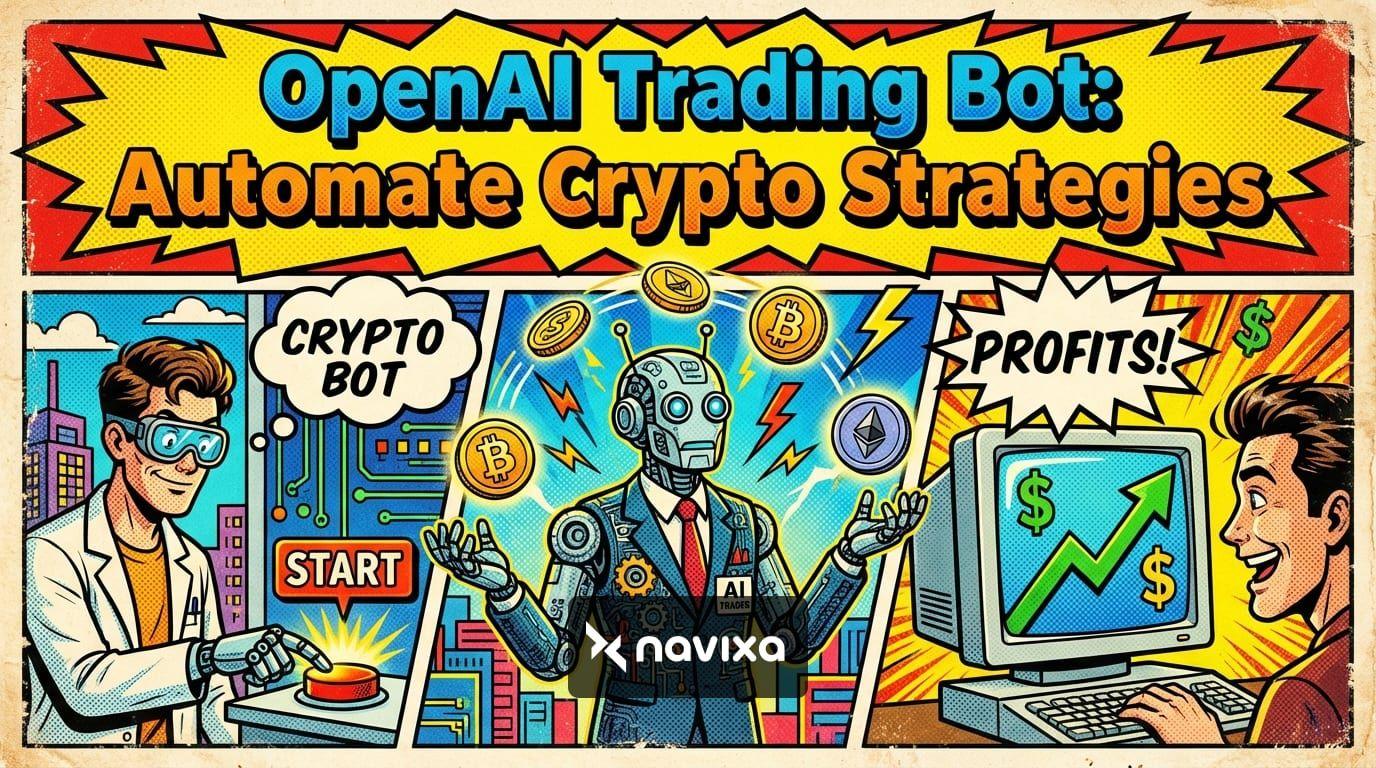
An OpenAI trading bot is an automated software application that utilizes OpenAI's API to analyze cryptocurrency market conditions and autonomously execute trades. Unlike traditional algorithms that rely strictly on hardcoded, binary "if-then" rules (such as buying an asset only when the Relative Strength Index drops below 30), an AI-driven bot leverages natural language processing and advanced contextual reasoning to make highly dynamic decisions.
By connecting an LLM to a cryptocurrency exchange via an API (such as Binance, Coinbase, or Hyperliquid) and feeding it structured and unstructured market data, traders create a sophisticated agentic system. This intelligent system can read global news headlines, analyze social media sentiment trends, interpret order book density, and synthesize this vast amount of information into actionable trading signals.
The Shift from Hardcoded Rules to LLM Logic
Historically, retail and institutional algorithmic traders used platforms like MetaTrader or custom Python scripts that were heavily reliant on moving averages, Bollinger Bands, and MACD crossovers. While effective in slow, trending markets, these bots frequently failed during unforeseen macroeconomic events, regulatory shifts, or sudden liquidity shocks.
With an OpenAI trading bot, the technical paradigm shifts from static logic to adaptive reasoning. The bot can process deep contextual data, such as Federal Reserve interest rate announcements or sudden shifts in stablecoin liquidity, and immediately adjust its risk parameters accordingly. If a major regulatory change triggers a flash crash across the market, the LLM can instantly analyze the news context and decide whether to close long positions to preserve capital or aggressively buy the dip, performing complex situational analysis in mere seconds.
Core Capabilities of an AI Crypto Trading Bot
To understand why developers and quantitative analysts are flocking to open-source frameworks like OctoBot and Freqtrade to integrate OpenAI, it is essential to examine the unique core capabilities these large language models unlock for traders.
Real-Time Sentiment Analysis
Cryptocurrency markets are notoriously sentiment-driven and highly reactive to news. A single tweet from a tech visionary or a press release from the SEC can swing Bitcoin's price by thousands of dollars within minutes. An OpenAI trading bot excels at scraping and interpreting unstructured data from platforms like Twitter, Reddit, Discord, and global financial news outlets. By processing this text through its deep neural network, the bot assigns a sentiment score (bullish, bearish, or neutral) to specific digital assets. This capability allows the bot to front-run retail panic or euphoria, entering positions just as a narrative begins to gain traction in the broader market.
Advanced Technical Analysis and Code Generation
While LLMs are inherently text-based systems, their ability to understand and generate code makes them formidable technical analysts. A trader can dynamically prompt the bot to generate complex Pine Script for TradingView, creating highly custom technical indicators on the fly. Furthermore, by feeding historical price data and candlestick formations into the model as text arrays, the bot can identify nuanced chart patterns—such as head-and-shoulders, ascending triangles, or complex Elliot Wave structures—that a standard algorithm might easily overlook due to minor market noise.
Portfolio Rebalancing and Risk Profiling
Beyond executing individual asset trades, an OpenAI trading bot can act as a comprehensive, round-the-clock portfolio manager. By establishing your personal risk tolerance within the bot's system prompt, the agent can automatically rebalance your holdings based on macroeconomic shifts. For instance, if Bitcoin dominance rises sharply during a broader market flight to safety, the AI can programmatically rotate capital out of high-beta altcoins and into Bitcoin or yield-bearing stablecoins, actively preserving your portfolio's capital edge.
How to Build and Deploy Your OpenAI Trading Strategy
Building an AI trading bot requires a blend of basic programming knowledge, API management, and strategic foresight. Here are the actionable steps to bring your automated trading strategy to life.
1. Secure Your API Keys
The fundamental foundation of your bot relies on secure communication between the AI and the financial market. First, you will need an API key from OpenAI to access models like GPT-4o. You can obtain this via the official OpenAI Platform. Additionally, you need API credentials from your chosen cryptocurrency exchange (e.g., Binance, Bybit, or Kraken) to allow the bot to fetch live order book data and execute buy/sell actions.
2. Choose a Trading Framework
You do not need to build the complex infrastructure from scratch. Numerous open-source repositories on GitHub provide robust foundations for AI trading. Frameworks like Freqtrade allow you to integrate machine learning and LLM predictions directly into your backtesting and live trading environments. Alternatively, platforms like OctoBot offer highly user-friendly interfaces where you can simply plug in your OpenAI credentials and begin deploying Grid or Dollar Cost Averaging (DCA) strategies infused with advanced AI logic.
3. Engineer Your Prompts
The effectiveness of an OpenAI trading bot is directly correlated to the quality of its prompts. A vague prompt like, "Should I buy Ethereum today?" will yield poor, unreliable results. Instead, traders must design complex system prompts that provide the LLM with strict roles, parameters, and constraints, such as:
"You are an expert quantitative analyst. Analyze the following 1-hour candlestick data arrays, MACD momentum levels, and the attached recent news headlines. Provide a strictly formatted 'BUY', 'SELL', or 'HOLD' recommendation with a designated stop-loss level, optimizing for a maximum 2% portfolio risk per trade."
4. Backtest Extensively
Before deploying real capital into the unpredictable crypto markets, you must backtest your bot against historical data. Ensure that the AI's logic holds up during both bull market expansions and severe bear market drawdowns. Keep a close eye on API latency and operational costs, as frequent, minute-by-minute requests to OpenAI's servers can accrue significant financial fees over time.
OpenAI Trading Bot vs. Traditional Algorithmic Bots
To highlight the specific advantages and trade-offs of integrating AI, here is a breakdown comparing modern AI bots against traditional quantitative scripts.
| Feature | OpenAI Trading Bot | Traditional Algorithmic Bot |
|---|---|---|
| Decision Logic | Adaptive, context-aware reasoning based on natural language and data arrays. | Fixed, hardcoded mathematical rules and strict indicator thresholds. |
| Data Processing | Can ingest unstructured data (news, social media, macroeconomic reports). | Limited strictly to numerical market data (price, volume, time intervals). |
| Adaptability | High. Can rapidly pivot strategies based on sudden market narrative shifts. | Low. Requires tedious manual reprogramming when market conditions change. |
| Development Time | Faster prototyping using natural language prompt engineering. | Slower. Requires extensive coding in Python, C++, or Pine Script. |
| Operating Costs | Higher due to recurring API request fees and computational overhead. | Lower. Can run locally on minimal server resources with zero external AI costs. |
Risk Management in AI-Driven Crypto Trading
While the prospect of a fully autonomous OpenAI trading bot is undeniably enticing, it introduces unique technological and financial risks that traders must rigorously manage.
Mitigating AI Hallucinations
LLMs are prone to "hallucinations"—generating plausible but factually incorrect information or misinterpreting data. If a bot misinterprets a sarcastic tweet as a genuine regulatory threat, it might execute an unwarranted market dump of your assets. To prevent this, traders should implement a "human-in-the-loop" system for abnormally large trades, or utilize consensus models where the AI must cross-reference multiple reputable news sources before executing an order.
Strict Stop-Loss and Position Sizing Parameters
Never give an AI bot unlimited access to your entire exchange balance. Utilize API endpoint restrictions to ensure the bot can only trade (and never withdraw) funds, and cap the maximum order size natively at the exchange level. Enforce strict stop-loss and take-profit levels outside of the AI's control so that even if the bot's internal logic fails, your account is protected against catastrophic, account-draining liquidations.
Managing API Limits and Latency
High-frequency trading (HFT) is generally unsuitable for an OpenAI trading bot due to inherent network latency. Sending large data arrays to OpenAI, waiting for a neural network response, and routing it back to the exchange takes valuable milliseconds—or even seconds. Traders should focus on swing trading, macro positioning, or hourly timeframe strategies where this API latency will not severely degrade their competitive edge.
Market Context: AI Trading in the Current Crypto Landscape
Deploying an AI bot today requires an understanding of the broader macroeconomic picture. In early 2026, the digital asset market has matured significantly. Following the previous cycle's massive volatility, Bitcoin has compressed into a structural uptrend, with the previous $69,000 peak effectively flipping into strong macroeconomic support.
This new institutional era is heavily defined by deep ETF inflows and shifting global liquidity as central banks adjust their interest rates. An OpenAI trading bot is exceptionally well-suited for this modern environment. As the market transitions from chaotic retail-driven hype to calculated, data-driven institutional flows, an AI's ability to instantly parse Federal Reserve commentary, track ETF volume data, and monitor stablecoin yields provides a massive competitive advantage. The trading bots that succeed in this environment are those carefully calibrated to navigate complex liquidity cycles rather than merely chasing short-term momentum.
Practical Takeaways
* Start with Open Source: Leverage existing, well-documented GitHub repositories like Freqtrade or OctoBot to minimize your development time and avoid starting from scratch. * Master Prompt Engineering: The profitability and precision of your AI's trading signals depend heavily on the context, data formatting, and strict constraints you provide in your system prompts. * Focus on Sentiment and Macro: Use the LLM for what it does best—processing unstructured text, news sentiment, and macro data—rather than forcing it to compete with traditional HFT bots on pure speed. * Protect Your Capital: Always sandbox your API keys, enforce hardcoded stop-losses outside the AI's logic loop, and closely monitor your OpenAI API usage costs.
Conclusion
The integration of artificial intelligence into digital financial markets is not a fleeting technological trend; it is a fundamental, irreversible shift in market mechanics. Building an OpenAI trading bot empowers retail investors and professional quants alike to bridge the vast gap between complex quantitative analysis and rapid market execution. By harnessing the context-aware reasoning of large language models, you can safely automate your crypto strategies, react instantaneously to breaking market news, and manage portfolio risk with unprecedented sophistication. As the cryptocurrency market continues its rapid institutional maturation, adopting AI-driven trading tools will be the ultimate key to maintaining a durable edge. Start experimenting in a simulated paper-trading environment today, and unlock the incredible future of digital asset automation.
Frequently Asked Questions
Is an OpenAI trading bot profitable?
Profitability depends entirely on the underlying strategy, risk management parameters, and current market conditions. While an AI bot can analyze data much faster than a human and completely eliminate emotional trading, it is not a guaranteed money-maker. Extensive historical backtesting and continuous prompt refinement are absolutely essential for long-term financial success.
Can I use ChatGPT directly to trade crypto?
You cannot use the standard ChatGPT web interface to execute trades automatically. However, by utilizing the official OpenAI API, developers can connect the underlying LLM models (like GPT-4o) directly to trading platforms and cryptocurrency exchanges via code, enabling a fully automated, programmatic trading environment.
Do I need to know how to code to use an AI bot?
While having programming knowledge (particularly in Python) is highly beneficial for creating custom infrastructure, several user-friendly platforms and open-source frameworks now offer intuitive plug-and-play interfaces. Solutions like OctoBot allow users to seamlessly integrate OpenAI models with minimal coding experience required.
How much does it cost to run an OpenAI bot?
Costs vary drastically based on your trading frequency and the complexity of the data sent to the AI. OpenAI charges based on token usage (the volume of input and output data). For bots operating on high timeframes (e.g., hourly or daily), API costs are generally minimal. However, bots evaluating complex data every single minute can quickly accumulate significant monthly fees, which must be factored into your trading margins.