
Introduction
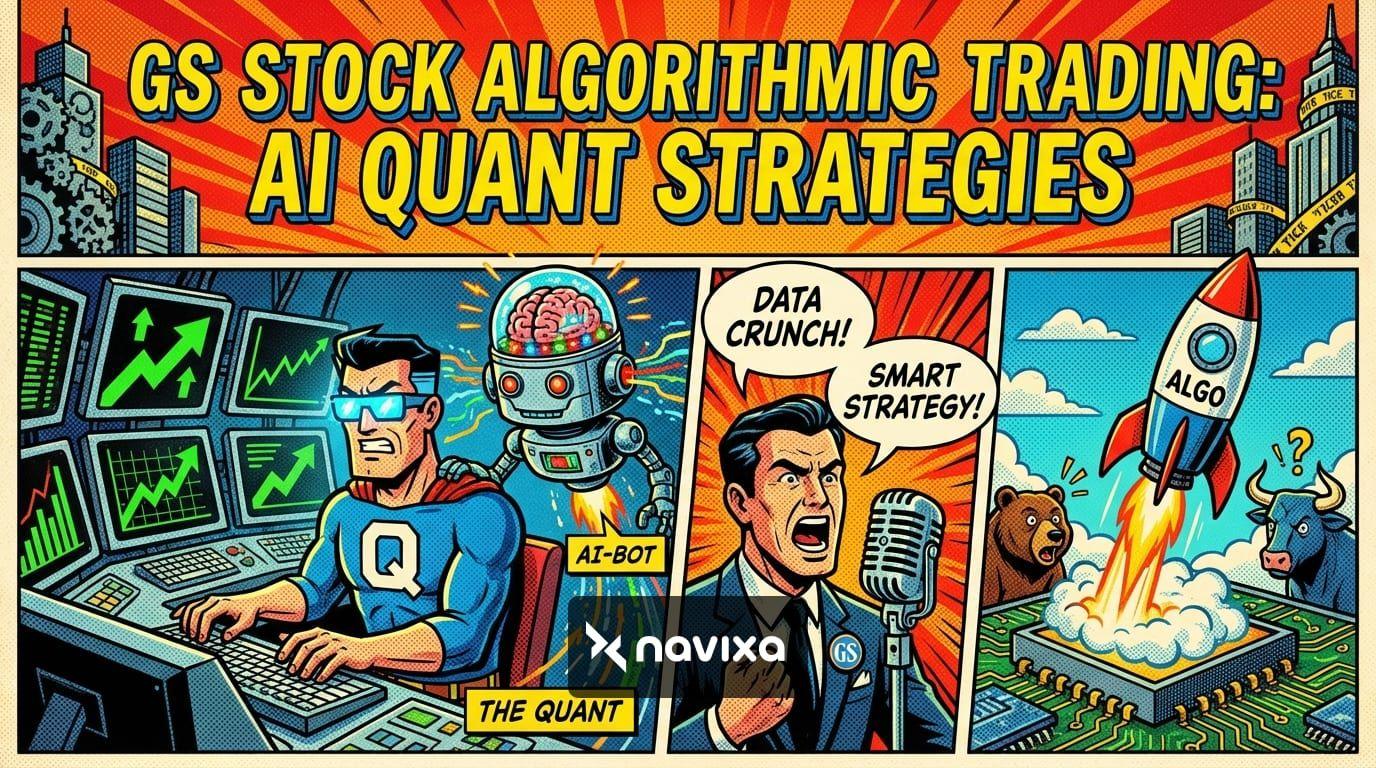
The financial landscape is undergoing a monumental shift, and at the heart of this transformation is the algorithmic execution of institutional powerhouse stocks. Among these, the Goldman Sachs Group Inc. (NYSE: GS) stands out as a prime candidate for sophisticated, automated execution. GS stock algorithmic trading involves the use of complex mathematical models, artificial intelligence (AI), and quantitative (quant) strategies to execute trades at speeds and frequencies that are impossible for human traders.
With Goldman Sachs shares trading robustly in the $900 range in early 2026, the volatility and deep liquidity of the stock have attracted top-tier hedge funds, institutional desks, and retail quants alike. According to recent industry data from Coalition Greenwich, over 78% of institutional equity trading volume on the NYSE now flows through algorithmic execution systems. As discretionary methods face widening performance gaps against automated solutions, institutional trading desks are aggressively adopting data-driven frameworks. In this comprehensive guide, we will explore why GS stock is ideal for AI-driven algorithmic trading, the core quant strategies deployed by institutions, and actionable steps to integrate these cutting-edge techniques into your own trading architecture.
Why GS Stock is a Prime Candidate for AI Quant Strategies
When designing an automated trading system, asset selection is just as crucial as the algorithm itself. Goldman Sachs possesses specific market microstructure characteristics that make it highly responsive to quantitative modeling and algorithmic execution.
Deep Liquidity and Institutional Order Flow
Goldman Sachs is a leading global investment banking firm with highly diversified revenue streams across global markets, asset management, and transaction banking. This massive operational scale translates into deep liquidity on the New York Stock Exchange. High liquidity is a fundamental requirement for algorithmic trading because it minimizes bid-ask spreads and reduces slippage. When an AI agent executes high-frequency trades (HFT) or large block orders, the depth of the GS order book ensures that the market can absorb the volume without triggering extreme price distortions.
Predictable Volatility and High Beta
Quantitative algorithms thrive on volatility. GS stock carries a relatively high beta compared to the broader market, meaning its price movements are amplified in response to macroeconomic catalysts such as Federal Reserve interest rate decisions, inflation reports, and global merger and acquisition (M&A) activities. AI models are exceptionally good at parsing these macroeconomic indicators and predicting the subsequent price action of high-beta stocks. This sensitivity allows algorithms to capture alpha during both bullish market breakouts and bearish pullbacks.
"In automated financial markets, volatility is not inherently a risk—it is the foundational fuel that powers statistical arbitrage and mean reversion algorithms."
Core AI Quant Strategies for GS Stock
Trading GS stock algorithmically requires more than simple moving average crossovers. Modern AI quant strategies leverage vast datasets, including tick-level order book data, alternative data, and macroeconomic feeds. Here are the primary strategies utilized by elite quant desks.
Statistical Arbitrage and Mean Reversion
Statistical arbitrage involves identifying pricing inefficiencies between historically correlated assets. For instance, an algorithm might monitor the historical price relationship between Goldman Sachs (GS) and other banking giants like Morgan Stanley (MS) or JPMorgan Chase (JPM). If GS stock temporarily deviates from this established correlation due to localized market noise, the algorithm will execute a pairs trade—shorting the overvalued asset and going long on the undervalued one—expecting the relationship to revert to the mean.
Mean reversion specifically assumes that extreme price deviations are temporary. By utilizing machine learning algorithms like Random Forests or Support Vector Machines (SVM), trading systems can dynamically calculate the true "mean" of GS stock under current market regimes, ignoring the static limits of traditional technical indicators.
Natural Language Processing (NLP) and Sentiment Analysis
One of the most profound advancements in AI algorithmic trading is the integration of Natural Language Processing (NLP). Goldman Sachs stock is highly sensitive to financial news, earnings call transcripts, and central bank commentary.
Modern NLP algorithms ingest thousands of unstructured data points—ranging from SEC filings and Federal Reserve press releases to social media sentiment and geopolitical news—in milliseconds. 1. Parsing the Data: The AI reads earnings reports or news articles as soon as they hit the wire. 2. Sentiment Scoring: The algorithm assigns a positive, negative, or neutral sentiment score to the text. 3. Execution: If the sentiment score exceeds a pre-set threshold and aligns with the current order book dynamics, the system executes a buy or sell order before human traders have even finished reading the headline.
Multi-Agent Reinforcement Learning
Reinforcement Learning (RL) has moved from academia into the core of institutional trading. Unlike supervised learning, which relies on historical labeled data, RL allows an AI agent to learn optimal trading strategies through trial and error in a simulated market environment. The algorithm is "rewarded" for maximizing risk-adjusted returns and "penalized" for excessive drawdowns.
Over millions of simulated trading epochs, multi-agent reinforcement learning models discover complex, non-linear trading patterns in GS stock that traditional analysts would never identify. These systems continuously adapt, modifying their execution tactics as market conditions shift from low-volatility consolidation to high-volatility breakouts.
The Institutional Playbook: How Goldman Sachs Uses AI Internally
It is impossible to discuss GS stock algorithmic trading without acknowledging how Goldman Sachs itself has pioneered these technologies. The firm has undergone a massive internal restructuring over the last decade, famously replacing hundreds of manual equity traders with highly skilled computer engineers and quantitative researchers.
Goldman Sachs utilizes AI to process unstructured data and fuse it with real-time market data to optimize its proprietary trading desks and client execution services. By leveraging tools like natural language processing and advanced predictive modeling, the institution dramatically reduces trade latency, mitigates counterparty risk, and improves intraday profitability. This aggressive internal adoption of AI highlights the necessity for independent traders and external funds to deploy sophisticated algorithms just to remain competitive in the market.
Integrating Technical Analysis with Machine Learning
While AI and machine learning dominate the modern quant landscape, classic technical analysis still provides a foundational framework for many algorithmic models. However, rather than using static indicators, AI systems create dynamic technical thresholds.
For example, traditional traders might use a 50-day and 200-day Simple Moving Average (SMA) crossover to generate buy or sell signals. An AI-driven algorithm, utilizing deep neural networks, will backtest millions of permutations to find the optimal, dynamic moving average parameters for GS stock based on real-time volatility.
Furthermore, algorithms ingest technical breakout levels—such as resistance zones near recent highs—and combine them with order flow imbalance data. If GS stock approaches a key resistance level, the AI does not just guess whether it will break out. It analyzes the bid-ask spread, the volume of institutional block trades, and options market positioning to predict the probability of a successful breakout with mathematical precision.
Traditional Discretionary Trading vs. AI-Driven Algorithmic Trading
To understand the sheer advantage of automation, it is helpful to compare traditional discretionary trading methods with modern AI-driven algorithmic systems when applied to Goldman Sachs stock.
| Feature | Traditional Discretionary Trading | AI-Driven Algorithmic Trading |
|---|---|---|
| Data Processing | Limited to human cognitive capacity and standard charts. | Ingests terabytes of tick-level, macro, and alternative data instantly. |
| Execution Speed | Seconds to minutes; highly susceptible to emotional hesitation. | Microseconds; complete absence of emotional bias or hesitation. |
| Strategy Adaptation | Slow manual adjustments based on periodic market reviews. | Real-time dynamic adjustments utilizing Reinforcement Learning. |
| Risk Management | Prone to human error, ignored stop-losses, and revenge trading. | Strict, programmatic risk limits and automated drawdown mitigation. |
| Market Monitoring | Limited to active screen time during market hours. | 24/7 analysis across global equities, futures, and correlated assets. |
Risk Management and Drawdown Mitigation
In the realm of algorithmic trading, a highly profitable model is useless if it lacks robust risk management. Machine learning models must be hard-coded with strict parameters to prevent catastrophic losses, especially in high-beta assets like GS stock.
Volatility-Adjusted Position Sizing
Algorithms utilize real-time calculations of the Average True Range (ATR) or the VIX (Volatility Index) to dynamically scale position sizes. If market volatility spikes unexpectedly, the AI automatically reduces its capital exposure on GS stock, ensuring that potential drawdowns remain within acceptable risk limits.
Algorithmic Circuit Breakers
Quant systems employ internal "circuit breakers" that halt trading if the model begins experiencing consecutive losses outside its expected statistical variance. This protects the portfolio from "model decay," a phenomenon where a previously successful algorithm stops working due to a fundamental regime shift in the market.
Transaction Cost Analysis (TCA)
High-frequency and algorithmic trading models execute hundreds of trades per day. Algorithms are programmed with advanced Transaction Cost Analysis (TCA) to ensure that slippage, exchange fees, and bid-ask spreads do not erode the overall alpha generated by the strategy.
Actionable Steps to Launch a GS Algo Strategy
If you are an institutional quant or an advanced retail trader looking to deploy an algorithmic trading strategy for GS stock, you must follow a strict, data-driven pipeline:
1. Acquire Institutional-Grade Data: Garbage in, garbage out. You need high-quality, tick-level historical data for GS stock, as well as accurate options market data and macroeconomic feeds. You can source reliable market data from platforms like NYSE Market Data. 2. Feature Engineering: Transform raw data into usable metrics. This involves creating custom indicators, sentiment scores, and statistical volatility measures that your AI model can learn from. 3. Model Selection and Training: Choose the appropriate machine learning architecture. Logistic regression might work for simple directional predictions, while Long Short-Term Memory (LSTM) networks are better suited for complex time-series forecasting. 4. Rigorous Backtesting: Test your algorithm against out-of-sample historical data. Ensure your backtesting engine accurately accounts for slippage, commissions, and latency. 5. Paper Trading and Live Execution: Before risking real capital, run the algorithm in a live simulated environment. Once validated, connect your system to a low-latency brokerage API to begin live trading. For detailed corporate insights to feed your fundamental models, regularly consult Goldman Sachs Investor Relations.
Conclusion
The integration of artificial intelligence and quantitative strategies has fundamentally rewired how Goldman Sachs stock is traded on the open market. By deploying multi-agent reinforcement learning, natural language processing, and high-frequency statistical arbitrage, modern algorithmic traders can extract consistent alpha from GS stock while maintaining rigorous, emotionless risk management. As institutional volume continues to consolidate into automated pipelines, adopting AI-driven trading methodologies is no longer a luxury—it is an absolute necessity for survival in the contemporary financial markets. Embrace the data, refine your models, and transition from discretionary guesswork to quantitative precision.
Frequently Asked Questions
What makes Goldman Sachs (GS) stock good for algorithmic trading?
GS stock is an ideal candidate for algorithmic trading due to its high beta, deep institutional liquidity, and extreme sensitivity to macroeconomic indicators. Its predictable volatility and vast options market allow AI models to effectively execute statistical arbitrage and mean reversion strategies.
How does Natural Language Processing (NLP) affect GS stock prices?
NLP algorithms scan thousands of financial news articles, earnings reports, and central bank transcripts in real-time. By instantly analyzing the sentiment of this text, the algorithms can execute buy or sell orders based on the news before human traders even have a chance to read the headlines, driving immediate price action in GS stock.
Can retail traders compete with institutional algorithms on GS stock?
While retail traders cannot easily compete with the microsecond execution speeds of institutional high-frequency trading (HFT) firms, they can absolutely compete on longer timeframes. Retail quants can successfully deploy machine learning models for swing trading and medium-term statistical arbitrage by focusing on predictive accuracy rather than raw execution speed.
What are the main risks of using AI to trade GS stock?
The primary risks include "model decay" (where market conditions change and the algorithm is no longer effective), extreme unmodeled black-swan events, and technical infrastructure failures like API outages or latency issues. This is why robust risk management and automated circuit breakers are essential components of any algorithmic trading system.