
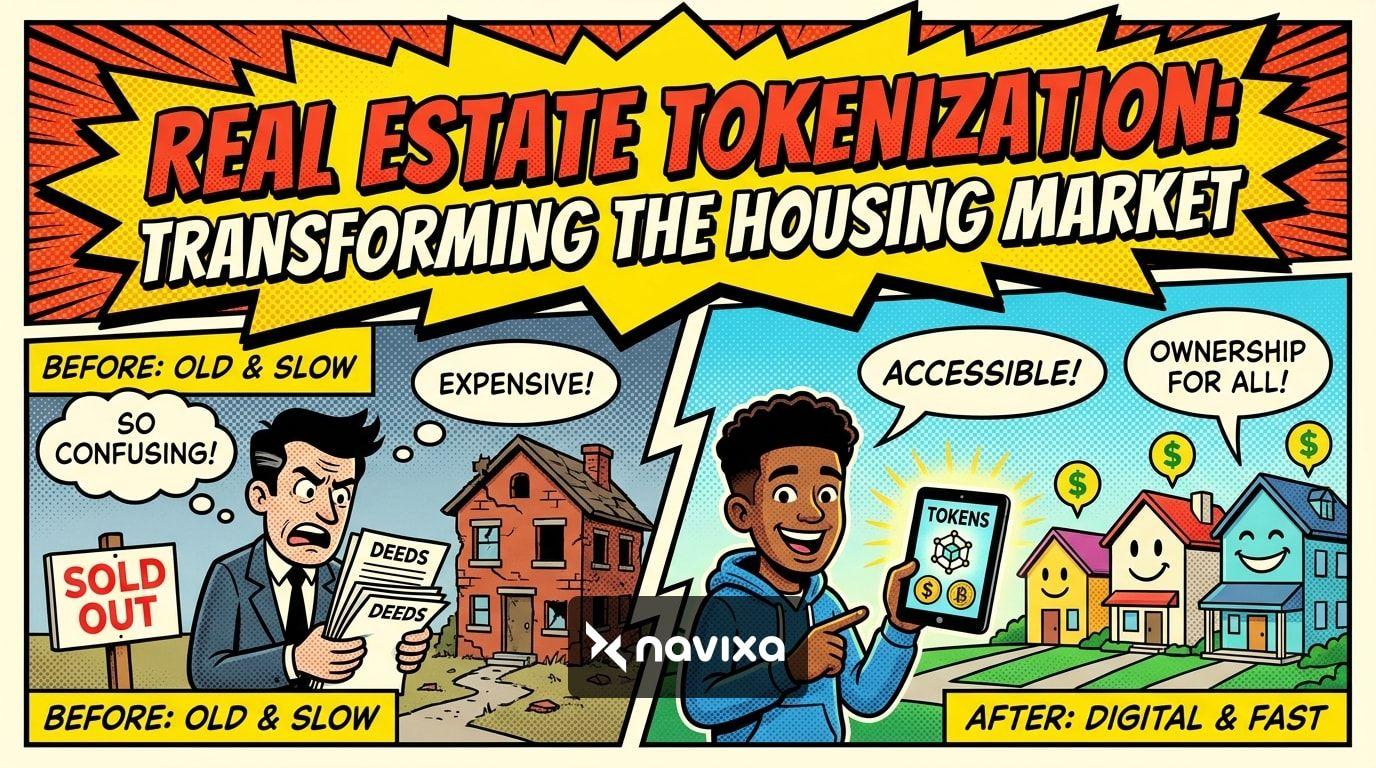
Introduction: The Dawn of a Liquid Asset Class
For centuries, real estate has been widely regarded as one of the most reliable stores of wealth and primary engines for capital appreciation. However, it has notoriously suffered from high barriers to entry, steep transaction costs, and severe illiquidity. The emergence of real estate tokenization is rapidly dismantling these barriers, transforming the housing market into a dynamic, accessible, and highly liquid digital ecosystem.
Real estate tokenization is the process of converting ownership rights of a physical property—or the cash flows it generates—into digital tokens recorded on a blockchain. By fractionalizing high-value assets, property owners can unlock capital, while retail investors gain access to institutional-grade real estate for a fraction of the traditional cost. As of 2025, the global market for tokenized real-world assets (RWAs) reached an impressive $24 billion, reflecting a massive 308% growth over three years. With the digital asset infrastructure maturing robustly into 2026, the housing market is undergoing a fundamental technological renaissance that bridges traditional finance with decentralized innovation.
How Real Estate Tokenization Works
At its core, tokenizing a property bridges physical real estate with distributed ledger technology (DLT). This transformative process typically involves several highly structured phases designed to ensure legal compliance and technological security:
1. Asset Identification and Valuation: A physical property or a portfolio of properties is appraised by independent auditors to determine its fair market value. 2. Legal Structuring: A Special Purpose Vehicle (SPV) or a similarly robust legal entity is created to hold the deed to the property. This ensures the digital tokens are backed by verifiable legal ownership. 3. Token Creation: Smart contracts are deployed on a secure blockchain (such as Ethereum, Polygon, or Avalanche) to mint digital tokens representing fractional shares of the SPV. 4. Distribution: These tokens are offered to investors through a Security Token Offering (STO), adhering to local securities regulations and compliance frameworks.
"The digitization of property rights allows a $10 million commercial building to be divided into 1,000,000 digital tokens, each priced at $10, fundamentally changing who can participate in the global real estate market."
According to rigorous projections by Deloitte, tokenized real estate could grow to command over $4 trillion in total value by 2035. This exponential growth trajectory is driven by the immutable transparency of blockchain technology and the automated efficiency of smart contracts, which programmatically distribute rental yields and manage compliance without costly, time-consuming intermediaries.
The Financial Impact: Lowering Barriers to Entry
The most profound impact of real estate tokenization is the aggressive democratization of investment. Historically, acquiring commercial or premium residential real estate required immense capital, exceptional credit scores, and a sprawling network of brokers, attorneys, and bankers. Tokenization removes these traditional gatekeepers.
Enhanced Liquidity in a Historically Illiquid Market
Traditional real estate has historically locked up investor capital for years or even decades. Tokenization introduces secondary markets where fractional shares can be traded seamlessly, 24/7. Investors are no longer strictly bound by multi-year holding periods; they can liquidate a portion of their real estate portfolio almost instantaneously, responding actively to market demand and personal financial needs.
Borderless Global Market Access
Blockchain networks operate without borders. A retail investor located in Tokyo can easily purchase fractional ownership of an apartment complex in Miami or a thriving commercial hub in Dubai. This unprecedented global reach exponentially increases the pool of available capital for property developers while offering unparalleled geographic diversification opportunities for modern investors.
Trading Strategy: Building a Tokenized Portfolio
Treating real estate as a tradable digital asset requires an evolution in traditional investment strategies. Forward-thinking investors must blend classic real estate fundamentals with modern crypto-economic strategies to maximize returns.
1. Portfolio Diversification and Sector Allocation
Unlike traditional real estate investing, where a retail investor might be forced to sink all their capital into a single single-family home, tokenization allows for intelligent micro-allocations. A robust, risk-adjusted strategy involves distributing capital across varied sectors—residential, commercial, industrial, and retail properties. Furthermore, geographic diversification protects an investor's portfolio against localized housing market downturns or regional economic stagnation.
2. Yield Farming Real Estate Assets
In the decentralized finance (DeFi) space, tokenized real estate can be leveraged far beyond passive capital appreciation and standard rental yields. Advanced investors can utilize their real estate security tokens as high-quality collateral in specialized DeFi lending protocols. By borrowing stablecoins against their tokenized property holdings, they can deploy that capital into higher-yielding liquidity pools or other tokenized assets, effectively multiplying their overall capital efficiency without selling the underlying asset.
Technical Analysis & Fundamental Due Diligence
While real estate tokenization operates on cutting-edge blockchain infrastructure, foundational due diligence remains absolutely essential. A well-rounded investment analysis requires meticulously scrutinizing both the physical asset and the digital architecture.
On-Chain Metrics and Smart Contract Audits
Before purchasing a real estate token, investors must rigorously verify the integrity of the underlying smart contract. Reputable token issuers will always provide comprehensive third-party audit reports from established cybersecurity firms. Additionally, analyzing on-chain metrics—such as the number of unique token holder addresses, network transfer speeds, and daily trading volume on secondary marketplaces—can provide critical, real-time insights into the asset's true liquidity profile.
Fundamental Property Valuation
It is vital to remember that the blockchain does not magically increase a property's intrinsic value. Prudent investors must heavily analyze the underlying asset's capitalization rate (cap rate), historical rental yields, tenant occupancy rates, and localized real estate market trends. An overvalued tokenized property carries the exact same fundamental risks as an overvalued physical property.
Actionable Steps: Investing in Tokenized Properties
For those ready to actively participate in the technological transformation of the housing market, here is a highly practical, step-by-step roadmap:
1. Select a Compliant and Regulated Platform: Choose a reputable tokenization issuance and trading platform. Industry leaders like Securitize and tZERO have established robust, regulatory-compliant marketplaces specifically engineered for the primary issuance and secondary trading of security tokens. 2. Complete Extensive KYC/AML Verification: Because real estate tokens are typically classified as registered securities, operating platforms require strict Know Your Customer (KYC) and Anti-Money Laundering (AML) identity checks. Prepare to verify your identity and, in some cases, your accredited investor status. 3. Set Up a Compatible Digital Wallet: Depending on the specific platform, you may need an institutional-grade digital wallet or a customized decentralized wallet capable of interacting seamlessly with the specific blockchain network hosting the RWA tokens. 4. Start Small and Scale Strategically: Begin your journey by purchasing small fractions of high-yield commercial real estate. This allows you to understand the specific mechanics of automated dividend payouts and secondary market liquidity before committing substantially larger sums of capital.
Overcoming Challenges & Advanced Risk Management
Despite the massive disruptive potential, real estate tokenization is not without its significant hurdles. Responsible investors must implement stringent risk management protocols to protect their capital.
Navigating Regulatory Uncertainty
The global regulatory landscape remains somewhat fragmented, though rapidly maturing. In the United States, tokens are generally regulated strictly as securities, subjecting them to intense SEC oversight, specific transfer restrictions, and accredited investor limits. Investors must ensure they are purchasing assets that fully comply with their local jurisdictional laws to avoid sudden delistings or frozen digital assets.
Mitigating Smart Contract Vulnerabilities
A minor coding flaw in the smart contract governing the tokens could theoretically lead to a catastrophic loss of funds. It is imperative to only invest in tokens minted by platforms that utilize standardized, heavily audited token protocols (such as the ERC-3643 standard, which is specifically designed with compliance and recovery features for security tokens).
Understanding the Liquidity Illusion
While tokenization conceptually *enables* liquidity, it does not magically *guarantee* it. If market demand for a specific property token completely dries up, the investor may find themselves holding a highly illiquid digital asset. Focusing your portfolio on high-tier properties located in globally desirable, high-growth urban centers is the absolute best defense against this inherent liquidity premium risk.
Regulatory Landscape & Institutional Adoption
The market architecture for tokenized real estate officially reached a massive inflection point between 2025 and 2026, driven by definitive regulatory clarity and accelerating institutional entry.
In the United States, the historic passage of the GENIUS Act in 2025 provided a crucial federal framework for fiat-backed stablecoins—a critical infrastructure component required for settling real estate token trades seamlessly without exposing investors to extreme cryptocurrency volatility. Furthermore, the 2026 Clarity Act continues to streamline secondary market compliance rules for digital asset securities, easing the regulatory burden on token issuers.
This regulatory easing has spurred immediate, large-scale institutional action. For instance, in February 2026, Cardone Capital boldly announced plans to tokenize its entire $5 billion real estate portfolio, sending a clear signal to the market that traditional mega-funds now view blockchain infrastructure as a superior path to global liquidity. Meanwhile, the Middle East continues to lead in aggressive geographic adoption; the Dubai Land Department launched Phase II of its real estate tokenization project on February 20, 2026. This landmark initiative enables real-time resale activity in a fully regulated secondary market overseen by Dubai's Virtual Assets Regulatory Authority (VARA), setting a global gold standard for RWA integration.
Traditional Real Estate vs. Tokenized Real Estate
To fully grasp how real estate tokenization is transforming the housing market from the ground up, consider the fundamental differences outlined in the direct comparison below:
| Market Feature | Traditional Real Estate | Tokenized Real Estate |
|---|---|---|
| Barrier to Entry | Extremely High (Requires large capital down payments and excellent credit) | Very Low (Fractional shares often starting well under $100) |
| Market Liquidity | Low (Typically takes months or years to successfully sell an asset) | High (Facilitates 24/7 secondary market trading on digital exchanges) |
| Intermediaries | Many (Real estate brokers, notaries, escrow services, title companies) | Few (Blockchain smart contracts automate legal compliance and title transfers) |
| Transfer Speed | Slow (Averaging 30 to 90 days for traditional transaction settlement) | Fast (Near-instantaneous blockchain settlement and verification) |
| Geographic Scope | Limited (Heavily bound by localized banking systems and national laws) | Global (Borderless, enabling frictionless global investor access and capital flow) |
Practical Takeaways
- Leverage Fractional Ownership: Tokenization dramatically lowers the traditional barrier to entry, allowing everyday retail investors to access premium, institutional-grade real estate markets. - Pursue Enhanced Diversification: Forward-thinking investors can now effortlessly build a globally diversified property portfolio without ever shouldering the massive burden of physical property management or maintenance. - Maintain Regulatory Vigilance: Always prioritize fully compliant trading platforms and take the time to thoroughly understand the nuanced tax and legal implications of holding regulated security tokens within your specific jurisdiction. - Explore DeFi Integration: The exciting convergence of tokenized real-world assets with decentralized finance (DeFi) offers incredibly innovative ways to leverage your digital real estate holdings for additional, compounding yield.
Conclusion
Real estate tokenization is no longer a speculative, futuristic concept; it is actively and irreversibly transforming the global housing market and commercial property sectors today. By systematically converting historically illiquid, highly capital-intensive physical assets into frictionless, tradable digital tokens, blockchain technology is actively democratizing wealth generation for a new era of investors.
As major institutional players bring multi-billion-dollar portfolios on-chain, and progressive global jurisdictions finalize robust regulatory frameworks for secondary digital markets, the ultimate blueprint for the future of real estate is unmistakably clear. Investors who take the initiative to educate themselves now, proactively adapt their modern trading strategies, and carefully navigate the evolving regulatory landscape will find themselves uniquely positioned to capitalize on the multi-trillion-dollar tokenized real estate boom unfolding over the next decade.
Frequently Asked Questions
What is real estate tokenization?
Real estate tokenization is the innovative process of representing the legal ownership or economic rights of a physical property as digital tokens on a secure blockchain. Each token equates to a fractional share of the underlying asset, allowing investors to buy, sell, and trade portions of real estate seamlessly in a digital environment.
Is it completely legal to tokenize a property?
Yes, but it must strictly comply with local and international securities laws. In most major jurisdictions, including the United States and the European Union, real estate tokens are legally classified as securities. They require robust legal wrappers, such as Special Purpose Vehicles (SPVs), and must adhere to strict regulatory compliance, including mandatory KYC/AML investor requirements.
How exactly do I earn money from tokenized real estate investments?
Investors typically earn financial returns in two primary ways: capital appreciation (if the underlying physical property increases in market value, the digital token's value theoretically increases alongside it) and passive income (monthly or quarterly rental yields generated by the property, which are automatically distributed to token holders' digital wallets via programmed smart contracts).
Can I trade or sell my real estate tokens at any time?
In theory, yes. One of the core benefits of asset tokenization is 24/7 global market access. However, actual, real-world liquidity heavily depends on the current trading volume and active buyer demand on the specific secondary market platform where your property token is listed and traded.
Are there significant risks involved in real estate tokenization?
Absolutely. Beyond the traditional real estate market risks—such as housing market downturns, physical property damage, or prolonged vacant tenancies—tokenized real estate carries unique technological risks, including potential smart contract vulnerabilities, as well as regulatory risks depending on shifting government policies regarding digital assets.