
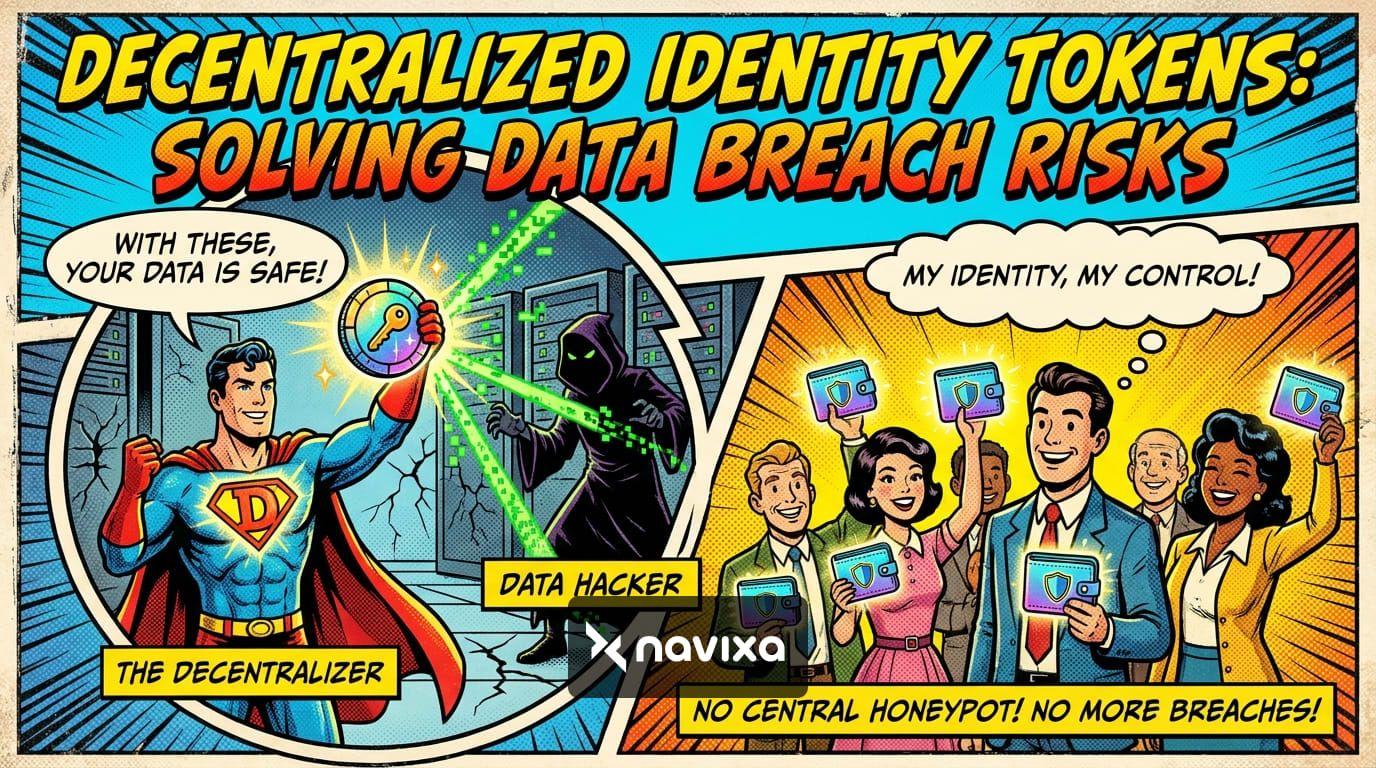
The digital era has brought unprecedented convenience, but it has also ushered in a silent epidemic: the mass exploitation of personal data. According to recent data from the Federal Trade Commission, consumers have reported losses exceeding $12.5 billion due to fraud in a single year, reflecting a massive surge in cyber theft. Traditional centralized databases act as massive "honey pots," inviting malicious actors to breach corporate servers and steal millions of passwords, social security numbers, and biometric profiles in a single fell swoop.
Enter decentralized identity tokens, the financial and structural backbone of a new technological paradigm known as Self-Sovereign Identity (SSI). These digital assets power decentralized networks that allow users to verify who they are without handing over sensitive personal data to third-party corporations. By fundamentally restructuring how identity verification operates across the global economy, these protocols are not merely theoretical concepts—they are actively solving data breach risks.
In this comprehensive guide, we will break down the mechanics of decentralized identity systems, explore the current market landscape of identity tokens, and provide actionable trading strategies and risk management protocols for investors looking to capitalize on this rapidly expanding sector.
The Mechanisms of Decentralized Identity
To understand why decentralized identity tokens are gaining massive institutional traction, one must first understand the fundamental technology underpinning them. The traditional internet relies heavily on federated identity (such as logging in with Google or Facebook) or isolated database silos. Web3 replaces this antiquated infrastructure with three core pillars:
1. Decentralized Identifiers (DIDs): A DID is a globally unique, cryptographically verifiable identifier that does not require a centralized registration authority because it is registered directly on a distributed blockchain ledger. 2. Verifiable Credentials (VCs): These are digital, tamper-proof versions of physical credentials, such as passports, driver's licenses, or university degrees, issued securely to a user's digital wallet. 3. Zero-Knowledge Proofs (ZKPs): This cryptographic breakthrough allows a user to prove a specific statement is true without revealing the underlying data. For example, a user can definitively prove they are over 18 without ever revealing their exact birthdate or address.
Behind the scenes, independent node operators maintain the decentralized ledger that time-stamps and secures these DIDs. The native decentralized identity tokens compensate these node operators, ensuring that the network remains secure, immutable, and resistant to censorship. Without this tokenomic incentive structure, the decentralized identity framework would struggle to scale globally.
"By shifting the burden of data custody from the enterprise to the individual, decentralized identity transforms personal data from a corporate liability into a secure, user-owned asset."
Solving Data Breach Risks: The Core Proposition
The primary driver behind the explosive growth of the decentralized identity market—which is projected to reach hundreds of billions in valuation in the coming decade—is the complete elimination of the centralized "honey pot."
When a hospital, retail bank, or social media platform stores your personal data, they must build massive, expensive cybersecurity infrastructures to protect it. If their firewall is breached, millions of users are compromised instantly. Decentralized identity networks flip this model on its head. Instead of storing a vast database of names and passwords, a company only verifies a cryptographic proof presented by your personal digital wallet. If the company is hacked, the attacker finds nothing but mathematically verified hashes that are completely useless without the user's localized private keys.
Tokens are the vital lifeblood of this ecosystem. They are utilized to pay for the computational power required to verify credentials, incentivize network security, and occasionally reward users for participating in decentralized identity protocols.
Market Analysis: Top Decentralized Identity Tokens
The decentralized identity market has matured significantly, shifting from speculative hype to tangible enterprise and consumer adoption. Two primary examples highlight the diversity and distinct value propositions within this sector: Worldcoin (WLD) and Civic (CVC).
Worldcoin (WLD) and the Proof-of-Personhood Narrative
Worldcoin remains one of the most actively traded, heavily debated identity tokens on the market. Launched with the ambitious goal of differentiating verifiable humans from AI bots, Worldcoin utilizes specialized biometric hardware known as the "Orb" to scan users' irises. In exchange for verifying their humanness, users historically received WLD tokens.
Recently, Worldcoin has rolled out enhanced security protocols, such as Face Auth, using facial recognition to bolster biometric security and prevent credential theft. Despite massive historical volatility—crashing from an all-time high near $11.80 down to extreme lows before stabilizing in the $0.20 to $0.30 range—the network has actively expanded to roughly 25 million users globally. Market participants increasingly view WLD as a direct proxy for AI development; whenever major artificial intelligence advancements or regulatory discussions about AI safety occur, WLD frequently experiences correlated price momentum.
Civic (CVC) and Enterprise Integration
While Worldcoin focuses heavily on global consumer onboarding, Civic (CVC) has successfully taken an enterprise-first approach. Civic provides blockchain-based identity verification that integrates directly into complex corporate workflows. With the recent advancement of the Civic Nexus platform and deep integrations into major ecosystems like Google Workspace, Civic is embedding its identity solutions directly into sophisticated AI and enterprise data systems.
The CVC token serves as the critical settlement layer for these identity transactions. Furthermore, Civic's achievement of the CASA Tier 2 Security Certification has fortified its appeal to institutional clients. The recent introduction of perpetual contracts on major cryptocurrency exchanges for CVC has also injected fresh liquidity into its trading pairs, offering technical traders robust new avenues for speculation and hedging.
Technical Analysis & Key Indicators
Trading decentralized identity tokens requires a nuanced approach to technical analysis, as these assets frequently decouple from the broader cryptocurrency market depending on regulatory news, hardware deployments, and software integrations.
Moving Averages and Structural Shifts
For identity tokens recovering from extended bear cycles, monitoring short-term moving averages is critical. Traders typically watch the 20-day and 50-day Exponential Moving Averages (EMAs). A successful daily close where the asset breaks above the 50-day EMA often signals a shift from accumulation to markup phases. For instance, an asset basing near historic support levels will rely on these EMAs to confirm a "rounded bottom" formation before testing overhead resistance zones.
Momentum Oscillators
Because identity tokens can experience sudden, news-driven spikes, utilizing the Relative Strength Index (RSI) and Moving Average Convergence Divergence (MACD) helps prevent buying the top. An RSI pushing past 70 during a protocol upgrade announcement suggests overbought conditions, warning traders of an impending retracement. Conversely, extreme oversold readings on the daily timeframe often present lucrative swing trading entries, provided the fundamental network adoption metrics remain intact.
Volume Profile and Support/Resistance Mapping
When trading assets that have experienced significant drawdowns, identifying historical volume nodes is imperative. Traders utilize Volume Profile Fixed Range (VPFR) to spot areas where heavy institutional accumulation occurred. In the identity token sector, these high-volume nodes often act as impenetrable support during broader market sell-offs. Conversely, areas with thin volume during previous crashes act as low-friction zones where price can rapidly ascend upon a confirmed breakout.
Trading Strategy for Identity Tokens
Decentralized identity tokens require distinct strategies compared to Layer-1 blockchains or meme coins.
Thematic Trading and AI Correlation
Identity verification is becoming fundamentally linked to the Artificial Intelligence sector. As AI agents become more autonomous and prevalent, the need to cryptographically prove "Proof of Personhood" skyrockets. Traders should actively monitor major tech announcements regarding AI safety and regulation. Creating a specialized watchlist that pairs high-cap AI tokens with identity tokens allows traders to execute momentum strategies when the broader AI narrative catches a bid in the market.
Volatility Arbitrage
Identity tokens are heavily influenced by geographic network expansions and regulatory decisions. A country launching a regulatory probe into an identity protocol can cause an immediate, sharp drop, while an enterprise security certification or a major exchange listing can trigger a massive short squeeze. Traders can use volatility arbitrage by executing tight stop-limit orders around major scheduled announcements, such as predetermined token unlock events or mainnet upgrades.
Traditional vs. Decentralized Identity Systems
| Feature | Traditional Identity | Decentralized Identity (Web3) |
|---|---|---|
| Data Custody | Stored on centralized, third-party corporate servers. | Controlled locally by the user via secure digital wallets. |
| Breach Vulnerability | High risk of mass data extraction (Honey Pots). | Extremely low risk; hackers cannot access centralized data pools. |
| Privacy & Consent | Companies track, farm, and monetize user logins. | Zero-Knowledge Proofs ensure absolute minimal data disclosure. |
| Authentication | Passwords and highly vulnerable SMS 2FA. | Cryptographic private keys and biometric consensus. |
| Interoperability | Fragmented across hundreds of different silos. | Universal, cross-chain, and globally recognized standards (DIDs). |
Risk Management
While the technological fundamentals of decentralized identity are incredibly strong, trading these utility tokens carries unique systemic risks that must be aggressively managed.
Regulatory Scrutiny
Identity is inherently a matter of national security and citizen privacy. Governments and global data protection agencies—particularly in regions enforcing stringent frameworks like Europe's GDPR—heavily scrutinize biometric data collection. Any mainstream news of a regulatory probe can lead to aggressive algorithmic sell-offs. Traders must size their positions conservatively to account for unpredictable legal actions against token issuers.
Tokenomics and Supply Shocks
Many identity tokens launched with low initial circulating supplies and aggressive vesting schedules for insiders. Traders must consistently track on-chain token unlocks. If a massive tranche of tokens is scheduled to unlock for early investors or team members, the sudden influx of circulating supply can suppress price action regardless of bullish technical indicators. Always consult on-chain analytics platforms before entering a long-term swing trade.
Liquidity and Slippage Risks
Identity tokens can sometimes suffer from thin order books on secondary spot exchanges. If a trader attempts to exit a large position during a low-volume weekend, they may experience severe price slippage. To mitigate this, traders should execute large orders using Time-Weighted Average Price (TWAP) algorithms or utilize highly liquid perpetual futures contracts when looking to capture short-term volatility.
Actionable Steps for Investors
To successfully navigate the decentralized identity sector, market participants should follow these actionable steps:
1. Verify On-Chain Adoption: Do not rely purely on marketing metrics. Use blockchain explorers to track the daily active addresses and the number of verifiable credentials being minted on-chain. True token utility is reflected directly in network usage. 2. Hedge with Broader Narratives: Because identity tokens correlate heavily with AI and Web3 infrastructure, consider constructing a diversified portfolio that includes foundational Layer-1 blockchains and AI data-layer protocols. This heavily cushions the volatility of holding pure-play identity tokens. 3. Utilize Self-Custody Security: It is fundamentally contradictory to trade decentralized identity tokens while leaving them vulnerable on centralized exchanges. Practice what the sector preaches by moving long-term token holdings into secure cold storage wallets. Check verified resources like Ledger's official security guidelines for best practices on self-custody. 4. Implement Strict Invalidation Levels: Given the rapid sentiment shifts in regulatory-heavy sectors, never enter a swing trade without a predefined stop-loss. If an identity token loses a critical multi-month support level, cut the loss immediately and wait for structural re-accumulation.
Practical Takeaways
* Fundamentally Superior: Decentralized identity utilizes DIDs and Zero-Knowledge Proofs to dismantle the centralized "honey pots" that directly cause mass data breaches. * Dual Utility: Identity tokens not only secure their native networks but also offer unique speculative exposure to the rapidly merging worlds of Web3 data privacy and Artificial Intelligence. * Narrative Driven: Price action in this specialized sector is heavily influenced by international regulatory news, biometric hardware rollouts, and enterprise software integrations. * Technical Precision: Always wait for moving average crossovers and volume profile confirmation before assuming a bearish macro trend has reversed, as these tokens are prone to extended downtrends during regulatory quiet periods.
Conclusion
The transition from highly vulnerable centralized databases to decentralized identity networks is not a passing cryptocurrency trend; it is a fundamental, necessary upgrade to global digital security. By shifting data custody back to the individual, decentralized identity tokens provide a definitive, mathematical solution to the catastrophic data breaches that have plagued the Web2 era.
For forward-thinking traders and investors, this sector offers a unique blend of high market volatility, rapid technological innovation, and deep structural correlation with the artificial intelligence boom. By employing strict technical analysis, continuously monitoring international regulatory developments, and practicing highly disciplined risk management, market participants can successfully navigate the complexities of identity tokens. The future of the digital economy relies entirely on verifiable truth, and the tokens powering this infrastructure represent one of the most compelling frontiers in the digital asset space.
Frequently Asked Questions
What are decentralized identity tokens?
Decentralized identity tokens are native digital assets on blockchain networks that facilitate the secure, user-controlled verification of personal data. They are utilized to pay for complex verification transactions, incentivize network node security, and reward participants without ever relying on centralized authorities.
How do zero-knowledge proofs protect personal data?
Zero-Knowledge Proofs (ZKPs) are advanced cryptographic protocols that allow a user to prove the absolute validity of a statement without revealing the underlying data itself. For instance, a user can definitively prove they are a citizen of a specific country to access a service without disclosing their passport number, drastically enhancing digital privacy.
Why do identity tokens often correlate with AI trends?
As artificial intelligence becomes substantially more advanced, the internet faces a massive, growing problem of autonomous bots mimicking actual humans. Decentralized identity systems provide "Proof of Personhood," distinguishing verifiable humans from AI agents. Consequently, when AI adoption and capabilities surge, the market actively speculates on the increased necessity for human verification infrastructure.
Are decentralized identity tokens safe from regulation?
No. Because they inherently deal with highly sensitive biometric data and cryptographic proof-of-identity, these networks face intense regulatory scrutiny, particularly regarding international data protection laws like Europe's GDPR. Prudent investors must closely monitor geopolitical and legal developments within this sector.
Can decentralized identity completely prevent data breaches?
While no digital system is entirely flawless, decentralized identity structurally eliminates the centralized "honey pots" of personal data that cybercriminals typically target. Since users hold their own data locally in hardware or encrypted wallets and only share cryptographic proofs with service providers, catastrophic mass data breaches become virtually impossible on a systemic level.