
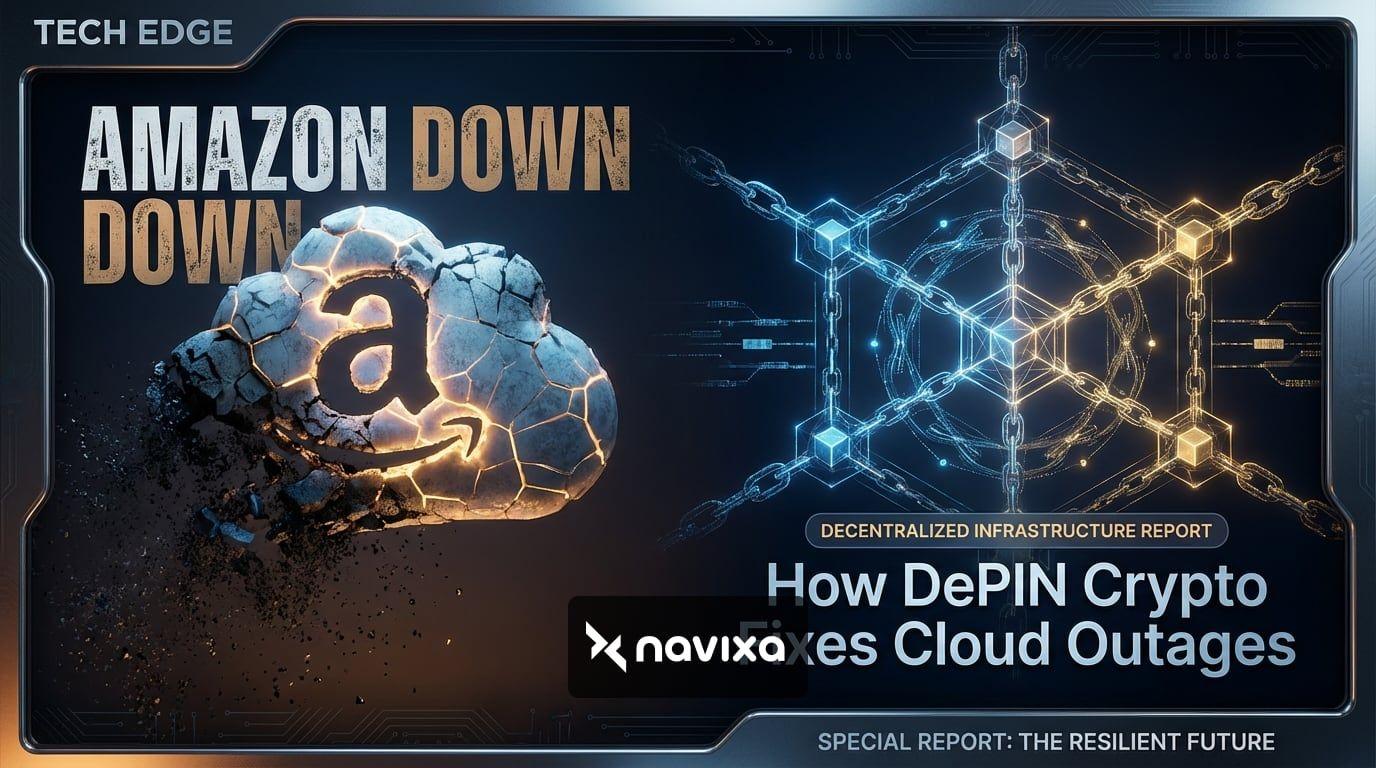
Picture this: It is early morning, and suddenly half the internet simply stops working. Messages fail to send, crypto portfolios will not load, smart doorbells turn into useless bricks, and remote workers are locked out of their collaborative tools. E-commerce checkouts freeze, causing thousands of dollars in abandoned carts per minute. This is not a hypothetical doomsday scenario—it is exactly what happened during the massive Amazon Web Services (AWS) outage that cascaded through the digital world, silencing major platforms like Snapchat, Coinbase, Duolingo, and Fortnite. The collective financial loss across global industries was staggering.
The harsh reality of modern cloud computing is that convenience often comes at the cost of profound vulnerability. When a single centralized region like AWS `us-east-1` experiences a critical failure, the ripple effects disrupt millions of lives and cost businesses untellable millions in lost revenue. We have built a decentralized internet, but we are running it on heavily centralized hardware.
Enter DePIN crypto. Decentralized Physical Infrastructure Networks (DePIN) represent the next evolution of the internet's backbone. By leveraging blockchain technology and tokenomics, DePIN distributes the heavy lifting of cloud computing, storage, and networking across a global, decentralized web of participants.
In this comprehensive guide, we will explore exactly how DePIN crypto fixes the single points of failure inherent in legacy cloud systems, highlight the top projects building this infrastructure, and provide actionable trading strategies for investors looking to capitalize on the multi-billion-dollar DePIN market.
The Core Problem with Centralized Cloud Giants
To understand why DePIN is so revolutionary, we must first dissect the fundamental flaws of our current cloud architecture. Today, the internet is dominated by an oligopoly: Amazon Web Services (AWS), Google Cloud Platform (GCP), and Microsoft Azure. AWS alone powers roughly a third of the internet's infrastructure.
The Anatomy of an Outage
During the infamous AWS crash, a Domain Name System (DNS) race condition affecting the DynamoDB API in the Northern Virginia (`us-east-1`) region triggered a catastrophic chain reaction. Because DynamoDB is a foundational database service used by countless other applications, its failure caused an avalanche of secondary outages.
"In distributed systems, failures in one part of the system can result in cascading failures in other parts. When thousands of apps hardcode a dependency to a single centralized region, a tiny localized error can shut down half the internet."
This event highlighted three glaring issues with centralized cloud infrastructure: 1. Single Points of Failure: Even with redundant backups, relying on a single corporate entity means that a localized software bug can have global consequences. 2. Opaque Resolution Processes: When AWS goes down, users and businesses are entirely at the mercy of Amazon's engineers. There is no transparent, decentralized protocol to route traffic automatically through independent nodes. 3. Monopolistic Pricing: Because a few companies control the market, they can dictate pricing, keeping the cost of compute, bandwidth, and storage artificially high.
What is DePIN Crypto and How Does it Solve This?
DePIN stands for Decentralized Physical Infrastructure Networks. It is a paradigm-shifting model that uses blockchain tokens to incentivize individuals and businesses to deploy and maintain physical infrastructure—such as servers, GPUs, wireless routers, and storage drives.
Instead of one company building massive, multi-billion-dollar server farms in a few geographic locations, a DePIN crypto network crowdsources the hardware from thousands or even millions of independent providers worldwide.
The DePIN Flywheel Effect
DePIN projects rely on a carefully balanced economic model known as the "flywheel": * Incentivization: The network issues its native crypto token to reward users who provide their physical resources, such as spare computational power or unused bandwidth. * Affordability: Because these individual providers are utilizing sunk costs (hardware they already own) or operating with lower overhead than massive corporate data centers, the network can offer services to end-users at a fraction of the cost of AWS or Google Cloud. * Adoption: Attracted by the lower prices and higher resilience, developers and businesses migrate to the DePIN network. * Value Accrual: As network usage grows, the demand for the native token increases, which drives up its value, thereby incentivizing even more hardware providers to join the ecosystem.
When a localized failure occurs in a DePIN network, the system automatically and permissionlessly routes workloads to other available nodes around the globe. There is no `us-east-1` vulnerability to take down the whole system.
Top DePIN Projects Disrupting the Status Quo
Several top-tier DePIN crypto projects are actively proving that decentralized networks can handle enterprise-grade workloads with zero downtime.
Akash Network (AKT): The Decentralized Cloud
Akash Network is a decentralized marketplace for cloud computing. It allows anyone with spare server capacity to lease it out to developers needing compute power. Often described as the "Airbnb of cloud compute," Akash claims to offer services up to 85% cheaper than traditional cloud providers like AWS or Azure. During localized AWS failures, decentralized protocols like Akash remain entirely unaffected, as their computational nodes are spread out globally.
Render Network (RNDR) and Filecoin (FIL): Compute and Storage
Render Network is a blockchain-based platform that democratizes access to high-performance GPU rendering. With the explosion of Artificial Intelligence (AI) and the metaverse, GPU compute is in incredibly high demand. Render allows users to monetize their idle GPUs, offering a decentralized alternative to corporate rendering farms that frequently face capacity limits and hardware shortages.
Filecoin, on the other hand, tackles the storage side of the equation. It transforms cloud storage into an open algorithmic market. By distributing data across thousands of independent nodes, Filecoin ensures that a server crash in Virginia will not prevent a user in London from accessing their mission-critical files.
Helium (HNT) and Theta Network (THETA): Connectivity and Bandwidth
Helium is revolutionizing wireless infrastructure by incentivizing users to deploy hotspots, creating a globally distributed wireless network for Internet of Things (IoT) devices and 5G cellular communication. Meanwhile, Theta Network focuses on decentralized video delivery and edge computing, utilizing spare bandwidth to improve streaming quality and drastically reduce a platform's reliance on centralized Content Delivery Networks (CDNs).
Trading Strategy: Capitalizing on the DePIN Crypto Market
As an investor or trader, understanding the technological superiority of DePIN is only half the battle. The other half is knowing how to trade these assets effectively in a volatile cryptocurrency market. The DePIN sector has matured rapidly, transitioning from speculative hype to generating substantial real-world revenue.
Market Analysis and Fundamentals
Recent analytics reports have shown that the DePIN sector has surpassed a $10 billion market capitalization, generating tens of millions in on-chain revenue. This is a critical metric. Unlike meme coins or vaporware, top DePIN crypto networks have tangible cash flows. Users are actively paying real money for compute, storage, and bandwidth.
However, despite this measurable growth, many leading DePIN tokens currently trade at significantly lower revenue multiples (around 10x to 25x) compared to the euphoric 1000x multiples seen in past cycles. This discrepancy presents a massive opportunity for value investors. The revenue has started to decouple from token price action, meaning the underlying networks are growing stronger even when the broader crypto market consolidates.
Technical Analysis Approach
When trading DePIN tokens, technical analysis (TA) should be paired closely with on-chain metrics. * Support and Resistance Mapping: Given the utility-driven nature of these tokens, established horizontal support zones are often vigorously defended by institutional buyers. Look for high-volume nodes on the Volume Profile indicator to identify areas where smart money is accumulating. * Moving Averages: For trend following, a combination of the 50-day and 200-day Exponential Moving Averages (EMA) is highly effective. A "Golden Cross" on a DePIN token chart, coupled with an uptick in network usage (like active nodes or deployed storage), is a strong fundamental buy signal. * Relative Strength Index (RSI): Because DePIN tokens occasionally decouple from Bitcoin's price action, look for bullish divergences on the RSI. If a token like AKT or RNDR makes a lower low in price but a higher low on the RSI while network revenue is climbing, a reversal is highly probable.
Actionable Steps
1. Track On-Chain Revenue: Use analytics platforms to monitor the actual usage of the DePIN network. An increase in active compute leases or storage deals is a leading indicator for token demand. 2. Look for BME Models: Prioritize projects implementing a Burn-Mint Equilibrium (BME) model. In this setup, every dollar spent on network services results in the equivalent value of the native token being burned. As adoption scales, this creates immense deflationary pressure on the token supply, organically driving up prices. 3. Dollar-Cost Average (DCA) into Leaders: The DePIN sector is highly competitive. Instead of searching for micro-cap gems with unproven hardware, allocate the majority of your DePIN portfolio to established leaders with massive node counts, active developer ecosystems, and enterprise partnerships.
Risk Management
Trading DePIN crypto is not without its pitfalls. The most significant risk in this sector is token inflation. To bootstrap a physical network, projects must aggressively emit tokens to reward early hardware providers. If the network does not generate enough real-world demand to offset these emissions, the token price will bleed out over time.
Always check the vesting schedules of early investors and team members. Implement strict stop-loss orders below major structural support levels, and limit your exposure to any single DePIN token to no more than 5% of your total trading portfolio. Diversify across sub-sectors: hold a compute token (Akash), a storage token (Filecoin), and a connectivity token (Helium) to hedge against localized ecosystem risks.
Centralized Cloud vs. DePIN Crypto
To summarize the paradigm shift, let us compare legacy cloud providers with the emerging DePIN model.
| Feature | Legacy Cloud (AWS, Google) | DePIN Crypto Networks |
|---|---|---|
| Architecture | Centralized server farms in localized regions. | Globally distributed nodes run by independent users. |
| Point of Failure | High risk of regional cascading failures. | Extremely resilient; automatic peer-to-peer rerouting. |
| Cost | High, dictated by corporate monopolies. | Often 50% to 85% cheaper due to utilized idle hardware. |
| Control & Governance | Opaque, corporate-controlled, prone to censorship. | Transparent, open-source, governed by token holders. |
| Incentive Structure | Profits flow exclusively to corporate shareholders. | Value is distributed to hardware providers and token holders. |
Practical Takeaways for Builders and Investors
For developers building the next generation of web applications, the lesson from the recent AWS outages is clear: diversify your infrastructure. You cannot afford to have your entire backend anchored to a single corporate entity. Integrating decentralized compute and storage protocols into your tech stack is no longer an ideological choice; it is a business imperative for maintaining uptime and preserving your company's reputation. Furthermore, startups can drastically reduce their initial burn rate by leveraging DePIN services for intensive tasks like machine learning model training or video rendering.
For investors, the DePIN sector offers one of the most compelling risk-to-reward ratios in the digital asset space. We are witnessing the financialization of physical infrastructure. The opportunity lies in identifying the networks that are successfully transitioning from the speculative phase of bootstrapping supply, to the mature phase of capturing enterprise demand.
You can monitor these trends by keeping an eye on CoinGecko's DePIN tracker and exploring the enterprise adoption case studies published by top decentralized networks.
Frequently Asked Questions
What is DePIN crypto?
DePIN stands for Decentralized Physical Infrastructure Networks. It is a category of cryptocurrency projects that use blockchain technology and token incentives to crowdsource the creation and maintenance of physical infrastructure, such as cloud computing, wireless networks, GPU rendering, and data storage.
How does DePIN prevent outages like the AWS crash?
Centralized cloud providers rely on massive data centers in specific regions. If a critical component like a DNS router fails in that region, everything connected to it goes down. DePIN prevents this by distributing the infrastructure across thousands of independent nodes globally. If one node or region fails, the network automatically routes the workload to other available providers, ensuring continuous uptime.
Are DePIN networks cheaper than AWS or Google Cloud?
Yes, in most cases. Because DePIN networks utilize spare, idle hardware owned by individuals and independent data centers, they do not have the massive overhead costs of building and staffing corporate mega-facilities. Projects like Akash Network claim to offer cloud computing services at a fraction—sometimes up to 85% less—of the cost of traditional cloud providers.
What are the top DePIN crypto projects right now?
Some of the leading DePIN projects by market capitalization and real-world adoption include Render Network (GPU rendering), Akash Network (cloud computing), Filecoin (decentralized storage), Helium (wireless connectivity), and Theta Network (video delivery and edge compute).
Conclusion
The massive cloud outages that occasionally paralyze the internet serve as a stark reminder that our digital world is built on a fragile, centralized foundation. When AWS goes down, the economy halts. DePIN crypto offers an elegant, inevitable solution to this problem. By aligning financial incentives with the deployment of global hardware, decentralized networks are building a cheaper, more resilient, and completely unstoppable internet backbone.
Whether you are a developer looking to disaster-proof your applications or a trader searching for the next multi-billion-dollar crypto narrative, DePIN is a sector you cannot afford to ignore. Start tracking on-chain revenue, utilize the technical analysis strategies outlined above, and consider diversifying your portfolio with the infrastructure of tomorrow. To dive deeper into the overarching blockchain ecosystem, check out the resources available on Amazon Web Services' Blockchain page to see how even the centralized giants are interacting with Web3 technology. The future is decentralized; make sure your infrastructure and your portfolio are positioned for it.