
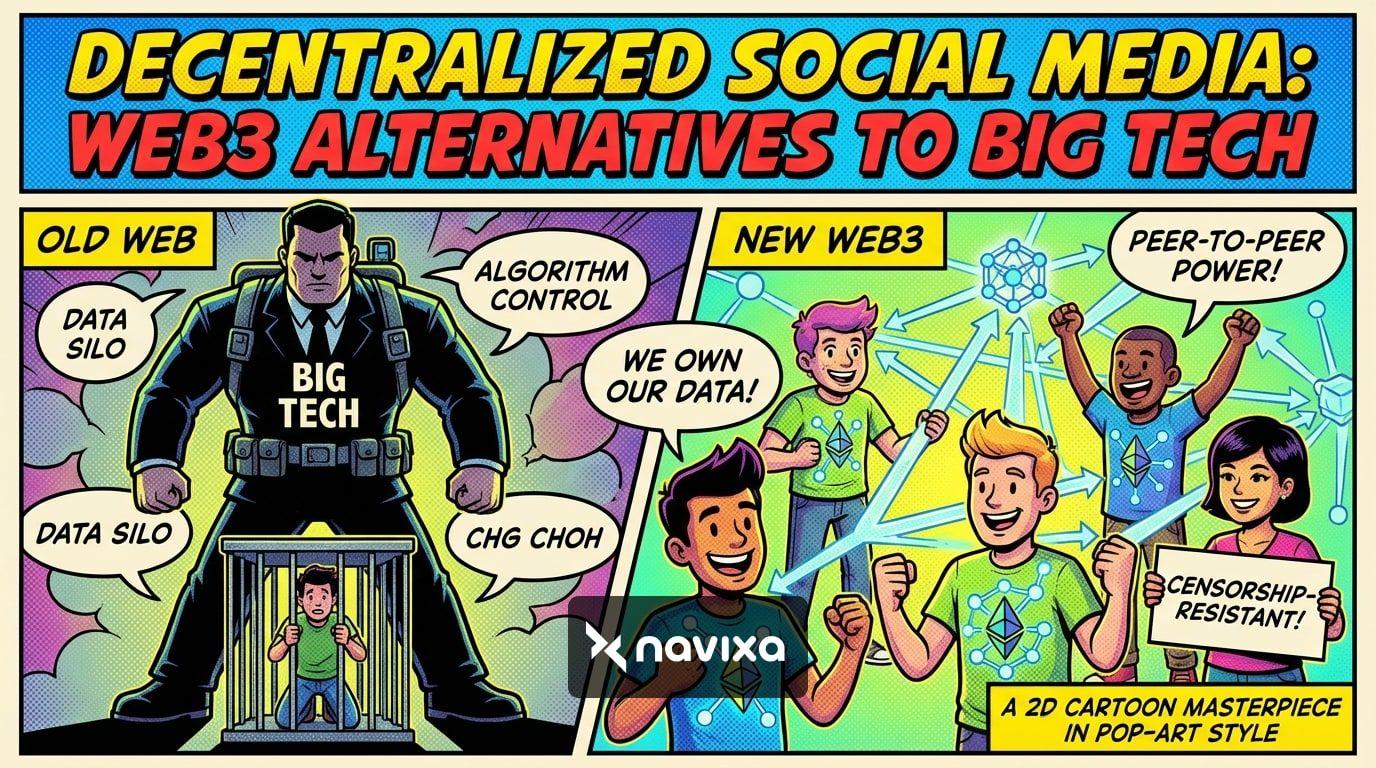
For over a decade, Big Tech platforms have dominated the digital landscape, harvesting user data, dictating algorithmic visibility, and enforcing opaque moderation policies. As users grow increasingly frustrated with centralized control, decentralized social media has emerged as a revolutionary alternative. By leveraging blockchain technology and open-source protocols, these Web3 networks are returning ownership, privacy, and monetization back to the creators and their communities.
Decentralized social media is not just a technological upgrade; it represents a fundamental shift in how digital identities and social graphs are managed. Instead of renting space on a corporate server, users in Web3 own their data as portable assets.
"If we want a better society, we need better mass communication tools. Decentralization enables competition by allowing multiple clients to operate on a shared social data layer." — Vitalik Buterin
The Core Mechanics of Web3 Alternatives
To understand why decentralized social media is gaining traction, one must look at the structural differences between Web3 protocols and traditional Big Tech platforms.
Data Portability and Social Graphs
In traditional social media, your followers, posts, and engagements are locked within a walled garden. If you are banned or choose to leave, you lose your audience. Web3 protocols decouple the user interface (the app) from the underlying data layer (the protocol). By storing your social graph on an immutable public ledger, you can seamlessly plug your digital identity into any front-end client without losing your connections.
Censorship Resistance
Centralized platforms rely on corporate moderation teams that can shadowban or deplatform users arbitrarily. Decentralized platforms operate on decentralized nodes, meaning no single authority has the power to silence voices. Moderation is often community-driven, utilizing algorithmic choice rather than top-down enforcement.
Integrated Monetization (SocialFi)
Perhaps the most disruptive element of decentralized social media is the integration of decentralized finance, commonly referred to as SocialFi. Creators are no longer dependent on ad-revenue sharing models dictated by Big Tech. Instead, they can tokenize their influence, mint posts as NFTs, and interact via micropayments using cryptocurrency.
The 2026 Landscape: Evolution and Reality Checks
The Web3 social space underwent a massive transformation in early 2026. The industry has matured past the initial hype, facing both widespread adoption and necessary reality checks.
Ethereum co-founder Vitalik Buterin declared 2026 a year of renewed focus on decentralized social networks. He highlighted the importance of multi-client interfaces like Firefly, which allow users to aggregate their feeds from X, Lens Protocol, Farcaster, and Bluesky into a single, unified dashboard.
However, the ecosystem has also experienced significant structural shifts. For example, Farcaster—one of the leading Web3 social protocols—saw a transition in leadership when its founders stepped back, transferring ownership of the protocol, smart contracts, and apps to the infrastructure provider Neynar. Similarly, Lens Protocol was acquired by Mask Network from Avara. These major acquisitions signal an industry moving away from highly speculative consumer applications toward deep, resilient, builder-focused infrastructure.
Top Decentralized Social Media Protocols
While numerous alternatives exist, a few key protocols are currently dominating the decentralized social media sector.
Farcaster
Initially built by ex-Coinbase developers, Farcaster operates on a "sufficiently decentralized" model. It uses an off-chain hub system for fast data storage while keeping user identities firmly on-chain via the Optimism network. Farcaster revolutionized Web3 interaction with Frames—interactive posts that allow users to mint NFTs, play games, or execute trades directly within their social feed without leaving the app. Following its acquisition by Neynar in 2026, the protocol has doubled down on a wallet-first, infrastructure-heavy approach.
Lens Protocol
Originally developed by the team behind Aave, Lens Protocol takes a more aggressive on-chain approach. Every profile, post, and follower relationship is minted as an NFT. Operating primarily on EVM-compatible networks, Lens leverages "Open Actions" to allow custom smart contract interactions directly within a post. Under the stewardship of Mask Network, Lens continues to lead in on-chain identity portability.
Bluesky
Initially incubated by Twitter, Bluesky operates on the AT Protocol. While not heavily focused on blockchain-based financialization, it emphasizes federated social networking and interoperability. Bluesky allows users to choose their own algorithms and seamlessly move their accounts between different servers, presenting a highly scalable alternative to mainstream microblogging.
Comparing Big Tech to Web3 Alternatives
To illustrate the differences, here is a comparison between traditional Big Tech and the leading Web3 social protocols:
| Feature | X (Big Tech) | Farcaster | Lens Protocol | Bluesky |
|---|---|---|---|---|
| Data Ownership | Centralized / Corporate | User-owned (On-chain ID) | User-owned (NFT profiles) | User-owned (Federated) |
| Monetization | Ad-revenue share | Direct crypto tips / Tokens | Tokenized posts / NFTs | None native (Yet) |
| Censorship | Top-down moderation | Protocol-level neutrality | Protocol-level neutrality | Server-level moderation |
| Interactivity | Standard links | Frames (In-feed dApps) | Open Actions (Smart Contracts) | Standard links |
Trading Strategy: Capitalizing on SocialFi
For crypto investors and traders, decentralized social media is not just about free speech; it is a highly active, volatile market. Trading SocialFi assets requires a distinct strategy that combines fundamental analysis of social metrics with technical trading principles.
Evaluating Creator Coins and Social Tokens
Creator coins are hyper-volatile assets tied to the popularity and social capital of an individual or platform. When executing a trading strategy in the SocialFi space, traders must look beyond traditional metrics. Key indicators include Daily Active Users (DAU), engagement retention rates, and the velocity of capital moving through a protocol's smart contracts.
If you are trading on Dune Analytics data, look for a divergence between social engagement and token price. If a protocol's user base is growing steadily but the associated token is consolidating, it may signal an accumulation phase. Conversely, an explosive spike in token price without a corresponding increase in active developers or users is often a bearish divergence, indicating a potential sell-off.
Technical Analysis for Web3 Social Assets
Technical analysis (TA) in SocialFi is notoriously difficult due to low liquidity and sentiment-driven price action. However, traditional TA principles still apply: 1. Volume Profile: Monitor volume spikes on decentralized exchanges (DEXs) when new protocol features (like a new Farcaster Frame) are announced. 2. Support and Resistance: Because creator coins often suffer from rapid inflation, support levels are frequently broken. Focus on historical demand zones established during periods of low volatility. 3. Momentum Indicators: Use the Relative Strength Index (RSI) on lower timeframes (1H or 4H) to catch oversold bounces during the inevitable panic selling that plagues micro-cap social tokens.
Risk Management in SocialFi Markets
The SocialFi sector is a high-risk environment. According to late 2025 industry data, a staggering 92% of users abandon early-stage SocialFi platforms within 30 days, creating a "boom and bust" cycle for many associated tokens. Proper risk management is non-negotiable.
The Cautionary Tale of friend.tech
Traders must heed the lessons of platforms like friend.tech. In 2024, the platform generated nearly $90 million in fees and dominated the Base network's activity. However, developers abruptly transferred control of the smart contracts to a null address, effectively abandoning the project. The native token plummeted by 98%, wiping out investor portfolios.
Actionable Risk Mitigation
To protect your capital while trading in the decentralized social media sector: * Strict Position Sizing: Never allocate more than 1-2% of your total trading portfolio to a single creator coin or early-stage SocialFi token. * Beware of Illiquidity: Check the liquidity pools on platforms like CoinMarketCap or DEX screeners. High slippage can turn a theoretical profit into a realized loss. * Monitor Developer Activity: Social platforms without active GitHub commits or transparent developer communications are prime candidates for sudden abandonment.
Actionable Steps: Migrating Your Audience
If you are a creator or a brand looking to transition away from Big Tech, waiting for legacy platforms to fail is a losing strategy. Here is how you can proactively migrate your audience:
1. Secure Your Web3 Identity: Start by registering an Ethereum Name Service (ENS) domain and claiming your Lens or Farcaster handles. Your handle is your on-chain identity. 2. Utilize Multi-Client Interfaces: Tools like Firefly allow you to cross-post to X, Farcaster, Lens, and Bluesky simultaneously. This reduces friction and helps you bridge your Web2 audience into Web3. 3. Leverage Interactive Elements: Do not just post text. Use Farcaster Frames or Lens Open Actions to create polls, distribute token rewards, or mint free NFTs. Rewarding your audience for engaging on decentralized platforms accelerates migration.
Practical Takeaways
* Data Sovereignty is the Future: Decentralized social media ensures you own your social graph, protecting you from Big Tech censorship and algorithm changes. * SocialFi is Evolving: The 2026 acquisitions of major protocols by infrastructure providers signal a shift from speculative hype to sustainable blockchain utility. * Trading Requires Caution: The 92% churn rate in early SocialFi platforms means traders must use strict technical analysis and risk management to survive boom-and-bust cycles. * Start Bridging Now: Use multi-client aggregators to slowly migrate your audience without abandoning your existing reach.
Conclusion
The era of unchecked Big Tech dominance over our digital lives is facing its most credible threat yet. Decentralized social media and Web3 protocols offer a tangible, blockchain-backed alternative that restores privacy, enables censorship resistance, and provides unprecedented monetization opportunities through SocialFi. While the ecosystem is still navigating extreme volatility and structural realignments in 2026, the foundational technology is stronger than ever. Whether you are a content creator looking to secure your digital legacy or a trader seeking the next frontier of crypto markets, now is the time to embrace the decentralized web. Take control of your on-chain identity today and explore the protocols building the future of digital interaction.
Frequently Asked Questions
What is decentralized social media?
Decentralized social media refers to online networking platforms built on blockchain technology or open-source protocols. Unlike Big Tech platforms, which store data on centralized corporate servers, decentralized alternatives give users true ownership of their data, enhanced privacy, and protection against arbitrary censorship.
How do creators make money on Web3 social platforms?
Through a model known as SocialFi, creators can monetize their influence directly without relying on ad-revenue sharing. They can earn cryptocurrency tips, mint their posts or profiles as NFTs, and launch their own creator coins. Automated smart contracts ensure transparent and instant revenue distribution.
Are decentralized social networks completely immune to censorship?
While the underlying blockchain protocols are immutable and censorship-resistant, individual front-end applications (the clients you use to view the protocol) can still implement community moderation or filter illicit content. However, because you own your social graph, you can easily take your profile and audience to a different client if you disagree with one app's moderation policies.
What happened to early SocialFi projects like friend.tech?
Many early SocialFi platforms suffered from severe user retention issues and speculative boom-and-bust cycles. For instance, friend.tech saw massive early success but collapsed when its developers abandoned the project and transferred smart contract control to a null address, causing its token to crash by 98%. This highlights the importance of risk management in Web3.
Which decentralized social platform should I use?
The choice depends on your goals. Farcaster is excellent for crypto-native communities, developers, and interactive in-feed apps (Frames). Lens Protocol is ideal for creators heavily focused on NFT monetization and deep on-chain integration. Bluesky is a great choice if you prefer a user experience similar to traditional microblogging but with decentralized, federated infrastructure.