
Introduction
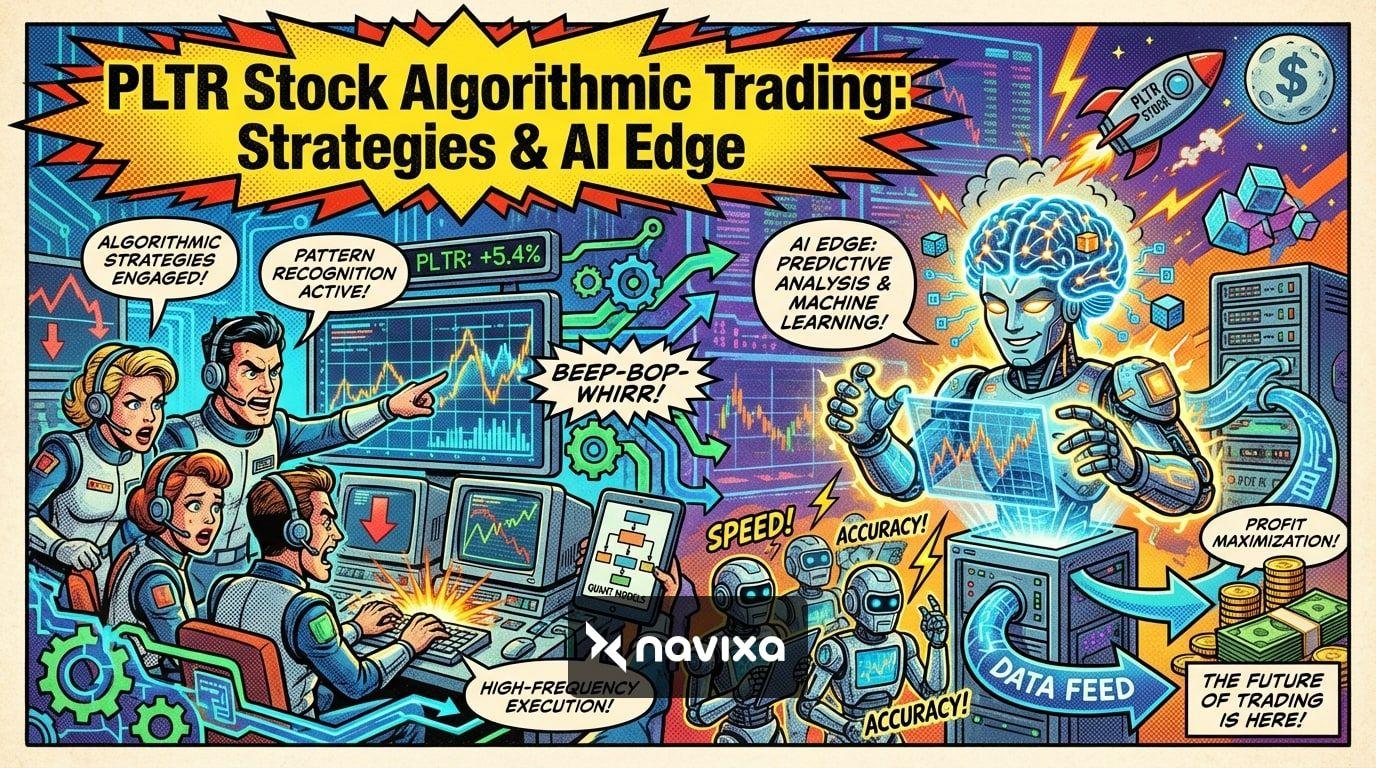
The intersection of artificial intelligence and modern financial markets has birthed a new era of quantitative analysis, and few equities embody this transformation quite like Palantir Technologies. For modern retail and institutional quants, mastering PLTR stock algorithmic trading has become a highly sought-after pursuit. As a company that actively builds the foundational AI architecture for governments and global enterprises, Palantir's market behavior is deeply intertwined with the broader artificial intelligence hype cycle.
Trading Palantir (PLTR) is essentially trading the AI revolution itself. The stock exhibits immense volatility, driven by both retail enthusiasm and massive institutional shifts. In recent market cycles, we have witnessed PLTR's share price rally aggressively on the back of blockbuster earnings, only to undergo sharp, rapid corrections. This high-beta environment—characterized by massive daily trading volumes and sudden catalyst-driven swings—creates the perfect playground for algorithmic trading systems.
In this comprehensive guide, we will explore the fundamental reasons why PLTR is an ideal candidate for quantitative trading. We will break down actionable strategies—ranging from mean reversion to sentiment analysis—and outline exactly how traders can architect, backtest, and deploy sophisticated algorithms to capture the alpha hidden within Palantir's price action.
Why PLTR Stock is Ideal for Algorithmic Trading
To build a profitable algorithmic trading system, the underlying asset must possess three critical traits: ample liquidity, measurable volatility, and catalyst-driven price action. Palantir scores exceptionally high across all these metrics.
Exceptional Liquidity and Volume
With daily trading volumes routinely exceeding tens of millions of shares, PLTR is highly liquid. For an algorithmic trader, liquidity is paramount. High trading volume ensures tight bid-ask spreads, which significantly reduces slippage—the difference between the expected price of a trade and the price at which it is actually executed. Whether your bot is executing high-frequency scalps or longer-term swing trades, PLTR's deep order book allows algorithms to enter and exit large positions seamlessly without heavily impacting the market price.
High Volatility and Beta
Algorithmic trading relies on price movement. A stagnant stock provides no opportunities for profit. PLTR is notoriously volatile. For instance, after soaring from the mid-$60s to highs above $200, the stock experienced sharp corrections back into the $140–$150 range. This massive variance is exactly what quantitative models feed on. High-beta stocks like PLTR amplify broader market movements, ensuring that momentum and mean-reversion algorithms have enough price displacement to capture meaningful profits.
Catalyst-Driven Movements
Palantir's business model is structured around securing massive, multi-year contracts with entities like the U.S. military (e.g., the Maven AI system) and commercial giants (e.g., their expanding partnership with Stellantis). These announcements act as powerful catalysts. Because algorithmic bots can scrape and process news data in milliseconds, they hold a distinct advantage over manual traders when reacting to these sudden fundamental shifts.
Core PLTR Stock Algorithmic Trading Strategies
Designing an algorithm for PLTR requires choosing a mathematical logic that aligns with the stock's unique personality. Below are some of the most effective quantitative strategies utilized by algorithmic traders in the tech sector.
Momentum and Trend Following
When PLTR catches a bid—often fueled by a new commercial contract for its Artificial Intelligence Platform (AIP)—the resulting trend can last for several days or weeks. Momentum algorithms are designed to identify the start of these trends and ride them until exhaustion.
Quants typically use a combination of Moving Averages (such as the 50-day and 200-day SMA crossovers, known as Golden or Death Crosses) and the Average Directional Index (ADX) to confirm the strength of a trend.
"The trend is your algorithm's best friend. In high-beta tech stocks, early identification of momentum shifts often yields the highest risk-adjusted returns."
An algorithm might be programmed to buy PLTR when its 10-day Exponential Moving Average (EMA) crosses above the 21-day EMA, provided the trading volume is at least 150% of the 30-day average. The position is held until a reverse crossover occurs.
Statistical Arbitrage and Mean Reversion
Because PLTR attracts significant retail attention, it frequently overshoots its intrinsic valuation during hype cycles, only to snap back to its historical mean. Mean reversion algorithms capitalize on these overreactions.
Using indicators like the Relative Strength Index (RSI) and Bollinger Bands, an algorithm can identify when PLTR is mathematically overbought or oversold. If PLTR's RSI spikes above 80 (indicating severe overbought conditions) and the price pierces the upper Bollinger Band, the algorithm can automatically execute a short position or buy put options, betting that the price will revert to its 20-day simple moving average.
Natural Language Processing (NLP) Sentiment Trading
Given that Palantir's stock is highly sensitive to news regarding government contracts, global conflicts, and commercial AI adoption, NLP algorithms provide a massive edge.
Instead of relying solely on price and volume data, sentiment algorithms scrape financial news feeds, SEC filings, and platforms like X (formerly Twitter). Using machine learning models like FinBERT, the algorithm assigns a sentiment score (from -1 to 1) to incoming news regarding Palantir. If a press release announces a "billion-dollar AIP expansion," the NLP bot detects the highly positive sentiment and executes a long order milliseconds before human traders can even read the headline.
Actionable Steps: Building Your PLTR Trading Bot
Transitioning from theory to a live trading algorithm involves a systematic approach to data, backtesting, and execution.
Step 1: Data Acquisition
An algorithm is only as good as the data it consumes. You need high-quality historical tick data to backtest your strategies. Many traders use APIs provided by platforms like Alpaca Trading API or Interactive Brokers to pull real-time and historical price, volume, and order-book data. For PLTR, you will want to gather at least 3-5 years of historical minute-by-minute data to properly train your quantitative models.
Step 2: Designing the Logic and Backtesting
Using programming languages like Python and libraries such as Pandas and scikit-learn, you can code the logic of your strategy. Once coded, the strategy must be rigorously backtested against PLTR's historical data.
Backtesting reveals how your algorithm would have performed during Palantir's massive run-ups and severe drawdowns. Pay close attention to metrics like the Sharpe Ratio (risk-adjusted return) and the Maximum Drawdown. Ensure you factor in trading commissions and slippage; what looks profitable on a spreadsheet can quickly turn negative in a live market.
Step 3: Paper Trading and Live Execution
Before risking real capital, deploy your algorithm in a paper-trading environment. This simulated live market will help you identify bugs in your code, API latency issues, or flaws in execution logic. Once the algorithm proves consistent and stable, you can transition to live trading, starting with small position sizes.
Manual vs. Algorithmic Trading for PLTR
To fully understand the advantage of automating your PLTR trading, let's compare algorithmic trading directly against manual discretionary trading.
| Feature | Algorithmic Trading | Manual Discretionary Trading |
|---|---|---|
| Execution Speed | Milliseconds; reacts instantly to market data and news. | Seconds to minutes; relies on human reaction time. |
| Emotional Bias | Zero. Executes strictly based on mathematical logic. | High. Susceptible to FOMO and panic selling during PLTR swings. |
| Data Processing | Can analyze thousands of variables, including NLP sentiment, concurrently. | Limited to what the trader can read and interpret on a few charts. |
| Monitoring | Runs 24/5 without fatigue, capturing pre-market and after-hours moves. | Requires constant screen time, leading to trader burnout. |
| Risk Management | Stop-losses and position sizing are strictly and instantly enforced. | Stop-losses are often ignored or manually moved due to hope/fear. |
Risk Management in PLTR Algorithmic Trading
While automation offers significant advantages, PLTR stock algorithmic trading carries inherent risks. A poorly coded bot can execute hundreds of losing trades in a matter of seconds. Robust risk management protocols are absolutely non-negotiable.
Dynamic Position Sizing
Never allow an algorithm to allocate your entire portfolio into a single trade. Implement volatility-adjusted position sizing, such as sizing trades based on the Average True Range (ATR). If PLTR's volatility spikes (meaning wider price swings), the algorithm should automatically reduce the position size to maintain a constant risk profile.
Hard Circuit Breakers and Stop-Losses
Flash crashes and API errors happen. Your algorithm must have "circuit breakers" hard-coded into its architecture. For example, if the bot experiences three consecutive losses or the portfolio drops by 2% in a single day, it should automatically halt all trading activities and send an alert to your phone. Additionally, every single entry order must be paired with an immediate, non-cancelable stop-loss order.
Avoiding the Trap of Overfitting
When backtesting, it is tempting to tweak the algorithm's parameters until it shows a perfect profit curve on historical data. This is known as overfitting. An overfitted model performs brilliantly in the past but fails miserably in real, live market conditions because it has memorized historical noise rather than identifying true market patterns. Always test your algorithm on out-of-sample data before going live.
Practical Takeaways
* Exploit the Beta: Use PLTR's high volatility to your advantage by deploying mean-reversion and momentum-based algorithms. * Integrate Alternative Data: Relying solely on technical indicators is no longer enough. Incorporate NLP sentiment analysis to trade on AI platform updates, defense contracts, and earnings announcements. * Test Relentlessly: Never deploy a live algorithm without rigorous backtesting across multiple years of Palantir's price history and extensive paper trading. * Automate Risk: Hard-code your maximum drawdowns, daily loss limits, and ATR-based position sizing directly into your bot's logic.
Conclusion
The landscape of the stock market is shifting, and AI-centric equities require AI-centric trading strategies. PLTR stock algorithmic trading offers a distinct pathway to strip human emotion out of a highly emotional asset. By leveraging programmatic execution, quantitative technical analysis, and real-time sentiment data, traders can position themselves to capitalize on Palantir's explosive market movements.
Whether you are an institutional quant building complex statistical arbitrage models or a retail trader using Python to automate momentum crossovers, the key to long-term success lies in robust backtesting and ironclad risk management. The tools to build these systems are more accessible than ever—now is the time to start coding your edge. To learn more about Palantir's underlying AI architecture that drives these market moves, you can explore the official Palantir Technologies website.
Frequently Asked Questions
Is PLTR stock good for algorithmic day trading?
Yes, PLTR is highly suitable for algorithmic day trading. Its combination of high daily volume, deep liquidity, and high volatility (beta) ensures that algorithms can easily enter and exit positions with minimal slippage while capturing meaningful intraday price swings.
How do AI developments affect PLTR stock algorithmic trading?
News regarding Palantir's Artificial Intelligence Platform (AIP) adoption directly impacts the stock's price action. Algorithms equipped with Natural Language Processing (NLP) can instantly scan news headlines for AI-related keywords, allowing the bot to execute trades based on positive or negative sentiment before the broader market reacts.
What programming languages are best for building trading bots?
Python is the industry standard for algorithmic trading due to its vast ecosystem of data science libraries, such as Pandas for data manipulation, scikit-learn for machine learning, and various API wrappers for seamless broker integration. C++ is also used by institutions for ultra-high-frequency trading where microsecond latency matters.
Can retail traders compete with institutional algorithms on PLTR?
While retail traders cannot compete with the ultra-low latency (speed) of institutional high-frequency trading firms, they can absolutely compete on strategy. By focusing on longer timeframes, swing-trading momentum algorithms, and alternative data sources (like social media sentiment), retail quants can carve out highly profitable niches in PLTR.