
Introduction
Microsoft Corporation (NASDAQ: MSFT) sits at the core of the digital economy, dominating cloud computing, productivity software, and artificial intelligence infrastructure. With the recent rollouts of its Maia 200 AI inference chip and the continued acceleration of Azure AI workloads, MSFT has become a bellwether for tech-driven market movements. For traders, this translates to massive liquidity, tight spreads, and multi-timeframe opportunities.
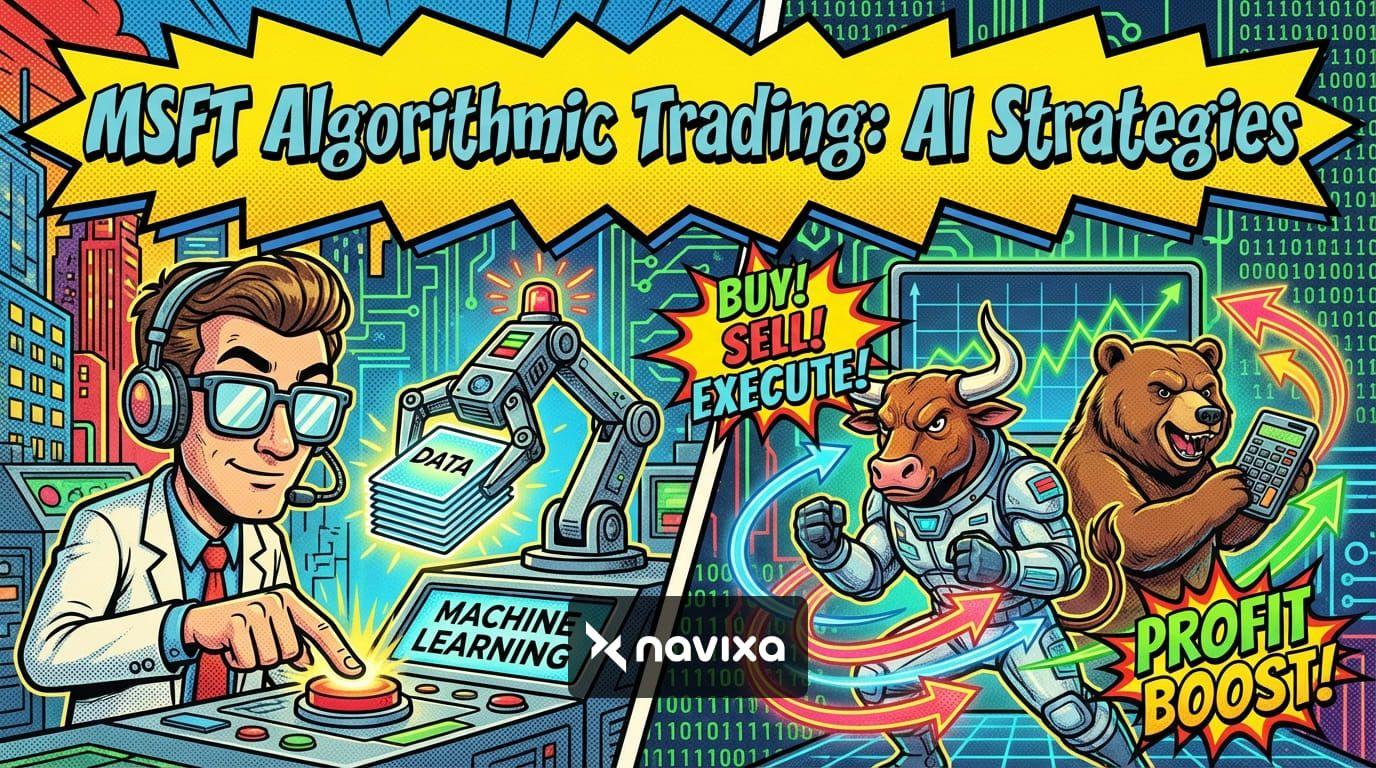
However, manually trading a stock so heavily influenced by macroeconomics, high-frequency institutional algorithms, and split-second news cycles is becoming increasingly difficult. Enter MSFT algorithmic trading. By leveraging artificial intelligence (AI) and machine learning, traders can deploy highly systematic, rules-based strategies that capture alpha while strictly managing risk.
In this comprehensive guide, we will explore the cutting-edge AI strategies powering MSFT algorithmic trading, delve into the technical analysis frameworks required to build robust models, and provide actionable steps to automate your Microsoft stock execution.
Why Microsoft (MSFT) is Prime for Algorithmic Trading
Algorithmic trading is the systematic execution of rules-based strategies using code, market data, and risk engines. When it comes to large-cap tech stocks, Microsoft is arguably one of the most attractive assets for algorithmic systems.
First, MSFT offers unmatched liquidity. Algorithms rely on tight bid-ask spreads and deep market depth to execute orders without significant slippage. Because Microsoft is heavily traded by both retail and institutional investors, algorithms can scale in and out of positions in milliseconds.
Second, Microsoft's price action is heavily driven by clear catalysts. Earnings reports, dividend dates, and product announcements—such as updates to Microsoft 365 Copilot or the deployment of new AI infrastructure—create predictable volatility clusters. An algorithmic system can ingest corporate event feeds and alternative data to trade these volatility spikes faster than a human ever could.
"Automated trading strategies for MSFT typically reduce drawdowns while improving Sharpe ratios, especially when combining momentum and mean reversion with AI filters."
Core AI Strategies for MSFT Algorithmic Trading
The most sophisticated trading algorithms have moved beyond simple moving average crossovers. Today, AI-powered systems utilize vast amounts of computing power to analyze data and predict price action. Here are the core AI strategies utilized in modern MSFT algorithmic trading.
Machine Learning and Predictive Modeling
Advanced algorithmic systems use machine learning models, such as XGBoost or Long Short-Term Memory (LSTM) neural networks, to predict the future price direction of MSFT. These models analyze years of historical tick-by-tick data, order book depth, and options chain activities.
Instead of relying on a single technical indicator, a machine learning model assigns dynamic weights to hundreds of variables. For example, if MSFT is approaching a resistance level, the AI model might analyze the current options volume and order book imbalances to calculate a probabilistic forecast of whether the stock will break out or face rejection.
Financial Sentiment Analysis via LLMs
In the era of AI, sentiment is just as important as technical data. Algorithmic systems now incorporate Large Language Models (LLMs) and specialized tools like FinBERT to monitor financial news, social media sentiment, and earnings call transcripts in real-time.
If a news outlet drops an article about Microsoft securing a massive new Azure contract or outperforming competitors with its in-house AI chips, the sentiment algorithm instantly categorizes the news as highly bullish. The trading bot can then execute a long position before the broader market has fully priced in the news.
Regime-Adaptive Hybrid Systems
A major flaw of traditional algorithmic trading is the failure to adapt to changing market conditions. A trend-following strategy works perfectly during a bull run but suffers massive drawdowns during a sideways, choppy market.
AI solves this through regime-adaptive hybrid systems. By using machine learning to detect the current "market regime" (e.g., high-volatility downtrend vs. low-volatility uptrend), the algorithm dynamically switches its underlying logic. It might use MACD and Exponential Moving Averages (EMA) during a strong trend, but automatically pivot to Relative Strength Index (RSI) mean-reversion tactics when the stock enters a consolidation phase.
Essential Technical Indicators for Your MSFT Algo
While AI provides the overarching brain of the operation, technical indicators remain the foundational building blocks for signal generation. A robust MSFT algorithmic trading setup will typically integrate the following:
1. Exponential Moving Average (EMA): The 50-day and 200-day EMAs are critical for establishing the macro trend. Algorithms frequently look for "Golden Cross" or "Death Cross" events as foundational filters before executing smaller timeframe trades. 2. Relative Strength Index (RSI): This momentum oscillator measures the speed and change of price movements. Algorithms often buy MSFT when the daily RSI drops below 30 (indicating oversold conditions) and sell when it crosses above 70. 3. Moving Average Convergence Divergence (MACD): Used to capture directional momentum. An AI algorithm might use MACD crossovers to time entries during temporary market weaknesses. 4. Bollinger Bands: Excellent for mean-reversion strategies. Algorithms can fade extreme moves by selling when MSFT touches the upper band and buying at the lower band, provided the overall AI sentiment filter agrees.
Structuring Your MSFT Algorithmic Trading System
Building a profitable algorithmic trading system requires a systematic approach. You cannot simply plug a bot into an exchange and expect passive income. The architecture of a professional setup usually involves four distinct layers:
1. Data Ingestion
Your algorithm is only as good as the data it consumes. You need reliable APIs to feed real-time pricing, historical datasets, and news feeds into your system. Ensuring low-latency data capture is vital for avoiding execution delays.
2. Signal Generation
This is where the AI and technical indicators live. The signal generator processes the incoming data, applies your trading rules (e.g., buying when MSFT drops 3% below its 20-day moving average), and decides whether to output a buy, sell, or hold command.
3. Execution and Routing
Once a signal is generated, the system must execute the trade. Multi-broker orchestration allows algorithms to route Microsoft trades across multiple venues to find optimal execution prices, comparing fills between different platforms to reduce slippage.
4. Risk Management
Perhaps the most crucial layer. The risk engine enforces position sizing limits, stop-losses, and maximum drawdown controls. It ensures that a single bad trade does not wipe out your portfolio.
Comparison of Algorithmic Trading Approaches
Understanding which strategy fits your risk tolerance and technical expertise is critical. Below is a comparison of common algorithmic approaches used for trading Microsoft stock.
| Strategy Type | Core Mechanism | Best Market Condition | Risk Level |
|---|---|---|---|
| Trend-Following | EMA/MACD Crossovers | Strong Bull/Bear Trends | Medium |
| Mean Reversion | RSI, Bollinger Bands | Sideways/Range-bound | Medium |
| Sentiment-Driven | NLP/LLM News Parsing | High-Volatility/News Heavy | High |
| High-Frequency (HFT) | Arbitrage, Microstructure | High Liquidity/Tight Spreads | Low (per trade) |
| Options Spread Algos | Automated Bull Call Spreads | Directional with Volatility | Medium |
Advanced Risk Management in AI Trading
Deploying an MSFT algorithmic trading bot without strict risk parameters is a recipe for disaster. The stock market is inherently unpredictable, and even the most advanced machine learning models can be blindsided by black swan events or sudden macroeconomic shifts.
To safeguard your capital, your algorithm must include:
* Dynamic Position Sizing: The algorithm should adjust the size of its trades based on current market volatility (e.g., reducing position sizes when the VIX spikes above 20). * Hard Stop-Losses: Never let a trade run infinitely against you. Set strict percentage-based or volatility-based stop-losses. * Time-Based Exits: If a trade does not move in your favor within a specified timeframe, the algorithm should automatically close the position to free up capital. * System Kill Switches: In the event of an API failure, a flash crash, or erratic bot behavior, you need an automated mechanism that halts all trading instantly.
Practical Takeaways for Automating MSFT Trades
Ready to integrate AI into your trading routine? Here are the actionable steps to get started:
* Define Your Edge: Decide whether you want to capture intraday momentum, swing trade earnings gaps, or utilize options strategies like automated bull call spreads. * Choose the Right Platform: If you lack coding experience, leverage platforms like Coinrule Automated Trading or Vestinda, which offer pre-built templates specifically calibrated for stock market dynamics. If you are a developer, Python libraries like Backtrader paired with the Alpaca Trading API provide ultimate flexibility. * Backtest Rigorously: Before risking real money, backtest your strategy against years of historical MSFT data. Ensure your system survives various market cycles, including tech sell-offs and bull runs. * Paper Trade: Run your algorithm in a simulated live environment to ensure the execution logic works exactly as intended without slippage or latency issues. * Monitor and Optimize: AI models require continuous training. Regularly review your bot's performance and adjust parameters to maintain your edge.
Frequently Asked Questions
Can I use AI to trade MSFT automatically?
Yes. By connecting algorithmic trading platforms or custom Python scripts to a broker's API, you can fully automate your trading. These systems use AI to analyze market data, generate signals, and execute trades without manual intervention.
What are the best technical indicators for Microsoft stock algorithms?
The most effective indicators depend on the strategy. However, a combination of Exponential Moving Averages (EMA) for trend identification, Relative Strength Index (RSI) for mean reversion, and MACD for momentum are widely considered the foundational indicators for MSFT algos.
How does sentiment analysis improve MSFT algorithmic trading?
Sentiment analysis uses Large Language Models (LLMs) to read and interpret news headlines, earnings reports, and social media. This allows the algorithm to react instantly to market-moving news—such as the announcement of new AI chips or cloud revenue growth—before traditional technical indicators even register a change in price.
Do I need to know how to code to start algorithmic trading?
Not necessarily. While coding in Python offers the most customization for advanced machine learning models, there are numerous no-code platforms available today. These platforms allow you to build rules-based strategies using intuitive drag-and-drop interfaces.
Conclusion
The landscape of the stock market is evolving rapidly, and the dominance of high-frequency algorithms is impossible to ignore. For traders looking to capitalize on the massive liquidity and growth of Microsoft, adopting an MSFT algorithmic trading approach is no longer just an advantage—it is a necessity.
By integrating machine learning models for predictive analysis, LLMs for sentiment tracking, and robust technical indicators for signal generation, you can build a regime-adaptive system that thrives in any market condition. Remember, the key to long-term success lies in strict risk management, continuous optimization, and rigorous backtesting.
Take the first step today: design your strategy, set up a paper trading account, and watch how AI can transform your approach to the markets.