The intersection of decentralized blockchain networks and artificial intelligence has created one of the most explosive financial narratives in the digital asset market. If you want to successfully trade AI crypto tokens, you must understand both the underlying technology driving these networks and the extreme volatility that characterizes their market cycles.
As artificial intelligence reshapes traditional industries, decentralized alternatives are emerging to offer permissionless compute power, decentralized machine learning, and autonomous agent networks. Navigating this sector requires a different playbook than trading legacy cryptocurrencies like Bitcoin or Ethereum.
This comprehensive guide will show you exactly how to trade AI crypto tokens, from understanding the core fundamentals to executing advanced technical strategies.
Understanding the Landscape of AI Crypto Tokens
Before you risk your capital, it is crucial to understand what you are actually buying and selling. AI crypto tokens represent the economic layer of decentralized artificial intelligence networks. They incentivize hardware providers, data scientists, and developers to contribute resources to a shared network.
The Evolution of the AI Narrative
The initial hype around AI tokens was largely driven by mainstream technological breakthroughs, such as the release of advanced large language models (LLMs). However, the market has rapidly matured. We are now seeing tangible utility, structural network upgrades, and significant ecosystem consolidations.
For example, the historic token merger that formed the Artificial Superintelligence (ASI) Alliance brought together Fetch.ai (FET), SingularityNET (AGIX), and Ocean Protocol (OCEAN) into a unified economic layer. This kind of consolidation reduces ecosystem fragmentation and creates massive liquidity pools, but it also creates unique trading opportunities based on conversion ratios and migration timelines.
Key Categories of AI Projects
To trade AI crypto tokens effectively, you should categorize them by their utility:
* Decentralized Compute Networks: Projects like Render (RENDER) and Akash Network (AKT) focus on crowd-sourcing GPU computing power, which is essential for training and running complex AI models. * Autonomous AI Agents: Networks utilizing assets from the ASI alliance allow developers to build autonomous software agents that can negotiate, trade, and execute tasks on behalf of users. * Decentralized Machine Learning: Bittensor (TAO) operates as an open-source protocol that powers decentralized, blockchain-based machine learning networks, creating a peer-to-peer intelligence market. * Data Provenance and Verification: As AI-generated content floods the internet, tokens associated with data verification, identity, and origin tracking are becoming highly sought after by institutional players.
How to Trade AI Crypto Tokens: A Step-by-Step Framework
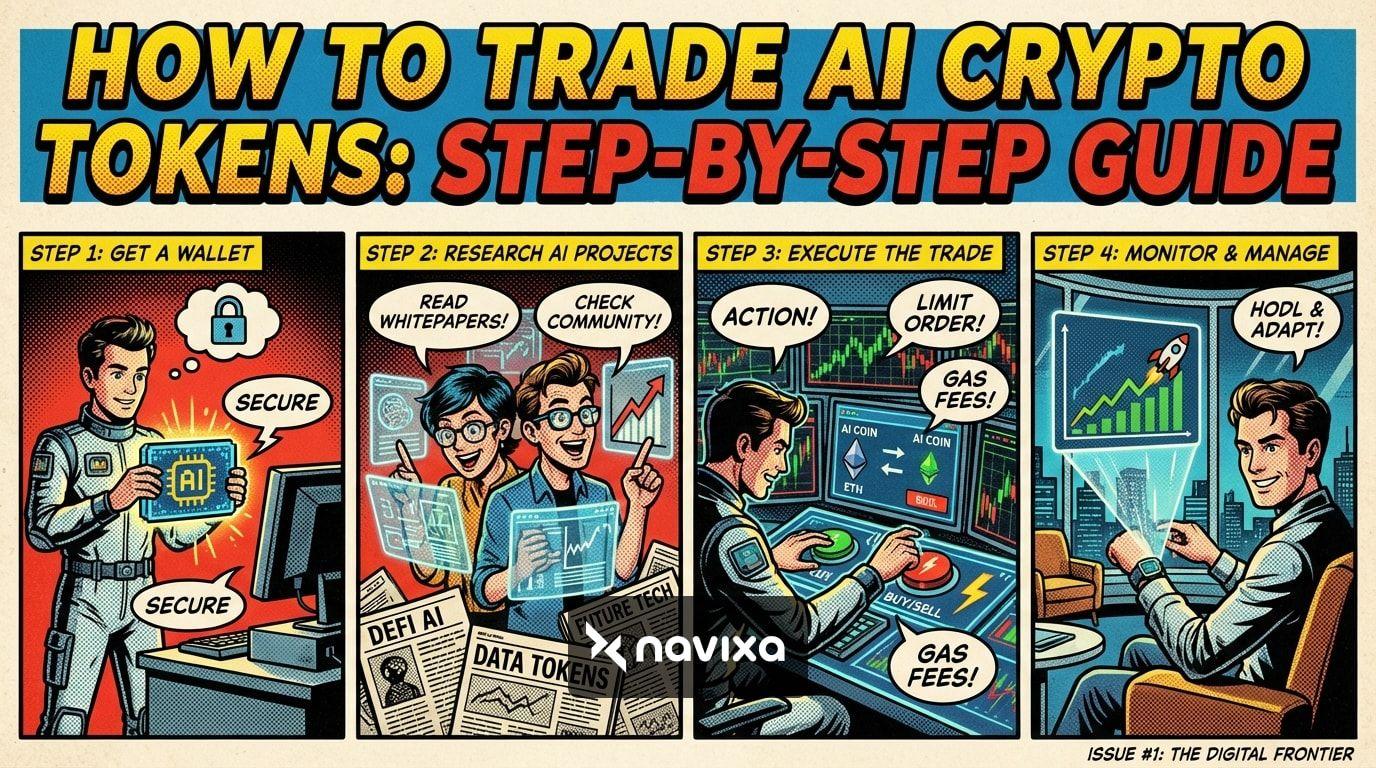
If you are ready to enter the market, you need a systematic approach. The volatility of AI tokens can be unforgiving to unprepared traders. Follow these steps to build a resilient trading routine.
Step 1: Choose the Right Trading Platform
Liquidity is paramount when you trade AI crypto tokens. You must select an exchange that offers deep order books and multiple trading pairs.
Centralized exchanges (CEXs) generally provide the best liquidity and the most advanced trading interfaces for large-cap AI tokens. Look for platforms that support advanced order types, such as trailing stop-losses and OCO (One-Cancels-the-Other) orders. If you are trading smaller, emerging AI tokens, you may need to utilize decentralized exchanges (DEXs) like Uniswap or Raydium, depending on the project's native blockchain.
Step 2: Conduct Thorough Market Analysis
Successful trading relies on a blend of fundamental and technical analysis.
Fundamental Analysis: Monitor project GitHub repositories, development updates, and major enterprise partnerships. For AI tokens, tracking the broader artificial intelligence industry is just as important. Announcements from traditional tech giants often trigger algorithmic and speculative bidding in the AI crypto sector. You can track overall market capitalization and volume metrics through data aggregators like CoinMarketCap AI Tokens.
Technical Analysis: Because AI tokens often experience parabolic rallies, momentum indicators are highly effective. Utilize the Relative Strength Index (RSI) to identify overbought or oversold conditions, and use the Moving Average Convergence Divergence (MACD) to confirm trend reversals on higher timeframes.
Step 3: Define Your Entry and Exit Parameters
Never enter a trade without a clear plan. Before executing a buy order, you should know exactly where you will take profits and where you will cut your losses.
"The difference between a successful trader and a gambler is a predefined exit strategy. In the high-beta world of AI crypto tokens, a strict exit plan is your only defense against sudden market corrections."
If you are swing trading an AI token leading up to a major mainnet upgrade or a token merger, plan to scale out of your position as the event date approaches. "Buy the rumor, sell the news" remains a persistent dynamic in the digital asset space.
Step 4: Execute Your Trade and Secure Your Assets
Once your parameters are set, execute your order. If you are building a long-term position, consider using a dollar-cost averaging (DCA) strategy to mitigate the impact of short-term volatility.
If you do not plan to actively day trade your tokens, move them off the exchange and into a secure, non-custodial hardware wallet. For ecosystem-specific assets, ensure you are interacting with verified smart contracts, especially when bridging or staking your assets on decentralized platforms.
Proven Trading Strategies for the AI Sector
To consistently profit when you trade AI crypto tokens, you must deploy strategies tailored to their unique market behavior.
The Momentum Breakout Strategy
AI tokens are notorious for aggressive, high-volume breakouts. A momentum breakout strategy involves identifying key resistance levels on a high timeframe (such as the daily or weekly chart). When the token breaks above this resistance with a significant increase in trading volume, you enter a long position.
To filter out false breakouts, wait for a daily candle close above the resistance line, or look for a successful retest of the broken resistance level turning into support before deploying your capital.
Trading Network Catalysts and Mergers
Structural events, such as ecosystem consolidations, create distinct arbitrage and swing trading windows. By studying the fixed conversion ratios and the migration timelines established by leading entities like the Fetch.ai Foundation, traders can identify mispricings between legacy tokens and newly unified assets.
Furthermore, network testnet launches and mainnet integrations frequently serve as bullish catalysts. Smart traders build positions weeks ahead of these scheduled updates and scale out as retail liquidity enters the market during the actual announcement.
Correlation Trading with Legacy Tech
Interestingly, AI crypto tokens often exhibit a strong correlation with the stock performance of traditional AI hardware manufacturers and software developers. If a major semiconductor manufacturer reports earnings that heavily beat expectations due to AI chip demand, decentralized compute tokens often experience an immediate, sympathetic price pump. Monitoring traditional financial markets can provide a massive edge in anticipating crypto market movements.
Comparing Top AI Crypto Assets
When deciding which assets to include in your portfolio, comparing their core utility, target market, and tokenomics is essential. Below is a comparative overview of some leading AI-focused networks.
| Token Asset | Core Utility Focus | Network Infrastructure | Volatility Profile |
|---|---|---|---|
| ASI (Alliance) | Unified AI economy, autonomous agents, data sharing | Multi-chain (Ethereum, Native L1) | Moderate to High |
| TAO (Bittensor) | Decentralized machine learning models and subnets | Substrate-based | Very High |
| RENDER (Render) | Distributed GPU rendering and compute power | Solana | Moderate |
| WLD (Worldcoin) | Proof of personhood, AI identity verification | Optimism (Ethereum L2) | High |
Essential Risk Management: Protecting Your Capital
Trading volatile assets requires strict adherence to risk management principles. Without them, even the most accurate market analysis will eventually lead to catastrophic losses.
Position Sizing
Never allocate your entire portfolio to a single AI token. A standard rule of thumb is to risk no more than 1% to 2% of your total trading capital on a single trade setup. This ensures that a string of losing trades will not drain your account, allowing you to stay in the game long enough to capture the massive upside moves characteristic of the AI sector.
Implementing Hard Stop-Losses
A stop-loss order automatically sells your asset when it reaches a certain price, capping your downside risk. When you trade AI crypto tokens, you must place your stop-losses strategically. Because these assets are highly volatile, placing a stop-loss too tight will result in you being forced out of your position during normal market fluctuations. Place stop-losses below major support zones or dynamic moving averages.
Taking Profits into Strength
Greed is the downfall of many crypto traders. When an AI token rallies 50% or 100% in a matter of days, it is mathematically prudent to take partial profits. By selling a portion of your position to recover your initial investment, you create a risk-free trade. You can leave the remaining tokens to ride the trend, securing peace of mind and locked-in capital.
Practical Takeaways for Modern Traders
* Stay Updated on Tech Developments: AI is moving at lightning speed. Follow the core developers and network architects, not just cryptocurrency influencers. * Understand Tokenomics: Always check the circulating supply versus the fully diluted valuation (FDV). High FDV tokens with upcoming massive unlocks can face severe downward price pressure. * Use Multi-Timeframe Analysis: Determine the overall trend on the weekly chart, find your key levels on the daily chart, and execute your entries on the 1-hour or 4-hour charts. * Never FOMO (Fear Of Missing Out): If an AI token has already gone parabolic, wait for a natural pullback or consolidation phase before entering. Chasing green candles is a proven way to lose your trading capital.
Conclusion
Learning how to trade AI crypto tokens is one of the most lucrative skills you can develop in the current digital asset market. By combining a deep understanding of decentralized artificial intelligence with rigorous technical analysis and unwavering risk management, you can navigate this high-growth sector with confidence.
The convergence of AI and blockchain is not a fleeting trend; it is a fundamental shift in how compute power, data, and machine learning models are distributed globally. Take the time to study the networks, respect the volatility, and execute your trading plans with discipline. Start small, refine your strategy, and position yourself to capitalize on the financial revolution of decentralized artificial intelligence.
Frequently Asked Questions
What drives the price of AI crypto tokens?
The price of AI crypto tokens is heavily influenced by a combination of network utility, ecosystem developments, and broader sentiment in the traditional artificial intelligence sector. Breakthroughs in mainstream AI technology, high-profile tech earnings, and major network upgrades or token mergers act as massive price catalysts.
Is it better to hold or actively trade AI crypto tokens?
This depends entirely on your financial goals and risk tolerance. Actively trading allows you to capitalize on the sector's extreme short-term volatility and compound your gains. However, holding fundamentally strong AI tokens through market cycles can also be highly rewarding, provided you are willing to withstand deep drawdowns during bear markets. Many modern investors use a hybrid approach: holding a core position while actively trading a smaller portion of their portfolio.
How does a token merger affect my holdings?
When a token merger occurs, such as the consolidation of legacy tokens into the unified ASI ecosystem, existing holders typically transition their assets based on a fixed, mathematically verified conversion ratio. If your tokens are held on a major centralized exchange, this process is usually handled automatically. If you hold them in a self-custodial wallet, you will need to utilize the project's official migration portal to swap your legacy tokens for the new unified asset.
Which technical indicators work best for AI tokens?
Because AI tokens are prone to massive momentum shifts, trend-following and momentum indicators are highly effective. The Relative Strength Index (RSI) helps identify overextended rallies, while the Moving Average Convergence Divergence (MACD) is excellent for spotting shifts in structural momentum. Additionally, Volume Profile analysis can help you identify strong areas of historical support and resistance where algorithmic trading bots are likely to execute.