
In the hyper-accelerated world of cryptocurrency, speed is the ultimate asset. While institutional investors battle over microseconds in execution, retail traders face a different hurdle: information lag. By the time a sudden price spike registers on a traditional candlestick chart or aggregator site, the optimal entry window has often already closed. This is where Grok AI crypto trading strategies are fundamentally changing the landscape, allowing savvy market participants to front-run lagging technical indicators.
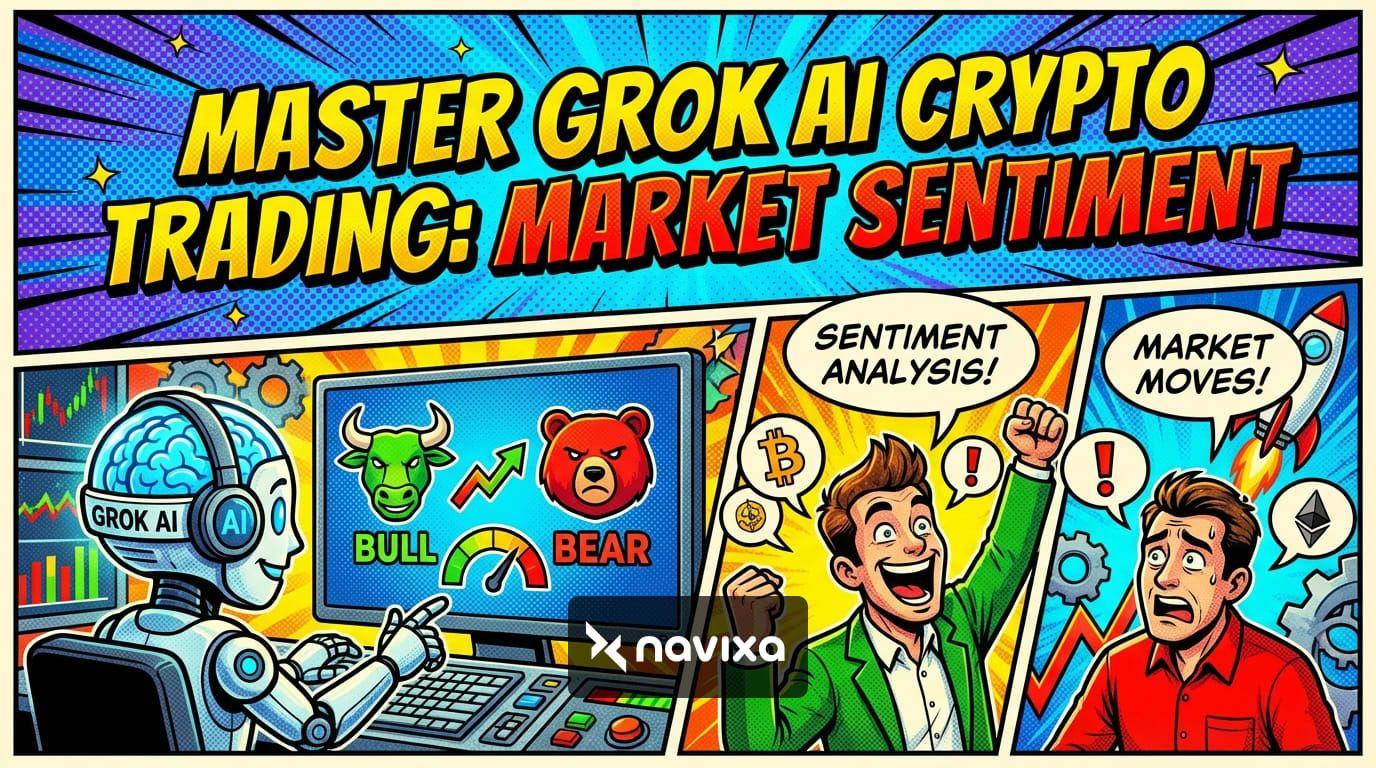
Developed by Elon Musk's xAI, Grok is an artificial intelligence model built directly into X (formerly Twitter) that actively monitors real-time conversations, hashtags, and trends to detect sentiment shifts before price action follows. Because cryptocurrency markets are notoriously driven by emotion—oscillating wildly between irrational exuberance and sheer panic—having a tool that can instantly parse millions of posts to pick up on sudden shifts in hype or fear gives traders an unprecedented edge.
This comprehensive guide will explore how modern traders are abandoning purely reactive technical analysis in favor of predictive sentiment monitoring. We will break down exactly how to use Grok AI to spot early market signals, formulate robust trading setups, and avoid the dangerous pitfalls of algorithmic trading illusions.
The Evolution of Crypto Market Sentiment
Historically, traders relied heavily on lagging technical indicators like the Relative Strength Index (RSI), Moving Average Convergence Divergence (MACD), and Bollinger Bands. While these tools remain critical for confirming trends and measuring historical momentum, they suffer from a fatal flaw in the modern Web3 era: they only tell you what has already happened.
"In cryptocurrency, the narrative often precedes the chart. By the time trading volume confirms a breakout, the smart money has already positioned itself."
With the continuous rise of memecoins, decentralized finance (DeFi) protocols, and highly speculative altcoins, price action is increasingly dictated by social media velocity rather than pure underlying utility. A single viral post, a cryptic developer update, or a sudden spike in a specific cashtag can ignite massive liquidity flows in a matter of minutes.
Why Social Data is the New Order Book
Traditional order books show market intent, but social data reveals the market's underlying motivation. When thousands of verified accounts suddenly begin discussing a "massive token unlock," a "whale dump," or a "bullish rate cut," the collective psychology of the market begins to shift. Grok AI bridges the gap between raw social noise and actionable trading intelligence. By filtering out basic bot spam and focusing on context, emotional tone, and engagement quality, traders can accurately gauge the organic momentum of an asset before significant capital actually deploys.
Understanding Grok AI Crypto Trading Dynamics
To truly leverage a Grok AI crypto trading system, one must understand the architecture of the tool itself and why it dominates the sentiment analysis sector. Unlike traditional large language models (LLMs) that rely on static, historical datasets, Grok benefits from a direct, unrestricted pipeline to the global town square of X.
Direct Access to the X Firehose
X is the undisputed epicenter of the cryptocurrency industry. It is where founders announce network upgrades, whales debate macroeconomic policy, and retail communities aggressively rally around their favorite digital assets. Grok actively monitors this massive firehose of data, analyzing syntax, slang, and sentiment anomalies in real time,. Whether it is tracking the keyword velocity of specific altcoins or deciphering the sarcasm in a prominent influencer's post, Grok excels at reading the digital room.
SuperGrok and Advanced Tiering in 2026
To maintain an edge in 2026, serious traders have rapidly adopted xAI's tiered subscription models. In March 2026, xAI officially launched SuperGrok, offering a structured paid tier system: SuperGrok Lite at $10/month, the Standard tier at $30/month, and the Heavy tier designed for intensive power users at $300/month. Because free tier users face strict limits on their query volume and feature access,, upgrading to these premium tiers has become virtually mandatory for active day traders. During periods of extreme market volatility, uninterrupted access to real-time scanning prevents a trader from being throttled exactly when critical market shifts are occurring.
Actionable Strategies: Trading the Noise
Integrating AI into your workflow requires more than simply asking a chatbot what token to buy. Successful Grok AI crypto trading relies on highly structured, repeatable strategies that seamlessly isolate alpha signals from background noise.
Spotting Early Momentum and Memecoin Rallies
Memecoins and low-cap altcoins are incredibly sensitive to social volume. A proven strategy involves querying Grok to identify abnormal spikes in token mentions over a condensed timeframe. Sentiment spikes often precede explosive price action.
For example, in March 2024, when Elon Musk tweeted a Pepe meme, the $PEPE coin pumped 12% within minutes and broke key resistance. Grok-style tools caught this rapid spike in mentions instantly, allowing alert traders to enter positions well before the majority of the market reacted,.
Similarly, in the altcoin sector, Grok proved its worth when mentions of the token $ORDI jumped from under 50 to over 400 within a single 24-hour window. Influential traders had begun discussing potential listings, and Grok flagged this "narrative velocity" spike long before the price surged to reflect the incoming attention.
Tracking Macroeconomic Shifts
Cryptocurrency does not exist in a vacuum. It is heavily influenced by global liquidity, inflation data, and regulatory actions. Grok serves as an instantaneous macro-monitor. Traders frequently use Grok to track real-time sentiment around massive macroeconomic events, such as U.S. Consumer Price Index (CPI) releases or Federal Reserve interest rate decisions. When breaking news hits X, Grok synthesizes the prevailing sentiment—such as whether the market interprets a data point as a bullish "risk-on" signal or a bearish "risk-off" panic—allowing a savvy trader to take the correct, profitable side of the resulting volatility.
Grok AI vs. Traditional Crypto Tools
To understand where Grok fits into a comprehensive trading stack, it is helpful to compare it directly against established analytical frameworks.
| Feature | Grok AI | Traditional Indicators (RSI, MACD) | Traditional LLMs (e.g., standard ChatGPT) |
|---|---|---|---|
| Primary Data Source | Real-time X (Twitter) social feeds | Historical price & volume data | Static training data (unless explicitly web-linked) |
| Speed of Signal | Predictive (Pre-price action) | Lagging (Post-price action) | Reflective (Analysis focused) |
| Best Trading Use Case | Catching momentum & narrative shifts | Confirming trends & timing entries | Structuring logic, code, & risk parameters |
| Execution Capability | None (Signal generation only) | None (Chart analysis only) | None (Strategy structuring only) |
A Step-by-Step Blueprint for Execution
A modern AI-assisted trader never relies on a single tool. Instead, they build a localized ecosystem where AI sentiment analysis feeds into technical verification, which is then structured by strict logic engines.
Step 1: Prompting for Sentiment Spikes
The journey begins on X. You must engineer precise prompts to force Grok to deliver quantifiable data rather than vague summaries. Request specific metrics: percentage increases in mentions, the ratio of bullish to bearish vocabulary, and the caliber of the accounts driving the conversation. Avoid broad questions like "Is Bitcoin bullish?" and instead ask, "Scan crypto discussions over the last 4 hours. Which altcoins are seeing a 5x increase in positive mentions from verified accounts, particularly concerning upcoming network upgrades?"
Step 2: Combining Insights with Technical Analysis
Once Grok delivers a compelling sentiment signal (e.g., identifying a surge in $TURBO discussions), you must immediately cross-reference it with on-chain data and price charts using professional platforms like TradingView. If Grok highlights massive bullish sentiment for a token, but the token is simultaneously facing heavy historical resistance on the daily chart with declining actual buying volume, the sentiment might simply represent "exit liquidity" coordination by early investors. Sentiment must always be strictly validated by market mechanics.
Step 3: Leveraging ChatGPT for Trade Structuring
While Grok is the ultimate scout for raw signals, other AI models excel at logistical planning. Many professional developers and traders feed Grok's real-time data directly into ChatGPT to automate and design strict trading plans. You can instruct ChatGPT to process Grok's sentiment alert by calculating your exact position size based on a strict 1% account risk parameter, defining optimal stop-loss levels just below local market support, and establishing staged take-profit targets,. This powerful hand-off between real-time sentiment extraction and cold, mathematical risk management removes human emotion from the equation.
Vital Risk Management and Platform Limitations
As powerful as a Grok AI crypto trading workflow can be, it is fraught with unique risks that can devastate an unprepared portfolio. AI is a highly effective co-pilot, but it is not an autopilot.
The Danger of Coordinated Hype
The greatest vulnerability of a sentiment-based trading model is active manipulation. Crypto markets are rife with coordinated pumping groups and sophisticated bot networks designed to artificially inflate social volume. Grok is intelligent, but it can still struggle to differentiate between genuine, organic momentum and coordinated hype spam. If a token's sentiment suddenly skyrockets, but there is zero corresponding fundamental news verified by reputable aggregator sources like CoinMarketCap, you are likely walking into a trap. Always use volume filters and on-chain verification to ensure the social hype is backed by actual capital.
Execution Hurdles and Microcap Blindspots
Traders must remember that Grok is purely a signal generator—it does not possess trade execution capabilities. It will not protect you from severe market slippage, exchange API failures, or sudden liquidation wicks. Furthermore, while Grok is exceptionally strong at tracking trending narratives and mid-to-large cap assets, it suffers from limited depth when analyzing small altcoins. For niche DeFi tokens or deeply obscure microcaps where the overall community discussion is thin, Grok may return weak, delayed, or entirely irrelevant signals.
Conclusion
The integration of artificial intelligence into retail trading has democratized access to institutional-grade sentiment analysis. A disciplined Grok AI crypto trading strategy empowers traders to front-run lagging technical indicators, capture emerging narratives before they hit the mainstream news, and navigate the volatile waters of cryptocurrency with a distinct informational advantage. However, the true secret to longevity in these markets is synthesis. By pairing Grok's lightning-fast social intelligence with rigorous technical analysis, strict risk management protocols, and structured trade planning, you transition from a reactive gambler into a proactive market operator. Start integrating sentiment scans into your daily routine, refine your prompting skills, and let empirical data—not sheer emotion—dictate your next move.
Frequently Asked Questions
Can Grok AI automatically execute crypto trades for me?
No, Grok AI cannot execute trades. It is a conversational and analytical AI model designed strictly to parse real-time information and gauge market sentiment from social feeds. It does not have API access to cryptocurrency exchanges to execute buy or sell orders, nor can it manage your portfolio. Traders must manually execute trades on their preferred exchange or route Grok's insights through a custom-built automated trading bot that handles the actual market interactions.
How does Grok differ from traditional crypto sentiment tools like the Fear and Greed Index?
Traditional metrics like the Crypto Fear and Greed Index aggregate broad, market-wide data points (like overall volatility, total market momentum, and overarching survey data) to provide a single, delayed daily score. Grok, on the other hand, provides instant, highly granular, and token-specific sentiment analysis by directly decoding the live, second-by-second conversational data, emotional tone, and context flowing through the X platform.
Is Grok AI effective for finding early entries into small, unknown altcoins?
Grok's effectiveness depends heavily on social volume. While it excels at identifying early momentum in trending mid-caps and popular memecoins, it struggles significantly with deep-niche microcaps. If an asset has extremely low visibility or lacks a baseline level of organic community discussion, the data pool is simply too thin, and Grok may return weak or entirely irrelevant signals. Traders focusing on obscure DeFi tokens are better off relying on specialized on-chain analysis tools.
What are the main risks of relying on social sentiment for trading?
The primary risk is artificial market manipulation. The crypto space frequently experiences coordinated bot activity, paid influencer campaigns, and "pump and dump" groups designed to create fake hype around a token. While Grok attempts to parse genuine context, it can occasionally misinterpret orchestrated spam as organic bullish momentum. Therefore, sentiment signals must always be strictly validated by real trading volume and traditional technical analysis.
Do I need a paid subscription to use Grok for crypto trading?
While basic access to Grok 3 exists for free users, xAI implements strict limits on query volume and feature depth. To effectively utilize Grok for high-frequency trading queries without severe interruptions, a premium SuperGrok subscription (such as the Lite, Standard, or Heavy tiers introduced in 2026) is highly recommended. Upgrading ensures uninterrupted, real-time data scanning, which is absolutely crucial during fast-moving, volatile market sessions.