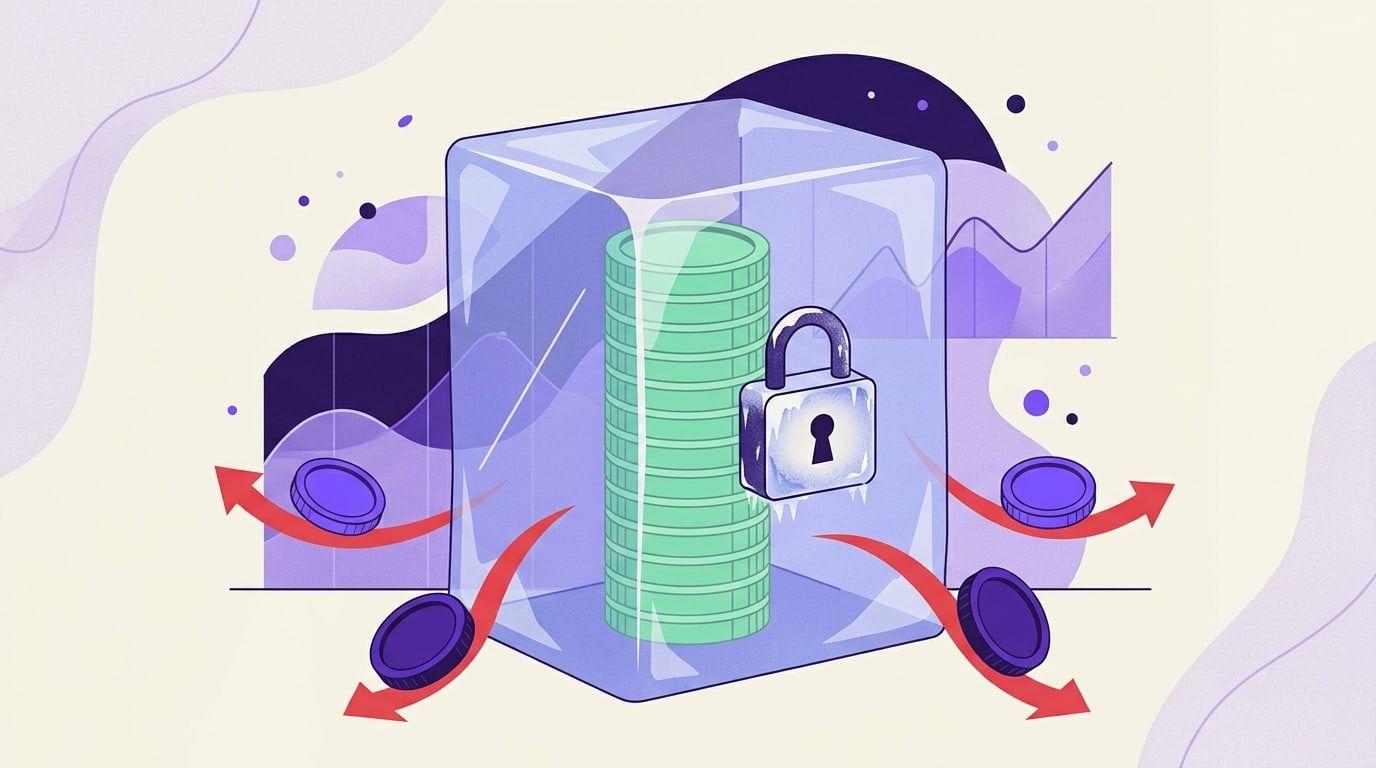
Yes, USDT and USDC can be frozen, and it doesn't matter where they sit. Tether and Circle, the companies that issue them, keep a blocklist inside each token's smart contract. Once an address is on that list, the tokens at that address stop moving, whether the address belongs to an exchange, a MetaMask wallet or a hardware wallet. Bitcoin and ether have no issuer and no such switch.
The theft from Binance on October 29, 2026, the largest crypto theft on record, showed the difference in a single night. By the blockchain analytics firm Elliptic's count, about three quarters of the stolen stablecoins ended up locked, most of it within about an hour of the main drain, while only about 6% of the stolen bitcoin, ether and other coins was.
- USDT and USDC have a blocklist built into their contracts. A blocked address can't send its tokens, wherever they are held.
- In the Binance theft, Tether locked 1.18 billion USDT 37 minutes after it reached the attacker's main wallet, and Circle froze 823 million USDC in the same wallet minutes later.
- About 77% of the stolen stablecoins ended up frozen, against about 6% of everything else, by our split of Elliptic's figures.
- Coins with no issuer, like BTC and ETH, can't be frozen on-chain, which is why the attacker swapped about $786 million of stablecoins into ETH and TRX at a loss.
- Under the US GENIUS Act, which takes effect on January 18, 2027, a permitted stablecoin issuer must be able to carry out court and agency orders to freeze or seize its tokens.
- Freezes target addresses linked to hacks, scams or sanctions, but receiving funds from a flagged address can get you caught. You can check any Ethereum address in a minute.
What happened at Binance
On October 29, 2026, starting at about 20:05 UTC, an attacker drained Binance's hot wallets on 11 blockchains in a few hours. Elliptic counts $6.43 billion stolen; Binance's own estimate is about $6.3 billion. That is more than four times the $1.46 billion taken from Bybit in February 2025, the previous record.
According to Elliptic, no private keys were stolen: the attacker got Binance's own systems to sign the withdrawals. Binance's first account, reported by CoinDesk, pointed to a DevOps engineer's compromised laptop. On October 31 the FBI attributed the theft to TraderTraitor, a North Korean hacking group, Al Jazeera reported. Binance said it would absorb the losses, "not our users", and by that day said it had replaced 90% of the stolen amount with company money. Withdrawals began to reopen on November 1.
For anyone holding stablecoins, the interesting part came after the theft.
How a stablecoin freeze works
USDT and USDC are tokens issued by companies, and their contracts carry admin functions that native coins don't have:
- USDC: Circle's open-source contract code has
blacklist,unBlacklistandisBlacklistedfunctions. A blocked address can neither send nor receive USDC. - USDT: On Ethereum, Tether's contract has
addBlackList,isBlackListedanddestroyBlackFunds. A blocked address can't send USDT, but it can still receive it, so anything sent to it gets stuck too.destroyBlackFundslets Tether burn the frozen balance. - Both can also pause every transfer of the token at once, a switch that exists but is meant for emergencies.
A freeze works per address and per chain: Tether issues USDT on many blockchains, and each version has its own contract and blocklist. In the Binance case Tether froze addresses on both Ethereum and Tron.
Frozen isn't always final. The issuer can lift the block, or, in Tether's case, burn the frozen tokens and issue the same amount to a new address, for example a victim's or a government wallet. In a November 2026 report, The Paypers wrote that Tether says it has frozen more than 7 billion USDT in secondary-market addresses in total, and returned about 1.2 billion USDT to rightful owners and law enforcement through this kind of reissuance.
Who could freeze what in the Binance theft
The theft worked like a stress test of every freeze switch in crypto at once. Based on Elliptic's tracking, last updated on November 1:
| Asset or layer | Who could stop it | What happened |
|---|---|---|
| USDT | Tether | Main attacker wallet frozen 37 minutes after the USDT arrived, locking 1.18 billion USDT; four more addresses within 17 minutes |
| USDC | Circle | 823 million USDC frozen in the same wallet about three minutes later |
| Other stablecoins | Their issuers | Ripple, World Liberty Financial, Paxos and First Digital froze tokens; 48 million RLUSD was sold before Ripple's freeze |
| Exchange-issued tokens | The exchange | Binance froze its own WBETH |
| Some layer-2 networks | Security council or governance | Arbitrum's Security Council moved assets out of reach; Optimism's governance appears to have done the same |
| DeFi lending | Protocol governance | Aave froze its markets: new activity was blocked, but nothing was seized |
| BTC, ETH, XRP, SOL | Nobody | About $3.25 billion stayed with the attacker, spread over more than 800 addresses |
Both Tether CEO Paolo Ardoino and Circle CEO Jeremy Allaire said they were coordinating with law enforcement on the freezes. Counting every address it blocked, Tether put its own total at over 1.5 billion USDT.
The stablecoins got frozen; the rest mostly didn't

Elliptic verified $2.85 billion as frozen or seized, 44% of the theft, and 94% of that was stablecoins. Of the $3.46 billion stolen in stablecoins, about $2.67 billion was locked. Of the $2.97 billion stolen in everything else, only about $0.18 billion was.
The attacker clearly knew the rule. Before the freezes landed, about $786 million of stablecoins was swapped into ETH and TRX. One batch of 434 million USDT bought 160,451 ETH at what Elliptic estimates was 12% to 26% below the market price. Taking that loss was worth it to the attacker: ether has no issuer, so no company can freeze it. The FBI said the funds were being converted mainly into ether.
Who decides when to freeze: Tether vs Circle
The two largest issuers can do the same thing technically, but they don't use the power in the same way.
Tether acts fast and broadly. Its terms of service let it freeze tokens when the law requires it, when it suspects a prohibited use, or when it judges it prudent, and blacklist any address that holds them. In the Binance case that speed saved over a billion dollars. The same speed is now being tested in court: in August 2026, two Thai businessmen sued Tether in New York over about $42.4 million in USDT. According to their complaint, Tether froze it after an informal request from a US Homeland Security agent, months before a judge issued a seizure warrant. They say they bought the USDT on the secondary market and never agreed to Tether's terms. Tether called the suit "a baseless attempt to interfere with Tether's important work with global law enforcement."
Circle says it acts on legal orders. Its access denial policy, as summarized by CryptoSlate, limits freezes to valid orders from US or French authorities or to threats to the network's security, and a freeze is lifted only when that basis no longer applies. The USDC terms give Circle wider room: it may block addresses it believes are linked to illegal activity, and holders of frozen USDC may lose the right to redeem it. Circle has drawn criticism both ways. On-chain investigator ZachXBT faulted it for not freezing more than $280 million in USDC from the Drift exploit, and for freezing 16 business wallets in a sealed US civil case; Circle later unfroze at least one of them.
What the law says: the GENIUS Act
In the US, the ability to freeze is becoming a legal requirement rather than a company choice. The GENIUS Act, signed on July 18, 2025, says:
- A permitted stablecoin issuer may issue tokens "only if the issuer has the technological capability to comply, and will comply, with the terms of any lawful order" (Section 4(a)(6)(B)).
- A lawful order is a final and valid order from a court or an authorized federal agency that requires the issuer to seize, freeze, burn or block transfers of its tokens. It must name the tokens or accounts "with reasonable particularity" and be open to review or appeal (Section 2(16)).
- Issuers' anti-money-laundering programs must include the technical means to "block, freeze, and reject" transactions that break the law (Section 4(a)(5)(A)(iv)).
- US platforms may not offer a foreign issuer's stablecoin unless that issuer can also comply with lawful orders (Section 3(b)(2)).
The OCC finalized its main rule under the act on October 21, 2026, and the act takes effect on January 18, 2027. The anti-money-laundering and sanctions rules for issuers come later, in a separate rulemaking with the Treasury. For a wider look at US crypto policy and how markets react to it, see our post on the Clarity Act and stablecoin FUD.
Can your USDT or USDC be frozen?
Technically, yes, any address can be. In practice, freezes target addresses linked to hacks, scams, sanctions or a law-enforcement case. A normal holder is most likely to get caught up by receiving tokens straight from such an address, for example in a peer-to-peer trade with a stranger.
A few things are worth knowing:
- Self-custody doesn't change it. Holding stablecoins in your own wallet protects you from an exchange failing or freezing your account. It doesn't protect you from the issuer, because the freeze lives in the token contract. Our comparison of custody security models covers the other side of that trade-off.
- Know which of your assets have an issuer. Stablecoins, wrapped tokens and tokenized stocks or bonds all have one. Native coins like BTC and ETH don't, but the exchange holding them can still restrict your account.
- Check an address before a large transfer. On Etherscan, open the USDT token contract, go to Contract, then Read Contract, and enter the address in
isBlackListed. For USDC, use Read as Proxy andisBlacklisted. "True" means the address is blocked. - Only the issuer can lift a freeze. Reach Tether or Circle only through their official websites. Lifting a freeze usually takes a legal process, so anyone who offers to "unfreeze" your USDT for a fee is almost certainly running a scam. Our guide to protecting your digital assets covers the common recovery scams.
A self-custody wallet does not make stablecoins unfreezable. The block sits in the token's contract, so it applies wherever the tokens are held, and only the issuer can remove it. Treat any paid "unfreeze" service as a scam.
A freeze button cuts both ways
The Binance theft is the strongest case yet for the freeze button: without it, the attacker would hold nearly $3 billion more. But the same power can lock an innocent address by mistake or on an informal request, and a holder who isn't a customer of the issuer has few ways to fight it. The pending lawsuit against Tether may decide whether secondary-market holders can.
The clearest way to think about it: a stablecoin is a dollar claim on a company that has legal duties, which is why stolen stablecoins can come back. Bitcoin and ether are bearer assets with no issuer, which is why nobody can freeze them, and also why nobody can recover them for you. Neither is better in general. It is worth knowing which one you hold and why.
What to watch next:
- January 18, 2027: the GENIUS Act takes effect. If the follow-up anti-money-laundering rules set clear standards for freezes, issuers' policies may converge.
- The Tether lawsuit: if the court recognizes secondary-market holders' rights, issuers may lean more on formal orders before freezing.
- The remaining $3.25 billion: the FBI expects it to be laundered in stages. If it passes through exchanges or stablecoins again, it comes back within reach of a freeze.
FAQ
Can Tether freeze USDT in my MetaMask or hardware wallet?
Yes. The block is applied to the address in USDT's contract, not to the wallet app, so it works the same on an exchange, in MetaMask or on a hardware wallet.
Can frozen USDT or USDC be unfrozen?
Yes. The issuer can remove an address from its blocklist. Circle's policy requires confirmation that the legal or security reason no longer applies, and Tether can also burn the frozen tokens and reissue them to a rightful owner.
Can Bitcoin or Ether be frozen?
Not on-chain, because no company issues them. An exchange can still freeze an account that holds them, and wrapped versions such as WBETH have an issuer that can block them.
Did Binance users lose money in the hack?
Binance said it would cover the losses itself, "not our users", using its user protection fund, its insurance fund and company money, and by October 31 said it had replaced 90% of the stolen amount. Withdrawals started reopening on November 1.
The bottom line
The Binance theft settled a question many crypto users had only thought about in theory: stablecoins can be frozen, quickly and at scale, and US law will soon require it. That helps victims of hacks and can hurt innocent holders who end up on the wrong list. If you hold stablecoins, know who issues them, be careful whom you take them from, and check an address before a large trade. For a hands-on look at moving tokens between your own wallet and the market, see our guide on how to trade on a DEX.