

Fidelity Data Breach vs DeFi Custody: Security Models Compared
- May 16, 2026
- 14 min read
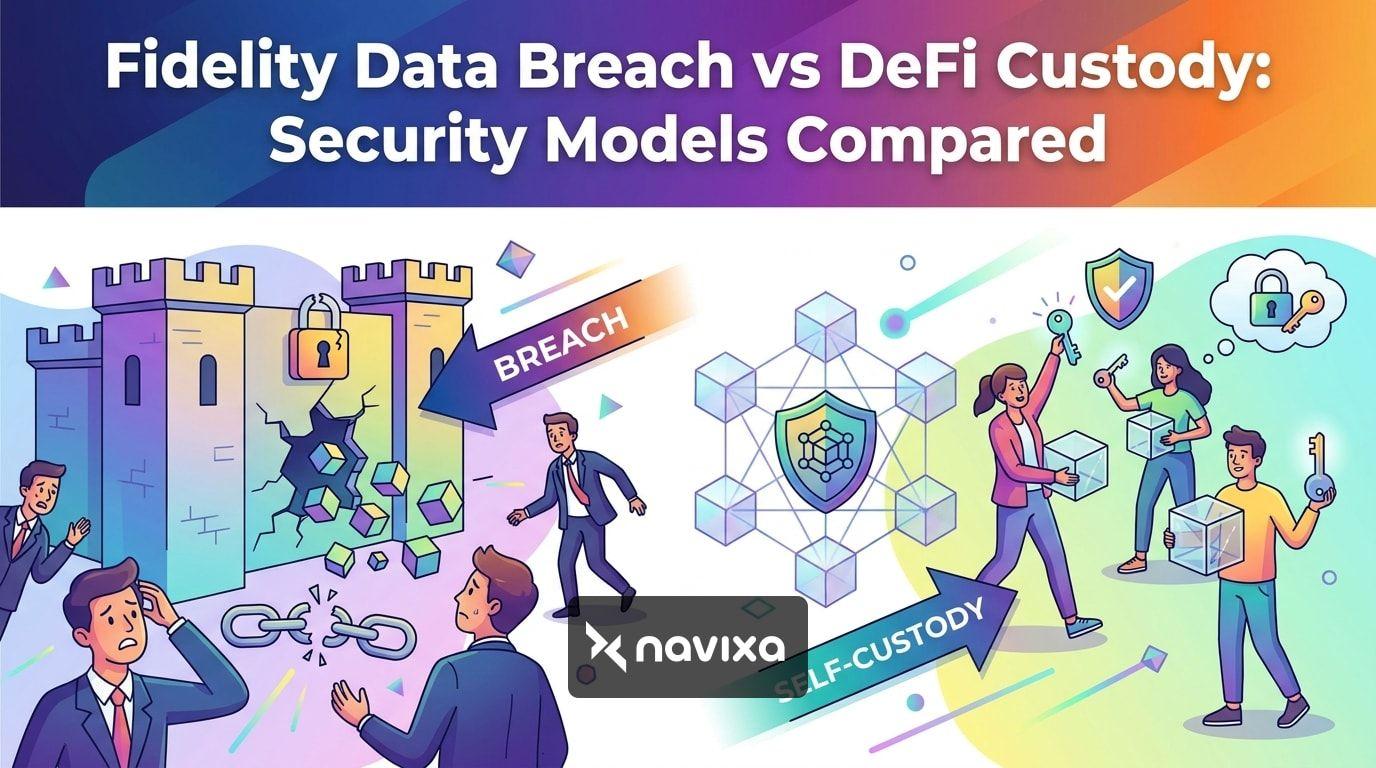
The intersection of traditional finance (TradFi) and digital assets has never been more heavily scrutinized than it is today. When news of a major Fidelity data breach broke—revealing that adversaries successfully compromised internal databases by creating fraudulent accounts—it sent immediate shockwaves through the global investment community. This incident, which compromised the highly sensitive personal data of over 77,000 customers and culminated in a proposed $2.5 million settlement, highlighted a persistent vulnerability inherent in centralized financial systems: the honeypot effect.
As the global cryptocurrency market capitalization holds steady at an impressive $2.69 trillion, with Bitcoin trading actively around $78,336, modern investors are increasingly questioning the absolute safety of their stored assets. Is the traditional, heavily guarded brokerage model still the gold standard for financial security, or does decentralized finance (DeFi) offer a fundamentally superior alternative for long-term asset custody? This article deeply explores the structural differences between these competing security models and examines what they mean for the modern trader navigating today's volatile financial landscape.
- The Fidelity data breach exposed the inherent, catastrophic risks of centralized data repositories.
- DeFi custody relies strictly on cryptography and private keys rather than corporate security firewalls.
- Centralized platforms act as massive honeypots for hackers, whereas decentralized wallets distribute risk.
- Modern traders must successfully blend strong technical analysis with robust self-custody practices.

Understanding the Fidelity Data Breach
The alarming details of the Fidelity data breach serve as a textbook example of Centralized Finance (CeFi) vulnerabilities. In this particular incident, which took place in August 2024, malicious actors managed to bypass standard identity verification processes to create entirely fraudulent customer accounts. Once inside the secure perimeter, they seamlessly accessed images of internal customer documents. This breach of trust led to severe privacy compromises, resulting in widespread class-action litigation that forced the firm into a multi-million dollar settlement.
"A centralized database is intrinsically only as secure as its weakest point of access. Once the perimeter is successfully breached, the entire repository is at the absolute mercy of the attacker."
In traditional finance, institutions inherently hold not only your liquid funds but also your sovereign identity. From social security numbers and physical addresses to passport images and bank routing details, the sheer volume of personally identifiable information (PII) stored by legacy brokers like Fidelity is staggering. When comparing platform structures, a thorough Bitcoin ATM vs crypto exchange comparison often reveals that while traditional fiat exchanges heavily rely on stringent KYC (Know Your Customer) data gathering, decentralized alternatives purposefully minimize data collection, thereby drastically reducing severe identity theft risks.
The Mechanics of Centralized Failure
Traditional financial institutions use a model that demands absolute trust. You are required to trust the bank's IT infrastructure, its hiring practices, its firewall configuration, and its response times. When hackers targeted Fidelity, they didn't necessarily need to break complex cryptographic codes; they merely had to exploit a flaw in the account creation logic. Once authenticated as a "user," the lateral movement within the network allowed them to scrape sensitive document images.
Centralized Finance (CeFi) vs. Decentralized Custody (DeFi)
To genuinely grasp why the Fidelity data breach is such a pivotal moment for digital asset investors, one must profoundly understand the architectural differences between CeFi and DeFi.
Centralized entities operate exclusively on a trust-based model. You explicitly trust the institution to secure your raw data, flawlessly execute your market trades, and instantly honor your fiat withdrawals. However, this centralized architecture creates a massive, singular point of failure.
Decentralized Finance (DeFi), conversely, operates on a trustless, strictly non-custodial model. In this framework, you hold the unique private keys to your digital assets. No corporate entity physically stores your personal documents on a cloud server, and no overworked employee can accidentally expose your active account to a sophisticated phishing scam.

The Inescapable Honeypot Effect
When a single institution deliberately holds the deeply personal data of millions of active users, it inadvertently becomes an irresistible, highly lucrative target for global cyber syndicates. Even with annual multi-million dollar cybersecurity budgets, simple human error—such as an employee falling for advanced social engineering tactics—can fatally compromise the system. In stark contrast, successfully breaking into a mature decentralized network like Bitcoin or Ethereum requires cracking cryptographic protocols, a mathematical feat which currently far exceeds the collective computing power of the world's most advanced supercomputers.
The Core Security Models Compared
The fundamental differences between traditional financial security layers and modern blockchain-based self-custody can be comprehensively distilled into several core operational vectors.
| Feature | Traditional Brokerage (CeFi) | Non-Custodial DeFi Wallet |
|---|---|---|
| Asset Custody | Institution holds the assets legally | User exclusively holds the private keys |
| Data Storage | Centralized servers (High breach risk) | Decentralized architecture / No PII required |
| Account Recovery | Customer service identity verification | 12/24-word Seed phrase (No corporate backup) |
| Asset Accessibility | Subject to business hours and freezing | 24/7 global permissionless digital access |
| Regulatory Risk | Highly regulated, subject to policy shifts | Protocol-driven, where code is the ultimate law |
Market Analysis & Trading Psychology
Understanding overarching market dynamics goes far beyond reading candlestick charts; it inherently requires grasping the deep psychological impact of massive institutional failures. When a globally trusted financial giant experiences a catastrophic breach, the collective market psychology shifts violently from implicit trust to active, defensive skepticism.
Currently, Bitcoin is fiercely battling resistance levels around the $78,000 mark. While recent news stemming from the US CLARITY Act has brought a major, highly documented spike of euphoria to the broader digital asset market, seasoned traders remain notably cautious. A sudden flash crash just recently liquidated over $500 million in leveraged crypto longs, violently reminding investors that unchecked market volatility is just as financially dangerous as sophisticated cybersecurity threats.

When major tier-one institutions suffer public security lapses, we predictably observe a massive migration of retail and institutional capital moving rapidly toward self-custodial assets. This specific psychological pivot forces individual traders to starkly confront their own internal risk management systems. Accurately understanding stablecoin FUD and trading psychology is absolutely essential during these volatile transitional periods, as widespread panic often drives uninformed retail investors to make hasty, portfolio-destroying decisions.
**Risk Management Alert:** Self-custody completely eliminates the risk of corporate data breaches but introduces intense personal responsibility. If you lose your hardware wallet's recovery seed phrase, your funds are permanently and irreversibly lost. There is no traditional customer support hotline available to reset your password.
To effectively and safely navigate these intense psychological hurdles, traders must establish exceptionally strict rules for overall asset allocation. If you are deliberately holding digital assets through extreme market volatility, maintaining a rock-solid crypto long-term holding strategy utilizing an offline cold storage wallet ensures your core capital remains entirely insulated from both centralized exchange bankruptcies and devastating corporate data leaks.
Navigating the Shift: Actionable Steps for Traders
If the harsh realities of the Fidelity data breach have correctly prompted you to deeply reconsider exactly where you hold your generational wealth, transitioning safely to a decentralized operational model requires careful, methodical planning.
1. Educate Yourself Thoroughly on Private Keys: You must intimately understand the stark difference between a hot wallet (actively connected to the internet) and a cold wallet (an offline hardware device). 2. Aggressively Diversify Custody: Do not keep all your working capital in one single place. Utilize regulated exchanges solely for active daily trading, and sweep profits into hardware wallets for secure long-term storage. 3. Minimize Your Digital Footprint: Be exceptionally cautious about where you digitally upload your KYC documents. Actively use zero-knowledge proofs and privacy-preserving protocols wherever structurally possible. 4. Utilize Advanced Trading Tools: As you intelligently move away from highly centralized traditional brokers, you can explore Navixa strategies to maintain a sharp, highly competitive edge in volatile crypto markets.
The conscious shift from relying on a trusted third party to fully embracing personal financial sovereignty is deeply empowering but undeniably demands strict discipline. The absolute latest CoinDesk's recent coverage on derivative market liquidations emphasizes perfectly that strong technical security must always be systematically paired with highly disciplined trading execution.
Regulatory Landscape: What's Next?
The global regulatory environment is shifting incredibly rapidly in direct response to both massive CeFi failures and rapid DeFi innovations. US House committee leaders are currently actively urging the current administration to immediately fill CFTC commissions, explicitly citing the urgent need for clearer, much more robust oversight frameworks like the recently proposed CLARITY Act. These bold legislative moves are specifically designed to protect everyday consumers from massive systemic risks while carefully fostering continued technological innovation.
For active traders and long-term investors alike, staying well ahead of these complex regulations is undeniably crucial. Clear regulatory clarity historically leads to massive institutional adoption, which in turn drastically drives up market liquidity. However, aggressive over-regulation can severely stifle the fundamentally permissionless nature of DeFi, potentially pushing brilliant innovation offshore. Closely monitoring Cointelegraph's regulatory updates can easily provide the vital foresight needed to intelligently adjust your portfolio before any major policy shifts officially take full effect.
**Industry Shift:** The Saudi Arabian government's historic recent move to actively tokenize vast parts of its multi-trillion dollar economy highlights a massive global macroeconomic trend: sovereign nations are officially recognizing decentralized blockchain technology as an essential safeguard against traditional centralized systemic shocks.
Conclusion
The ongoing financial fallout directly resulting from the Fidelity data breach is significantly more than just a momentary news headline; it is a powerful catalyst for radically rethinking global financial sovereignty. Traditional centralized systems, while admittedly convenient and heavily historically regulated, inherently and unavoidably carry the massive risk of mass consumer data exposure. The decentralized custody model brilliantly flips this outdated paradigm, permanently substituting fragile corporate trust for absolute mathematical certainty.

Fully embracing DeFi custody definitely does not mean entirely abandoning traditional finance, but rather actively recognizing the clear strengths and fatal weaknesses of both disparate systems. By intelligently integrating highly secure self-custody practices with advanced, algorithmic trading methodologies, modern investors can perfectly shield their hard-earned wealth from glaring corporate vulnerabilities while simultaneously maximizing lucrative market opportunities. If you are finally ready to officially take total control of your financial future and efficiently implement these advanced operational methodologies, it is definitively time to start trading with Navixa and leverage our cutting-edge market intelligence to your distinct advantage.
Frequently Asked Questions
What exactly was the Fidelity data breach?
The Fidelity data breach was a massive cybersecurity incident identified around August 2024, where malicious adversaries successfully bypassed internal security protocols to fraudulently create unauthorized customer accounts. This explicit access allowed them to view and scrape a secure database containing internal images of personal documents for over 77,000 customers.
How does DeFi custody protect against massive data breaches?
DeFi protocols are fundamentally non-custodial and generally do not ever require any personal identifiable information (PII) like legal names, physical addresses, or social security numbers. Because there is absolutely no centralized corporate database of user identities, there is physically no "honeypot" of personal data for external hackers to steal.
Is it completely safe to hold my own digital crypto?
Self-custody completely eliminates the glaring risk of corporate data breaches, but it simultaneously introduces the severe risk of human error. If you accidentally lose your private keys or backup seed phrase, or if you unknowingly sign a highly malicious smart contract, your digital funds can be permanently lost without any central authority to offer recourse.
How did the broader financial market react to recent traditional finance breaches?
While traditional finance breaches often severely erode institutional trust in centralized entities, they concurrently drive massive retail interest and institutional capital directly toward decentralized alternatives like Bitcoin and DeFi protocols, actively reinforcing the growing global narrative of self-sovereign digital wealth protection.