

Bitcoin ATM vs Crypto Exchange: Fees and Security Compared
- May 2, 2026
- 12 min read
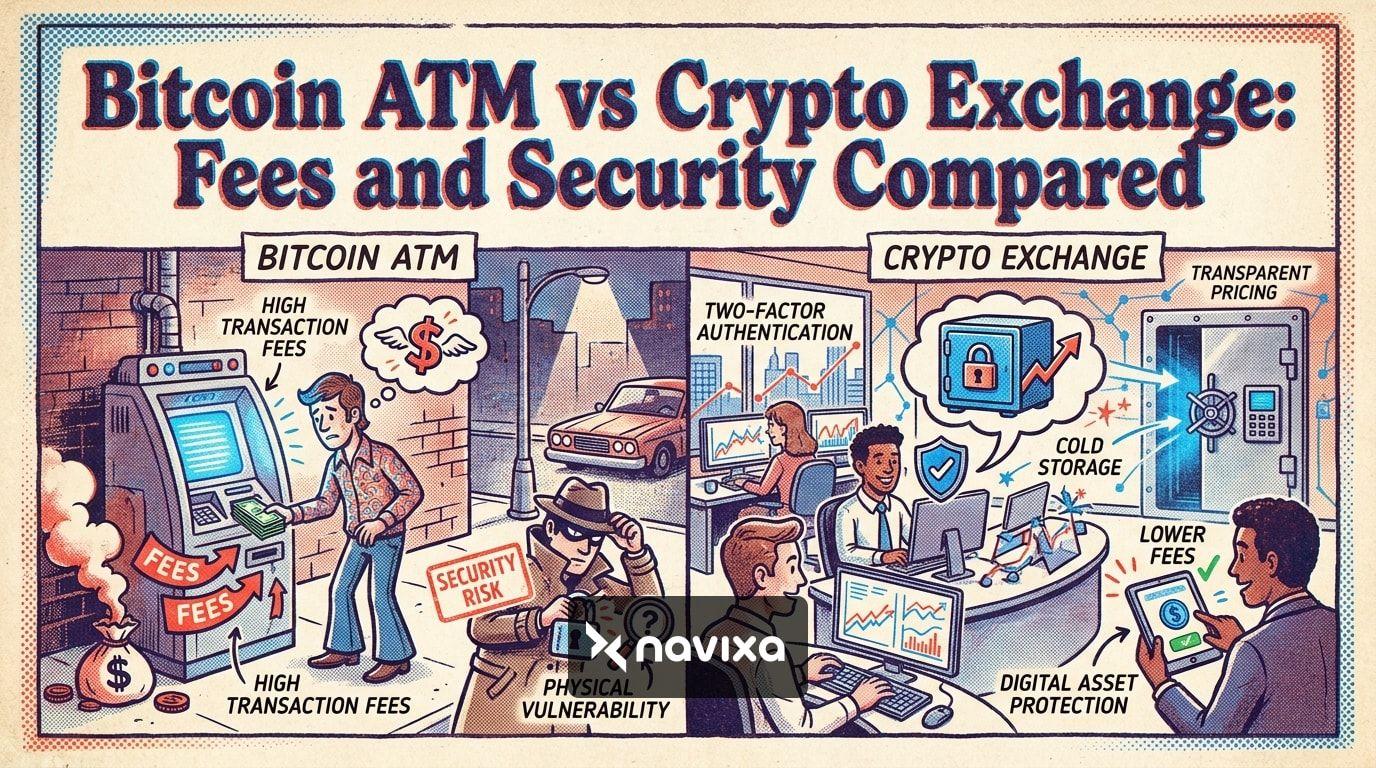
The cryptocurrency landscape has rapidly matured, yet the onboarding process remains a significant hurdle for many new market participants. With Bitcoin surging past $78,190 and the total global crypto market cap exceeding $2.67 trillion, the influx of retail capital brings a persistent question to the forefront: what is the most efficient way to convert fiat currency into digital assets?
At the center of this debate is the bitcoin atm vs crypto exchange comparison. On one hand, physical kiosks offer the tangible familiarity of a traditional cash machine. On the other, digital trading platforms provide institutional-grade liquidity and fractional costs. While the broader narrative for digital scarcity continues to solidify—bolstered by institutional adoptions and a robust 58.49% Bitcoin market dominance—the mechanics of how you purchase these assets can dramatically impact your actual returns.
- Physical kiosks offer unparalleled cash-to-crypto convenience but charge heavily for the privilege.
- Digital trading platforms provide significantly lower fees, advanced trading tools, and deeper market liquidity.
- Spread markups at physical terminals can instantly erase up to 25% of your initial investment capital.
- Understanding the nuanced differences in security protocols is essential for protecting your digital wealth.

What is a Bitcoin ATM?
A Bitcoin ATM (Automated Teller Machine), sometimes referred to as a BTM, is a physical kiosk that allows users to purchase cryptocurrency using cash or debit cards. Some advanced, two-way machines also permit users to sell their cryptocurrency for immediate physical cash.
As the industry has expanded, the infrastructure for physical on-ramps has grown steadily. Recent data shows there are roughly 39,000 active cryptocurrency kiosks operating worldwide, with the United States hosting the vast majority—over 30,000 machines. While the pace of deployment has stabilized compared to earlier boom cycles, thousands of new terminals are still being installed in convenience stores, gas stations, and dedicated embassy shops globally.
The primary appeal of a physical kiosk is immediate accessibility. For underbanked populations or those who prefer to deal in physical cash, these machines offer a straightforward, tangible bridge into the digital economy without requiring complex wire transfers or banking integrations.
What is a Crypto Exchange?
A digital crypto exchange is an online marketplace where users can buy, sell, and trade a wide variety of digital assets. Platforms like Binance, MEXC, Coinbase, and Kraken act as intermediaries that match buyers with sellers globally.
Exchanges represent the backbone of the digital asset economy. They facilitate massive trading volumes—currently hovering around $80 billion daily across the global market. Unlike physical kiosks, digital platforms require users to link a bank account, credit card, or third-party payment processor to fund their accounts. In exchange for this digital integration, users gain access to real-time order books, advanced charting tools, futures markets, and automated trading bots.
Fee Comparison: Where Does Your Capital Go?
The most glaring discrepancy in the bitcoin atm vs crypto exchange debate is the fee structure. Understanding how these costs compound over time requires studying the Bitcoin historical returns to realize how much capital is permanently lost to initial friction.
The True Cost of Physical Kiosks
When you use a physical kiosk, you are paying for the physical hardware, the commercial real estate rent, the armored cash collection services, and the operator's profit margin. Consequently, the fees are astronomical compared to online standards.
The average transaction fee at a kiosk ranges between 11% and 25%. However, this cost is rarely presented as a simple line-item receipt. Instead, operators utilize "spread markups." If the global spot price of Bitcoin is $78,190, the machine might sell it to you at an effective rate of $90,000.
If you insert $1,000 in cash into a machine with a 15% combined fee and spread, you immediately lose $150. You walk away with only $850 worth of digital assets. Your investment must now appreciate by 17.6% just for you to break even on the initial purchase.
Hidden spread markups at physical kiosks can be deceiving. While an operator might advertise a flat $5 transaction fee, they often inflate the asset's exchange rate by 10% to 20% above the current global spot price.
The Efficiency of Digital Platforms
Digital platforms operate on a "maker" and "taker" fee model, leveraging global liquidity pools to drive costs down to fractions of a percent.
A "maker" adds liquidity to the order book by placing a limit order, while a "taker" removes liquidity by executing a market order. Top-tier global exchanges routinely charge between 0.0% and 0.1% for maker orders, and 0.05% to 0.2% for taker orders. Even beginner-focused platforms that charge a premium for a simplified interface typically cap their fees around 0.4% to 0.6%.
Using the same $1,000 example, a 0.1% fee on an exchange costs you exactly $1. You retain $999 of purchasing power, allowing your capital to compound efficiently from day one.

Security and Privacy Showdown
Security profiles differ drastically between physical and digital acquisition methods.
Physical kiosks used to be championed for their anonymity. However, modern regulatory frameworks now require operators to enforce Anti-Money Laundering (AML) and Know Your Customer (KYC) protocols. In 2026, purchasing any meaningful amount of digital assets at a kiosk requires scanning a government-issued ID and providing a phone number. Furthermore, carrying large amounts of physical cash to a public terminal introduces severe physical security risks, including the threat of robbery.
Conversely, digital platforms eliminate the physical risk but introduce cybersecurity vectors. Because exchanges hold billions in assets (like the $189 billion managed by Tether or the massive reserves of major altcoins like Solana), they are prime targets for sophisticated hackers. However, top-tier platforms mitigate these risks by holding the majority of user funds in cold storage (offline wallets), conducting regular proof-of-reserves audits, and employing advanced encryption.
Market Analysis & Trading Psychology
To navigate these volatile environments, traders often rely on a comparative market analysis to weigh technological adoption against speculative froth. The method you use to enter the market intrinsically affects your trading psychology.
When a retail investor uses a physical kiosk and instantly loses 15% to 25% of their capital, they start their trading journey in a deep psychological hole. This immediate drawdown often triggers "revenge trading" or excessive risk-taking as the investor attempts to quickly recoup the lost fees. If they buy at the top of a local cycle, the combination of high fees and price depreciation can lead to catastrophic panic selling.
Conversely, trading on a highly liquid digital exchange with negligible fees fosters patience. Because the friction of entry and exit is virtually zero, traders are not forced to chase unrealistic returns. Establishing a strong long-term holding strategy helps mitigate the emotional damage of short-term volatility, and low fees make dollar-cost averaging (DCA) a viable approach.
From a macroeconomic perspective, as traditional finance continues to merge with the digital economy—evidenced by recent stablecoin yield regulations and massive pension fund accumulations—institutional efficiency is trickling down to retail. The smart capital is leveraging digital order books, recognizing that paying a 20% premium for an asset effectively negates years of potential yield.

Feature Comparison Summary
To summarize the core differences in the bitcoin atm vs crypto exchange debate, consider the following structural comparison:
| Feature | Physical Crypto Kiosk | Digital Trading Exchange |
|---|---|---|
| Average Fees | 11% - 25% (Including spread) | 0.0% - 0.6% (Maker/Taker) |
| Funding Methods | Physical Cash, some Debit Cards | ACH, Wire Transfer, Credit Cards, Crypto |
| Asset Variety | Limited (Usually BTC, ETH, LTC) | Extensive (Hundreds of spot and futures pairs) |
| Transaction Speed | Immediate cash execution | Instant market execution (after initial bank clearing) |
| Primary Risk | High fees, physical theft of cash | Cyber attacks, account phishing |
| Best For | Unbanked users, emergency cash conversion | Active traders, long-term investors, large volume |
Actionable Steps: Which Should You Choose?
Before deploying significant capital, evaluating the crypto macro outlook will help determine whether a spot purchase or a structured dollar-cost averaging plan makes more sense.
When to Use a Physical Kiosk: - You are entirely unbanked and operate exclusively in physical cash. - You are in a remote location or traveling and need an immediate, local fiat-to-crypto conversion without waiting for bank clearance. - You are making a minor, one-off purchase where the convenience outweighs the percentage cost.
When to Use a Digital Platform: - You are investing substantial capital where a 15% fee would equate to hundreds or thousands of dollars lost. - You plan to actively trade, rebalance your portfolio, or utilize advanced order types like stop-losses and limit orders. - You want access to a broader ecosystem of assets beyond just Bitcoin and Ethereum, such as emerging Layer-1 blockchains and DeFi tokens.
If you decide to use an online platform, always enable Two-Factor Authentication (2FA) via an authenticator app (like Google Authenticator or Authy) rather than SMS, as SIM-swapping attacks remain a prevalent threat in the digital asset space.

Conclusion
The choice between a physical kiosk and a digital platform ultimately boils down to a trade-off between absolute physical convenience and financial efficiency. While physical machines serve a critical role in bringing the unbanked into the financial fold and offering tangible on-ramps, their exorbitant fee structures make them entirely unsuitable for serious investing or active trading.
For the vast majority of market participants looking to build sustainable wealth in the digital asset space, taking the time to set up and secure a reputable online exchange account is the objectively superior route. Protect your capital, minimize your friction costs, and let the market work for you, not against you.
Frequently Asked Questions
Do Bitcoin ATMs require identification to use?
Yes, modern regulatory compliance requires most physical operators to enforce KYC (Know Your Customer) rules. Depending on the purchase amount, you will typically need to provide a phone number for SMS verification, and for larger transactions, you must scan a valid government-issued ID.
Why are the fees so much higher at a physical kiosk?
Operating physical hardware comes with significant overhead. Companies must pay for the physical machine, location rent, maintenance, software licensing, and specialized armored transport companies to collect the physical cash securely. These logistical costs are passed directly to the consumer via inflated spreads and transaction fees.
Are my digital assets safer on an exchange or a personal wallet?
While top-tier exchanges have robust security measures, including cold storage and insurance funds, maintaining your assets on an exchange means you do not possess the private keys. For maximum security, it is highly recommended to purchase your assets on a low-fee exchange and immediately transfer them to a personal hardware wallet for long-term safekeeping.
Can I sell my digital assets for cash at a kiosk?
Not all kiosks offer this feature. While one-way machines only allow you to buy assets, two-way machines allow you to sell your cryptocurrency and dispense physical fiat cash. However, selling at a kiosk incurs the same heavily inflated spread markups as buying, significantly reducing your total payout.