
Introduction
The integration of artificial intelligence into cryptocurrency trading has completely transformed the financial landscape. By leveraging Large Language Models (LLMs) and agentic workflows, modern algorithms can parse real-time news sentiment, analyze complex order book dynamics, and execute nuanced trading strategies previously reserved for institutional human traders. However, outsourcing critical financial decisions to third-party cloud APIs introduces a severe vulnerability: AI trading bot downtime.
When an LLM provider experiences an outage or throttles your connection due to strict rate limits, your trading bot can be left paralyzed. In volatile cryptocurrency markets—where double-digit percentage swings can occur in a matter of minutes—a paralyzed bot is a massive liability that can lead to catastrophic liquidations. Understanding how to engineer robust fallback mechanisms and mitigate the risks associated with API dependency is no longer optional; it is the cornerstone of professional algorithmic trading.
This comprehensive guide explores the root causes of LLM API failures, the financial impact of trading bot outages, and advanced technical strategies for handling AI trading bot downtime effectively to ensure your crypto portfolio remains secure under all market conditions.
Understanding the Causes of LLM API Downtime
To build a resilient trading architecture, developers and quantitative analysts must first understand why Large Language Models fail to return responses. Unlike traditional, deterministic code that runs locally on a Virtual Private Server (VPS), LLM-based bots rely on continuous HTTP requests to external servers. These remote requests can fail for a variety of reasons.
Aggressive Rate Limiting (RPM and TPM)
The most common cause of AI trading bot downtime is not a global server outage, but rather localized rate limiting. Major LLM providers enforce strict quotas to manage server load, typically measured in Requests Per Minute (RPM) and Tokens Per Minute (TPM).
With the rise of agentic AI—where bots autonomously spawn sub-tasks to analyze multiple market indicators—trading systems burn through token allocations at unprecedented rates. For example, while advanced models like GPT-5 offer high capacities for top-tier enterprise accounts, developer accounts often hit TPM limits unexpectedly during periods of high market volatility. Similarly, platforms like Anthropic dynamically adjust session limits during peak weekday hours (such as 5 AM to 11 AM PT), causing token-intensive trading bots to hit virtual walls abruptly. When a bot exceeds its quota, the API returns an `HTTP 429 Too Many Requests` error, effectively blinding the trading system.
Network Latency and Cloud Outages
Cryptocurrency trading is a 24/7 endeavor, but cloud infrastructure is not infallible. Occasional maintenance windows, routing failures, or localized data center outages can sever the connection between your trading bot's hosting environment and the LLM's endpoint. When an API call times out or returns an `HTTP 503 Service Unavailable` status, your bot might freeze while holding an unhedged position in a rapidly crashing market.
Context Window Overloads
Another nuanced form of downtime occurs when a trading bot dynamically feeds too much historical data, order book depth, or live news text into the prompt. If the prompt context exceeds the model's maximum allowed context window, the API will reject the request outright, causing a crash in the decision loop.
The Hidden Costs of AI Trading Bot Downtime
When your AI loses its cognitive engine, the financial repercussions are immediate. The cryptocurrency market's liquidity can fragment across dozens of exchanges, and execution risk spikes significantly during API outages.
"A trading bot is only as strong as its weakest dependency. In the era of LLMs, your risk model must account for the reality that the 'brain' of your algorithm will occasionally go offline."
Severe Slippage and Missed Executions
If your AI trading bot relies on real-time LLM analysis to calculate optimal entry and exit points, a delay of even a few seconds can result in massive slippage. By the time the API connection is restored and the trade is processed, the asset's price may have moved significantly, turning a theoretically highly profitable trade into a losing one.
The Danger of Stranded Capital and Liquidations
In leveraged futures trading, position management is a matter of absolute survival. If a bot opens a high-leverage long position just before a flash crash, it needs immediate cognitive bandwidth to assess whether the drop is transient market noise or a macroeconomic shift requiring an emergency exit. If the LLM API is down, the bot cannot process the context. Without independent, hardcoded circuit breakers, the margin position remains completely open until the exchange liquidates the account.
Trading Strategy: Decoupling Execution from Intelligence
The golden rule of mitigating AI trading bot downtime is absolute separation of concerns. You must never allow an external LLM API to have exclusive control over your basic risk management protocols.
Hardcoded Stop-Losses and Take-Profits
The most critical defense mechanism against AI trading bot downtime is delegating risk parameters directly to the cryptocurrency exchange's matching engine. When the AI model decides to enter a trade, it should simultaneously calculate the invalidation point (stop-loss) and the target (take-profit).
The bot must transmit these orders to the exchange alongside the primary execution order. By lodging these parameters on the broker's side via the Kraken REST API or similar exchange interfaces, your capital remains protected even if your local server or the LLM provider spontaneously goes offline. If the LLM experiences downtime, the exchange will automatically close the position if the market turns against you.
Establishing "Default-to-Safe" Behaviors
What happens if the API times out before an order can be executed? A resilient trading bot operates on a "default-to-safe" paradigm. If an API request to evaluate market conditions fails, the bot should automatically default to its most defensive posture. Depending on your strategy, this could mean: - Halting all new trade entries immediately. - Tightening existing trailing stops. - Closing out highly volatile open positions to secure capital.
Technical Architecture: Engineering LLM API Resilience
To achieve institutional-grade reliability, developers must build multiple layers of redundancy into their AI trading bot's infrastructure. Relying entirely on a single LLM provider is a recipe for disaster.
1. Multi-Provider Fallback Routing
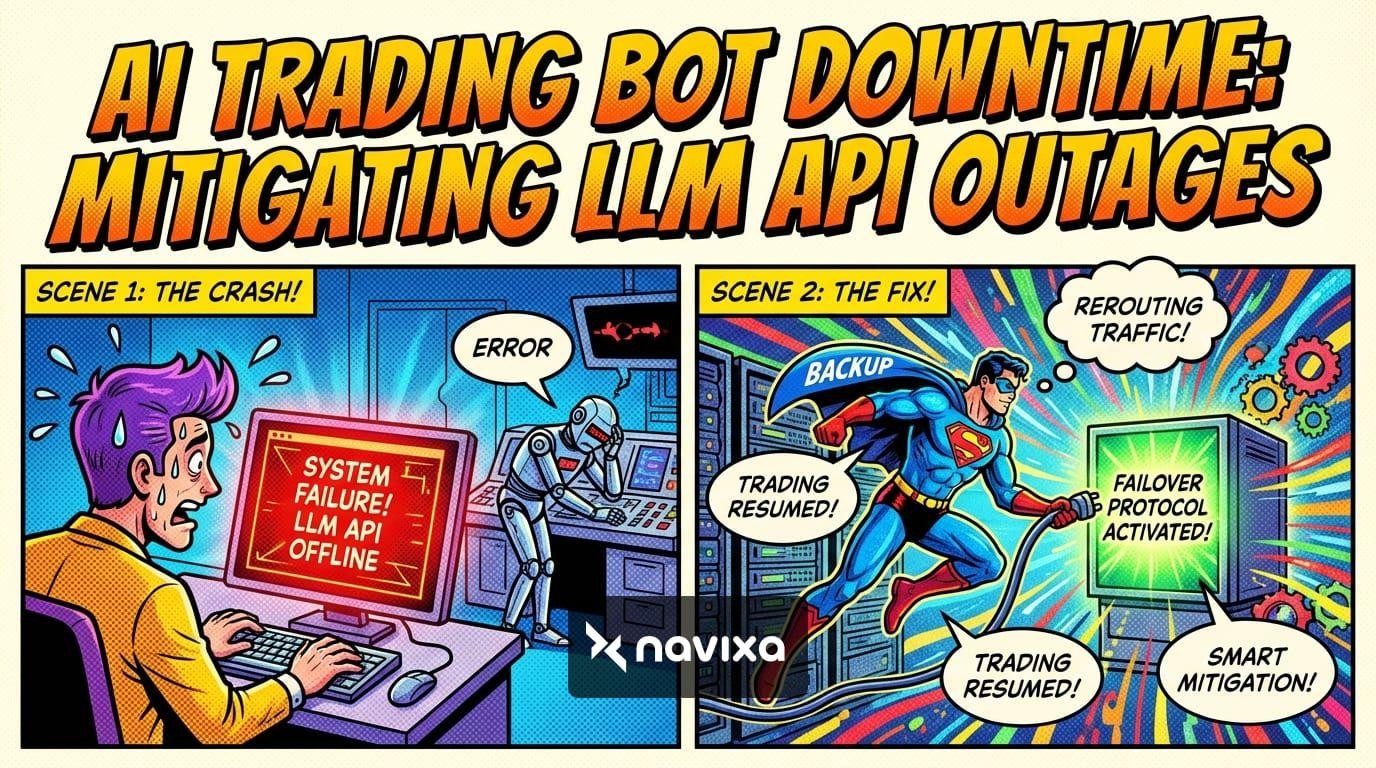
When an API call to your primary LLM fails, your system should automatically route the request to a secondary provider. For example, if OpenAI's API returns a 500-level server error, the bot's exception handler should instantly reformulate the prompt for Anthropic's Claude or Google's Gemini.
To implement this efficiently, developers should use an abstraction layer—a unified internal interface that standardizes prompt structures and output parsing. If the primary model goes down, the secondary model seamlessly takes over, ensuring zero interruption in the core trading logic.
2. Implementing Exponential Backoff with Jitter
When a bot encounters rate limits, aggressively resending requests will only result in longer bans from the API provider. The industry-standard approach is to use exponential backoff with jitter.
If a request fails, the bot waits 1 second before retrying. If it fails again, it waits 2 seconds, then 4 seconds, then 8 seconds. Adding "jitter" (a randomized millisecond delay) prevents multiple bot instances from synchronizing their retries and repeatedly slamming the server at the exact same moment. You can learn more about configuring this logic in the official OpenAI Rate Limits Documentation.
3. Deploying Local LLM Fallbacks
The ultimate safeguard against cloud-based AI trading bot downtime is maintaining a local, quantized LLM on the same Virtual Private Server (VPS) that hosts your trading execution logic. Models like Llama 3 or DeepSeek can be heavily quantized to run efficiently on specialized hardware without relying on the public internet.
While these local models may lack the deep reasoning capabilities of leading proprietary models, they are perfectly capable of executing emergency fallback protocols. If external APIs go down, the trading bot seamlessly switches to the local model to analyze immediate sentiment or finalize trade closures, guaranteeing zero external latency.
Comparison Table: Fallback Architectures
To help you determine the best approach for your algorithm, here is a comparison of different fallback architectures for mitigating API failures.
| Architecture Type | Setup Complexity | Execution Latency | Resilience to API Outages |
|---|---|---|---|
| Single LLM API | Low | Low to Medium | Very Poor |
| Multi-Cloud LLM Routing | Medium | Medium | Good |
| Cloud + Local LLM Fallback | High | Ultra-Low (Local) | Excellent |
| Fully Local LLM Infrastructure | Very High | Ultra-Low | Ultimate |
Actionable Steps for Traders and Developers
If you are actively running or developing an algorithmic system, you must audit your infrastructure immediately. Follow these actionable steps to fortify your systems against AI trading bot downtime:
1. Monitor Token Usage Dynamically: Implement an internal dashboard that tracks your RPM and TPM in real-time. If you approach 80% of your quota, instruct the bot to throttle its own non-essential analytical tasks. 2. Stress-Test Synthetic Downtime: Do not wait for a live market crash to see how your bot reacts to an API failure. Run simulated backtests where the LLM API randomly drops 20% of your requests or introduces a 10-second latency delay. Monitor the bot's behavior. 3. Use VPS Hosting Near Exchange Servers: Minimize network hops by hosting your bot on a VPS geographically close to your cryptocurrency exchange's matching engine. This reduces non-LLM latency, buying you precious milliseconds when API responses are delayed. 4. Implement Internal Circuit Breakers: If the bot detects three consecutive API timeouts within a five-minute window, it should trigger an internal circuit breaker that suspends trading and alerts the human operator.
Practical Takeaways
- Never rely on the LLM for core risk management: Always place your stop-losses directly on the exchange. - Implement graceful degradation: If the smartest AI model fails, fall back to a smaller, faster model, and if that fails, fall back to hardcoded safety parameters. - Respect Rate Limits: Token exhaustion during peak trading hours is the most preventable cause of bot downtime. Design smart queuing systems to serialize multi-agent requests. - Stay informed on provider changes: API limit adjustments often happen dynamically. Always keep abreast of your LLM provider's current enterprise and developer limits to prevent unexpected throttling.
Conclusion
The evolution of artificial intelligence has gifted cryptocurrency traders with unparalleled analytical power, but this power comes with severe infrastructural vulnerabilities. AI trading bot downtime remains a critical threat to algorithmic profitability. By understanding the mechanisms of LLM API rate limits, decoupling your core risk management from cloud dependencies, and building sophisticated fallback architectures, you can bulletproof your trading strategy. Embrace the intelligence of cloud AI, but always prepare your systems for the moment the network lights go out.
Frequently Asked Questions
What happens to my trades if the AI trading bot API goes down?
If you have not implemented hardcoded risk management, your trades will remain open and unmanaged, leaving you exposed to market volatility. However, if your bot correctly places stop-loss and take-profit orders directly on the exchange upon entry, your capital remains protected even during an extended API outage.
How can I prevent HTTP 429 Too Many Requests errors?
To prevent rate-limiting errors, monitor your Tokens Per Minute (TPM) dynamically. Use exponential backoff with jitter for retries, compress your prompt context to use fewer tokens, and consider upgrading your API usage tier to accommodate token-heavy agentic AI workflows without hitting the ceiling.
Is it viable to run an AI trading bot using only local models?
Yes, using highly optimized and quantized open-source models (like Llama 3) locally on a high-performance VPS is entirely viable and completely eliminates external API downtime. However, it requires advanced technical expertise, significant hardware investments, and the local model may not match the deep reasoning capabilities of flagship cloud-based LLMs.
Why do LLM providers change my rate limits during the day?
During peak usage hours (such as early business hours in the US), LLM providers face massive server strain. To ensure fair usage across their network, providers often dynamically adjust session limits or enforce stricter token caps. This is why having multi-provider routing is absolutely essential for continuous, 24/7 trading operations.