
Introduction: A Turning Point in the Financial Paradigm
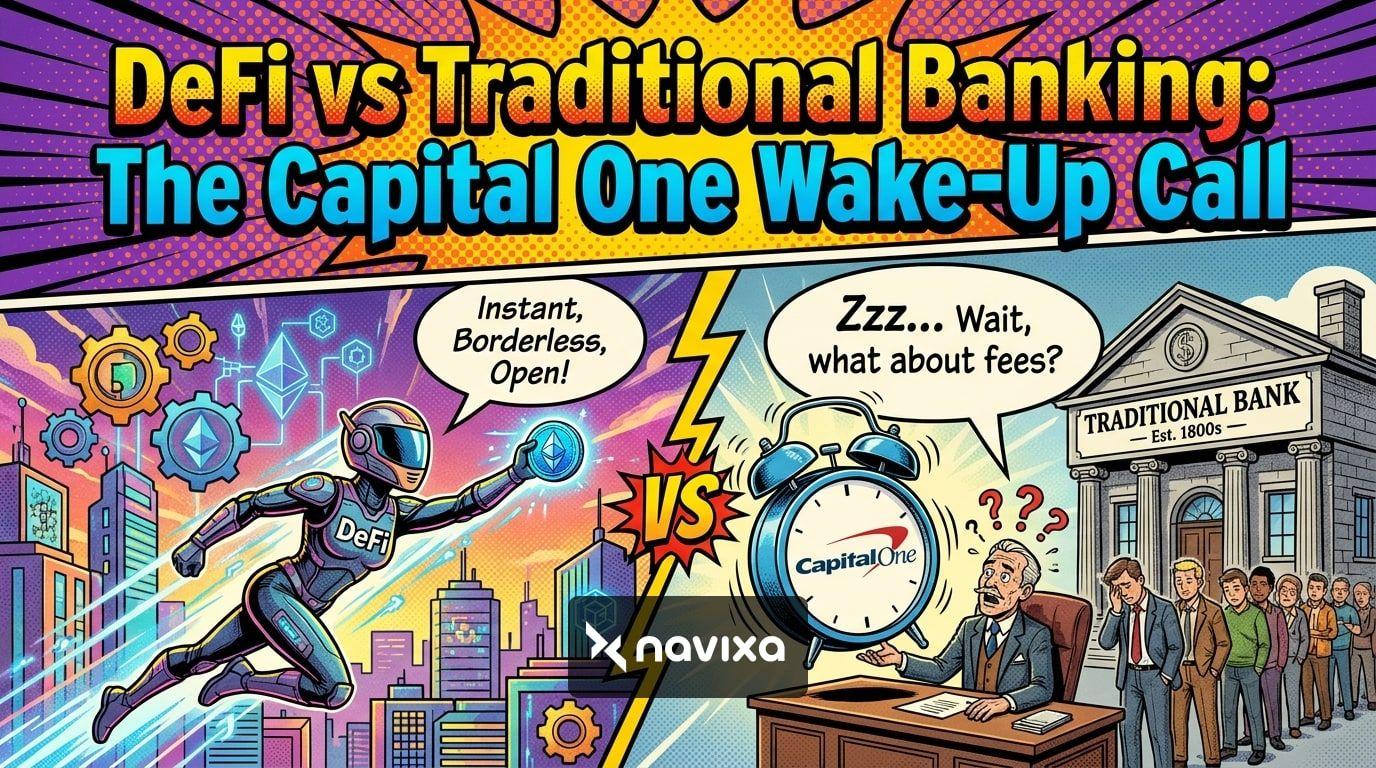
The recent approval of a staggering $425 million settlement involving Capital One has sent shockwaves through the consumer finance sector. For years, financial institutions have operated with a significant degree of opacity, leveraging information asymmetry to maximize their profits at the expense of their depositors. This landmark legal resolution acts as a massive wake-up call for consumers and investors alike, bringing the ongoing debate of DeFi vs traditional banking into sharp, unavoidable focus.
At the heart of this settlement is a classic bait-and-switch tactic. The bank was accused of leaving legacy "360 Savings" account holders stranded at a dismal interest rate of roughly 0.3%, while simultaneously and quietly launching a new "360 Performance Savings" product boasting yields as high as 4.3%. Millions of loyal customers were left earning practically nothing, entirely unaware that a vastly superior yield was available within the very same institution.
This incident is not an isolated error; it is a structural symptom of centralized banking. It perfectly illustrates why a decentralized, code-driven alternative is no longer just a speculative playground for tech enthusiasts, but a necessary evolution of personal finance. In this comprehensive guide, we will analyze the fallout of the Capital One settlement, dissect the mechanics of decentralized yields, and explain exactly why decentralized finance (DeFi) represents the transparent future of banking.
The Capital One $425M Settlement: A Symptom of a Broken System
To understand the true value proposition of Web3 financial infrastructure, one must first understand the specific failures of the legacy system it aims to replace. The Capital One settlement stems from allegations raised by consumer watchdogs, including the Consumer Financial Protection Bureau (CFPB), and subsequent class-action litigations.
Banks generate revenue through net interest margin—the difference between the interest they pay out to depositors and the interest they charge borrowers. To optimize this margin, traditional banks heavily rely on customer inertia. In the Capital One case, marketing budgets were aggressively deployed to attract new capital into the high-yield "Performance" accounts, while existing customers in legacy accounts were systematically ignored. Because traditional banking terms of service allow institutions to change interest rates at their discretion without explicit, prominent notifications to the end user, the bank legally (though highly unethically) squeezed billions of dollars in saved interest out of its depositor base.
This dynamic highlights the foundational flaw of the traditional banking model: Trust. Consumers must blindly trust that a centralized corporate board, whose fiduciary duty is to its shareholders rather than its depositors, will act in their best interest. As the $425 million penalty proves, that trust is fundamentally misplaced.
DeFi vs Traditional Banking: The Transparency Paradigm
When we evaluate DeFi vs traditional banking, the most jarring difference is the transition from opaque human governance to transparent algorithmic execution.
Decentralized Finance operates on public blockchain networks—primarily Ethereum, Solana, and Layer-2 scaling solutions like Arbitrum or Base. In this ecosystem, there are no corporate boardrooms setting interest rates behind closed doors. Instead, financial operations are governed by "smart contracts," which are self-executing lines of code stored publicly on the blockchain.
"In traditional finance, yield is a marketing decision. In decentralized finance, yield is a mathematical certainty dictated by real-time market demand."
If a decentralized lending protocol like Aave or Compound offers a 5% Annual Percentage Yield (APY) on stablecoins, that rate is not decided by a marketing executive. It is determined dynamically by an open-source algorithm that measures the real-time utilization rate of the capital pool. If borrowing demand increases, the APY automatically increases to attract more depositors. If demand falls, the APY adjusts accordingly.
More importantly, this code is auditable by anyone. A protocol cannot secretly create a "Legacy Pool" and a "Performance Pool" and silently drain your yield. Your funds are not custodied by a bank; they remain under your control via cryptographic private keys until you explicitly authorize a smart contract interaction.
Technical Analysis: How DeFi Yields Actually Work
Many skeptics view crypto yields with suspicion, often asking: *"Where does the yield actually come from?"* Unlike the unsustainable, inflationary token-printing models seen during the 2021 bull market, the modern decentralized finance landscape of 2026 relies on tangible, revenue-generating mechanics. To grasp the mechanics of DeFi vs traditional banking, we must examine three primary pillars of decentralized yield generation:
1. Overcollateralized Lending Markets
Protocols such as Aave and Spark operate decentralized money markets. A user can deposit a volatile asset (like Ethereum or Bitcoin) and borrow a stablecoin (like USDC) against it. To do so, they must overcollateralize their loan—for example, depositing $1,500 worth of Ethereum to borrow $1,000 worth of USDC. Borrowers pay a continuous interest rate, which is algorithmically distributed to the depositors providing the stablecoin liquidity. The system is inherently solvent because if the value of the collateral drops too low, a decentralized network of "liquidators" automatically sells the collateral to repay the lenders.
2. Automated Market Maker (AMM) Liquidity Provision
Decentralized exchanges (DEXs) like Uniswap do not use centralized order books or traditional market makers. Instead, they rely on Liquidity Pools. Users deposit pairs of tokens (e.g., ETH and USDC) into a pool. When traders swap between these tokens, they pay a small trading fee (typically 0.05% to 0.30%). These fees accrue directly back to the liquidity providers (LPs). Your yield is directly proportional to the trading volume of the global market.
3. Liquid Staking and Restaking
Blockchain networks like Ethereum require "validators" to secure the network by locking up capital (Staking). Protocols like Lido allow retail users to pool their assets, earn the base network security yield, and receive a liquid receipt token (e.g., stETH) in return. In recent years, restaking protocols like EigenLayer have expanded this utility, allowing staked assets to secure additional decentralized applications in exchange for compounded rewards.
These combined mechanisms drove the Total Value Locked (TVL) in DeFi to nearly $238 billion in the first quarter of 2026, according to on-chain analytics platforms like DefiLlama. This massive concentration of capital proves that the market is actively validating this transparent yield model.
Trading Strategy: Generating Decentralized Yield
Transitioning from traditional banking to DeFi requires a shift in strategy. While a traditional bank account is passive, decentralized finance allows users to be as active or passive as their risk tolerance permits. Here are a few advanced strategies utilized by modern crypto investors:
Delta-Neutral Stablecoin Farming
For users who want to avoid the notorious volatility of cryptocurrencies, stablecoin farming is the closest equivalent to a high-yield savings account. By supplying USDC or USDT to decentralized money markets, users can earn floating rates based on global borrowing demand. Because stablecoins are pegged to the US Dollar, the "delta" (exposure to price movement) is essentially zero.
Concentrated Liquidity Provisioning
Sophisticated traders use platforms like Uniswap V3 and V4 to provide "concentrated liquidity." Instead of spreading their capital across an infinite price curve, they provide liquidity only within a specific price range. If the asset trades within that range, the trader captures a disproportionately massive share of the trading fees, often realizing APRs upwards of 20-30%. However, this strategy requires active management to avoid "impermanent loss" if the asset price swings rapidly.
Looping for Capital Efficiency
Advanced yield farmers utilize money markets to "loop" their positions. An investor might deposit staked Ethereum (stETH) yielding 4%, borrow stablecoins against it at 2%, and reinvest those stablecoins into a higher-yielding stablecoin pool at 6%. While highly capital efficient, looping increases liquidation risk during sudden market drawdowns.
Actionable Steps: Transitioning to Decentralized Yields
If the Capital One settlement has inspired you to take control of your financial destiny, transitioning into DeFi requires careful, methodical steps:
1. Establish Self-Custody: Do not leave your funds on centralized exchanges (like Coinbase or Binance). Purchase a hardware wallet (e.g., Ledger or Trezor) to hold your private keys securely. 2. Utilize Layer-2 Networks: Ethereum mainnet gas fees can eat into your yields. Bridge your assets to Layer-2 networks like Arbitrum, Optimism, or Base, where transaction fees are mere pennies. 3. Identify Blue-Chip Protocols: As a beginner, avoid obscure, untested platforms promising astronomical yields. Stick to "blue-chip" protocols with billions in Total Value Locked, long track records, and multiple independent security audits (e.g., Aave, Maker, Uniswap). 4. Monitor On-Chain Data: Get comfortable reading blockchain explorers and aggregator dashboards to verify the health, liquidity, and real-time yield of the pools you are participating in.
Risk Management: The Elephant in the DeFi Room
While DeFi solves the opacity and bait-and-switch tactics of traditional banks, it is not without severe risks. To responsibly evaluate DeFi vs traditional banking, we must discuss the elephant in the room: security exploits.
In traditional finance, your savings are generally insured by the FDIC (up to $250,000 in the US). If Capital One is hacked, the bank—or the federal government—makes you whole. In decentralized finance, you operate in a permissionless, unforgiving environment. If a smart contract you interact with contains a vulnerability, your funds can be drained instantly, with no centralized authority to call for a refund.
This risk is not hypothetical. Just recently in April 2026, the DeFi space was rocked by the Kelp DAO rsETH exploit. Attackers compromised a cross-chain bridge infrastructure, minting nearly $292 million of unsecured assets and leaving massive bad debt across lending protocols. This single event wiped billions from the nominal DeFi TVL in a matter of days, triggering a flight to safety among institutional investors.
Therefore, robust risk management is non-negotiable. - Diversification: Never put all your capital into a single protocol, no matter how trusted it seems. - Smart Contract Insurance: Use decentralized insurance protocols like Nexus Mutual to cover your deposits against potential hacks. - Beware of Bridge Risk: Moving assets across different blockchains via "bridges" introduces massive vulnerabilities. Minimize cross-chain interactions where possible.
DeFi vs Traditional Banking Comparison
To summarize the vast structural differences highlighted by the recent banking settlements and current blockchain mechanics, refer to the comparison table below:
| Feature | Traditional Banking (e.g., Capital One) | Decentralized Finance (DeFi) |
|---|---|---|
| Yield Transparency | Highly opaque; subject to silent, marketing-driven changes. | 100% transparent; algorithmically visible on-chain. |
| Control of Funds | Custodial; the bank possesses and controls your money. | Non-custodial; you hold your cryptographic private keys. |
| Accessibility | Permissioned; requires credit checks, geography limits, and KYC. | Permissionless; globally accessible to anyone with an internet connection. |
| Yield Rates | Often lagging behind inflation; artificially suppressed to boost bank margins. | Dynamically determined by raw market supply and demand. |
| Major Risks | Bait-and-switch rate practices, inflation erosion, localized data breaches. | Smart contract bugs, cross-chain bridge exploits, zero native FDIC insurance. |
Practical Takeaways
* Read the Fine Print: The $425 million Capital One settlement proves that traditional banks rely on customer complacency. Always monitor your legacy bank accounts for silent rate drops. * Code is Law: DeFi replaces human corporate governance with open-source mathematics. The yield you see is exactly the yield generated by the pool's parameters. * Risk vs. Reward: The higher yields in DeFi compensate for the lack of FDIC insurance. You are stepping out of the walled garden and taking on smart contract risk. * Self-Custody is Mandatory: To truly benefit from decentralized finance, you must hold your own keys. "Not your keys, not your crypto" remains the golden rule of Web3.
Conclusion: The Financial Infrastructure of Tomorrow
The Capital One lawsuit and subsequent nine-figure settlement is not just a localized consumer grievance; it is an indictment of an archaic, centralized financial system built on information asymmetry. The fact that a major institution could suppress interest rates for millions of users while actively marketing high yields to new clients perfectly encapsulates why traditional banking is ripe for disruption.
Decentralized Finance offers an alternative that is transparent, borderless, and rigorously equitable. While it still grapples with significant growing pains—such as the recent cross-chain bridge exploits—the underlying technology provides a fundamentally fairer foundation for personal finance. As the sector matures, risk management protocols improve, and the barrier to entry lowers, the shift from opaque banking ledgers to transparent public blockchains will become inevitable. The time to educate yourself and take custody of your financial future is now.
Frequently Asked Questions
What exactly was the Capital One $425M settlement about?
The settlement resolved a massive class-action lawsuit and regulatory probes alleging that Capital One engaged in deceptive practices. The bank was accused of keeping loyal "360 Savings" account holders at a minimal interest rate (around 0.3%) while aggressively marketing a newer "360 Performance Savings" account with yields exceeding 4%, without adequately notifying legacy customers of the massive disparity.
How does DeFi vs traditional banking compare in terms of yield?
Traditional banking yields are set by corporate executives looking to maximize the bank's net interest margin, often resulting in rates well below inflation. In contrast, DeFi yields are determined algorithmically by real-time market demand for borrowing, trading liquidity, and network security, meaning users capture the true market rate of their capital without a corporate middleman taking a massive cut.
Can DeFi platforms lower my interest rate without telling me?
Yes, but not maliciously or secretly. Because DeFi rates are algorithmically tied to utilization (supply and demand), if many people deposit funds into a lending pool and few people borrow, the APY will automatically decrease. However, unlike traditional banks, this mechanism is 100% transparent, and you can view the exact mathematical formula and real-time data on the blockchain at any time.
Are decentralized finance platforms insured against hacks?
Unlike traditional banks which are backed by government agencies like the FDIC, DeFi protocols do not have native, guaranteed insurance. If a smart contract is hacked, deposited funds can be permanently lost. However, users can purchase coverage through decentralized insurance protocols (like Nexus Mutual) to protect their positions against specific smart contract failures and exploit events.