
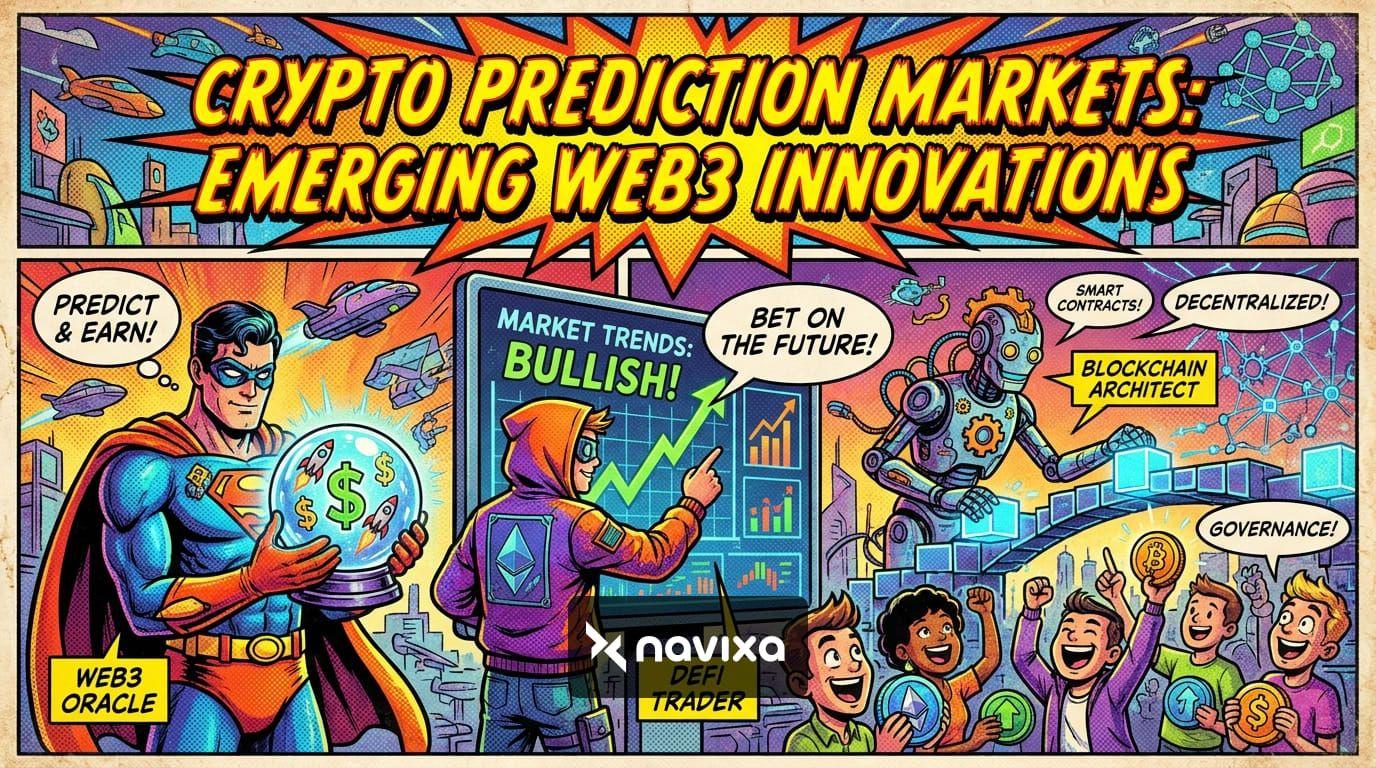
The intersection of decentralized finance (DeFi) and collective human intelligence has given rise to one of the most formidable financial instruments in the modern era: crypto prediction markets. By allowing participants to buy and sell contracts based on the outcome of real-world events, these platforms have evolved from niche blockchain experiments into a multibillion-dollar ecosystem. Whether it is forecasting macroeconomic trends, political elections, or the approval dates of new spot ETFs, Web3 event contracts provide an unfiltered, real-time probability engine driven by global liquidity.
For modern investors and traders, understanding crypto prediction markets is no longer optional—it is a critical component of a diversified Web3 trading strategy. These markets offer unique opportunities for hedging, speculation, and generating alpha in an environment where traditional polling and mainstream media often lag behind the wisdom of the crowd.
What Are Crypto Prediction Markets?
Crypto prediction markets are decentralized or hybrid exchanges where users trade event contracts that resolve to a specific outcome, usually in a binary "Yes" or "No" format. Unlike traditional speculative assets where value is derived from future cash flows or utility, the price of an event contract directly reflects the aggregate belief of the market regarding a specific probability.
The Mechanics of Decentralized Forecasting
In these markets, pricing is remarkably intuitive. If a contract forecasting that Bitcoin will breach a new all-time high by a specific date trades at $0.65, the market implies a 65% probability of that event occurring. If the event happens, the "Yes" contract pays out $1.00, netting a $0.35 profit for the buyer. If the event does not happen, the contract expires worthless at $0.00.
"Prediction markets do not just reflect the future; they actively synthesize global information into actionable financial data, providing an unparalleled edge over traditional forecasting methods."
Web3 prediction markets leverage smart contracts to lock collateral and automate payouts, eliminating the need for traditional escrow. Furthermore, they rely on decentralized oracles to verify real-world data and settle markets securely. This ensures that outcomes are transparent, tamper-proof, and free from centralized manipulation.
The Market Landscape: A New Era of Liquidity
As the technology has matured, the sector has witnessed staggering expansion. Recent data highlights that monthly trading volumes across major prediction markets have surged into the tens of billions. Platforms are seeing increased institutional participation, largely driven by the demand for uncensored data and the integration of sophisticated AI trading strategies.
Peak single-day volumes have recently smashed records, driven by simultaneous geopolitical and macroeconomic resolutions. The massive influx of capital has transformed these platforms into some of the most liquid venues in decentralized finance, rivaling traditional derivatives exchanges in execution speed and open interest.
Leading Crypto Prediction Markets
The ecosystem is dominated by a mix of purely decentralized protocols and regulatory-compliant centralized platforms. Below is a comparison of the key players currently leading the space.
| Platform | Blockchain / Infrastructure | Key Focus Areas | Regulatory Status |
|---|---|---|---|
| Polymarket | Polygon (Layer 2) | Politics, Crypto, Culture | Global / US Intermediated |
| Kalshi | Fiat / Crypto Deposits | Macroeconomics, U.S. Events | CFTC-Regulated |
| Drift BET | Solana | High-Speed Crypto Events | DeFi / Offshore |
| Crypto.com | Centralized Exchange | Sports, Pop Culture | Regulated Exchange |
Polymarket
Polymarket remains the undisputed giant of the decentralized prediction space. Built on the Polygon network to ensure minimal transaction fees, it settles markets in USDC. Polymarket boasts unparalleled liquidity in political and cultural events. Recently, the platform has made strides in integrating intermediated frameworks to align with global regulatory standards while maintaining its permissionless on-chain settlement.
Kalshi
While traditionally a fiat-first platform, Kalshi has increasingly integrated with the crypto ecosystem, now accepting deposits in major digital assets. Operating strictly under the purview of U.S. regulators, it is a powerhouse for institutional traders looking to speculate on federal interest rates, inflation data, and regulatory outcomes.
Drift Protocol (BET)
For traders demanding instant settlement and aggressive on-chain mechanics, Drift Protocol on Solana offers a high-speed alternative. It is highly favored by crypto-native speculators who trade purely on token ecosystem updates, airdrop timelines, and decentralized finance metrics.
Advanced Trading Strategies for Event Contracts
Trading in crypto prediction markets requires a fundamental shift in strategy. You are not trading an asset's inherent value; you are trading information asymmetry and crowd psychology.
1. Information Arbitrage
The most lucrative strategy in prediction markets involves reacting to news faster than the crowd. Because event contracts price in probabilities in real-time, traders who utilize customized data feeds, algorithmic alerts, or insider industry knowledge can buy mispriced contracts moments before the broader market adjusts. This requires utilizing a fast non-custodial wallet like MetaMask to ensure rapid execution.
2. Hedging Crypto Portfolios
Prediction markets are excellent tools for risk management. If you hold a substantial Bitcoin portfolio but fear a negative regulatory announcement, you can buy "Yes" shares on a contract predicting adverse regulatory action. If the bad news hits, your crypto portfolio may drop, but your event contract will pay out at $1.00, effectively offsetting your losses.
3. Automated Market Making and Yield Generation
Many decentralized prediction platforms incentivize liquidity providers. By depositing stablecoins into automated market maker (AMM) pools, users can earn trading fees. This strategy is ideal for those who prefer passive income over active speculation, though it comes with the risk of impermanent loss if the market heavily skews toward one outcome.
Technical Analysis in Prediction Markets
While traditional technical analysis (TA) relies on price history to forecast future asset values, applying TA to crypto prediction markets involves analyzing probability trends and order book depth.
Support and Resistance in Probabilities: Human psychology heavily influences probability markets. Traders often find strong resistance at the $0.90 (90%) and $0.10 (10%) levels. A market might consolidate around $0.50 when uncertainty is highest. Recognizing these psychological barriers can help traders pinpoint optimal entry and exit zones.
Volume and Momentum: A sudden spike in trading volume on a specific contract often precedes a major news leak or an institutional block trade. By tracking volume moving averages alongside probability charts, astute traders can ride the momentum of shifting public consensus before official announcements are made.
Risk Management and Regulatory Hurdles
Despite the immense upside, trading event contracts carries distinct risks that require stringent risk management.
Binary Wipeout Risk
Unlike spot trading where an asset rarely goes to absolute zero, event contracts are binary. If you hold a contract to expiration and the event does not occur, your position goes to zero. Traders must rely on strict bankroll management, never risking more than 1-2% of their total capital on a single unhedged prediction.
Liquidity and Slippage
While major markets feature deep liquidity, niche cultural or altcoin-specific markets can be highly illiquid. Placing large market orders in these environments can result in massive slippage. Always use limit orders when interacting with thin order books to ensure you get the probability price you desire.
The Evolving Regulatory Environment
Regulatory scrutiny remains a critical factor. The Commodity Futures Trading Commission (CFTC) has actively established frameworks like the Innovation Task Force to govern event contracts and the use of AI in trading. Furthermore, international frameworks like Europe's MiCA continue to assess how prediction derivatives fit into broader crypto legislation. Traders must stay informed about their local jurisdictional rules to avoid platform restrictions.
Actionable Steps to Start Trading
If you are ready to explore the potential of Web3 forecasting, follow these actionable steps:
1. Set Up a Web3 Wallet: Download and secure a non-custodial wallet compatible with Layer 2 networks or Solana, depending on your platform of choice. 2. Fund Your Account with Stablecoins: Most decentralized platforms quote and settle in stablecoins like USDC to avoid the volatility of the underlying crypto market. 3. Analyze the Oracles: Before trading, understand how a market is resolved. Read the contract's specific rules and verify which decentralized oracle (e.g., UMA) will provide the final data. 4. Start with Small Positions: Begin by trading low-stakes markets to familiarize yourself with the AMM mechanics, slippage, and execution speeds.
Conclusion
Crypto prediction markets represent a paradigm shift in how we quantify human knowledge and forecast the future. By merging the transparency of blockchain technology with the financial incentives of decentralized trading, Web3 event contracts have unlocked unprecedented opportunities for both retail and institutional participants. As the sector continues to experience exponential volume growth and regulatory maturation, mastering these platforms will become an indispensable skill for the modern crypto trader. Dive in, manage your risk, and start trading the future today.
Frequently Asked Questions
What are crypto prediction markets?
Crypto prediction markets are blockchain-based platforms where users trade contracts based on the outcome of future events. The price of the contract reflects the market's estimated probability of the event occurring, paying out if the prediction is correct.
How do Web3 prediction markets resolve outcomes without a central authority?
Decentralized platforms utilize oracle networks (like UMA or Chainlink) to feed real-world data onto the blockchain. These oracles reach a consensus on the outcome of an event, triggering smart contracts to automatically distribute payouts to the winning traders.
Are there trading fees on crypto prediction markets?
Fee structures vary by platform. Decentralized platforms like Polymarket often feature zero or negligible trading fees for makers, charging only minor taker fees or network gas costs, whereas centralized counterparts may charge a percentage of the profits.
Can I lose more than my initial investment?
No. When buying event contracts, your maximum risk is capped at the amount you invest. However, because these are binary options, you can lose 100% of your invested capital in a specific contract if the event resolves against your prediction.
Why are prediction markets considered more accurate than polls?
Prediction markets require participants to put "skin in the game." Because traders risk real capital, they are financially incentivized to set aside personal biases and trade based on the most accurate and up-to-date information, leading to highly efficient probability discovery.