

Introduction
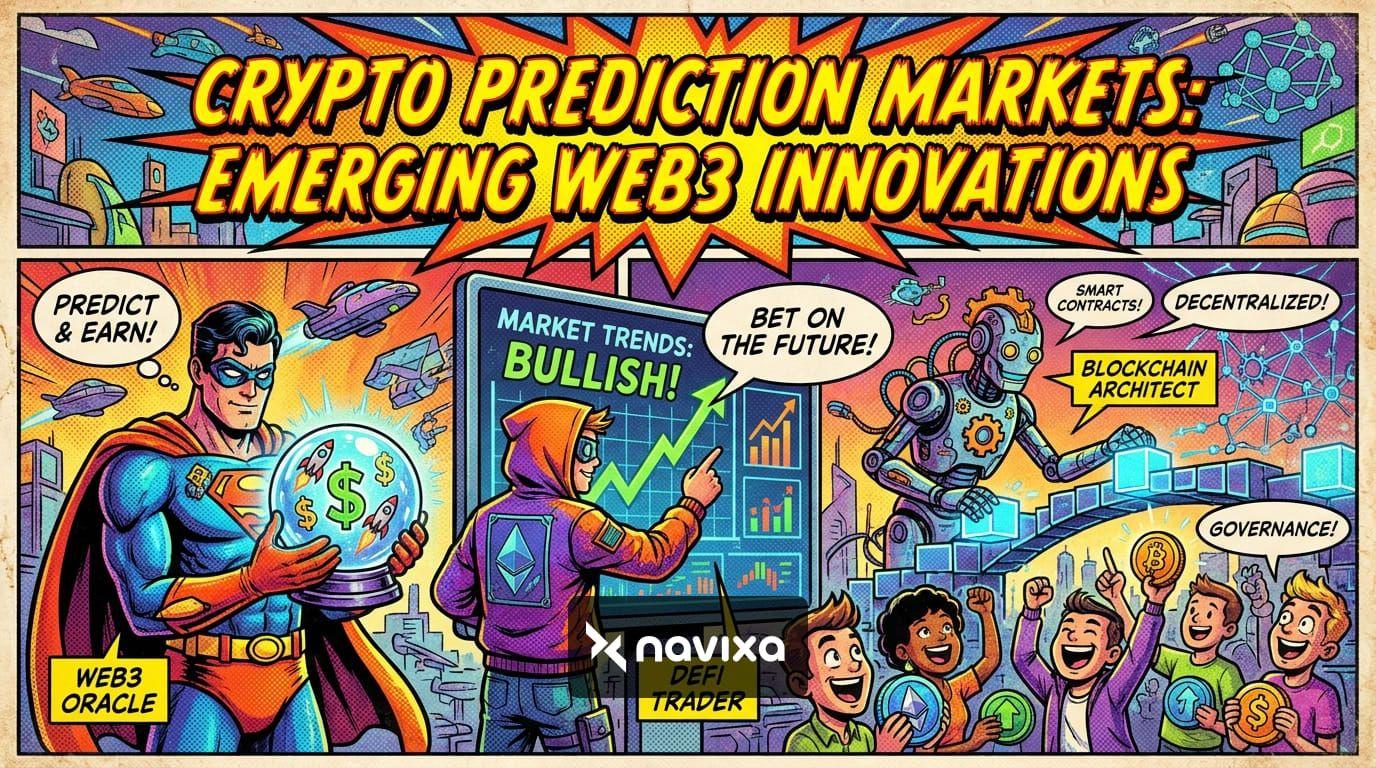
The financial landscape is undergoing a monumental shift. For decades, traditional markets have allowed investors to speculate on the future value of equities, commodities, and fiat currencies. However, the rise of Web3 has introduced a revolutionary way to capitalize on human foresight: crypto prediction markets. These platforms allow users to trade shares based on the outcomes of real-world events, transforming collective knowledge into actionable, tradable assets.
Whether it is the outcome of a major political election, the exact release date of a highly anticipated software upgrade, or the decision of a central bank regarding interest rates, crypto prediction markets offer a decentralized arena for forecasting. By leveraging smart contracts, blockchain infrastructure, and decentralized oracles, these platforms have removed the need for traditional bookmakers or intermediaries. Instead, they rely on the undeniable power of market consensus.
In this comprehensive guide, we will explore the inner workings of crypto prediction markets, highlight the platforms leading the charge, and provide actionable strategies to help you navigate and profit from trading global events.
The Evolution and Mechanics of Crypto Prediction Markets
At their core, prediction markets are event-driven exchanges where participants buy and sell shares representing the potential outcomes of a specific event. Unlike traditional sportsbooks or binary options platforms, crypto prediction markets operate on blockchain networks, utilizing automated market makers (AMMs) or decentralized central limit order books (CLOBs).
How Pricing and Shares Work
The most common structure in these markets is the binary event, which resolves as either "Yes" or "No."
When a market is created, smart contracts mint outcome tokens. If you believe a specific event will occur, you purchase "Yes" shares. The price of a share directly reflects the market's perceived probability of that outcome. For example, if a "Yes" share for an event is priced at $0.65, the market implies a 65% probability that the event will happen.
The beauty of prediction markets lies in their financial incentives: participants are financially rewarded for being correct, which drives rigorous research and highly accurate crowd-sourced forecasting.
If the event occurs, the "Yes" share resolves at exactly $1.00, yielding a $0.35 profit per share (minus fees). If the event does not occur, the share resolves at $0.00. This transparent mathematical structure allows traders to calculate their expected value and potential return on investment instantly.
Top Platforms Dominating the Ecosystem
The demand for decentralized forecasting has skyrocketed, leading to the rapid evolution of several premier platforms. Each offers distinct features tailored to different types of traders, from high-frequency scalpers to macroeconomic analysts.
Polymarket: The Decentralized Giant
Built on the Polygon network, Polymarket is arguably the undisputed leader in the decentralized prediction space. By seamlessly integrating with stablecoins like USDC, Polymarket offers an intuitive experience with deep liquidity. Recently, the platform achieved massive milestones, crossing billions in cumulative trading volume.
One of Polymarket's most groundbreaking innovations is the introduction of ultra-short-term, 5-minute crypto prediction markets. These hyper-liquid contracts allow users to wager on whether Bitcoin or Ethereum will close higher or lower within a five-minute window. Powered by high-speed oracles, these fast-paced markets routinely see tens of millions in daily trading volume, catering to traders who thrive on instant gratification and rapid price action.
Kalshi: The Regulated Powerhouse
While decentralization is a core tenet of crypto, regulatory compliance remains vital for institutional adoption. Kalshi has emerged as the premier CFTC-regulated prediction market in the United States. Though technically a centralized platform, Kalshi has rapidly expanded its market share by offering crypto deposit integrations, allowing Web3 natives to interact with a legally compliant, onshore environment. It is widely used for betting on US legislative actions, federal funds rates, and geopolitical shifts.
Drift BET and OPINION
For traders seeking ultra-low latency, Drift BET operates on the Solana blockchain, capitalizing on its high throughput and minimal transaction fees. This makes it ideal for rapid-fire trading strategies.
Meanwhile, platforms like OPINION on the BNB Chain cater specifically to macroeconomic data. Traders can speculate on niche financial metrics, such as inflation reports, unemployment claims, and central bank policies, making it a haven for traditional finance professionals transitioning into decentralized finance (DeFi).
Strategic Approaches to Trading Global Events
Trading in crypto prediction markets requires a different mindset than trading spot cryptocurrencies or perpetual futures. Here, you are not just analyzing price charts; you are analyzing human behavior, news cycles, and statistical probabilities.
1. Event-Driven Alpha
The most straightforward strategy is capitalizing on information asymmetry. In prediction markets, speed is everything. If you have access to breaking news or specialized knowledge about an industry before the broader market digests it, you can buy shares at a mispriced premium.
For example, if you closely monitor regulatory dockets and notice a positive signal regarding a Bitcoin ETF approval before mainstream media reports it, you can purchase "Yes" shares at a lower probability price, riding the price up as the crowd catches on.
2. Portfolio Hedging
Crypto prediction markets are exceptionally useful for risk management. Suppose you hold a large portfolio of a specific altcoin, and a major protocol upgrade is looming. There is a risk that if the upgrade fails or is delayed, the token's price will plummet.
You can hedge this risk by purchasing "Yes" shares in a prediction market asking, "Will the protocol upgrade be delayed?" If the delay occurs, the profit from the prediction market can offset the depreciation of your spot crypto holdings.
3. Arbitrage and Scalping
Because prediction markets are fragmented across different blockchains and platforms, price discrepancies frequently occur. A "Yes" share for a specific geopolitical event might trade at $0.55 on Polymarket but $0.62 on a competing platform. Savvy traders use arbitrage strategies to buy low on one exchange and sell high on another, locking in risk-free profit.
Additionally, traders scalp the 5-minute ultra-short-term crypto markets by using technical analysis indicators—like RSI and Bollinger Bands—to predict immediate micro-movements in Bitcoin's price.
The Role of Decentralized Oracles
A prediction market is only as reliable as its data source. Since blockchains cannot inherently access real-world data, they rely on decentralized oracles to securely pull external information on-chain to trigger smart contract settlements.
Networks like Chainlink Oracles and UMA's Optimistic Oracle provide the crucial infrastructure needed to resolve markets. Chainlink Data Streams, for instance, power high-frequency markets by delivering sub-second pricing data. Alternatively, optimistic oracles use a game-theoretic approach where a proposed outcome is accepted as truth unless actively disputed by token holders. This trustless resolution mechanism ensures that payouts are handled fairly and transparently without relying on a centralized judge.
Platform Comparison
Understanding the nuances of each platform is crucial for optimizing your trading strategy. Below is a comparison of the top prediction markets.
| Platform | Blockchain / Type | Key Focus Area | Target Audience |
|---|---|---|---|
| Polymarket | Polygon (DeFi) | Crypto prices, Politics, Pop Culture | Web3 Natives, High-Volume Traders |
| Kalshi | Centralized (CFTC) | Economics, US Legislation, Weather | US Residents, Institutional Investors |
| Drift BET | Solana (DeFi) | High-speed crypto price action | Scalpers, Low-fee seekers |
| OPINION | BNB Chain (DeFi) | Central Bank rates, Macroeconomics | TradFi analysts, Macro traders |
Actionable Steps: Executing Your First Trade
Ready to test your foresight? Follow these actionable steps to place your first trade in a decentralized prediction market:
1. Set Up a Web3 Wallet: Download and install a self-custodial wallet such as MetaMask, Phantom, or Rabby Wallet. Secure your seed phrase offline. 2. Acquire Stablecoins: Most decentralized prediction markets operate using USDC or USDT. Purchase stablecoins on a centralized exchange and transfer them to your Web3 wallet via the appropriate network (e.g., Polygon or Solana). 3. Connect and Browse: Connect your wallet to a platform like Polymarket. Browse the categories—ranging from Crypto to Global Politics—and find an event you understand deeply. 4. Evaluate the Odds: Look at the current share price. Ask yourself: *Is the market underestimating or overestimating the likelihood of this event?* If the share price is $0.30 but your research suggests a 50% chance of occurrence, you have found positive expected value. 5. Execute and Monitor: Purchase your shares. Remember that you do not have to hold the shares until the event resolves. If the probability shifts in your favor (e.g., the share price rises to $0.70), you can sell your position early to lock in profits.
Risk Management in Decentralized Forecasting
While prediction markets offer lucrative opportunities, they carry unique risks that must be managed.
Smart Contract Vulnerabilities: Because decentralized platforms rely entirely on code, there is always a residual risk of a smart contract bug or exploit. Only trade on platforms that have undergone rigorous security audits by reputable firms.
Oracle Disputes: In rare cases, the wording of a market can be ambiguous, leading to disputes over the final outcome. Always read the market's specific "Resolution Rules" carefully before committing capital. If the rules are subjective, avoid the trade.
Liquidity and Slippage: Niche markets may suffer from thin liquidity. If you place a large trade in an illiquid market, you may experience severe slippage, drastically reducing your potential returns. Stick to markets with high trading volumes unless you are trading small positions.
Frequently Asked Questions
What are crypto prediction markets?
Crypto prediction markets are decentralized platforms where users can buy and sell shares based on the outcomes of future real-world events. Utilizing smart contracts, these platforms offer transparent, peer-to-peer trading without traditional intermediaries.
How are market outcomes verified?
Decentralized platforms use Oracle networks, such as Chainlink or UMA, to securely feed real-world data into the blockchain. This data triggers the smart contract to automatically distribute payouts to the winning shares based on the actual outcome of the event.
Can I use prediction markets to hedge my crypto portfolio?
Yes. Many traders use prediction markets to hedge against adverse events. For instance, you can buy shares predicting a regulatory crackdown or a delayed protocol launch, which can offset potential losses in your actual cryptocurrency holdings if those events occur.
Are decentralized prediction markets regulated?
The regulatory landscape varies by jurisdiction. While some platforms like Kalshi are fully regulated by agencies like the CFTC in the United States, decentralized platforms operate via smart contracts and generally do not enforce KYC, putting them in a gray area depending on local laws.
Conclusion
Crypto prediction markets represent a fascinating evolution in both decentralized finance and human forecasting. By allowing individuals to seamlessly trade global events, macroeconomic trends, and micro-crypto price movements, these platforms are democratizing access to complex speculative instruments.
Whether you are using them to hedge a volatile portfolio, arbitrage market inefficiencies, or simply monetize your knowledge of global affairs, prediction markets offer an unparalleled arena for strategic trading.
Ready to trade the future? Start by setting up your Web3 wallet, diving into the data, and testing your foresight on platforms like Polymarket today. Remember to manage your risk, research your events thoroughly, and never invest more than you can afford to lose.