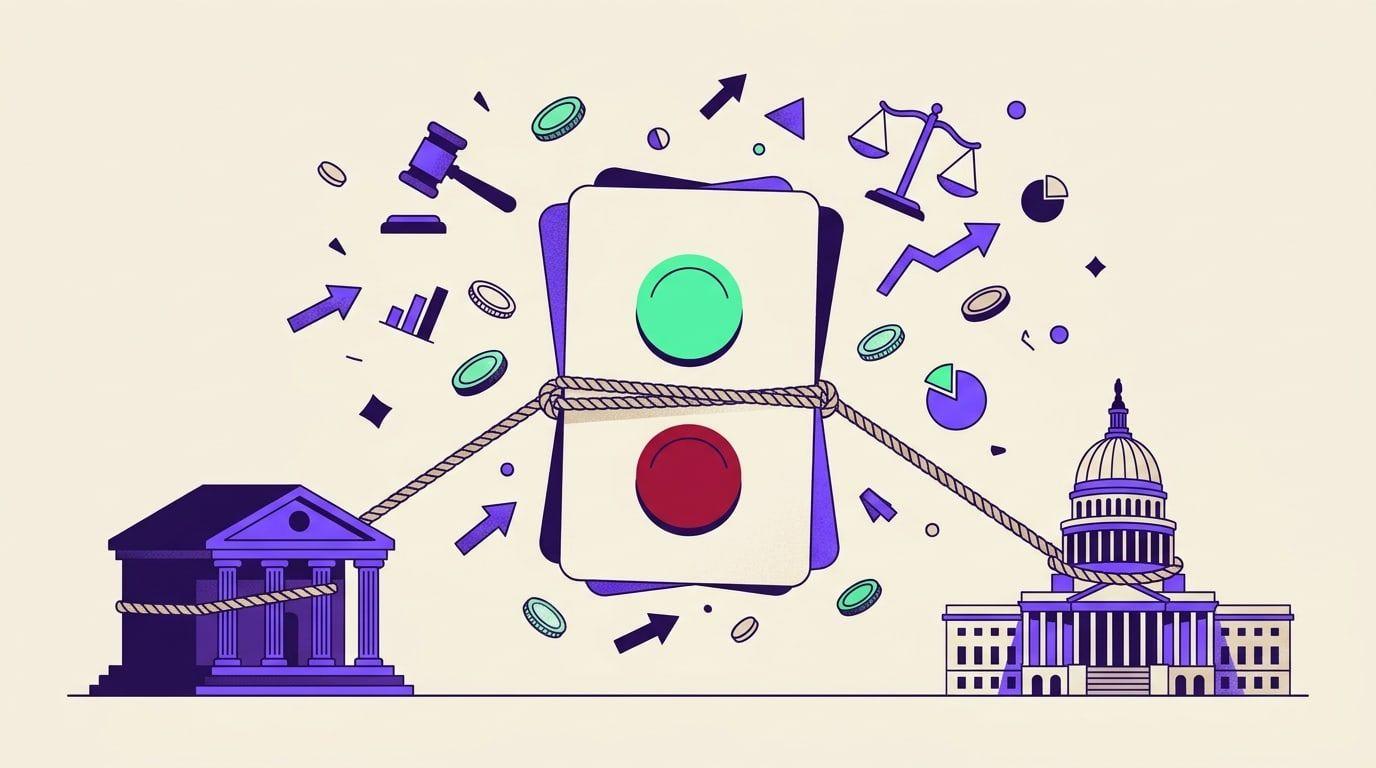
Prediction markets are legal under federal law in the US when they run on an exchange registered with the Commodity Futures Trading Commission (CFTC), such as Kalshi or Polymarket's US exchange. What is not settled is whether a state can still treat some of those contracts, above all bets on sports, as illegal gambling. As of November 15, 2026, federal appeals courts disagree, the CFTC has sued 12 states, and three petitions are waiting at the Supreme Court. So the honest answer to "is it legal for me?" depends on where you live, and it can change in a day.
This week showed how fast. On November 12, a Louisiana judge ordered 31 companies to stop offering event contracts in the state, and the next day the CFTC sued Louisiana to undo it. This article explains the fight behind those headlines, so it still makes sense when the next state moves.
- At the federal level, event contracts on CFTC-registered exchanges are legal and regulated as derivatives.
- States say sports contracts are gambling, which states license themselves; the platforms and the CFTC say federal law pushes state gambling law aside.
- Federal appeals courts are split: the Third Circuit sided with Kalshi, the Ninth and Sixth Circuits sided with the states. All three rulings are early-stage.
- The CFTC has sued 12 states and proposed a rule to write event contracts into the legal definition of a swap.
- For traders, access depends on your state and can be cut overnight, so size positions as if a platform could become unavailable.
What happened this week
On November 12, 2026, Louisiana Attorney General Liz Murrill sued Kalshi, Polymarket, Robinhood and other prediction market firms in state court. The same afternoon a judge signed a temporary restraining order, issued without a hearing, against 31 entities tied to Kalshi, Polymarket, Robinhood, Crypto.com, Coinbase, Gemini, Interactive Brokers' ForecastEx and others. The order bars them from offering contracts on sports, elections, awards and other events to people in Louisiana without a state license and tells them to block the state by location. Kalshi then cut off its Louisiana users, The Block reported.
On November 13, the CFTC sued Louisiana in federal court, asking a judge to declare that state gambling law cannot be applied to CFTC-regulated markets and to stop the state order. The agency called Louisiana "the 12th state the CFTC has sued" and, the same day, announced a suit against Arkansas. CFTC Chairman Michael Selig called the state's case "naked lawfare and a cynical political stunt." Murrill answered that "Gambling has been regulated by states for 250 years."
The federal side is not soft on the platforms either. On November 10, reports said the CFTC had warned Kalshi it could face charges over how it notified the agency of new contracts. Kalshi called it "a procedural error involving the submission of a handful of contracts." The fight is about who regulates prediction markets, not about whether they are regulated at all.
Why there are two rulebooks
A prediction market sells event contracts: a contract that pays out if something happens (a team wins, the Fed cuts rates, a candidate is elected) and pays nothing if it doesn't. Its price moves between zero and the payout, so it reads like a crowd's estimate of the odds. Two bodies of law claim these contracts.
Federal derivatives law. The Commodity Exchange Act gives the CFTC "exclusive jurisdiction" over swaps and futures traded on exchanges it registers, called designated contract markets. Kalshi is one, and Polymarket's US exchange received its CFTC approval in November 2025. An exchange can list a new contract by certifying to the CFTC that it follows the rules, without waiting for approval. If these contracts are swaps, the platforms argue, a state cannot add its own licensing on top.
State gambling law. Gambling has long been regulated by the states, and since the Supreme Court struck down the federal sports betting ban in Murphy v. NCAA on May 14, 2018, each state decides whether to allow sports betting and licenses the sportsbooks. A contract that pays out when a team wins looks to these states like a sports bet sold without a license.
The states also point to the CFTC's own rulebook. Rule 40.11 says a registered exchange may not list event contracts that involve "terrorism, assassination, war, gaming, or an activity that is unlawful under any State or Federal law." To a state, a sports contract involves gaming and an activity unlawful under state law. To the platforms, a sports contract is a financial instrument on an outcome, not gaming itself.
| Question | Platforms and the CFTC | States |
|---|---|---|
| What is a sports event contract? | A swap, a federally regulated derivative | A sports bet sold without a license |
| Who regulates it? | Only the CFTC, under the Commodity Exchange Act | The state gaming regulator, as with any sportsbook |
| Does state gambling law apply? | No, federal law preempts it on registered exchanges | Yes, federal law leaves gambling to the states |
| What about elections and awards? | Also event contracts under CFTC rules | Several states, including Louisiana, say these are illegal bets too |
What the courts have said so far

Three federal appeals courts have now ruled, and they don't agree:
| Court | Date | States covered | Result |
|---|---|---|---|
| Third Circuit (New Jersey) | April 6, 2026 | NJ, PA, DE | For Kalshi, 2 to 1 |
| Ninth Circuit (Nevada) | August 28, 2026 | Western states incl. NV, CA, AZ, WA | For the state, 3 to 0 |
| Sixth Circuit (Ohio, Tennessee) | September 25, 2026 | OH, TN, MI, KY | For the states, 3 to 0 |
| Fourth Circuit (Maryland) | Argued May 7, 2026 | MD, VA, NC, SC, WV | No ruling yet |
The Third Circuit held that Kalshi's sports contracts are swaps and that federal law blocks New Jersey from enforcing its gambling law against them. The dissenting judge wrote that the products are "virtually indistinguishable from the betting products available on online sportsbooks." The Ninth Circuit went the other way for Nevada and denied Kalshi's request for a rehearing on November 4.
The Sixth Circuit's opinion shows best where the courts part ways. The law counts a contract on an event as a swap if the event is "associated with a potential financial, economic, or commercial consequence." The Third Circuit read that broadly: a game has economic stakes for sponsors, networks and teams. The Sixth Circuit read it narrowly: the event must be "intrinsically associated with a financial consequence," like a change in interest rates, and a game's economic effects are only downstream. It added that even if the contracts were swaps, federal law would not push Ohio's and Tennessee's gambling laws aside.
That split explains why contracts on the economy are rarely the target. When a Washington state court ordered Kalshi to stop offering sports, election and entertainment contracts in August 2026, it left commodities, climate, economics and finance contracts alone.
One caveat applies to every ruling in the table: they decide whether to block enforcement while a case goes on (a preliminary injunction), not who wins in the end. And each binds only its own circuit.
The CFTC's counterattack, and the states' escalation
Under Selig, the CFTC has stopped waiting for the courts. It sued Arizona, Connecticut and Illinois on April 2, 2026, then New Mexico, Utah and others, and this week Arkansas and Louisiana. The agency says it has also filed briefs defending its jurisdiction in four federal appeals courts and one state supreme court.
It is also changing the definitions the courts argue about. On October 9, 2026 the CFTC proposed a rule that would write event contracts on sports, politics, culture and weather into the definition of a swap; Selig called them "commodity derivatives squarely within the CFTC's regulatory remit." The same day it issued an interim rule that keeps casino-style products, such as sportsbook wagers and casino games, out of that definition. The proposal goes straight at the question the Sixth Circuit answered against Kalshi. Whether courts will defer to the agency's new definition is a separate question that the coming cases will test.
The states have escalated too, from cease-and-desist letters to criminal cases. Arizona filed 20 criminal counts against Kalshi on March 17, 2026, the first criminal charges against a prediction market. Utah followed on October 28, charging Kalshi and its two founders. A CBS Sports state tracker updated on November 13 counted active lawsuits in 16 states.
Will the Supreme Court decide it?
Probably at some point, but not yet. When federal appeals courts disagree on an important question, that is one of the main reasons the Supreme Court takes a case, under its Rule 10. New Jersey, Robinhood and Crypto.com's US derivatives exchange filed petitions in September 2026, and none has been granted, according to DeFi Rate's litigation tracker. The Court has extended the deadline for the response to one of them to December 7. If the Court takes a case, a decision would likely come months later, and until then the patchwork stays.
What this means if you trade prediction markets
- Your location decides your access. The same app can offer sports contracts in one state and block them in the next. Kalshi's Louisiana users were cut off after a court order signed without a hearing.
- Sports contracts carry the most legal risk. Election and entertainment contracts are often included too, while the Washington order, for one, left economics and finance contracts alone.
- The orders so far target new trading. After a Michigan court order in June 2026, users reported being blocked from opening new sports positions while other markets stayed open. Each order is different, so read the platform's notice for your state rather than assuming.
- Don't route around a geoblock. If your state has blocked a platform, using it from there means trading against a court order and the platform's own terms.
- Know which platform you are on. Polymarket's crypto-based international site and its CFTC-registered US exchange are different venues with different rules. US customers of the US exchange trade through registered brokers.
- Size for the access risk. Treat the chance that a market becomes unavailable as part of the risk of the trade, and don't keep more on a platform than you could live with being frozen for a while. Our guide on how to calculate position size shows the method.
A platform being regulated by the CFTC does not settle whether its sports contracts are legal where you live. Courts are split on exactly that question, and a state order can take effect the same day it is signed. This article explains a legal dispute; it is not legal advice.
What to watch next
Dates as of November 15, 2026:
- November 20: a federal court in Utah hears the CFTC's request for a temporary restraining order against Utah.
- November 23: a federal court in western Louisiana hears Kalshi's own request for a preliminary injunction against the state.
- November 30: the hearing date set in Louisiana's order for turning it into a longer-lasting injunction. The case has since been moved to federal court, so this date may change.
- December 7: the response deadline in one of the Supreme Court petitions. A decision on whether to hear the case can only come after that.
- Any day: the Fourth Circuit's ruling on Maryland, which will add a fourth appeals court to the count.
- Later: the final version of the CFTC's swap definition rule, and whether the CFTC files charges against Kalshi over its contract filings.
If the Supreme Court takes a case, traders watch which question it agrees to answer: whether sports contracts are swaps at all, or whether federal law preempts state gambling law even if they are. The answer to the first decides the fate of sports contracts; the answer to the second decides who regulates every event contract.
FAQ
Is Kalshi legal in my state?
Kalshi is a CFTC-registered exchange and operates in most states, but some states have restricted it, mostly for sports contracts, and the list changes with each court order. Check the platform's own notice for your state and a recently updated tracker such as CBS Sports'.
Is Polymarket legal in the US?
Polymarket's US exchange is CFTC-registered; under its November 2025 approval, US customers trade through registered brokers. Its international, crypto-based site is a separate platform. Several states have named Polymarket in their actions, so the state-level picture is the same as for Kalshi.
Are prediction markets gambling?
That is the question the courts are splitting on. Federally they are regulated as derivatives. The Ninth and Sixth Circuits accepted that states may treat sports contracts as gambling; the Third Circuit did not. No court has yet issued a final ruling on the merits.
What happens to my money if my state blocks a platform?
The orders so far have been aimed at new trading in the state, such as opening new sports positions. How open positions and balances are handled differs by order and by platform, so read the platform's notice, and don't keep more on any single platform than you could do without for a while.
The bottom line
Prediction markets are legal federal products caught in a fight over who gets to regulate them. Until the Supreme Court or Congress settles it, the answer to "is this legal?" depends on your state, your contract type and this week's court docket. If you trade these markets, plan for that uncertainty the same way you plan for price risk. For how the two biggest platforms compare, see our guide to Kalshi vs. Polymarket, and for keeping your head when markets move on headlines, read Polymarket trading psychology.