
Introduction
The rise of prediction markets has fundamentally changed the way market participants interact with global events, politics, and financial news. As platforms like Polymarket hit record-breaking heights—exceeding $20 billion in monthly trading volume—a new breed of trader has emerged. But alongside this massive influx of capital comes a crucial realization: success in event-based trading is not just about having the right information; it is fundamentally about mastering Polymarket trading psychology.
Unlike traditional cryptocurrency trading, where assets can be held indefinitely, prediction markets are strictly bound by time and binary outcomes. A contract will ultimately resolve to $1.00 or $0.00. This definitive resolution leaves no room for holding onto a "losing bag" in the hope that it will recover years down the line. To thrive in this high-stakes environment, traders must master risk discipline and learn to navigate the unique emotional hurdles that prediction markets present.
In this comprehensive guide, we will break down the core components of Polymarket trading psychology, explore the cognitive biases that destroy traders' bankrolls, and provide an actionable risk management framework designed for the realities of modern event contracts.
The Unique Landscape of Prediction Markets
To understand the psychology of prediction markets, we first have to understand the mechanics that drive them. When you buy a "Yes" or "No" share on Polymarket, the price you pay (e.g., 35¢) represents the market's implied probability (35%) that an event will occur. If you are correct, the share pays out at $1.00. If you are wrong, it goes to zero.
This all-or-nothing mechanic creates an incredibly high-pressure psychological environment. In early 2026, global liquidity on the platform exploded following massive institutional backing, such as the $600 million direct cash investment from the Intercontinental Exchange (ICE). With mainstream adoption surging and sports, politics, and geopolitical markets routinely seeing tens of millions in volume, the temptation to over-leverage based on "breaking news" is at an all-time high.
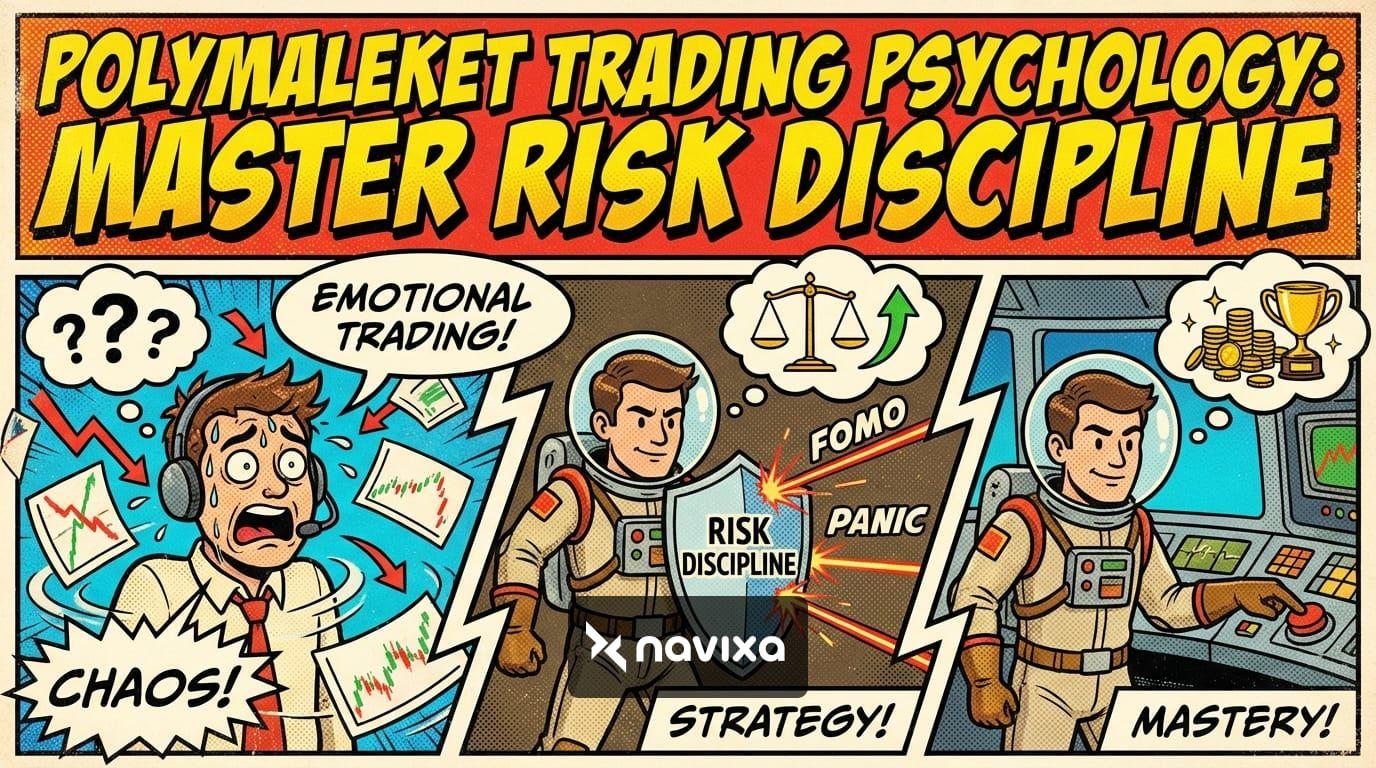
Because these markets react instantaneously to real-world events, traders frequently fall victim to impulsive decisions. A single headline can cause a contract's implied probability to swing wildly. Those who lack a solid grasp of Polymarket trading psychology often find themselves buying at the top of a news cycle out of Fear of Missing Out (FOMO) or panic-selling at the bottom.
Cognitive Biases: The Enemies of Risk Discipline
Mastering your mind is the first step toward profitability. The human brain is naturally wired to recognize patterns and avoid pain, but in prediction markets, these hardwired instincts often lead to catastrophic losses. Here are the most prominent cognitive biases you must overcome.
1. The Confirmation Bias and Ideological Tilt
Perhaps the most dangerous trap in Polymarket trading psychology is trading with your heart instead of your head. Because prediction markets heavily feature political elections and contentious geopolitical events, traders often blur the line between what they *want* to happen and what is *probabilistically likely* to happen.
"The market does not care about your political affiliation. It only cares about probability."
For example, if a trader passionately supports a particular political candidate, they may consistently buy "Yes" shares even when objective polling and market data suggest a low probability of victory. Mastering risk discipline requires leaving your personal ideology at the door. You are not voting; you are pricing risk.
2. The Long-Shot Bias (The Lottery Ticket Mentality)
Prediction markets are notorious for the "long-shot bias," where participants overvalue highly improbable events. Traders frequently buy "Yes" shares priced at 1¢ or 2¢ because the potential 50x payout feels exhilarating. However, probabilistically, a 1¢ share implies a 1% chance of occurrence. While it feels cheap, constantly buying these lottery tickets drains bankrolls over time. The "Nothing Ever Happens" markets—which reward the status quo and have generated hundreds of thousands in consistent volume—often quietly generate steady returns while novice traders bleed capital chasing black swan events.
3. Recency Bias and Headline Chasing
When news breaks, the market overreacts. In a 24/7 news cycle, an unverified rumor can temporarily push a contract's price from 20¢ to 60¢ within minutes. Traders suffering from recency bias will buy at 60¢, assuming the momentum will continue to 100¢. Often, as the news is digested or debunked, the price reverts to its mean. Successful traders anticipate these emotional spikes and use them as liquidity to fade the public, selling into the hype rather than buying it.
Master Risk Discipline: A Winning Strategy
To survive the brutal variance of binary outcomes, you need a mathematical approach to capital allocation. Polymarket trading psychology is ultimately about emotional control enforced by mathematical rules.
The Expected Value (EV) Framework
At the heart of professional prediction market trading is Expected Value (EV). You should only enter a trade if your calculated probability of an event occurring is significantly different from the market's implied probability.
If a "Yes" share is trading at 40¢, the market says there is a 40% chance of the event happening. If your rigorous research indicates the true probability is 60%, you have identified a +EV opportunity. Risk discipline means betting *only* when a +EV gap exists, regardless of how "sure" a mainstream narrative seems.
Position Sizing and the Kelly Criterion
Because prediction contracts can go to zero, going "all in" on a single event is guaranteed financial ruin. Advanced traders often adapt the Kelly Criterion—a mathematical formula used to determine the optimal size of a series of bets—to size their Polymarket positions.
Even if you believe an outcome is a 90% certainty, allocating more than 5-10% of your total bankroll exposes you to extreme tail-risk. Proper Polymarket trading psychology dictates that capital preservation is your primary objective. If you lose your bankroll, you lose your ability to capitalize on future mispricings.
Hedging and Taking Profits Early
A common psychological flaw is believing you must hold a contract until resolution. You do not. If you buy a contract at 20¢ and it surges to 70¢ due to shifting news, you have secured a 250% return. Risk discipline often involves selling a portion (or all) of your position to lock in profit rather than risking the remaining 30¢ upside against a potential drop back to zero. Taking profits early is the hallmark of a trader who understands variance.
Technical and Fundamental Synthesis
Polymarket offers order books, price charts, and depth charts. While fundamentals (real-world news, data, polling) drive the ultimate resolution, technical analysis (TA) plays a vital role in short-term trading.
Identifying Support and Resistance in Probabilities
Because humans are creatures of habit, certain probability levels act as psychological barriers. For instance, a contract might consistently find resistance at 50¢ because the market genuinely views the outcome as a coin flip. Recognizing these levels allows traders to place strategic limit orders, accumulating shares during irrational dips and distributing them at historical resistance points.
Navigating Insider Trading Narratives
Prediction markets operate on the bleeding edge of information. In early 2026, Polymarket implemented updated market integrity rules across its DeFi platform and CFTC-regulated U.S. exchange to explicitly prohibit insider trading based on stolen or confidential information. However, rumors still heavily influence price action. A disciplined trader doesn't blindly follow anonymous big money; they cross-reference sudden order book volume with verified macroeconomic or geopolitical data before committing capital. For deeper insights on global macro data, consider using tools like the Federal Reserve Economic Data (FRED) or Trading Economics.
Actionable Steps for Traders
If you want to refine your Polymarket trading psychology, implement these strict rules immediately:
* Establish a Dedicated Bankroll: Isolate your prediction market funds from your core crypto or traditional finance portfolios. * Set Hard Exposure Limits: Never allocate more than 5% of your bankroll to a single correlated event (e.g., if you bet on three different contracts related to the same geopolitical conflict, treat them as one exposure). * Journal Your Trades: Document exactly *why* you entered a trade. Was it based on a statistical edge, or were you bored and seeking dopamine? Reviewing a trading journal is the fastest way to eliminate emotional tilt. * Fade Your Own Biases: Actively seek out high-quality information that contradicts your current position. If your thesis cannot survive aggressive counter-arguments, close the trade.
Risk Management Framework
To highlight why risk discipline must be adapted for Polymarket, consider this comparison between traditional digital asset trading and prediction markets:
| Feature | Traditional Crypto Trading (e.g., BTC, ETH) | Polymarket Event Contracts |
|---|---|---|
| Asset Lifespan | Perpetual; can be held indefinitely. | Fixed; expires upon event resolution. |
| Maximum Loss | Rarely 100% (unless using extreme leverage). | Often 100% (incorrect predictions go to $0.00). |
| Valuation Metric | Network usage, tokenomics, macro liquidity. | Real-world probability, polling, direct news events. |
| Price Ceiling | Theoretically infinite. | Capped at $1.00 per share. |
| Psychological Driver | Greed, HODL mentality, cycle narratives. | Information asymmetry, binary risk, strict deadlines. |
This table clearly illustrates why the "HODL" mentality is fatal in prediction markets. You are trading time-bound probabilities, not digital commodities that can weather a multi-year bear market.
Practical Takeaways
Mastering Polymarket trading psychology requires a fundamental shift in how you view the market. Here are the core takeaways:
1. Probability Over Certainty: Never think in absolutes. Think purely in percentages and implied odds. 2. Emotional Detachment: The market does not care who you want to win an election or a sports match. Trade the numbers, not your preferences. 3. Active Risk Management: Utilize limit orders to avoid slippage on illiquid contracts, and never chase green candles sparked by unverified news. 4. Capital Preservation First: Your bankroll is your inventory. Protect it fiercely by avoiding the 1¢ long-shot lottery tickets unless you have a quantifiable statistical edge.
Conclusion
The unprecedented growth of platforms like Polymarket has ushered in a golden era for information-driven traders. With monthly volumes surging past $20 billion and regulatory frameworks like CFTC compliance taking shape, prediction markets are no longer a niche crypto experiment—they are a mainstream financial primitive.
However, the speed and binary nature of these markets act as a crucible for human emotion. Polymarket trading psychology is the dividing line between those who view the platform as a casino and those who treat it as a professional risk-transfer engine. By mastering risk discipline, understanding Expected Value, and ruthlessly stripping cognitive biases from your decision-making process, you can consistently identify mispriced probabilities.
Stop reacting to headlines and start trading the math. Equip yourself with the right mindset, stick to your risk management rules, and let your mathematical edge compound over time.
---
Frequently Asked Questions
What is Polymarket trading psychology?
Polymarket trading psychology refers to the mental and emotional framework required to successfully trade binary event contracts. It involves overcoming cognitive biases—such as confirmation bias and FOMO—and making rational, probability-based decisions rather than emotionally driven bets on real-world outcomes.
How does risk management differ in prediction markets compared to crypto?
In traditional crypto, spot assets rarely go to absolute zero, allowing traders to hold underwater positions. In prediction markets, a wrong prediction resolves exactly to $0.00. Therefore, risk management requires strict bankroll limits, expected value (EV) calculations, and the willingness to take profits before an event fully resolves.
Can you apply technical analysis to Polymarket?
Yes, but with caveats. While fundamental news and real-world data ultimately determine a market's resolution, technical analysis can be used to identify support and resistance levels in the implied probability (price). Traders use the order book and price charts to find strategic entry and exit points, capitalizing on short-term market overreactions.
Why do most novice traders lose money on prediction markets?
Novice traders often treat prediction markets like a casino. They suffer from the "long-shot bias," buying cheap, highly improbable contracts hoping for a lottery-like payout. They also frequently let political or ideological beliefs dictate their trades, completely ignoring objective probabilities and proper position sizing.
Is it necessary to hold a Polymarket contract until the event resolves?
No. Many professional traders rarely hold contracts to resolution. If you buy a contract at 30¢ and favorable news pushes it to 80¢, you can sell your shares to lock in a substantial profit. Taking early profits eliminates the risk of a late-stage reversal wiping out your investment.