
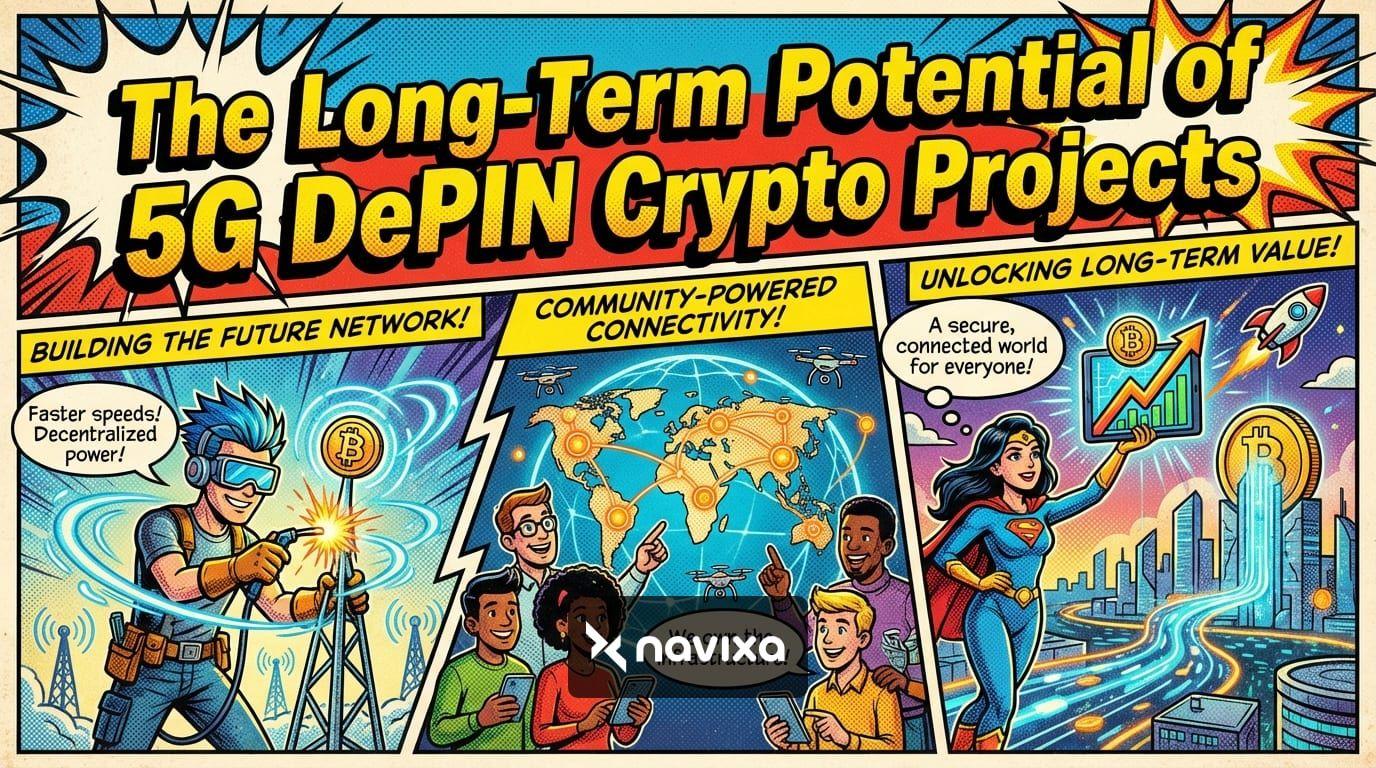
The telecommunications industry has historically been dominated by a handful of centralized, multi-billion-dollar conglomerates. For decades, these giants have controlled the pricing, coverage, and infrastructure of global connectivity. However, the rise of Decentralized Physical Infrastructure Networks (DePIN) is radically altering this landscape. By leveraging blockchain technology and tokenized incentives, a new wave of decentralized networks is crowdsourcing infrastructure development. Among the most disruptive innovations within this sector are 5G DePIN crypto projects, which aim to democratize mobile connectivity, lower costs for consumers, and reward hardware providers with cryptocurrency.
With the total market capitalization of the DePIN sector surging past $19 billion, the shift from theoretical blockchain applications to real-world utility is fully underway. This article delves into the long-term potential of 5G DePIN crypto projects, analyzing the fundamental technology, reviewing the top market leaders, and outlining actionable trading and investment strategies for navigating this rapidly growing asset class.
The Paradigm Shift: What Are 5G DePIN Crypto Projects?
At its core, DePIN stands for Decentralized Physical Infrastructure Networks. These ecosystems use cryptographic tokens to incentivize individuals and businesses to deploy and maintain physical hardware—such as sensors, storage drives, and wireless routers. When applied to telecommunications, 5G DePIN crypto projects create community-driven cellular networks.
Instead of a single corporation purchasing land, building massive cell towers, and monopolizing local coverage, DePIN relies on a distributed network of "node operators." These operators purchase specialized 5G small-cell hardware, install it on their rooftops, balconies, or storefronts, and broadcast localized cellular coverage. In exchange for providing verifiable network uptime and transferring mobile data, these operators are rewarded with native cryptocurrencies.
"DePIN uses token incentives to mobilize communities instead of corporations to build critical infrastructure, reshaping blockchain by taking decentralization into the physical world."
This model fundamentally flips the traditional telecom infrastructure narrative. It drastically reduces capital expenditures (CapEx) for the network creators, as the community funds the hardware. Furthermore, by utilizing consensus mechanisms like "Proof of Coverage," these blockchains ensure that the network is reliable, functional, and accurately positioned to serve actual mobile users.
Leading 5G DePIN Crypto Projects Dominating the Market
As the DePIN sector matures, several high-profile projects have established themselves as industry leaders. Understanding the nuances of these networks is essential for any investor or trader looking to capitalize on the 5G narrative.
Helium and Helium Mobile ($HNT, $MOBILE)
The undisputed pioneer of decentralized wireless infrastructure is the Helium Network. Originally focused on Internet of Things (IoT) connectivity via its LoRaWAN network, Helium successfully pivoted into the cellular space with Helium Mobile. Following its strategic migration to the Solana Blockchain, Helium unlocked lightning-fast transaction speeds and minimal fees, which are critical for processing millions of micropayments to hardware operators.
Within the Helium ecosystem, the overarching governance and utility token is $HNT. However, the specific sub-network dedicated to 5G coverage utilizes the $MOBILE token. Participants can earn $MOBILE in two primary ways: 1. Operating a 5G Hotspot: Users who purchase and deploy approved 5G small cells earn tokens by providing verified cellular offload coverage. 2. Discovery Mapping: Subscribers to the Helium Mobile phone plan can opt-in to share their location data. This "mapping" helps the network identify coverage blind spots and rewards the user with daily $MOBILE emissions, effectively gamifying mobile usage and sometimes offsetting the entire cost of their phone bill.
Helium Mobile has successfully implemented a hybrid model, partnering with major traditional carriers like T-Mobile to ensure that users maintain seamless connectivity even when outside the range of community-operated hotspots.
XNET ($XNET)
While Helium focuses heavily on retail consumers and grassroots expansion, XNET targets enterprise-grade carrier offloading. XNET is designed to relieve network congestion for traditional telecom operators in high-density urban environments. By deploying carrier-grade Wi-Fi and 5G nodes, XNET operators help absorb the massive data traffic generated in cities, sports arenas, and commercial districts. Participants in the XNET ecosystem are rewarded with $XNET tokens for maintaining highly reliable, compliant infrastructure.
Trading Strategy for 5G DePIN Tokens
Investing in 5G DePIN crypto projects requires a different approach than trading pure meme coins or Layer-1 smart contract platforms. Because these tokens are backed by physical hardware deployment and real-world cash flows (e.g., users paying for phone plans), traders must blend fundamental analysis with traditional crypto momentum strategies.
Fundamental Network Valuation
When evaluating a 5G DePIN token, traders should look beyond standard metrics like market capitalization. Key performance indicators (KPIs) include: * Active Node Count: The total number of operational hotspots. A steadily increasing node count signals strong community adoption. * Network Utilization: How much data is actually moving through the decentralized network? Projects that transition from simply "building coverage" to "processing paid data" have a much stronger fundamental floor. * Token Burn Mechanisms: Many DePIN networks require the native token to be burned (destroyed) to purchase network credits. If data usage scales, the token burn rate increases, creating deflationary pressure on the asset.
Cycle Positioning and Supply Shocks
DePIN tokens are uniquely tied to real-world supply chains. If a project experiences explosive popularity, the physical hardware required to mine the token often sells out. This creates a bottleneck where network emissions remain distributed among existing operators, potentially leading to increased profitability and concentrated token accumulation. Traders should monitor hardware manufacturer inventory levels; hardware shortages often precede localized supply shocks in the token market, presenting lucrative swing trading opportunities.
Technical Analysis and Market Dynamics
From a technical analysis perspective, tokens like $HNT and $MOBILE often exhibit distinct market structures dictated by emission schedules and broader crypto market cycles.
Moving Averages and Volume Profile
When analyzing DePIN charts on data aggregators like CoinMarketCap, traders should pay close attention to the 50-day and 200-day Exponential Moving Averages (EMAs). Because DePIN attracts long-term investors ("miners" who want to hold their earned rewards), these assets tend to trend steadily rather than experiencing violent, flash-crash volatility typically seen in other altcoin sectors.
Volume profiles are equally critical. Accumulation phases in 5G DePIN projects often feature prolonged periods of low-volatility sideways movement, punctuated by spikes in buying volume when the project announces a new traditional telecom partnership or hardware rollout. Buying near the Point of Control (POC) during these consolidation phases offers an asymmetric risk-to-reward ratio.
Actionable Steps: How to Invest and Participate
For those looking to gain exposure to the 5G DePIN narrative, there are multiple avenues of entry, ranging from passive holding to active infrastructure deployment.
1. Spot Accumulation and Staking
The easiest way to gain exposure is by purchasing governance tokens ($HNT) or network-specific tokens ($MOBILE, $XNET) on centralized or decentralized exchanges. To maximize returns, many DePIN networks offer native staking solutions. By locking your tokens into governance contracts, you can earn yield and vote on crucial network proposals, such as emission halving schedules or new hardware approvals.
2. Hardware Deployment (Mining)
For a more hands-on approach, investors can become node operators. This involves: * Researching your local area to ensure there is a demand for cellular coverage (e.g., avoiding highly saturated areas to prevent reward dilution). * Purchasing an approved 5G small cell or outdoor radio. * Installing the hardware with optimal line-of-sight (rooftops or elevated windows). * Connecting the device to a high-speed internet backhaul and a compatible Web3 wallet.
3. Participating in Mapping and Utility
If hardware deployment is too capital-intensive, simply becoming a user of the network is a highly effective way to earn tokens. By porting your phone number to a decentralized mobile provider and enabling discovery mapping, you can passively accumulate crypto assets just by going about your daily life.
Risk Management in DePIN Investments
While the long-term potential of 5G DePIN crypto projects is massive, the sector is not without its risks. Effective risk management is crucial for capital preservation.
Hardware Depreciation and ROI Lag
Unlike buying a token on an exchange, purchasing an expensive 5G hotspot carries the risk of hardware obsolescence. If token prices drop drastically, the Return on Investment (ROI) period for the hardware could extend from months to years. Operators must treat hardware purchases as sunk costs and calculate potential ROIs based on conservative token price estimates.
Emission Inflation
Most DePIN networks bootstrap their initial coverage by offering massive inflationary rewards to early adopters. Over time, these token emissions are reduced (halved) to prevent hyperinflation. Traders buying tokens during the early, high-emission phases must be wary of downward price pressure caused by miners continuously selling their rewards to cover electricity and internet overhead.
Regulatory Hurdles
Telecommunications is a highly regulated industry globally. The deployment of decentralized cellular networks requires navigating complex spectrum licensing laws. While projects currently use unlicensed spectrums like CBRS (Citizens Broadband Radio Service) in certain regions, regulatory shifts could potentially hinder network expansion. Investors must stay informed about governmental policies regarding wireless frequency allocations.
Project Comparison
To better understand how decentralized networks stack up against legacy systems, refer to the comparison table below:
| Feature / Project | Helium Mobile ($MOBILE) | XNET ($XNET) | Traditional Telecom |
|---|---|---|---|
| Infrastructure Ownership | Community / Node Operators | Enterprise / Node Operators | Centralized Corporation |
| User Rewards | Yes (Mapping & Hosting) | Yes (Hosting) | None |
| Token Ecosystem | Solana Blockchain ($MOBILE, $HNT) | Polygon / Blockchain-Agnostic | N/A (Fiat only) |
| Expansion Strategy | Grassroots retail & hybrid offload | Dense urban carrier offloading | Heavy CapEx & Debt Financing |
| Setup Cost for Users | Low (Phone plans as low as $0-$20) | N/A (B2B focused) | Moderate to High |
Practical Takeaways
* Diversify Your Approach: Combine spot token holding with active network participation (like discovery mapping) to maximize your yield while managing market volatility. * Follow the Data: Track on-chain metrics such as active node count and data usage to verify that a DePIN project is actually gaining real-world traction, rather than relying purely on speculation. * Hedge Your Bets: Because hardware ROI is tied to token prices, consider taking periodic profits on your mined tokens to recover your initial hardware investment faster. * Watch the Ecosystem: DePIN projects operate best on fast, low-cost blockchains. Keep an eye on the broader health of networks like Solana, as their stability directly impacts the efficiency of the DePIN protocols built on them.
Conclusion
The emergence of 5G DePIN crypto projects represents a rare convergence of blockchain technology and physical utility. By decentralizing the telecommunications infrastructure, networks like Helium and XNET are proving that community-driven models can legitimately compete with legacy telecom monopolies. For cryptocurrency traders and investors, this sector offers a unique blend of fundamental value investing and high-growth potential.
However, success in this niche requires a deep understanding of network tokenomics, hardware lifecycles, and localized supply-and-demand metrics. By conducting thorough fundamental and technical analysis, actively participating in the networks, and employing strict risk management, investors can position themselves at the forefront of the decentralized wireless revolution. The future of connectivity is no longer in the hands of massive corporations—it belongs to the people.
Take the next step: review your local mobile coverage, explore DePIN token charts, and consider how you can participate in the next generation of global infrastructure today.
Frequently Asked Questions
What are 5G DePIN crypto projects?
5G DePIN (Decentralized Physical Infrastructure Networks) crypto projects are blockchain-based networks that incentivize individuals to build and maintain cellular network coverage. Participants purchase and install 5G hardware, and in return, they earn cryptocurrency rewards for providing verifiable mobile coverage to users.
How do you earn passive income with 5G DePIN?
You can earn passive income primarily in two ways: by purchasing and operating a 5G hotspot that routes cellular data, or by subscribing to a decentralized mobile carrier and enabling "discovery mapping" on your smartphone to share location data in exchange for token rewards.
Are 5G DePIN tokens a good investment?
They offer strong long-term potential due to their real-world utility and ability to disrupt traditional telecom monopolies. However, like all cryptocurrencies, they are subject to high volatility. Investors should evaluate active node counts, token burn mechanics, and network usage to determine their fundamental value.
What blockchain do most 5G DePIN projects use?
Many leading DePIN projects, such as the Helium Network, have migrated to the Solana blockchain. Solana's high throughput and exceptionally low transaction fees make it ideal for managing the millions of micro-transactions required to reward hardware operators globally.
What are the main risks associated with 5G DePIN?
Key risks include token price volatility, which can delay the ROI of expensive mining hardware, regulatory challenges regarding cellular spectrum usage, and inflationary tokenomics that can suppress token prices if user demand does not match network emissions.