
The digital asset ecosystem has evolved at an astonishing rate, transforming from a fringe financial experiment into a mature, globally recognized asset class. Over the last few years, crypto futures trading has consistently eclipsed spot market volumes, propelled by massive institutional adoption, clear regulatory frameworks, and groundbreaking infrastructural upgrades. As we navigate the complexities of 2026, Bitcoin's decisive price action—pushing near the critical $80,000 threshold, bolstered by immense ETF inflows from asset managers like BlackRock—has injected unprecedented liquidity into the derivatives ecosystem. With legacy financial powerhouses such as the CME Group introducing 24/7 trading for cryptocurrency futures and options, eliminating the notorious 'weekend gap', there has never been a more opportune time to master this highly dynamic domain.
This comprehensive guide meticulously breaks down the intricate mechanics of crypto futures trading. Whether you are aiming to hedge a long-term holding, capitalize on short-term intraday price movements using strategic leverage, or deploy sophisticated algorithmic strategies, establishing a robust foundational understanding is non-negotiable. Read on to discover the essential strategies, risk management protocols, and technical analysis tools required to thrive in the modern crypto futures landscape.
What is Crypto Futures Trading?
Crypto futures trading is a mechanism that involves buying and selling standardized derivative contracts representing the value of a specific underlying cryptocurrency, such as Bitcoin, Ethereum, or Solana. Rather than taking self-custody and holding the actual digital tokens in a blockchain wallet, traders speculate solely on the asset's future price movements.
When you participate in the futures market, you are essentially entering into a legally binding agreement to buy or sell the asset at a predetermined price at a specified time in the future. However, in the realm of cryptocurrencies, a unique instrument known as the perpetual futures contract (or "perps") dominates the volume. Unlike traditional commodity futures, perpetual contracts do not possess a fixed expiration date. This key innovation allows traders to hold leveraged positions open indefinitely, provided they maintain sufficient margin in their accounts to satisfy exchange requirements.
"The distinct advantage of futures trading lies in its bidirectional nature—the ability to generate substantial profits in both aggressive bull markets and devastating bear markets, providing a degree of strategic flexibility that traditional spot holding simply cannot match."
To ensure that the price of a perpetual futures contract remains anchored to the actual real-time spot market price of the asset, cryptocurrency exchanges employ a clever algorithmic mechanism called the funding rate. If the derivative's price trades higher than the spot price, traders holding long positions are required to pay a calculated fee to those holding short positions. Conversely, if the market sentiment is heavily bearish and the derivative trades below the spot price, short sellers pay the long buyers. This continuous exchange of capital balances the market and prevents massive price deviations.
Spot vs. Crypto Futures Trading
Understanding the fundamental differences between spot trading and futures trading is arguably the most critical prerequisite before deploying your capital. While spot trading is a relatively straightforward endeavor—you purchase a digital token and secure it—futures trading introduces complexities such as leverage, margin requirements, and counterparty liquidation risks.
| Feature | Spot Trading | Crypto Futures Trading |
|---|---|---|
| Asset Ownership | Yes. You have ownership of the actual cryptocurrency. | No. You simply own a derivative contract tracking the price. |
| Market Direction | Profit only when asset prices appreciate (Long). | Profit from both upward and downward market trends (Long/Short). |
| Leverage | Usually 1x (No leverage available). | Can range from 2x up to 100x+ depending on the exchange. |
| Settlement | Immediate settlement to your crypto wallet. | Settled at contract expiration or held indefinitely (perpetuals). |
| Fees Structure | Standard trading fees (Maker/Taker). | Maker/Taker fees, plus recurring funding rates for perpetuals. |
Core Mechanics of the Futures Market
To consistently succeed in crypto futures trading, you must intimately understand several foundational concepts. Ignoring these mathematical mechanics is the fastest and most common way retail traders deplete their entire portfolios.
Leverage and Margin
Leverage is the primary draw of the futures market. It allows you to control a massive position with a relatively small amount of upfront capital, which is referred to as your margin. For instance, if you wish to open a $50,000 Bitcoin position using 10x leverage, you are only required to post $5,000 as initial margin. The exchange effectively loans you the rest. While leverage can exponentially magnify your financial gains during favorable market conditions, it symmetrically magnifies your losses when the market moves against you.
Cross Margin vs. Isolated Margin
Leading derivatives platforms provide traders with the option to choose between two distinct margin allocation modes: 1. Isolated Margin: Your margin is strictly restricted to a single open position. If the position goes against your prediction and hits the liquidation trigger, you will only lose the funds specifically allocated to that isolated trade. This is highly recommended for beginners. 2. Cross Margin: Your entire available account balance is utilized across all open positions to prevent localized liquidations. While this provides a much wider safety net for absorbing high volatility, a catastrophic market crash could potentially wipe out your entire account balance simultaneously.
Liquidation Dynamics
Liquidation occurs when the market moves against your leveraged position to the point where your margin can no longer sustain the open trade. When this mathematical threshold is breached, the exchange's risk engine automatically seizes your collateral and closes your position at the market price. Proper risk management is essential to survive unexpected volatility spikes.
Choosing the Right Derivatives Exchange
The platform you ultimately choose dictates the trading fees you pay, the liquidity available for your orders, and the advanced tools at your disposal. The ecosystem is currently categorized into highly regulated centralized entities and resilient decentralized networks.
1. CME Group: Targeting massive institutional players and hedge funds, the Chicago Mercantile Exchange offers strictly regulated, cash-settled futures. By implementing 24/7 continuous trading in 2026, CME has synchronized traditional finance with the inherent always-on nature of crypto. 2. Kraken Pro: Highly regarded for its transparent proof-of-reserves, sophisticated low-latency matching engine, and comprehensive institutional features, Kraken Pro is an exceptional centralized platform for both retail professionals and institutional derivatives traders. 3. Phemex and Binance: These centralized exchange titans continue to dominate global retail volume. They offer incredibly deep liquidity, highly competitive tiered fee structures, advanced copy-trading options, and access to hundreds of varied altcoin trading pairs. 4. dYdX: For traders prioritizing the ethos of Web3 decentralization, non-custodial security, and absolute self-custody, dYdX stands as a premier decentralized exchange (DEX). It offers fully on-chain perpetual contracts with deep liquidity and zero gas fees.
Essential Crypto Futures Trading Strategies
Entering the aggressive futures market without a well-defined and rigorously backtested strategy is akin to gambling. Successful market participants rely on specific methodologies to extract consistent gains.
1. Trend Following
Trend following is a robust macroeconomic strategy where traders identify the prevailing broader market direction and ride the established momentum. By focusing on higher timeframes—such as the 12-hour, daily, or weekly charts—you effectively filter out intraday volatility and algorithmic noise. For example, when Bitcoin pushes past heavy on-chain resistance, trend followers will systematically initiate long positions, patiently trailing their stop losses upward as the price steadily appreciates over weeks or months.
2. Breakout Trading
Cryptocurrencies are notorious for consolidating in tight, low-volatility ranges for extended periods before experiencing sudden, explosive directional movements. Breakout traders patiently wait for the asset's price to definitively breach a highly contested support or resistance level, heavily prioritizing instances accompanied by massive trading volume. Once the breakout is verified by a candlestick close, they aggressively enter a futures position in the direction of the momentum.
3. Scalping
Scalping is an intense, ultra-high-frequency trading strategy. Scalpers open and close highly leveraged positions within minutes—and sometimes seconds—aiming to capitalize on microscopic order book inefficiencies and fractional price movements. This demanding strategy requires unwavering focus, an intricate understanding of market depth, and a trading environment boasting virtually zero execution latency.
4. Strategic Hedging
If you hold a massive spot portfolio and anticipate a severe short-term macroeconomic downturn (such as a disappointing interest rate decision), you can utilize futures to hedge your downside exposure. By opening a short futures position equivalent in value to your spot holdings, any fiat value lost in your spot portfolio during the crash is perfectly offset by the leveraged profits generated from your short trade.
Leveraging Technical Analysis
Technical analysis (TA) acts as the navigational compass for active derivatives traders. By meticulously analyzing historical price action, patterns, and volume metrics, TA provides probabilistic insights into future market behavior.
Moving Averages (MA & EMA)
Moving averages effectively smooth out erratic price data to clearly illustrate the overarching market trend. The 50-day and 200-day Simple Moving Averages are widely monitored. Furthermore, Exponential Moving Averages (EMAs) react faster to recent price changes, making them invaluable for short-term futures traders seeking early entry signals.
Relative Strength Index (RSI)
The RSI is a highly popular momentum oscillator that measures the velocity and magnitude of recent price shifts. Ranging on a scale from 0 to 100, an RSI reading above 70 typically suggests a digital asset is overbought and potentially due for a bearish pullback. Conversely, an RSI plummeting below 30 indicates oversold market conditions, frequently signaling a lucrative entry point for a contrarian long position.
Volume Profile
Unlike standard traditional volume indicators that plot trading activity purely over a timeline, the Volume Profile plots trading activity at specific price levels. This advanced tool helps traders visually identify high-liquidity nodes that act as unbreakable support or massive resistance ceilings, allowing for surgical precision when placing limit entries and take-profit targets.
Strict Risk Management Rules
The fundamental reason the vast majority of retail traders fail in crypto futures trading is not due to a lack of an effective strategy, but rather a complete lack of risk management.
* The 1% Rule: Never, under any circumstances, risk more than 1% to 2% of your total trading capital on a single speculative trade. This mathematical safety net ensures that even if you suffer a string of consecutive losses, you will not bankrupt your account and can stay in the game. * Mandatory Stop-Loss Orders: A stop-loss is an automated exchange order that instantly closes your position once the price hits a predefined invalidation level, mechanically halting further financial bleeding. You must never enter a futures trade without a hard stop-loss firmly in place. * Optimize Risk-to-Reward Ratios: Consistently aim for trading setups that offer a minimum of a 1:2 risk-to-reward ratio. This structure dictates that for every $100 you risk losing, you stand to profit at least $200. With this asymmetric ratio, you can afford a 50% win rate and still yield consistent long-term profitability. * Resist the Allure of Over-leveraging: While the prospect of 100x leverage is intoxicating, it dramatically tightens the breathing room your trade needs to survive normal intraday market fluctuations. Limit yourself to conservative leverage (2x to 5x) until you have demonstrably proven consistent profitability over multiple quarters.
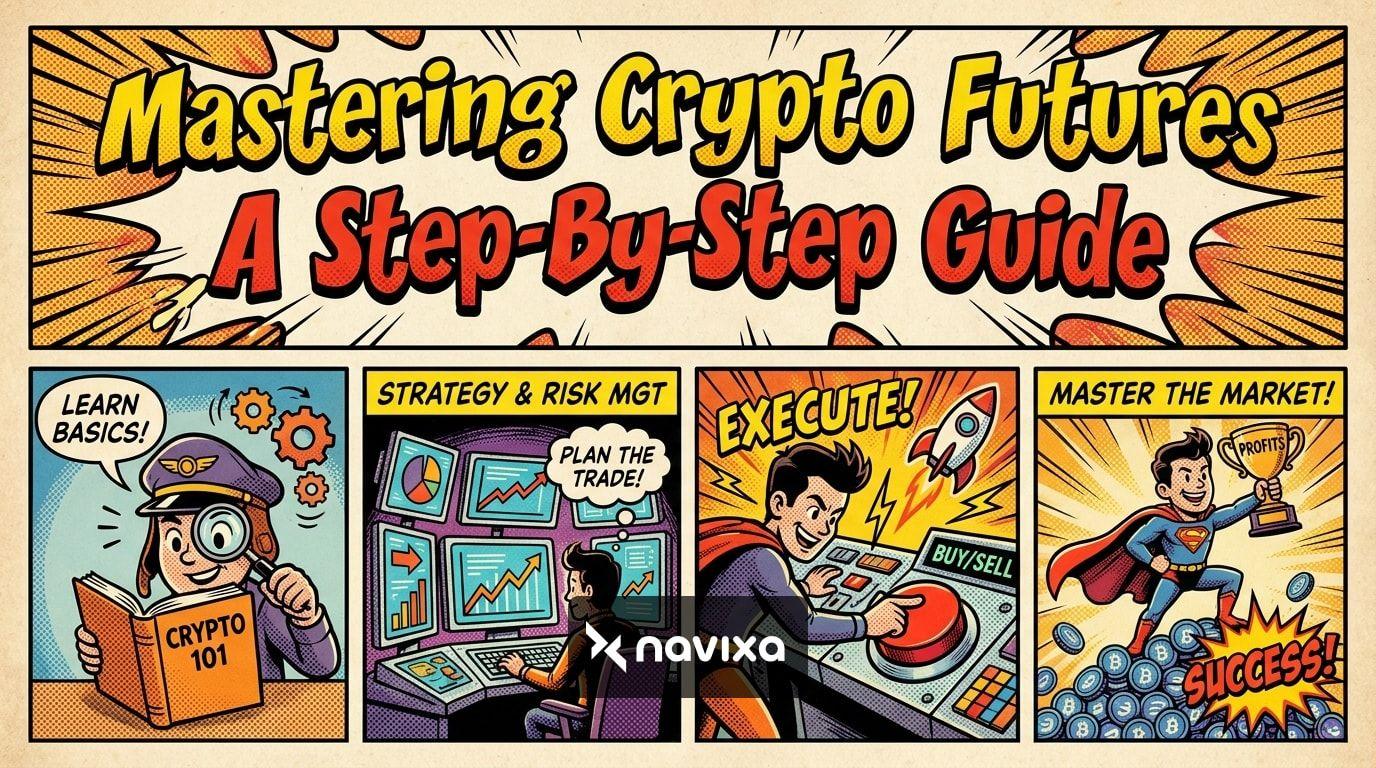
Step-By-Step Action Plan to Start Trading
If you are prepared to transition from studying theoretical concepts to executing live trades, follow this structured roadmap:
1. Aggressive Education: Dedicate time to thoroughly mastering technical analysis, fundamental on-chain metrics, and market structure. 2. Select a Robust Platform: Choose a reputable, liquid exchange such as Kraken Pro, Phemex, or a trusted DEX based strictly on your trading style and local regulatory constraints. 3. Engage in Paper Trading: Before committing a single dollar of real capital, utilize exchange testnet environments (paper trading). Execute your strategies in real-time market conditions using simulated funds until your edge is proven. 4. Start Micro-Sizing: When transitioning to live funds, deposit only a highly conservative amount of capital. Strictly utilize isolated margin and extremely low leverage to safely acclimatize to the intense emotional and psychological pressures of real financial risk. 5. Maintain a Detailed Journal: Document every single trade you execute. Record your entry price, exit price, technical reasoning, and emotional state. Systematically reviewing this journal is the single most effective way to identify repetitive mistakes and perpetually refine your trading edge.
Conclusion
Crypto futures trading is a remarkably dynamic and extraordinarily powerful vehicle for accelerating wealth creation within the digital asset economy. By utilizing leverage with extreme responsibility, executing rigorous technical analysis, and maintaining ironclad risk management protocols, you can successfully transition from an emotional market speculator into a highly calculated, profitable operator.
As the broader market continues to dramatically mature—highlighted by deep traditional finance integration and the rollout of 24/7 institutional trading—the financial opportunities available to skilled traders are virtually limitless. Take the necessary time to practice in simulated environments, ruthlessly refine your edge, and continuously adapt. Are you ready to take the next critical step? Select a reputable derivatives exchange, fund a paper trading account, and begin actively testing your strategies without financial risk today.
Frequently Asked Questions
What is the fundamental difference between perpetual and traditional crypto futures?
Traditional futures contracts possess a strictly defined expiration and settlement date. Upon that specific expiration date, the contract is officially settled. Perpetual futures, conversely, feature no expiration date whatsoever, empowering you to hold the leveraged position indefinitely as long as your account maintains sufficient margin. They utilize a recurring funding rate mechanism to continuously tether the derivative's price to the underlying spot market price.
Can I lose more money than I initially deposit in crypto futures trading?
On the vast majority of top-tier cryptocurrency exchanges, you cannot lose more than the margin you allocate to a position (or your total account balance if utilizing cross margin). This is because the exchange's automated liquidation engine will forcefully close your position before it can slip into a negative balance. However, you will absolutely lose 100% of the capital committed to that specific trade if a liquidation event is triggered.
What exactly is a funding rate in perpetual futures?
The funding rate is a periodic financial fee exchanged directly between long and short position holders. If the perpetual contract is aggressively bought and trades at a premium compared to the spot price, longs pay shorts to financially incentivize selling. If it trades at a steep discount, shorts pay longs. This elegant mechanism keeps the futures contract price tightly aligned with the actual spot asset price.
Is crypto futures trading legally permitted everywhere?
No. Cryptocurrency derivatives are heavily regulated or completely banned in various jurisdictions around the globe. For example, retail traders residing in the United Kingdom face strict prohibitions regarding the trading of crypto derivatives, and numerous international exchanges heavily geo-block users attempting to connect from the United States. You must always verify the current regulatory status of futures trading within your specific local jurisdiction.
How much leverage should a complete beginner use?
Beginners should either completely avoid leverage altogether or strictly adhere to exceptionally low leverage multipliers (e.g., 2x to 3x maximum) until they have generated a proven, mathematically profitable track record over several consecutive months. Utilizing high leverage exponentially amplifies the immediate risk of total liquidation during the completely normal volatility spikes that characterize the crypto market.