
The convergence of traditional finance (TradFi) and decentralized finance (DeFi) has sparked a revolution in how investors access global markets. For decades, trading the stock market meant adhering to strict exchange hours, dealing with legacy brokerage fees, and facing geographic restrictions. Today, blockchain technology has dismantled those barriers. One of the most exciting developments in this space is the ability to trade tokenized Netflix stock directly on-chain.
Whether you are a crypto-native trader looking to diversify into traditional tech equities or a stock investor curious about the 24/7 liquidity of Web3, understanding how to trade tokenized Netflix stock is essential. This comprehensive guide will explore the underlying mechanics of tokenized real-world assets (RWAs), review the best platforms for trading, and provide actionable strategies to maximize your returns while managing risk.
What Is Tokenized Netflix Stock?
"The tokenization of real-world assets is not just a technological upgrade; it is the fundamental rewiring of global liquidity."
Tokenized stocks are digital representations of traditional, publicly traded equities that are issued and traded on a blockchain. When you buy tokenized Netflix stock, you are purchasing a cryptographic token that tracks the price performance of Netflix (NFLX) shares.
In the modern DeFi ecosystem, these assets fall under the broader category of Real-World Assets (RWAs). The tokenization process bridges the gap between the NASDAQ and blockchain networks like Ethereum, Solana, and BNB Chain. Generally, there are two primary models for stock tokenization:
1. Custodial-Backed (1:1 Backing): This is the gold standard for compliance and safety. Issuers like Backed Finance or Ondo Finance hold actual Netflix shares in a highly regulated, third-party traditional brokerage or custody account. For every share held in the vault, exactly one token (e.g., bNFLX or NFLXON) is minted on the blockchain. 2. Synthetic Tokens: In this model, the token tracks the price of Netflix using decentralized oracles without actually holding the underlying asset. Investors lock up crypto collateral (like USDC or ETH) to mint synthetic Netflix tokens. While this provides price exposure, it does not represent legal ownership of the underlying share.
By leveraging decentralized price feeds—often powered by oracle networks like Chainlink—the smart contracts ensure that the token's on-chain price accurately reflects the real-world market value of Netflix.
Why Trade Tokenized Netflix Stock in DeFi?
The transition from a traditional brokerage account to a decentralized Web3 wallet offers several profound advantages for traders.
24/7 Market Access and Unrestricted Liquidity
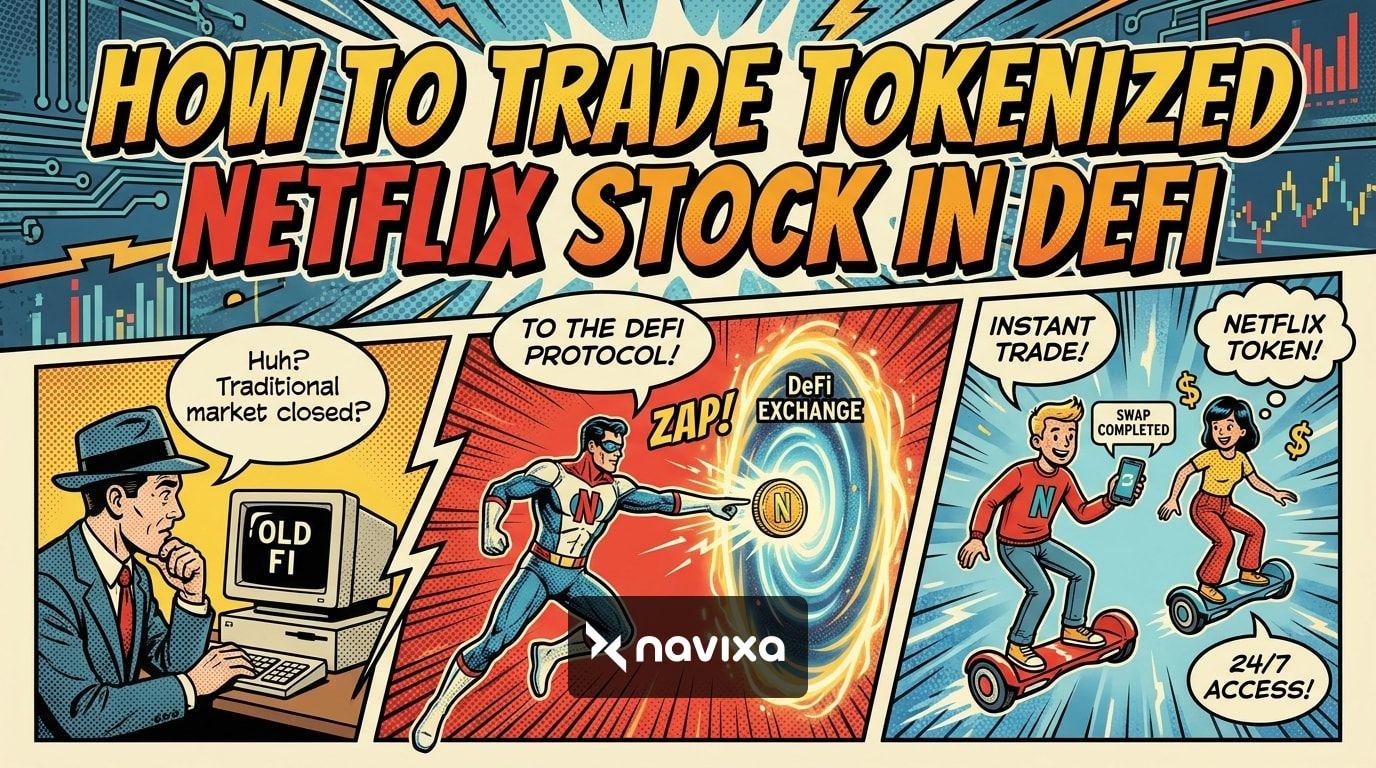
Traditional stock markets operate on a rigid schedule: Monday through Friday, 9:30 AM to 4:00 PM Eastern Time. If Netflix announces a massive earnings beat on a Friday evening, traditional investors must wait until Monday morning to react, often missing the optimal entry or exit points. In contrast, DeFi never sleeps. Tokenized Netflix stock can be traded on Decentralized Exchanges (DEXs) 24 hours a day, 7 days a week, allowing you to capitalize on breaking news over the weekend.
Fractional Ownership
With traditional brokerages, purchasing high-priced tech stocks can require significant capital, though fractional shares are becoming more common. DeFi tokenization natively supports fractional ownership down to eighteen decimal places. You can invest exactly $10 or $10,000 into Netflix, maximizing your capital efficiency.
Self-Custody and Instant Settlement
Traditional stock trades typically take two business days (T+2) to settle. On networks like Solana or Arbitrum, settlement happens in seconds. Furthermore, when you hold tokenized Netflix stock in a non-custodial wallet (like MetaMask, Phantom, or the Binance Web3 Wallet), you retain absolute control over your assets.
Integration with DeFi Yield Strategies
This is perhaps the most powerful advantage. A traditional share of Netflix sits idle in a brokerage account. A tokenized share of Netflix can be deployed into DeFi protocols. You can use your tokenized stock as collateral to borrow stablecoins, or provide liquidity to an Automated Market Maker (AMM) to earn trading fees on top of your stock's price appreciation.
Comparing Traditional and Tokenized Netflix Shares
Understanding the differences between the legacy system and the blockchain approach is crucial before deploying your capital.
| Feature | Traditional Netflix Stock (NFLX) | Tokenized Netflix Stock |
|---|---|---|
| Trading Hours | Mon-Fri, 9:30 AM - 4:00 PM EST | 24/7/365 |
| Settlement Time | T+1 or T+2 Days | Instant (Seconds) |
| Custody | Held by a centralized broker | Self-custodied in a Web3 wallet |
| DeFi Utility | None | High (Lending, Borrowing, LPs) |
| Geographic Access | Often restricted by region | Global (Subject to KYC/Geofencing) |
| Dividend Payouts | Cash to brokerage account | Airdropped via smart contracts |
Top Ecosystems for Tokenized Equities
Recent industry acquisitions and launches have rapidly matured the infrastructure for trading RWAs. Here are the leading avenues to access tokenized Netflix stock:
1. Backed Finance and xStocks (Kraken Integration)
Backed Finance is a regulated Swiss entity that issues fully compliant, 1:1 backed tokens representing traditional securities. Their Netflix token (bNFLX) is available across multiple EVM-compatible chains. Following Kraken's acquisition of Backed Finance's xStocks platform, these tokenized equities have gained immense liquidity, allowing global users to seamlessly trade blue-chip stocks on-chain.
2. Binance Web3 Wallet and Ondo Finance
For users operating within the BNB Chain ecosystem, Ondo Finance has unlocked massive volume for tokenized equities. Integrated directly into the Binance Web3 app, users can easily swap stablecoins for NFLXON, benefiting from deep liquidity and incredibly low transaction fees.
3. Solflare on Solana
For those who prefer the speed of the Solana blockchain, the Solflare wallet offers direct access to tokenized stocks (like NFLXX). This ecosystem is ideal for high-frequency traders who want to capitalize on micro-movements in the stock's value with sub-cent gas fees.
Actionable Steps: How to Buy and Trade Tokenized Netflix Stock
If you are ready to transition your portfolio on-chain, follow these foundational steps.
Step 1: Set Up a Compatible Web3 Wallet
To trade and self-custody RWAs, you need a secure wallet. Depending on your preferred blockchain, download and secure a wallet like MetaMask (Ethereum/Arbitrum), Phantom (Solana), or use the integrated Binance Web3 Wallet. Always write down your seed phrase and store it securely offline.
Step 2: Fund Your Wallet with Stablecoins
Tokenized stocks are predominantly traded against stablecoins. Transfer USDC or USDT from a centralized exchange to your Web3 wallet. Ensure you also hold a small amount of the network's native token (ETH, SOL, or BNB) to cover gas fees.
Step 3: Choose a Regulated DEX or Aggregator
Navigate to a decentralized exchange that supports tokenized equities. Platforms integrating with Backed Finance or Swarm Markets provide intuitive swap interfaces. You can also utilize decentralized analytics platforms like DeFiLlama to find which liquidity pools currently offer the best slippage rates for tokenized stocks.
Step 4: Execute the Swap
Select the stablecoin you wish to trade and find the correct ticker for tokenized Netflix stock (e.g., bNFLX). Double-check the contract address to ensure you are not interacting with a counterfeit token. Approve the smart contract to access your stablecoins, confirm the swap, and the tokenized shares will instantly appear in your wallet.
Advanced Trading Strategies for Tokenized Equities
Simply holding tokenized Netflix stock provides price exposure, but advanced traders use DeFi primitives to amplify their returns.
Earnings Arbitrage
Traditional markets close on Friday afternoon, locking the price of NFLX until Monday. If a macroeconomic event or a streaming industry shift occurs over the weekend, the on-chain price of tokenized Netflix stock will react immediately on DEXs. Traders can buy the tokenized version at a discount on a Sunday, anticipating a gap-up in the traditional market on Monday morning, and then arbitrage the difference.
Collateralized Stablecoin Lending
If you are bullish on Netflix long-term but need liquid capital for another crypto investment, you don't need to sell your shares. By depositing your tokenized Netflix stock into a decentralized lending protocol (like an RWA-focused fork of Aave), you can borrow USDC against it. You maintain your exposure to Netflix's upside while using the borrowed USDC to farm high-yield stablecoin pairs.
Liquidity Provision (LP)
DEXs rely on users to provide liquidity. By pairing your tokenized Netflix stock with USDC and depositing both into a liquidity pool, you become a market maker. Every time someone buys or sells the tokenized stock through that pool, you earn a percentage of the trading fees. This strategy generates passive income during periods when the stock is moving sideways.
Risk Management and Regulatory Considerations
While the benefits are substantial, trading tokenized equities requires rigorous risk management.
Smart Contract Risk: The tokenized stock is governed by code. If the issuing platform's smart contract contains a vulnerability, your funds could be compromised. Always stick to established issuers like Backed Finance that conduct regular, third-party security audits.
De-pegging and Liquidity Risk: In times of extreme market volatility, the on-chain liquidity of tokenized Netflix stock may dry up, causing its price to briefly de-peg from the real-world NASDAQ price. Utilize limit orders on DEXs to protect yourself from high slippage.
Regulatory Compliance: The regulatory landscape for digital securities is strict. Because tokenized stocks represent traditional equities, they are subject to securities laws. Consequently, major platforms typically geofence their products, excluding users from the United States and other restricted jurisdictions. Platforms enforce this through rigorous KYC/AML checks before allowing users to mint or redeem the underlying asset.
Practical Takeaways
Bridging your equity investments into the decentralized economy requires a mindset shift. By leveraging the blockchain, you unlock continuous market access, fractional precision, and the ability to compose your traditional assets with powerful DeFi protocols. As institutions continue to pour capital into the RWA narrative, early adopters who master these mechanics stand to gain a significant edge over traditional market participants.
Ensure that you are utilizing regulated issuers, actively managing your smart contract exposure, and taking full advantage of the yield-generating opportunities that only DeFi can provide.
Frequently Asked Questions
What is tokenized Netflix stock?
Tokenized Netflix stock is a digital asset existing on a blockchain that tracks the real-time value of traditional Netflix (NFLX) equities. Most legitimate forms are backed 1:1 by actual shares held securely in a regulated traditional custody account.
Can US residents trade tokenized stocks?
Currently, due to strict SEC regulations regarding unregistered securities, most compliant platforms issuing tokenized stocks (like Backed Finance and Swarm Markets) explicitly exclude US residents. Non-US residents can freely access these products after passing standard KYC protocols on the issuing platforms.
How are tokenized stocks priced outside of market hours?
When traditional stock markets are closed, the price of a tokenized stock is determined purely by supply and demand on decentralized exchanges, facilitated by Automated Market Makers (AMMs). Once the traditional market reopens, arbitrageurs quickly bring the token price back to the exact peg of the traditional asset.
Do tokenized stocks pay dividends?
Yes. For fully backed tokenized stocks, the underlying shares still accrue traditional dividends. The issuer collects the fiat dividend, converts it to a stablecoin (like USDC), and automatically airdrops it to the wallets holding the tokenized stock at the time of the snapshot.
What are the main risks of trading tokenized stocks?
The primary risks include smart contract vulnerabilities, potential de-pegging from the underlying asset due to low liquidity, and regulatory changes. Additionally, if the custodian holding the real-world shares faces legal or financial trouble, redeeming the token for fiat could be delayed.