
The cryptocurrency landscape has transformed remarkably over the years, and few digital assets embody this evolution quite like XRP. Originally designed to revolutionize cross-border payments, Ripple's native token has weathered immense regulatory storms to emerge stronger than ever. With the multi-year SEC lawsuit officially resolved and landmark developments like spot XRP Exchange-Traded Funds (ETFs) reshaping the market, trading XRP has entered a new era of institutional legitimacy and retail opportunity.
Whether you are a beginner taking your first steps into the digital asset market or an experienced trader refining your strategies, understanding how to trade XRP is paramount. This step-by-step walkthrough will equip you with the knowledge needed to analyze the market, execute trades efficiently, and manage risk in today's dynamic trading environment.
Understanding XRP and Current Market Dynamics
Before diving into the mechanics of buying and selling, it is crucial to understand what XRP is and what fundamentally drives its valuation. Unlike Bitcoin, which primarily serves as a decentralized store of value, or Ethereum, which functions as a foundational smart contract platform, XRP was engineered for speed, cost-efficiency, and utility in global finance. It serves as a bridge currency in the Ripple network, allowing financial institutions to settle cross-border transfers in seconds with negligible fees.
In recent times, the fundamental landscape for XRP has shifted dramatically. The long-standing legal battle with the U.S. Securities and Exchange Commission (SEC) concluded, lifting a massive cloud of uncertainty that had suppressed the asset's price and liquidity for years. Furthermore, regulatory clarity classifying XRP as a digital commodity has paved the way for traditional finance to aggressively enter the fray. This has led to the introduction of spot XRP ETFs, bringing billions in assets under management (AUM) and representing a structural change in how institutional capital accesses XRP exposure.
When trading XRP, you are not just trading technical chart patterns; you are trading the narrative of global banking adoption, real-world asset tokenization on the XRP Ledger, and ongoing legislative frameworks like the CLARITY Act. These unique factors make XRP an asset that behaves differently from the rest of the broader crypto market.
"To successfully trade XRP, an investor must look beyond the hype and monitor real-world adoption metrics, such as On-Demand Liquidity volume and ETF inflows, which act as the true barometers of its long-term value."
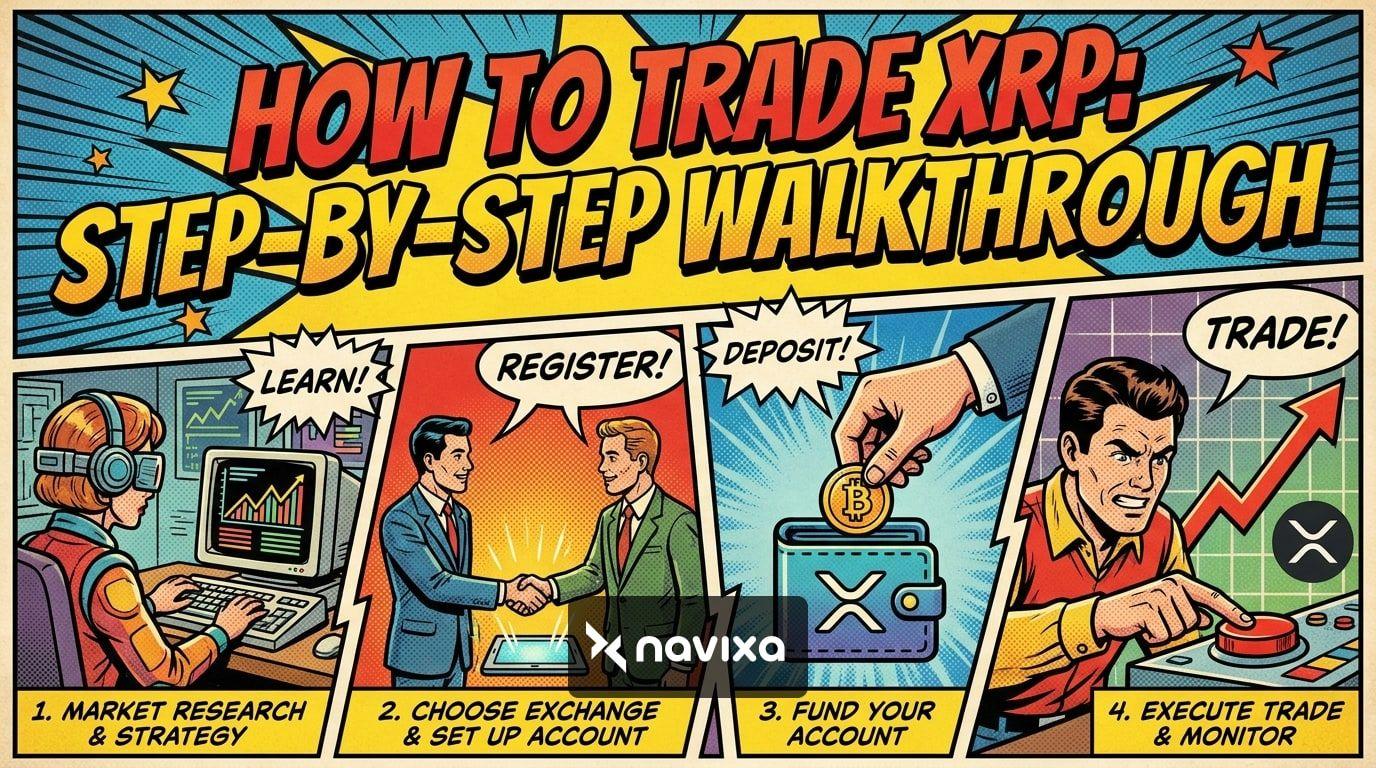
How to Trade XRP: Step-by-Step Walkthrough
Trading cryptocurrencies requires a systematic, disciplined approach. By following these foundational steps, you can set yourself up for a safer and more profitable trading experience.
Step 1: Choose the Right Crypto Exchange
The first step in learning how to trade XRP is selecting a platform that aligns with your trading goals. Since the resolution of its regulatory hurdles, XRP has been relisted across all major global exchanges. When choosing an exchange, prioritize deep liquidity, low trading fees, and robust security protocols.
For active day traders, platforms like MEXC and Binance offer highly competitive fee structures, with some exchanges even offering zero-fee promotions for maker orders. If you are based in regions with strict regulatory frameworks and prioritize compliance, platforms like Kraken and Coinbase are industry standards, offering seamless fiat-to-crypto on-ramps.
Step 2: Set Up and Secure Your Account
Once you have selected an exchange, you will need to create an account and complete the Know Your Customer (KYC) verification process. This typically involves submitting a government-issued ID and a proof of address to comply with international Anti-Money Laundering (AML) laws.
Security must be your absolute top priority. Always enable Two-Factor Authentication (2FA) using an application like Google Authenticator rather than SMS, which is highly vulnerable to SIM-swap attacks. If you plan on holding a large portion of your XRP long-term rather than actively trading it on a daily basis, consider transferring those funds to a hardware wallet (cold storage) to eliminate exchange counterparty risk.
Step 3: Conduct Comprehensive Market Analysis
Successful trading relies on a calculated blend of fundamental and technical analysis. You cannot consistently guess market directions; you must rely on actionable data.
Fundamental Analysis: Monitor institutional developments closely. Track the daily and weekly inflows into spot XRP ETFs. Keep an eye on Ripple's corporate announcements, particularly regarding the expansion of their On-Demand Liquidity (ODL) corridors and the deployment of their RLUSD stablecoin. You can track real-time macroeconomic data, circulating supply, and market capitalizations on platforms like CoinGecko.
Technical Analysis: Technical analysis involves reading historical chart patterns to predict future price movements. XRP is notorious for experiencing long periods of flat consolidation followed by explosive, high-volume breakouts. Key indicators to utilize include: - Moving Averages (MA): The 50-day and 200-day moving averages are critical support and resistance levels. A "Golden Cross" (when the 50-day crosses above the 200-day) often signals strong bullish momentum. - Relative Strength Index (RSI): This momentum oscillator helps identify overbought (above 70) and oversold (below 30) conditions in the market. - Volume Profiles: Always confirm a breakout with high trading volume. A sudden price surge on low volume is often a bull trap.
Professional charting tools like TradingView are indispensable for drawing trendlines, mapping support zones, and applying these technical indicators to your XRP charts.
Step 4: Execute Your Trade
Once your analysis points to a high-probability setup, it is time to execute the trade. Familiarize yourself with the primary order types to ensure precision: - Market Order: Executes immediately at the current market price. Use this only when you need to enter or exit a position instantly, as it may be subject to slippage during volatile periods. - Limit Order: Allows you to specify the exact price at which you want to buy or sell. The trade will only execute if the market reaches your target price. - Stop-Loss Order: Automatically sells your XRP if the price drops to a predetermined level, capping your potential downside. This is a non-negotiable tool for all active traders.
Top Strategies for Trading XRP
Now that the mechanics are clear, applying a defined trading strategy is what separates consistently profitable traders from emotional gamblers.
Breakout Trading
Because XRP often trades in tight ranges for extended periods, breakout trading is a highly effective strategy. Traders draw resistance lines at the top of a consolidation channel and wait for the price to break through with significant volume. The catalyst for these breakouts is often regulatory news or major institutional partnerships. When trading a breakout, wait for a daily candle close above the resistance level to confirm the move, rather than buying into a temporary wick.
Swing Trading
Swing trading involves capitalizing on medium-term price trends, which can last from a few days to several weeks. Because XRP frequently respects historical support and resistance zones, swing traders will accumulate positions near the bottom of a known range and take profits as the price approaches the top. This strategy requires patience and a solid understanding of macroeconomic trends, such as shifting interest rates and global liquidity cycles, which can dictate the broader crypto market's momentum.
Scalping
Scalping is a high-frequency trading strategy aimed at capturing small price movements multiple times a day. Scalpers rely heavily on 5-minute and 15-minute charts, using tight stop-losses. To scalp XRP effectively, you must use an exchange with exceptionally low maker and taker fees, as frequent trading costs can quickly eat into your profit margins.
The Role of Sentiment and On-Chain Data
Beyond technical indicators and traditional fundamental analysis, on-chain data and market sentiment are vital components of trading XRP successfully. Unlike traditional financial assets, blockchains operate transparently, allowing anyone to monitor the movement of funds in real time.
Whale Tracking: Monitoring large transactions, often referred to as "whale movements," can provide early warning signs of impending price volatility. If hundreds of millions of XRP are suddenly transferred from a cold wallet to a major exchange, it often signals an intent to sell, which could create downward price pressure. Conversely, massive withdrawals from exchanges into private wallets typically suggest accumulation and a reduction in available supply.
Sentiment Analysis: The cryptocurrency market is highly reflexive, meaning aggregate trader sentiment can directly impact price action. Utilizing sentiment tracking tools like the Crypto Fear and Greed Index can help you gauge the market's mood. The most lucrative trades are often contrarian—buying when extreme fear creates an oversold market, and taking profits when extreme greed signals an impending correction.
Comparing Top Exchanges for XRP Trading
To help you choose the best venue for executing your strategies, here is a comparison of some of the top centralized exchanges for trading XRP in the current market.
| Exchange | Maker / Taker Fees | Best Feature | Liquidity Rating |
|---|---|---|---|
| MEXC | 0.00% / 0.02% | Zero-fee promotions and altcoin pairs | High |
| Binance | 0.10% / 0.10% | Deep global liquidity and VIP tiers | Very High |
| Kraken | 0.16% / 0.26% | Strict regulatory compliance (US friendly) | High |
| Coinbase | 0.40% / 0.60% | Beginner-friendly interface and fiat ramps | Medium |
*Note: Fees are subject to change based on 30-day trading volume and native exchange token holdings.*
Risk Management and Practical Takeaways
Learning how to trade XRP is only half the equation; learning how not to lose your capital is the other half. The cryptocurrency market is inherently volatile, and even established assets like XRP are susceptible to violent price swings.
First, always employ strict position sizing. Never risk more than 1% to 2% of your total trading portfolio on a single XRP trade. If a trade goes against you, this rule ensures you have enough capital to live to trade another day.
Second, rigorously use stop-loss orders. Do not fall into the trap of moving your stop-loss further down because you "feel" the price will bounce back. Stick to your original trade thesis. If the thesis is invalidated, take the small loss and move on.
Third, avoid revenge trading. If you take a loss on an XRP trade, do not immediately enter a new, larger position out of frustration to win back your capital. Step away from the screens, re-evaluate your technical analysis, and wait for the next high-probability setup.
Finally, be aware of market correlations. While XRP has unique utility and institutional catalysts, it is still heavily influenced by the broader digital asset market. If Bitcoin experiences a sharp macroeconomic downturn, XRP is highly likely to follow suit, regardless of how bullish its individual chart may look.
Conclusion
Trading XRP offers unique opportunities for both retail and institutional market participants. By understanding the asset's underlying utility in global finance, staying updated on critical regulatory milestones, and applying disciplined technical analysis, you can navigate its price action with confidence. Remember to choose a reliable exchange, test your strategies with small amounts of capital first, and never compromise on risk management. The age of regulatory uncertainty for XRP is over—now is the time to trade with precision and a clear edge.
Frequently Asked Questions
Is the SEC lawsuit against Ripple finally over?
Yes. The long-running legal battle between Ripple and the SEC officially concluded with a final settlement. Subsequent developments and guidance from U.S. regulatory bodies have classified XRP as a digital commodity, providing long-awaited legal clarity for traders and institutional investors.
What primarily drives the price of XRP?
Unlike some cryptocurrencies driven entirely by retail sentiment, XRP's valuation is heavily influenced by its utility in cross-border payments (via Ripple's network), regulatory legislation, institutional adoption, and macroeconomic factors. Additionally, inflows into Spot XRP ETFs now play a significant role in its price action and liquidity.
Can I trade XRP using leverage or margin?
Yes. Most major cryptocurrency exchanges, including Binance, Bybit, and Kraken Pro, offer derivatives markets where you can trade XRP perpetual futures with leverage. However, leverage amplifies both potential profits and potential losses, making strict risk management and stop-loss execution essential.
Do I need a special wallet to trade XRP?
If you are actively day trading or swing trading, keeping your trading capital on a reputable, highly secure exchange is standard practice so you can execute trades instantly. However, for long-term holding and investing, it is highly recommended to move your XRP to a hardware wallet (cold storage) to protect your assets from exchange-related vulnerabilities.