
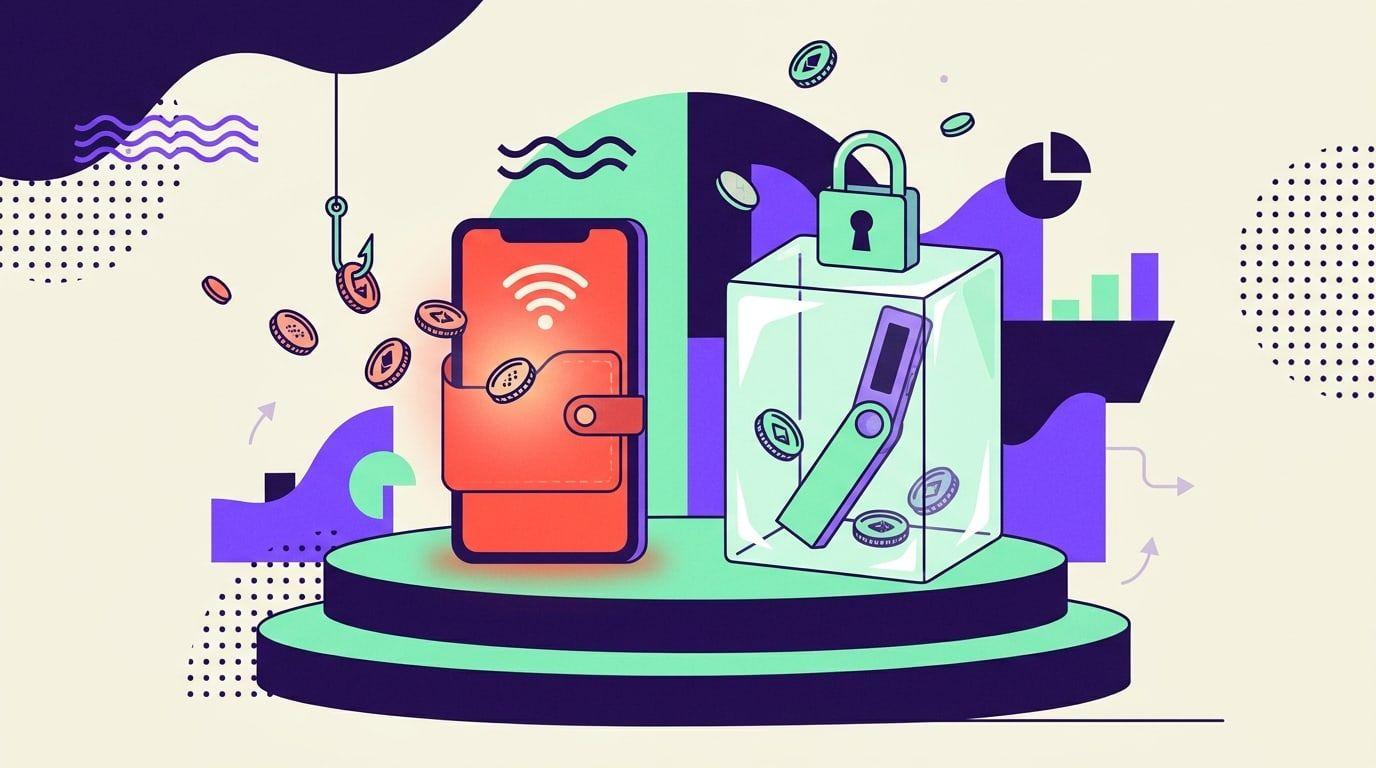
A hot wallet keeps the keys to your crypto on a device connected to the internet, such as a phone app or a browser extension. A cold wallet keeps them offline, usually on a small hardware device. Hot wallets are convenient for trading and spending but exposed to online attacks. Cold wallets are much harder to hack from a distance, but if you lose both the device and its recovery phrase, your coins are gone. Most people end up using both: a small balance hot, long-term holdings cold.
There is a third place most beginners actually start: an exchange, which holds the keys for you. This autumn showed what that means. On October 29, 2026, an attacker drained about $6.43 billion from Binance's hot wallets, the largest crypto theft on record, and Binance said it would cover the losses with its own money.
This guide explains what each option protects against, what it doesn't, and how to split your crypto between them.
Hot wallet vs cold wallet at a glance
| Exchange account | Hot wallet | Cold wallet | |
|---|---|---|---|
| Who holds the keys | The exchange | You | You |
| Where the keys live | The exchange's own systems | An app on your phone or computer | An offline device |
| Typical example | A Binance or Coinbase account | A phone wallet app or browser extension | A hardware wallet |
| Convenience | Highest: trade in seconds | High: send coins and use apps quickly | Lower: connect and confirm each move |
| Main risk | The exchange is hacked, halts withdrawals or fails | Phishing, fake apps, malware, bad approvals | Losing the device and the phrase, or someone finding the phrase |
| Cost | Free to hold, fees to withdraw | Usually free | A device to buy |
| Best for | Money you actively trade | Small amounts you use often | Long-term holdings |
What a crypto wallet actually stores
Your coins don't sit "in" a wallet. They are recorded on the blockchain, and the wallet holds the keys that let you move them. The SEC's custody guide for retail investors (December 12, 2025) puts it simply: a private key is like the password to your wallet, a public key is like an email address that others can send to, and "if you lose your private key, you permanently lose access to the crypto assets in your wallet."
Most wallets also give you a recovery phrase, or seed phrase, when you set them up: typically 12 to 24 words. The most widely used format, BIP-39, draws them from a fixed list of 2,048 words. The phrase can rebuild every key on a new device, which makes it the most important thing you own in crypto. Anyone who has it has your coins, and with a wallet you control yourself there is no "forgot password" button.
So the real question behind hot versus cold is: where do the keys live, and who can reach them?
Hot wallets: convenient, and always online
A hot wallet is an app on your phone, your computer or in your browser. It creates and stores your keys on a device that is online, so you can send coins, swap on a decentralized exchange or connect to an app within seconds. Most are free.
The convenience comes from that same connection. The SEC notes that hot wallets "expose your crypto assets to cyberthreats." In practice, people rarely lose coins because someone breaks a wallet's cryptography. They lose them to:
- Phishing and fake apps that copy a real wallet's look or ask for the recovery phrase.
- Malicious approvals: signing a transaction or a token permission on a scam site, which lets a "drainer" empty the wallet.
- Malware on the phone or computer that steals keys or swaps a copied address for the attacker's.
Chainalysis, a blockchain analytics firm, counts these as personal wallet compromises. Its 2025 theft report (December 18, 2025, data through early December) found about 158,000 thefts from personal wallets in 2025, with at least 80,000 victims, nearly triple the 54,000 incidents of 2022. The total taken fell to $713 million, from a peak of $1.5 billion in 2024. That works out to about $4,500 per theft on average, by our calculation: attackers are hitting more people for smaller amounts. These numbers cover all wallets that people control themselves, not only hot ones, and Chainalysis notes the real count is probably higher.
Cold wallets: keys that never touch the internet
A cold wallet keeps the private keys on something that isn't connected to the internet. Today that usually means a hardware wallet: a small device that creates the keys, stores them and signs transactions inside itself. You connect it to a phone or computer to send coins, but the keys never leave the device; only the signed transaction does.
Because an attacker online can't reach the keys, a cold wallet is, in the SEC's words, "generally more secure from cyberthreats than hot wallets." It still has three weak points:
- The recovery phrase. If someone photographs or finds it, they can empty the wallet from anywhere. If you lose it and the device breaks, the coins are gone for good.
- The device. It can be lost, damaged or stolen. That is survivable if the phrase is safe, because the phrase restores the wallet on a new device.
- What you sign. A hardware wallet signs whatever you approve. If you approve a bad transaction, the device can't save you.
The third point is how what was then the largest crypto theft on record happened. On February 21, 2025, attackers took about $1.5 billion from the exchange Bybit, out of an Ethereum cold wallet that needed several signers to approve each transaction. According to NCC Group's technical analysis, the attackers had altered the web app the signers used, so it showed a routine transfer while the request they signed did something else. The signers "blind-signed the messages without carefully checking their contents." The keys stayed safe; the approval was the weak point.
The lesson for anyone with a hardware wallet: check the address and the amount on the device's own screen before you confirm, not only on your computer, and reject anything the device shows as data you can't read.
Exchange wallets: someone else holds the keys
When you keep coins on an exchange, you don't have a wallet of your own. You have a claim on the exchange, which holds customers' coins in its own mix of hot and cold wallets. The SEC's guide is blunt about what that means: "If the third-party custodian is hacked, shuts down, or goes bankrupt, you may lose access to your crypto assets."

The last two years gave examples of both outcomes:
- Binance, October 29, 2026. An attacker drained Binance's hot wallets on 11 blockchains in a few hours, about $6.43 billion by Elliptic's count. Elliptic's evidence suggests the attacker got Binance's own systems to sign the withdrawals rather than stealing its private keys. Binance said it would cover all losses from its SAFU fund and company money, and began reopening withdrawals, starting with bitcoin.
- Bitget, September 24, 2026. Attackers took funds from Bitget's hot and warm wallets on seven blockchains, and Bitget said its cold wallets were unaffected, according to TRM Labs. Bitget later put the loss at $387.5 million and said its Protection Fund covers it and "user account balances remain unaffected" (BleepingComputer).
- Bybit, February 2025. After the cold-wallet theft, Bybit's CEO said client assets remained backed one to one, and within days the exchange said it had replaced the stolen ether (The Block).
- FTX, November 2022. No hacker was needed. The exchange collapsed, and its founder was later convicted of fraud over the misuse of customer deposits and sentenced to 25 years in prison in March 2024.
The pattern: on an exchange, your safety rests on the exchange's security, its reserves and its honesty. In 2025 and 2026, three large exchanges had the money to absorb huge thefts. FTX is the case where the money was already gone.
One thing cold storage does not change: USDT and USDC can be frozen by the companies that issue them at any address, a hardware wallet included. Our post on whether USDT and USDC can be frozen explains how that works.
How to split your crypto: a simple setup
Most people don't pick just one. They use each place for its own job, the way you might keep some cash in your pocket and your savings in the bank:
- Trading balance on the exchange. Keep there only what you actively trade. If you trade with a strategy, whether by hand or through a signal bot that executes alerts, the coins or USDT it trades have to sit on the exchange. Turn on two-factor authentication and a withdrawal whitelist, and give any bot an API key that can trade but never withdraw.
- Spending balance in a hot wallet. For using apps, DeFi or sending money. Keep it to an amount you could lose without serious harm, and use a separate wallet for trying new apps.
- Long-term holdings in a cold wallet. Coins you plan to hold for months or years, that you don't need to move often.
When is a hardware wallet worth buying? There is no official threshold. A practical test: if losing the amount would really hurt, and you don't plan to trade it soon, it belongs in cold storage. The device costs money up front, while hot wallets are usually free, as the SEC's guide notes. Every move between an exchange and your wallet also costs a withdrawal or network fee, so moving in batches rather than after every purchase keeps costs down. Our guide to crypto trading fees shows what those add up to.
How to set up a cold wallet safely
- Buy the device new from the maker or an authorized reseller. Never second hand, and never one that arrives with a recovery phrase already filled in.
- Let the device create the recovery phrase, and write it down by hand on paper or metal. Never type it into a phone, computer, cloud note or photo.
- Store the phrase somewhere safe and private, apart from the device. Some people keep a second copy in another secure place.
- Send a small test amount first, then send a little back out to make sure everything works before you move the rest.
- Check every address and amount on the device's screen before you confirm. Reject anything you can't read.
- Keep the firmware and the companion app up to date, and download them only from the maker's official site.
No real wallet, exchange or support agent will ever ask for your recovery phrase. Anyone who asks for it, by email, chat, phone or a pop-up that wants to "verify your wallet", is trying to steal your coins.
FAQ
Is a hot wallet safe?
For small amounts you use often, a reputable hot wallet on an up-to-date phone is a reasonable choice. The bigger risk is usually not the app itself but what you approve and where you type your recovery phrase. For large or long-term holdings, a cold wallet is safer.
Can a cold wallet be hacked?
Not from a distance in the usual sense, because the keys stay on the device. Coins in cold storage are lost in other ways: a recovery phrase that is stolen or photographed, a phrase that is lost along with a broken device, or a bad transaction approved by the owner, as at Bybit.
What happens if my hardware wallet breaks or the maker shuts down?
Your coins are on the blockchain, not in the device. With the recovery phrase you can restore the wallet on a new device or in another wallet that supports the same backup format. Without the phrase, a broken device means lost coins.
Is an exchange account a hot wallet?
Not exactly. On an exchange you don't hold any keys; the exchange does, and it keeps coins in a mix of hot and cold wallets. What matters for you is that you depend on the exchange to stay secure, stay solvent and process your withdrawal.
Do I need a cold wallet for a small amount?
Not necessarily. For a small amount you are still learning with, an exchange account with two-factor authentication, or a hot wallet, is fine. A cold wallet starts to make sense when the amount grows to something you would really miss.
The bottom line
Hot and cold describe where the keys live; custody describes who holds them. Keep what you trade where you trade it, a small spending balance in a hot wallet, and long-term holdings in a cold wallet whose recovery phrase only you can reach. If you are just starting, our guide to buying bitcoin on Binance covers the first purchase. And if you want to see how a rules-based strategy builds a position on spot, without leverage, the Smart DCA strategy page shows how its ladder works and how it has performed.