

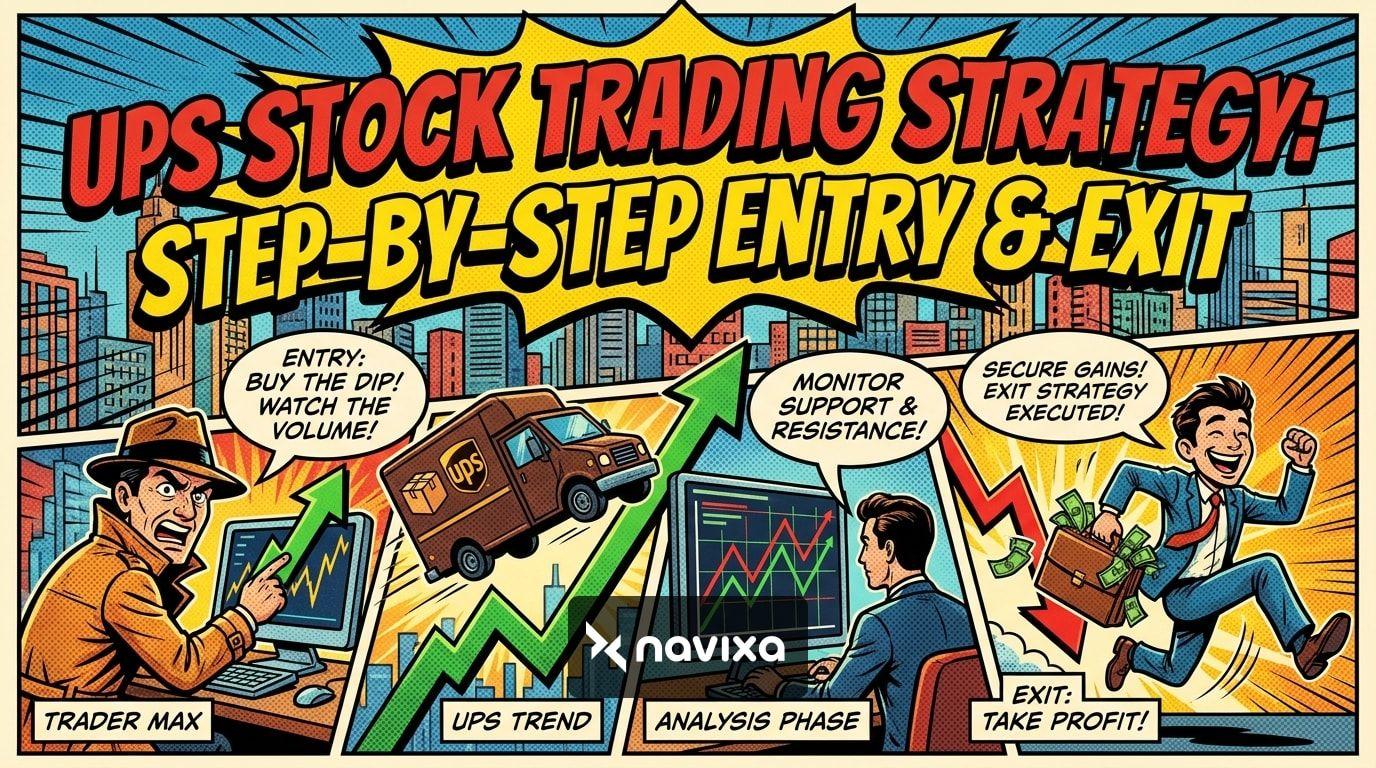
The logistics and transportation sector is experiencing seismic shifts, demanding that market participants continually adapt their approaches. With United Parcel Service (UPS) navigating structural network overhauls and facing fresh competition from major tech giants, developing a resilient UPS stock trading strategy requires precision and deep fundamental awareness. The company is currently executing its "Network of the Future" transformation, a bold initiative aimed at pruning low-margin deliveries and aggressively expanding into high-margin healthcare and B2B logistics.
However, a successful strategy must account for recent market volatility. Following a solid earnings beat, the stock encountered severe headwinds when competitors launched direct threats to UPS's core small and medium-sized business (SMB) market. For traders, this presents a classic dilemma: is the recent price compression a value trap, or a prime accumulation opportunity? By combining fundamental data, technical price levels, and disciplined risk management, traders can formulate a clear roadmap for entry, exit, and long-term portfolio optimization.
- UPS successfully beat recent quarterly earnings estimates, posting a robust $1.07 EPS despite strategic volume declines.
- The company is actively shedding low-margin Amazon deliveries by 50% to boost high-yield healthcare and SMB logistics.
- Technical support levels around the $88 to $90 zone offer potential dollar-cost averaging opportunities for dividend-focused traders.
- Amazon's launch of Supply Chain Services (ASCS) introduces fresh volatility and significant competitive risk to the SMB segment.

The Macro Context: Earnings, Restructuring, and Competitive Threats
Before diving into technical charts, a profitable UPS stock trading strategy must be grounded in the macroeconomic reality. Recently, UPS reported a critical earnings beat, generating $21.2 billion in quarterly revenue and an adjusted EPS of $1.07, which comfortably outpaced consensus estimates. This performance underscores the early success of CEO Carol Tomé's initiative to prioritize "better, not bigger" operations. By systematically reducing reliance on Amazon—planning to cut that specific volume by more than 50%—UPS is freeing up network capacity to pursue highly profitable healthcare logistics, which recently posted a milestone $3 billion quarter.
However, the market is rarely straightforward. In early May, UPS shares experienced a dramatic gap-down, shedding nearly 10% of their value to trade in the mid-$90s. The catalyst was Amazon's aggressive expansion into logistics with the launch of Amazon Supply Chain Services (ASCS). This new service directly targets the SMB market, challenging one of UPS's most critical growth avenues. Traders must evaluate whether this massive sell-off represents a structural defeat or an overreaction. Reviewing the company's latest financial filings confirms that while the Amazon threat is real, UPS's balance sheet remains robust enough to sustain its restructuring.
Furthermore, broader economic policies play a significant role in industrial sector valuations. Changes in monetary policy can dramatically shift the cost of capital for capital-intensive businesses. Traders must monitor how interest rates affect the logistics sector, much like analyzing a Jerome Powell stock market warning for macroeconomic clues that could trigger broader market sell-offs.
Market Analysis & Trading Psychology
Navigating a legacy giant undergoing a multi-year turnaround is arguably one of the most psychologically demanding endeavors in the market. When a blue-chip stock like UPS drops double digits in a single session, the natural instinct is either blind panic or aggressive "falling knife" buying. Neither reaction serves a disciplined trader.
A robust E-E-A-T (Experience, Expertise, Authoritativeness, and Trustworthiness) approach to trading psychology emphasizes patience and conviction in your thesis. If your strategy is built around capturing UPS's ~6.1% dividend yield while waiting for the projected second-half inflection point, short-term volatility should be viewed as noise rather than a fundamental invalidation. It requires extreme discipline to master SBUX stock trading psychology during corporate restructurings, and managing a UPS position demands that exact same emotional fortitude.
The psychological edge comes from understanding the difference between cyclical weakness and terminal decline. UPS is intentionally reducing its total volume to improve profit per piece. Therefore, headlines screaming about "declining package volumes" must be contextualized. If the profit margin per package is rising, the volume decline is a feature, not a bug. Keeping this perspective prevents traders from being shaken out of their positions during planned consolidation phases.

Step-by-Step UPS Stock Trading Strategy
Executing a profitable trade requires moving from theoretical analysis to precise, actionable steps. Below is a structured framework for defining your entry, managing your capital, and executing your exit.
1. Identifying the Optimal Entry Point
With UPS experiencing significant gap-downs, the stock is testing major historical support zones. The current technical landscape suggests that the $88 to $90 range serves as a critical floor. Instead of allocating your entire position at once, a phased entry approach is highly recommended. By breaking your capital into smaller tranches, you can absorb the volatility of the ASCS news while building a favorable average cost basis.
For traders looking to automate and optimize this phase, utilizing a smart DCA strategy can help systematically scale into the stock during periods of extreme fear, mitigating the risk of a single poor entry price.
2. Managing the Position and Capturing Yield
One of the primary benefits of trading UPS during its transition is the substantial dividend yield, often exceeding 6%. While waiting for the stock to recover to fair valuation, these quarterly payouts provide a steady stream of capital return. Traders must track ex-dividend dates carefully, as stock prices frequently adjust downward by the dividend amount on these days.
Always factor ex-dividend dates into your trading timeline. If you plan a short-term swing trade, holding through the ex-dividend date might trigger an unexpected price drop that nullifies your capital gains.
3. Setting Strict Profit Targets and Exits
If UPS's "Network of the Future" begins yielding visible margin expansion, the stock will likely experience a rapid re-rating. Immediate resistance sits near the $102 to $103 gap-fill level, with major structural resistance forming between $112 and $115. A disciplined trader will place limit orders at these tiers to scale out of the position.
If your horizon extends beyond a few quarters, reviewing a Zillow stock long-term strategy provides valuable insights into holding legacy assets through multi-year technological transformations. The timeline for UPS's full recovery is projected toward late 2026, meaning long-term holders must be willing to endure sideways price action.
UPS vs. Competitors: Logistics Market Comparison
Understanding relative strength is crucial. Here is how UPS stacks up against its primary rivals in the current macroeconomic environment:
| Feature/Metric | UPS (United Parcel Service) | FedEx | Amazon (ASCS) |
|---|---|---|---|
| Core Focus | Healthcare, high-margin SMB | Express, freight spin-offs | End-to-end e-commerce fulfillment |
| Dividend Yield | High (~6.1%) | Moderate (~2.5%) | None |
| Current Headwinds | Shrinking Amazon volume, ASCS threat | Network consolidation costs | Regulatory scrutiny, unproven B2B |
| Turnaround Target | H2 2026 Inflection | Ongoing cost-cutting | Aggressive market capture |

Technical Analysis & Key Price Levels
Pure fundamentals tell you *what* to buy, but technical analysis tells you *when* to buy. Following the massive sell-off triggered by the Amazon ASCS announcement, UPS's chart structure suffered severe technical damage.
Moving Averages: The stock's recent plunge caused the 20-day Simple Moving Average (SMA) to cross sharply below the 60-day SMA. This "death cross" formation on the daily timeframe indicates overwhelming short-term bearish momentum. The 200-day moving average, hovering near the $101 level, has flipped from support to formidable resistance.
Support and Resistance Zones: - Primary Support ($88 - $90): This is the psychological and historical floor. A breakdown below this level could trigger margin calls and institutional capitulation. - Immediate Resistance ($102 - $103): This zone represents the gap-down origin. Gaps act as magnets, but filling them requires immense buying volume. - Medium-Term Target ($112 - $115): The consensus average price target among Wall Street analysts. Breaking above this zone signals that the turnaround is fully priced in.
Momentum Indicators: The Relative Strength Index (RSI) plunged into deeply oversold territory (below 30) following the early May sell-off. While oversold conditions can persist during strong downtrends, they often precede violent "dead cat bounces" or genuine trend reversals.
Risk Management & Practical Takeaways
No UPS stock trading strategy is complete without a rigorous risk management protocol. The logistics industry is inherently exposed to external variables that management cannot control. Chief among these are volatile fuel prices. Spikes in crude oil, often driven by geopolitical tensions, immediately compress operating margins despite fuel surcharges passed on to customers.
Furthermore, traders must monitor macroeconomic data regarding consumer spending and inflation. A slowdown in U.S. consumer confidence directly translates to fewer packages shipped, threatening the revenue base before the high-margin healthcare segment can fully mature to offset the losses.
Finally, the Amazon threat cannot be overstated. Amazon's massive capital reserves allow it to operate ASCS at a loss to capture market share, potentially forcing UPS into a destructive pricing war within the SMB sector.
Never allocate your entire position into a stock immediately following a major gap-down event. Wait for technical confirmation, such as a double-bottom formation or volume stabilization, before committing heavy capital.

Conclusion
Constructing a profitable UPS stock trading strategy requires balancing the immediate technical damage caused by competitive threats against the long-term potential of a leaner, higher-margin corporate structure. The company's intentional pivot away from empty volume toward lucrative healthcare and B2B logistics creates a compelling, albeit delayed, bullish thesis.
For traders, the current environment demands patience, strict position sizing, and a willingness to collect the generous dividend while the "Network of the Future" takes root. Buy at technical support, respect your stop-loss parameters, and never ignore the macroeconomic winds shaping the broader industrial sector. If you are ready to refine your approach and discover more advanced setups across multiple asset classes, be sure to explore Navixa strategies and elevate your trading journey.
Frequently Asked Questions
What is the current dividend yield for UPS stock?
As of recent market evaluations, UPS offers a high dividend yield of approximately 6.1%. The company currently maintains a quarterly payout of $1.64 per share, making it highly attractive for income-oriented investors during periods of consolidation.
How is Amazon's new Supply Chain Services (ASCS) affecting UPS?
Amazon's ASCS is a direct challenge to UPS's core growth area: the small and medium-sized business (SMB) market. By offering end-to-end logistics solutions to external vendors, Amazon threatens to erode UPS's pricing power and market share, which caused a significant stock sell-off upon announcement.
When does UPS management expect profitability to inflect?
UPS management, led by CEO Carol Tomé, has guided that the back half of 2026 will serve as the primary inflection point. By this time, the intentional reduction of low-margin Amazon volume will be complete, allowing the higher-margin healthcare and SMB segments to drive consolidated margin expansion.
What are the key technical support levels for UPS stock?
Following the recent market corrections, technical analysis indicates a strong historical support zone between $88 and $90. Traders closely watch this area for volume stabilization and potential bullish reversal signals, utilizing it as a prime zone for dollar-cost averaging.
Is UPS a good stock for short-term day trading?
Due to its high liquidity and recent gap-downs, UPS can offer lucrative opportunities for short-term swing and day traders. However, because it is heavily influenced by macroeconomic news and competitor announcements, traders must utilize strict stop-losses to mitigate overnight risk.