
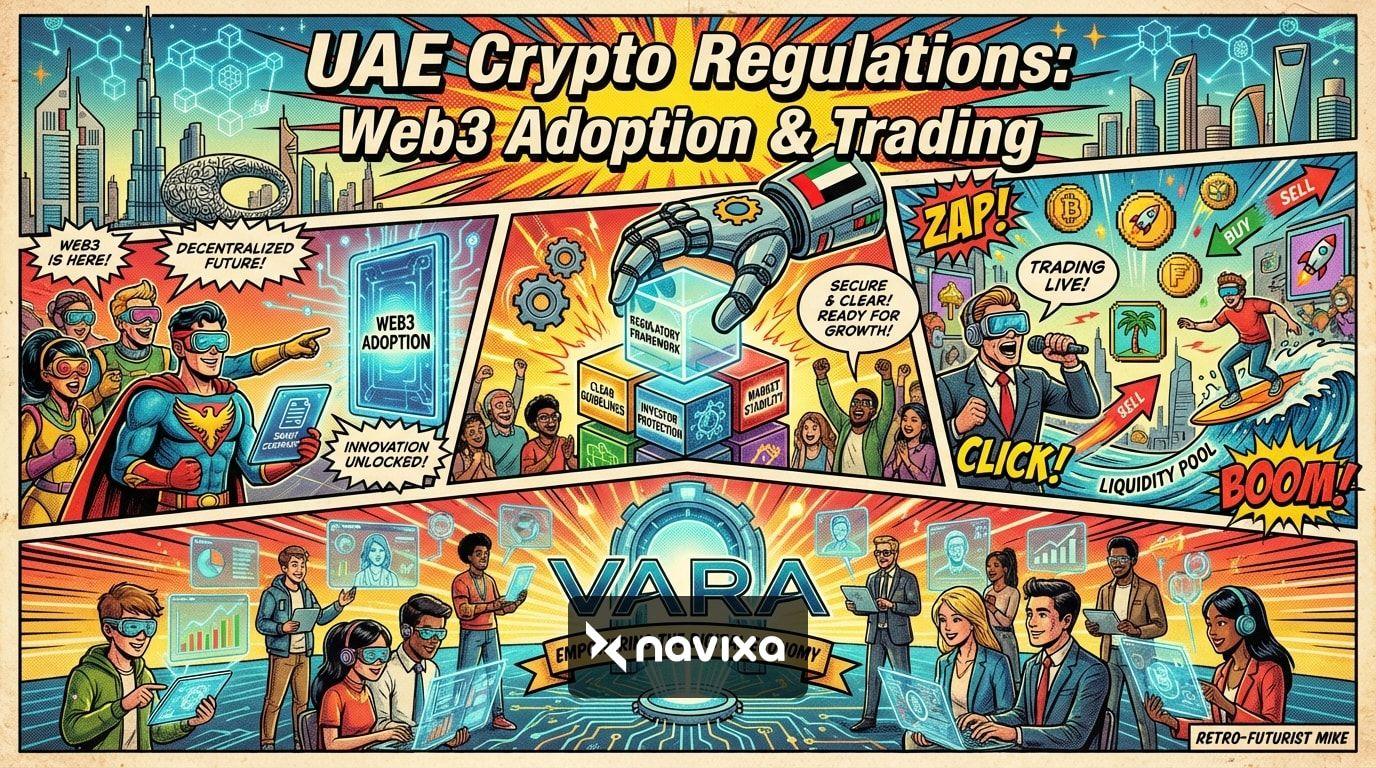
The United Arab Emirates has officially transitioned from a promising digital asset hub into a highly regulated, supervision-first global powerhouse. With legislative frameworks firmly operational across multiple free zones and mainland jurisdictions, UAE crypto regulations are no longer just about obtaining a license—they are about rigorous enforcement, operational resilience, and institutional-grade compliance.
For Web3 enterprises, institutional investors, and algorithmic traders, this regulatory maturity presents both a high barrier to entry and an unprecedented opportunity. The ecosystem has purged opaque actors, paving the way for sophisticated decentralized finance (DeFi), Real-World Asset (RWA) tokenization, and heavily regulated derivative markets.
In this comprehensive guide, we will explore the nuances of the UAE's digital asset regulations, how they are driving Web3 adoption trends, and the exact ways market participants must adapt their trading strategies, technical analysis, and risk management frameworks to thrive in this robust environment.
The Pillars of UAE Crypto Regulations
The UAE does not rely on a single, monolithic regulator. Instead, it utilizes a sophisticated multi-jurisdictional approach tailored to specific financial zones and emirates. Understanding this architecture is the foundational step for any Web3 business or institutional trader looking to deploy capital.
VARA: Dubai's Supervision-First Authority
Dubai's Virtual Assets Regulatory Authority (VARA) is the world's first independent regulator specifically established for digital assets. Transitioning from an initial licensing phase to a strict supervisory posture, VARA now mandates robust governance, capital discipline, and continuous compliance. Recent milestones include strict mandates for Exchange Traded Derivatives (ETDs). Under this framework, licensed Virtual Asset Service Providers (VASPs) must enforce stringent client classification, provide deep transparency, and implement algorithmic leverage controls.
ADGM and DIFC: The Financial Free Zones
The Abu Dhabi Global Market (ADGM), governed by the Financial Services Regulatory Authority (FSRA), has long been a pioneer in institutional crypto. Its updated frameworks demand higher capital entry barriers—such as increasing Category 4 capital requirements from USD 10,000 to USD 50,000—and provide profound clarity on regulated stablecoin businesses. Conversely, the Dubai International Financial Centre (DIFC) operates under the Dubai Financial Services Authority (DFSA). Recently, the DFSA shifted the burden of token suitability onto the firms themselves, dismantling its previous "Recognised Crypto Tokens" list to encourage more agile, yet responsible, tokenization. This has catalyzed massive interest in the DIFC's Tokenization Regulatory Sandbox.
CBUAE and SCA: Federal Oversight
The Central Bank of the UAE (CBUAE) and the Securities and Commodities Authority (SCA) handle onshore federal regulations. The CBUAE's Payment Token Services Regulations effectively integrated fiat-backed stablecoins into the mainstream financial infrastructure, legally classifying them as regulated financial plumbing. Crucially, the Central Bank explicitly prohibits algorithmic stablecoins and anonymity-enhanced cryptocurrencies (privacy coins), ensuring full alignment with international anti-money laundering standards.
Jurisdictional Comparison: Where to Build and Trade
Selecting the right jurisdiction dictates a firm's operational costs, tradable assets, and targeted investor base. The below comparison highlights the core differences across the UAE.
| Jurisdiction / Regulator | Primary Focus | Notable Regulatory Rules | Ideal For |
|---|---|---|---|
| Dubai Mainland (VARA) | Complete Web3 ecosystem, Exchanges, Custody | Implementation of ETD rules; mandatory AML/FATF gap assessments. | Native crypto exchanges, retail and institutional brokers, NFT marketplaces. |
| Abu Dhabi (ADGM / FSRA) | Institutional finance, traditional-to-crypto bridge | Increased capital requirements; strict algorithmic stablecoin ban. | Institutional custodians, heavy-capital market makers, RWA tokenization. |
| Dubai (DIFC / DFSA) | Fintech, Tokenized traditional assets | Firm-led token suitability assessments; active tokenization sandbox. | Wealth management funds, traditional finance (TradFi) pivoting to blockchain. |
| UAE Onshore (SCA/CBUAE) | Federal payment infrastructure, securities | Strict payment token licensing; integration of dirham-backed stablecoins. | Payment gateways, fiat-to-crypto off-ramps, domestic stablecoin issuers. |
Adapting Your Trading Strategy for Regulated Markets
The maturation of UAE crypto regulations requires traders to fundamentally pivot from the aggressive, unregulated tactics of the past into highly structured, institutional models.
Leveraging Exchange Traded Derivatives (ETDs)
With VARA launching a dedicated framework for virtual asset derivatives, traders can now access sophisticated financial instruments legally and securely. A compliant trading strategy in the UAE must account for strict margin limitations and segregated client accounts. Traders looking to short the market or hedge their spot portfolios can utilize these regulated ETDs, knowing that the counterparty risk is actively monitored by government authorities. Retail investors must undergo rigorous suitability tests before accessing these leverage pools, meaning institutional algorithms face less unpredictable retail-driven liquidations.
Stablecoin and RWA Arbitrage
Because the CBUAE has formally recognized payment tokens—paving the way for fully-backed, dirham-pegged stablecoins like Zand AED—new arbitrage opportunities have emerged. Quantitative traders can build latency-sensitive strategies that exploit the micro-inefficiencies between local UAE dirham-backed stablecoins and global USD-backed assets like USDC (which holds strong regulatory backing within the ADGM). Furthermore, as real estate and traditional securities become tokenized in the DIFC, cross-asset arbitrage between on-chain RWAs and off-chain traditional equities provides a fertile ground for market-neutral strategies.
"Regulation does not stifle institutional trading; it clarifies the perimeter. By clearly defining the rules for margin, leverage, and asset suitability, the UAE has invited sovereign and institutional capital to execute strategies that were previously deemed too risky in offshore markets."
Technical Analysis in a Compliant Web3 Ecosystem
Technical analysis (TA) must evolve when operating within a tightly regulated framework. Because UAE regulators prohibit privacy coins (such as Monero or Zcash) and severely restrict algorithmically backed stablecoins, the tradable universe on local exchanges is heavily curated to high-liquidity, transparent assets.
Volume Profiling on Regulated Exchanges
Volume analysis becomes profoundly more reliable on licensed UAE exchanges. VARA enforces strict Anti-Market Abuse rules—including heavy operational penalties and immediate license suspensions for wash trading, front-running, and spoofing. Consequently, the order book data is inherently cleaner. Technical analysts can trust support and resistance levels built on Volume Profile Visible Range (VPVR) indicators without the constant fear of manipulated, algorithmic liquidity hunting.
Moving Averages and Institutional Flows
Because the UAE digital asset ecosystem is largely driven by family offices, sovereign wealth funds, and high-net-worth individuals, the asset flows mimic traditional financial markets. Traditional indicators like the 200-day Moving Average (MA) or Volume Weighted Average Price (VWAP) behave much more reliably than in retail-heavy, offshore exchanges. Breakouts tend to be backed by genuine spot accumulation rather than over-leveraged retail euphoria.
On-Chain Analysis as a Compliance Tool
Regulators demand full traceability, strictly aligned with the Financial Action Task Force (FATF) Travel Rule. For technical analysts relying on on-chain data, this means large whale movements between licensed VASPs are easier to track and categorize. Monitoring inflows and outflows from known ADGM or VARA-licensed custodial wallets serves as a potent leading indicator for institutional accumulation or distribution phases.
Actionable Steps for Web3 Adoption
For entrepreneurs, brokers, and trading firms looking to establish a presence or migrate operations to the UAE, navigating the landscape requires meticulous planning and legal precision.
1. Conduct a Jurisdictional Gap Assessment: Before incorporating, map out your exact business model against VARA, ADGM, DIFC, and SCA. Do not assume one license covers the entire nation. If you are launching a retail payment token, CBUAE compliance is absolutely mandatory. 2. Eliminate Prohibited Assets: Immediately audit your token offerings or exchange trading pairs. Ensure there is zero exposure to algorithmic stablecoins or privacy-enhancing tokens, as touching these assets can trigger immediate license revocation. 3. Appoint a Local MLRO: Regulators expect VASPs to act as the first line of defense against financial crime. Hiring a locally based, deeply experienced Money Laundering Reporting Officer (MLRO) is a strict requirement for almost all UAE virtual asset licenses. 4. Upgrade Institutional-Grade KYC/AML: Implement real-time blockchain analytics and Travel Rule compliance APIs. Standard KYC is no longer sufficient; firms must execute continuous transaction monitoring and source-of-wealth verifications. 5. Implement Segregation of Funds: If operating an exchange or broker-dealer under VARA's new ETD guidelines, establish strict, auditable firewalls between corporate operational capital and client trading funds. 6. Prepare for Continuous Supervision: Move away from the legacy crypto mindset of "obtaining a license" to the TradFi mindset of "maintaining a license". Expect regular regulatory audits, capitalization checks, and mandatory reporting cycles.
Risk Management in a Regulated Landscape
Effective risk management is the cornerstone of surviving the UAE's supervision-first environment. The era of thinly capitalized, loosely governed crypto operations has officially ended.
Managing Regulatory Risk
Regulatory risk is arguably the highest threat vector for crypto firms today. The penalty for non-compliance ranges from severe operational fines to immediate criminal enforcement and license revocation. Firms must build automated compliance engines that dynamically halt trades if a client's risk classification changes, or if a counterparty wallet is suddenly flagged by international targeted financial sanctions lists.
Counterparty and Leverage Risk
Under the latest VARA derivative guidelines, liquidation protocols are strictly monitored. Retail traders must be appropriately classified through deep suitability tests, and higher-risk products are walled off for qualified or institutional investors. From an algorithmic trader's perspective, risk management requires calculating exact liquidation points within the newly permitted, tightened leverage bands, ensuring that stop-losses are executed on compliant matching engines designed to prevent systemic cascade failures.
For further reading on the exact compliance manuals, market participants should consult the VARA Official Portal and review the federal frameworks published by the Central Bank of the UAE.
Practical Takeaways
* Supervision over Licensing: Holding a license in the UAE is just the beginning. It requires continuous operational reporting, strict capital adequacy, and real-time AML monitoring. * Derivatives are Regulated: Traders can now legally access ETDs through VARA-licensed exchanges, but must adhere to strict leverage, margin, and client classification controls. * Clean Order Books: Stringent anti-market manipulation laws mean technical analysis on UAE-regulated exchanges is more reliable due to the severe penalties associated with wash trading and spoofing. * Stablecoins are Mainstream: Fully backed payment tokens are officially integrating into the UAE's core financial infrastructure, opening massive new avenues for institutional arbitrage and RWA tokenization.
Conclusion
The rapid evolution of UAE crypto regulations represents a historic paradigm shift for the global Web3 industry. By choosing to build a comprehensive, multi-layered regulatory architecture, the UAE has successfully filtered out bad actors while rolling out the red carpet for institutional capital.
Whether you are a Web3 founder looking for a stable, legally clear jurisdiction to launch a tokenization project, or a quantitative trader deploying algorithmic strategies on newly regulated derivative markets, aligning with these stringent compliance standards is completely non-negotiable. The future of decentralized finance, real-world assets, and institutional digital trading is happening right now in the Middle East. Embrace the rigorous compliance standards, upgrade your operational infrastructure, and position yourself at the absolute forefront of the global digital asset revolution.
Frequently Asked Questions
What are the main regulatory bodies for crypto in the UAE?
The primary regulators include VARA (for Dubai mainland and most free zones), the FSRA in the ADGM (Abu Dhabi), the DFSA in the DIFC (Dubai), and federal entities like the CBUAE and SCA for onshore payment tokens and broader digital securities.
Are privacy coins legal to trade in the UAE?
No. To maintain strict alignment with FATF anti-money laundering standards and ensure transparent transaction tracing, UAE regulators (including VARA and CBUAE) have explicitly prohibited the issuance, trading, and custody of anonymity-enhanced cryptocurrencies, commonly known as privacy coins.
How do VARA's new derivative rules affect retail traders?
VARA's Exchange Traded Derivatives (ETDs) framework requires strict client classification and suitability testing. While retail traders can access certain basic products, higher-risk derivatives with significant margin and leverage are generally restricted to qualified or institutional investors to ensure adequate consumer protection and risk management.
Do I pay taxes on crypto trading in the UAE?
Currently, the UAE does not levy personal income tax on individual cryptocurrency capital gains. However, standard corporate tax rules do apply to commercial entities, brokerages, and Web3 businesses generating profit within the region, though specific financial free-zones may offer distinct tax exemptions or incentives.