
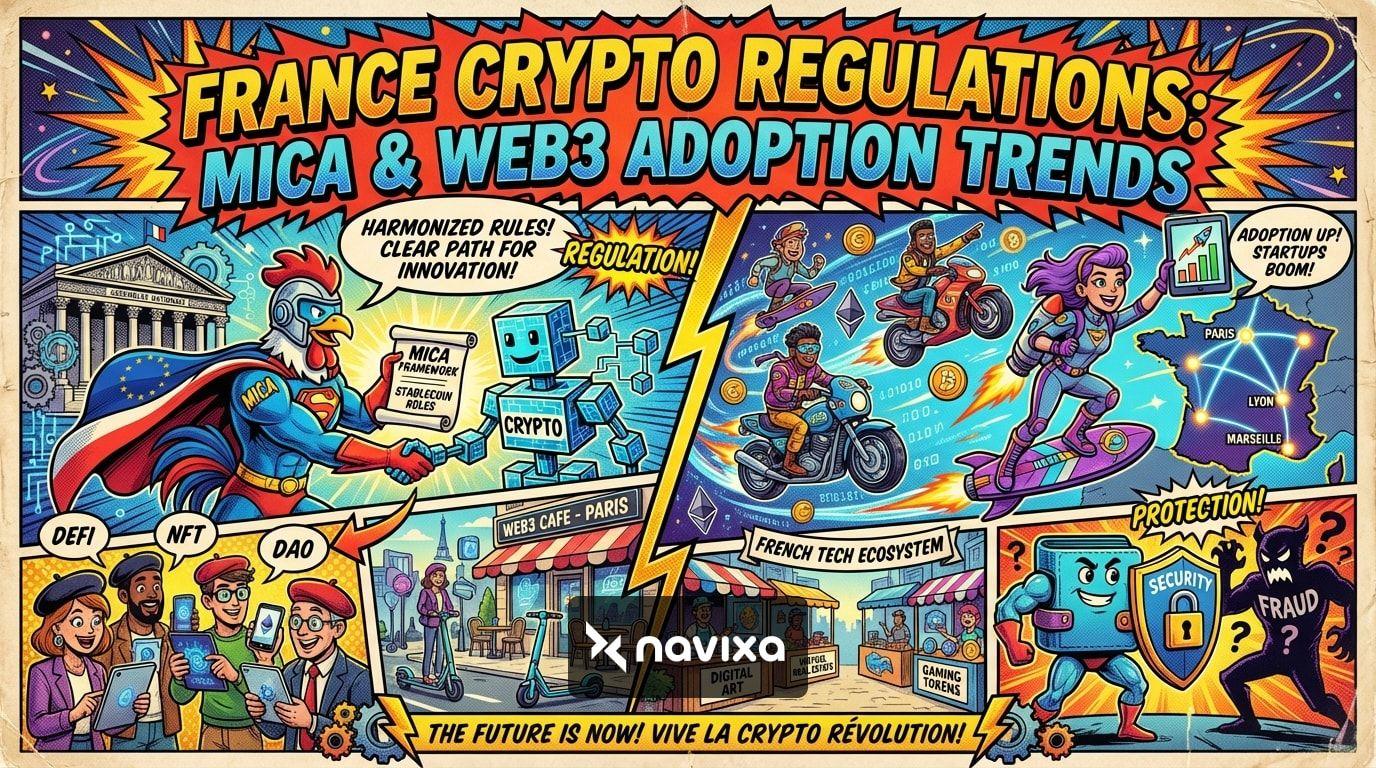
France has consistently positioned itself as a vanguard of digital asset innovation and legal clarity. When discussing France crypto regulations, the conversation inevitably highlights a proactive approach that balances consumer protection with technological advancement. As the European digital asset landscape matures, France finds itself at a critical intersection between its pioneering national laws and the broader, harmonized European framework.
Navigating this environment is essential for anyone involved in the digital asset space—from retail day traders and institutional investors to Web3 developers. Understanding the regulatory shifts, market dynamics, and technological adoption trends in France provides a strategic edge in a highly competitive global market.
The Evolution of France Crypto Regulations
France's journey toward becoming a primary hub for cryptocurrency and blockchain technology was catalyzed by recognizing the necessity of clear legal frameworks. Rather than stifling innovation through forced categorizations, French authorities opted to create bespoke legislation tailored to the unique attributes of decentralized technologies.
The PACTE Act and the DASP Legacy
In 2019, the French government enacted the PACTE Act (Action Plan for Business Growth and Transformation). This landmark legislation introduced a comprehensive, dedicated regulatory framework for the cryptocurrency industry. It established the status of the Digital Asset Service Provider (DASP), known in French as PSAN (Prestataire de Services sur Actifs Numériques).
Under this regime, any entity wishing to provide services such as crypto custody, fiat-to-crypto exchange, or operating a digital asset trading platform within France was required to register with the country's primary financial regulator. Investors and firms must closely monitor updates from the Autorité des Marchés Financiers (AMF), which handles the registration, licensing, and supervision of these service providers in collaboration with the Autorité de Contrôle Prudentiel et de Résolution (ACPR).
This framework was highly successful in establishing trust. Over 100 players, including some of the largest global exchanges and local startups, registered under the DASP regime. It made the French sector one of the most structured and compliant in the world, fostering an environment where both institutional and retail participants could operate with legal certainty.
The Shift to MiCA and CASP Licensing
As the industry evolved, so did the need for cross-border regulatory harmony. The European Union's Markets in Crypto-Assets (MiCA) regulation has now become the definitive law of the land. By the end of 2024, MiCA became fully applicable for new market entrants, replacing the fragmented national laws with a unified European rulebook.
For existing French DASPs, a crucial transitional period was established, extending until mid-2026. During this window, companies registered under the PACTE Act must transition to the standardized European designation: the Crypto-Asset Service Provider (CASP) license. To facilitate this, the AMF introduced a "Fast-Track" procedure, allowing mature companies that already meet stringent local compliance metrics to upgrade their licenses with reduced administrative friction.
Furthermore, understanding the broader European context through the European Securities and Markets Authority (ESMA) is critical for firms looking to passport their services. A CASP license obtained in France allows a firm to seamlessly offer its services across all 27 EU member states, a massive upgrade from the localized DASP model.
Comparing Regulatory Frameworks: PACTE vs. MiCA
Understanding the nuanced differences between the legacy French framework and the new European standard is vital for legal compliance and strategic planning.
| Feature | PACTE Act (France) | MiCA (European Union) |
|---|---|---|
| Primary Jurisdiction | France only | All 27 EU Member States |
| Provider Classification | DASP (PSAN) | CASP |
| Stablecoin Oversight | Limited specific provisions | Stringent e-money token (EMT) reserve rules |
| Market Abuse Rules | General financial guidelines | Dedicated crypto market abuse regime |
| Passporting Rights | None (Local authorization only) | Full EU passporting capabilities |
Web3 Adoption Trends in the French Ecosystem
Despite macroeconomic headwinds, such as fluctuating interest rates and global market restructuring, the French Web3 ecosystem has demonstrated remarkable resilience. France is home to several major Web3 unicorns—including hardware wallet manufacturer Ledger, fantasy sports platform Sorare, and metaverse pioneer The Sandbox—cementing its status as a European technological powerhouse.
Institutional Growth vs. Retail Stabilization
Recent industry barometers and surveys reveal a fascinating divergence in adoption trends. Awareness of crypto-assets in France has reached all-time highs, with over 90% of the population acknowledging familiarity with digital currencies. However, the actual percentage of retail holders has seen a slight stabilization or minor decline as the market matures and speculative fervor cools.
In contrast, institutional adoption has accelerated dramatically. The convergence between traditional finance (TradFi) and decentralized finance (DeFi) is more pronounced than ever. Trading volumes in digital assets within France are now predominantly driven by institutional players, asset managers, and family offices looking to diversify their portfolios with Bitcoin, Ethereum, and tokenized real-world assets (RWAs).
Banking Challenges and Digital Sovereignty
While the regulatory environment provides clarity, operational friction remains. A significant hurdle for French Web3 adoption is access to traditional banking services. Reports indicate that up to 70% of crypto-native companies in France have faced difficulties in securing basic banking facilities, such as opening corporate accounts.
Bridging this gap is essential for France to maintain its digital sovereignty. Public authorities and specialized banking institutions are increasingly collaborating to create trusted financial corridors for Web3 entities, ensuring that regulatory compliance translates into operational enablement.
Trading Strategy & Technical Analysis in a Regulated Market
For traders, the maturation of France crypto regulations fundamentally alters market mechanics. A regulated market attracts deeper liquidity, reduces the risk of exchange insolvency, and changes how trading strategies are formulated.
Adapting to Institutional Liquidity
With institutional capital dominating French trading volumes, retail traders must adapt their strategies. Institutional algorithms operate on different timeframes and volume metrics than retail speculators.
Traders should focus on: * Volume Profile Analysis: Tracking where institutional money is stepping in. In a regulated environment, major support and resistance levels are heavily defended by large limit orders. * Macroeconomic Correlation: Because institutions treat crypto as a macroeconomic asset, traders must incorporate global interest rate decisions, inflation data, and traditional market indices into their crypto technical analysis. * Liquidity Sweeps: Recognizing patterns where large players hunt for liquidity above prior highs or below prior lows before reversing the market direction.
Actionable Steps for Traders in France
To safely navigate this regulated ecosystem, traders should take specific actionable steps: 1. Utilize Licensed Platforms: Always trade on platforms that hold a DASP or CASP license. This ensures your assets are protected by local safeguarding rules and cybersecurity mandates. 2. Maintain Pristine Records: Because regulated exchanges enforce strict KYC (Know Your Customer) policies, your trading data is inherently linked to your identity. Keeping immaculate records of all trades is essential for tax reporting purposes. 3. Monitor Regulatory News Flow: Regulatory announcements from the AMF or ESMA can trigger localized market volatility. Traders should incorporate regulatory news scraping into their daily fundamental analysis routines.
Risk Management and AML/CFT Compliance
In the wake of global market scandals and the collapse of offshore exchanges, French regulators have doubled down on risk management and compliance.
"The transition from the French PACTE framework to the European MiCA regulation marks a critical maturation point for the digital asset industry, shifting the focus from local registration to pan-European authorization, backed by uncompromising security standards."
Anti-Money Laundering and Combating the Financing of Terrorism
France enforces one of the most robust Anti-Money Laundering and Combating the Financing of Terrorism (AML/CFT) frameworks in the world. As of the end of 2024, crypto-asset service providers must adhere strictly to the Transfer of Funds Regulation (TFR2), commonly known as the Travel Rule. This mandates that information regarding the sender and beneficiary of a crypto transfer must travel alongside the transaction, effectively stripping away the anonymity of centralized platform transfers.
Digital Operational Resilience
Additionally, risk management now encompasses cybersecurity. Under European directives like the Digital Operational Resilience Act (DORA), crypto companies operating in France must prove their IT infrastructure can withstand severe cyber threats. For the end user, this means less risk of platform downtime during extreme market volatility and a drastically reduced threat of wallet breaches.
Practical Takeaways and Taxation
No trading strategy is complete without considering the impact of taxation. The French government has established a clear, albeit strict, tax regime for cryptocurrency capital gains.
The Flat Tax Regime (PFU)
For individual, occasional investors, France applies a flat tax rate—known as the Prélèvement Forfaitaire Unique (PFU)—of 30% on capital gains derived from the sale of digital assets for fiat currency (like Euros). This 30% is composed of a 12.8% income tax and a 17.2% social contribution.
Exemptions and Professional Trading
Crucially, crypto-to-crypto trades are considered tax-exempt events. You only trigger a taxable event when you cash out into fiat or use crypto to purchase real-world goods and services. Furthermore, there is a de minimis exemption: if your total sales for the year do not exceed €305, your gains are completely tax-free.
However, it is vital to distinguish between occasional trading and professional trading. If the tax authorities determine that you are a professional trader—based on the frequency of your trades, the sophistication of your tools, and the proportion of your overall income derived from trading—you may be subject to the BIC (Bénéfices Industriels et Commerciaux) regime, which carries different tax implications and higher obligations. Consulting with a certified French tax professional is highly recommended to optimize your tax liabilities.
Conclusion
The landscape of France crypto regulations is a testament to the country's desire to lead the European digital economy. By pioneering the DASP regime and smoothly transitioning into the MiCA era, France offers a secure, regulated, and institutionally backed environment for Web3 innovation and cryptocurrency trading.
While compliance demands and taxation frameworks are stringent, they provide the necessary guardrails for sustainable, long-term market growth. Whether you are a retail trader optimizing your technical strategies or a Web3 founder looking to launch a compliant token, understanding and leveraging this regulatory clarity is your greatest asset. Embrace the regulated future, utilize licensed infrastructure, and stay informed on European policy shifts to maximize your success in the digital asset markets.
Frequently Asked Questions
Is cryptocurrency legal in France?
Yes, cryptocurrency is completely legal and highly regulated in France. While digital assets are not recognized as legal tender, their issuance, trading, and custody operate within a comprehensive legal framework supervised by the AMF and ACPR.
What is the difference between a DASP and a CASP?
A DASP (Digital Asset Service Provider or PSAN) is the national regulatory status established by France's 2019 PACTE Act. A CASP (Crypto-Asset Service Provider) is the new, standardized European designation under the MiCA regulation. Existing DASPs have a transitional period until mid-2026 to upgrade to CASP status, which will allow them to passport their services across all EU member states.
How are cryptocurrency capital gains taxed in France?
For individual investors, capital gains from converting crypto to fiat currency are subject to a 30% flat tax (12.8% income tax + 17.2% social contributions). However, crypto-to-crypto trades are tax-exempt, and total cash-outs under €305 per year are not taxed. Professional traders are taxed under a different regime (BIC).
How does the MiCA regulation impact Web3 adoption in France?
MiCA provides a harmonized, pan-European rulebook that significantly boosts institutional trust. While it imposes stricter compliance and reserve requirements—especially for stablecoin issuers and centralized exchanges—it ultimately legitimizes the Web3 sector, making it easier for traditional financial institutions to safely enter and invest in the market.