
Introduction
Learning how to trade POET stock (NASDAQ: POET) has become a top priority for active investors looking to capitalize on the explosive artificial intelligence and photonics sectors. POET Technologies Inc. has transitioned from a quiet, pre-revenue research firm into one of the most volatile and heavily traded micro-to-mid-cap technology proxies in the market.
- Understanding how to trade POET stock requires mastering technical analysis to navigate extreme, news-driven price volatility.
- The company's core technology, the POET Optical Interposer, targets the booming AI and data center markets but remains in early commercialization.
- Strict risk management is essential, as seen in massive recent gap-downs triggered by canceled purchase orders.
- Swing traders and day traders should focus on volume spikes, support and resistance levels, and gap fills rather than purely long-term fundamentals.
Understanding POET Technologies: The Fundamental Drivers
Before diving into technical charts, it is essential to understand what drives this company. POET Technologies designs and develops photonic integrated packaging solutions. Its flagship product, the POET Optical Interposer, allows for the seamless integration of electronic and photonic (light-based) devices onto a single chip.
As artificial intelligence models grow exponentially, traditional copper wiring inside data centers is hitting physical limits regarding heat and bandwidth. Optical interconnects—using light to transmit data—are the solution. This macroeconomic shift has drawn intense speculative interest into POET. However, trading this stock is vastly different from trading established mega-cap tech giants.
If you are exploring the AI Job Market Outlook: Macro Trends in Tech Stocks, you will understand that infrastructural plays like POET are where early capital flows, creating both massive upside potential and terrifying drawdowns.
**High Volatility Alert:** POET is a pre-revenue, speculative growth stock. In late April 2026, the stock plummeted over 47% in a single day after Marvell Technology canceled all purchase orders with POET citing breached confidentiality rules. Always use stop-loss orders.
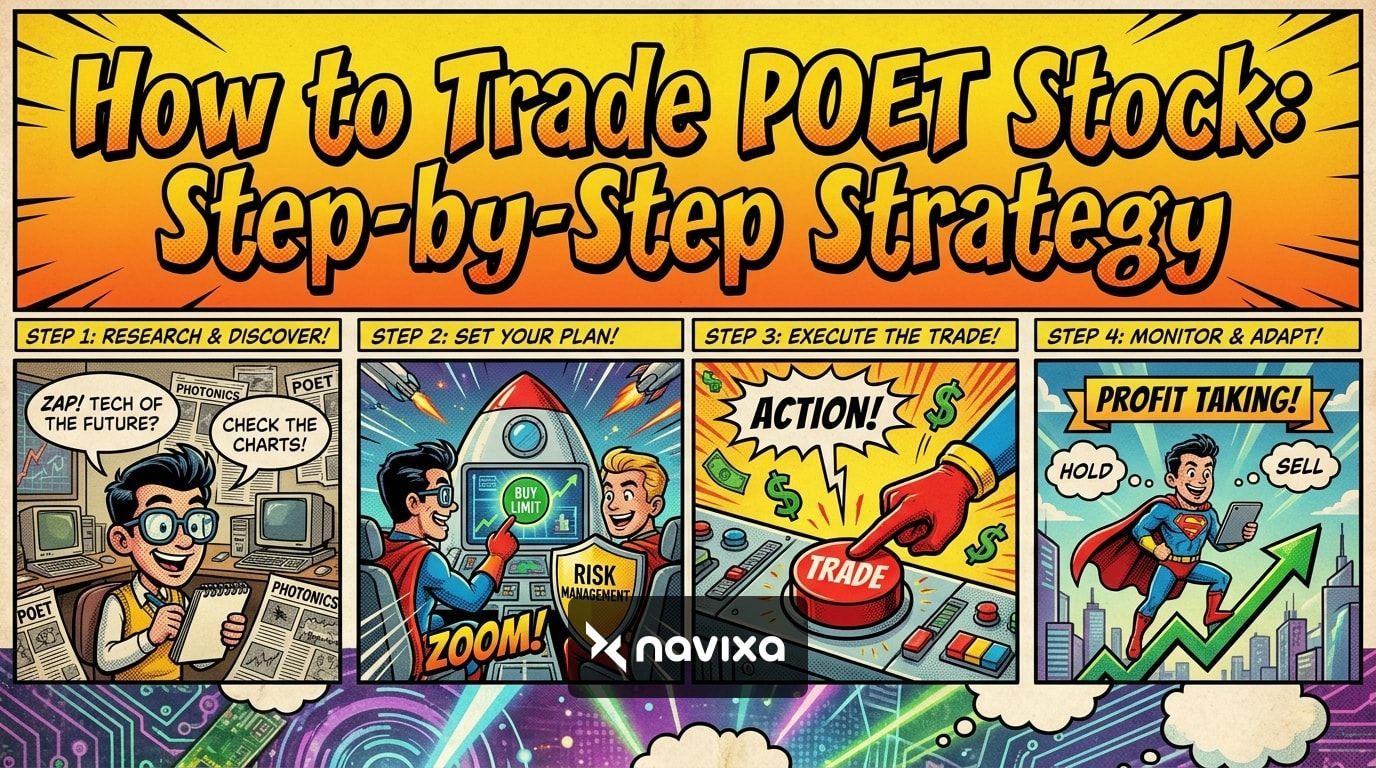
How to Trade POET Stock: Step-by-Step Strategy
Learning how to trade POET stock effectively requires a strict rule-based approach. Because the stock is heavily influenced by retail sentiment, short squeezes, and sudden corporate announcements, traditional buy-and-hold strategies carry immense opportunity cost and risk.
Step 1: Map Out Key Support and Resistance Zones
The first step in trading a highly volatile asset is mapping out the technical landscape. You should identify structural support (where buyers historically step in) and resistance (where sellers take profit).
* Gap Fills: Look for areas where the stock has "gapped" up or down overnight. For instance, massive news-driven sell-offs often leave large gaps in the chart. Over time, prices tend to gravitate back to fill these gaps. * Moving Averages: Utilize the 50-day and 200-day Simple Moving Averages (SMA). For day trading, the 9-period and 21-period Exponential Moving Averages (EMA) on a 15-minute chart are highly effective for timing entries.
When assessing the MACD (Moving Average Convergence Divergence), traders look for crossovers as a signal for entering a trade. A bullish crossover, where the MACD line crosses above the signal line, particularly below the zero line, often precedes a sustained upward momentum shift. Combining this with the Relative Strength Index (RSI) helps confirm if the stock is overbought or oversold. If POET drops below an RSI of 30 due to a sudden panic sell-off, it often presents a high-probability mean-reversion setup for agile day traders.
Step 2: Monitor Volume and Options Activity
Volume precedes price. When POET stock breaks out, it must be accompanied by abnormally high trading volume (e.g., trading tens of millions of shares in a single session). If the stock is moving up on low volume, it is often a "bull trap," and the price will likely reverse.
Additionally, keeping an eye on the options chain can give you clues about where market makers are positioned. High open interest in out-of-the-money call options can sometimes lead to a gamma squeeze, propelling the stock higher as market makers are forced to buy shares to hedge their positions.
Step 3: Implement Tight Risk Management
Because POET is prone to violent swings—capable of dropping 40% to 50% in a single trading session due to fundamental shifts or canceled contracts—risk management is non-negotiable.
* Position Sizing: Never allocate more than 1% to 2% of your total trading portfolio to a single highly volatile stock like POET. * Stop-Loss Orders: Always set a hard stop-loss or trailing stop. Do not rely on mental stops. If the trade breaks your predetermined risk threshold, exit immediately and reassess.
Moreover, understand the mechanics of scaling in and out of trades. Instead of buying your entire position at a single price point, consider a fractional entry approach. Buy 50% of your intended position at initial support, and add the remaining 50% only if the stock confirms the uptrend. When the trade moves in your favor, sell half of the position at the first major resistance level to lock in guaranteed profits, while letting the remainder run with a trailing stop. This approach systematically reduces psychological stress.
For broader insights into protecting your capital during volatile market conditions, consider reviewing our guide on a Stock Market Crash Crypto: Long-Term Holding Strategy.
Market Analysis & Trading Psychology
This section highlights the psychological warfare involved in trading emerging technology stocks. Market Analysis & Trading Psychology is arguably more critical than charting because human emotion is the weakest link in any trading strategy.
When a stock like POET announces a new potential partnership or breakthrough in optical engines, retail investors often experience Fear Of Missing Out (FOMO). They rush to buy at the top of a parabolic spike. Conversely, when bad news drops—such as a canceled order or a short-seller report—panic ensues, leading to capitulation at the absolute bottom.
The market can remain irrational longer than you can remain solvent. Traders who survive volatile stocks prioritize risk management over emotional conviction.
To succeed, you must adopt a contrarian, purely mechanical mindset.
1. Buy the Rumor, Sell the News: Often, the anticipation of an earnings report or a partnership announcement is priced in before the actual event. By the time the news hits mainstream retail channels, institutional algorithms are already taking profits. 2. Trade the Chart, Not the Dream: POET's narrative of revolutionizing AI data centers is compelling. However, your job as a trader is not to invest in the dream but to trade the price action. If the chart signals a trend reversal, you must respect the technicals over the fundamental narrative.
As noted in the Buffett Stock Market Warning: Crypto Macro Outlook, recognizing macroeconomic liquidity trends is essential. When liquidity dries up, speculative, pre-revenue stocks are usually the first to face severe drawdowns. You must detach your emotions from the underlying company and treat the ticker symbol purely as an instrument for capturing price volatility.
**Pro Trading Tip:** When trading a stock with heavy short interest, watch for "squeeze" setups. If the stock pushes past a critical resistance level on high volume, short sellers may be forced to buy shares to cover their positions, adding explosive upward momentum.
Day Trading vs. Swing Trading POET
Deciding your timeframe is crucial when determining how to trade POET stock. The table below outlines the differences between day trading and swing trading this specific asset.
| Feature | Day Trading POET | Swing Trading POET |
|---|---|---|
| Time Horizon | Minutes to hours (No overnight holds) | Days to weeks |
| Primary Indicators | VWAP, 5-min RSI, Level 2 Data | MACD, Daily Support/Resistance, 50-day SMA |
| Risk Profile | High intra-day volatility, zero overnight gap risk | Exposure to overnight news, gaps, and broader market shifts |
| Catalysts | Intraday volume spikes, algorithmic order flow | Corporate earnings, SEC filings, macro AI trends |
External Tools and Resources
To maintain an edge, traders must utilize reputable external tools. Monitoring SEC filings and real-time financial news is critical. You can track real-time price action and market depth using platforms like NASDAQ's Official Site or by studying detailed company financials and analyst ratings on Yahoo Finance. Staying connected to these hubs ensures you are not trading on outdated or stale information, a mistake that could cost you dearly in a fast-moving AI proxy stock.
Conclusion
Mastering how to trade POET stock is an exercise in discipline, technical proficiency, and emotional control. The company sits at the fascinating intersection of artificial intelligence, semiconductor manufacturing, and advanced photonics—a sector ripe with astronomical gains and equally staggering risks.
By employing strict stop-losses, understanding the impact of sudden news events, mapping out structural support zones, and relying on proven technical indicators, traders can confidently navigate the turbulent price action of POET Technologies. Stay vigilant, respect your position sizing, and never let FOMO dictate your entries. Your trading strategy should be as precise and calculated as the microscopic optical chips POET aspires to manufacture.
Frequently Asked Questions
What does POET Technologies do?
POET Technologies is a design and development company that creates photonic integrated packaging solutions. Its primary technology, the POET Optical Interposer, integrates electronic and photonic devices onto a single chip, aiming to improve data transfer speeds and reduce power consumption in AI data centers.
Why is POET stock so volatile?
POET stock is highly volatile because it is largely pre-revenue and highly dependent on future contract validations, partnerships, and overall AI industry trends. Retail sentiment, short seller activity, and sudden corporate news (like contract cancellations or expansions) can trigger massive double-digit percentage swings in a single trading session.
Is POET stock better for day trading or long-term investing?
For active market participants, POET offers excellent day trading and swing trading opportunities due to its high beta and volume spikes. Long-term investing in POET carries a higher fundamental risk since the company is still working toward large-scale commercialization and consistent profitability.
How do macroeconomic trends affect POET stock?
Macro trends, especially those relating to AI infrastructure spending and data center expansions, heavily influence POET. Increased capital expenditure by hyperscalers on optical networking generally creates a bullish sentiment for proxy stocks like POET. Conversely, broader market liquidity drains can severely punish speculative assets.
What should I look for before entering a trade on POET?
Before entering a trade, look for a clear technical setup, such as a bounce off a major support level or a breakout above resistance supported by exceptionally high volume. Ensure you have reviewed recent news catalysts to avoid buying into a "bull trap," and establish a firm, unbreakable stop-loss level before executing your order.