

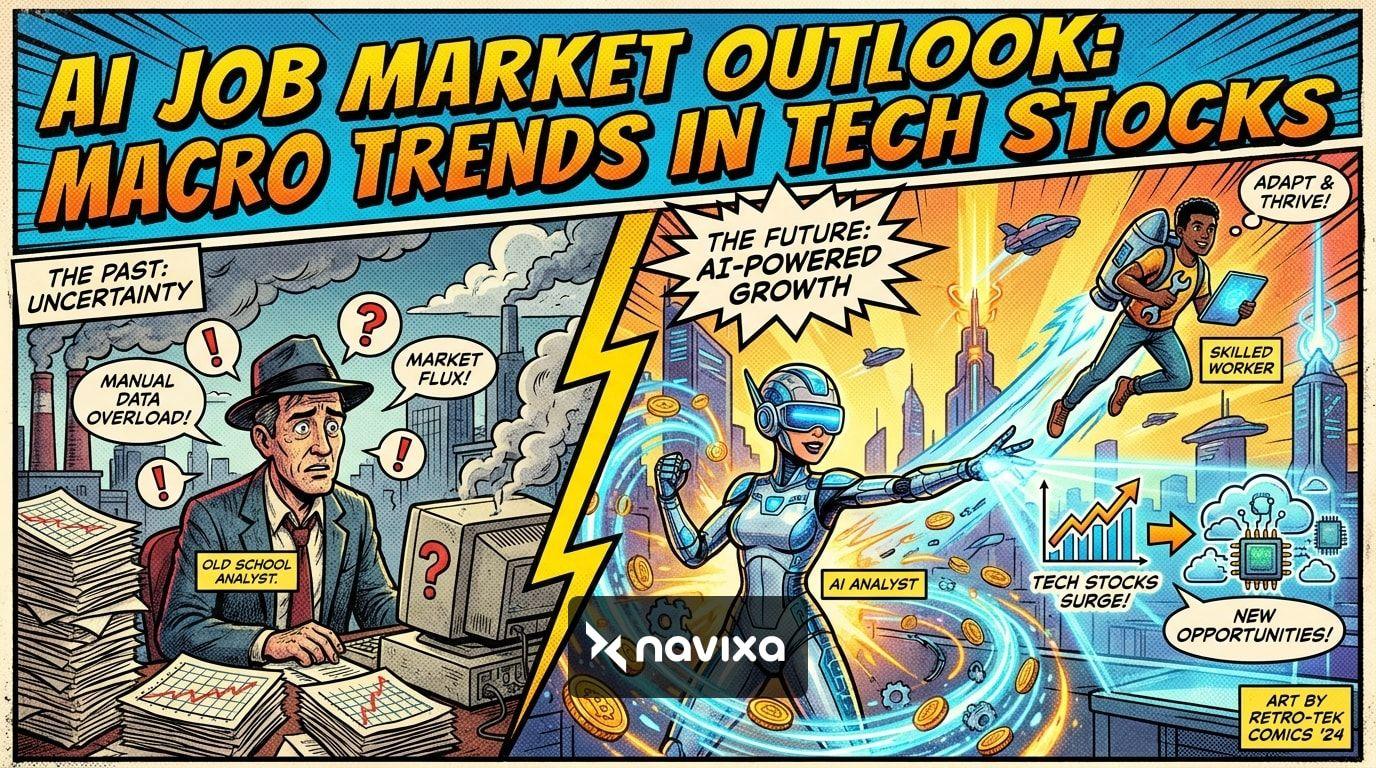
The intersection of artificial intelligence and the global workforce is no longer a futuristic concept; it is the definitive economic driver of our time. As automation rapidly reshapes industries, investors and traders are closely monitoring the AI job market outlook to anticipate shifts in tech stock valuations, sector rotations, and broader macroeconomic trends. The narrative surrounding artificial intelligence has shifted from speculative excitement to measurable financial impact, fundamentally altering how corporations allocate capital and hire talent.
For traders and long-term investors alike, understanding the nuances of the AI labor transition is critical. The market is currently digesting a complex duality: the fear of mass job displacement on one hand, and the reality of unprecedented corporate margin expansion and productivity gains on the other. This article delves into the macroeconomic trends driving the AI job market, how these shifts impact tech stock valuations, and the actionable strategies required to navigate this volatile yet highly lucrative environment.
The Macroeconomic Picture: Job Creation vs. Automation
The most pressing question for economists and market participants is how AI will structurally alter global employment. According to research from Goldman Sachs, an estimated 300 million jobs globally are exposed to some form of AI automation, representing a monumental shift in the labor landscape. However, this headline figure often masks the underlying reality of the current AI job market outlook: artificial intelligence is simultaneously acting as a massive engine for specialized job creation.
While generalist tech roles and repetitive knowledge-worker positions face consolidation, demand for highly specialized talent is skyrocketing. Roles such as Agentic AI Engineers, AI Product Managers, and Machine Learning Architects are "going vertical" in terms of hiring velocity. In fact, current industry data shows that over 67,000 engineering roles remain open globally, proving that the technology sector is aggressively hiring, albeit with a strict focus on AI proficiency.
The compensation for these specialized roles reflects intense capital competition. Data from Pace University indicates that AI engineers in major tech hubs like the New York metro area command salaries ranging from $170,000 to $230,000. This aggressive talent acquisition underscores a broader macroeconomic trend: companies are heavily investing in human capital that can build, deploy, and manage AI infrastructure, rather than relying on bloated departments of traditional software developers.
How Labor Shifts Reshape Tech Stock Valuations
For equity markets, the AI job market outlook directly translates into corporate profitability and stock valuations. The transition from large, generalized workforces to lean, AI-augmented teams is driving historic margin expansion across the technology sector.
According to an extensive analysis by Morgan Stanley, full AI adoption could add an astounding annual net benefit of $920 billion to S&P 500 companies. This massive influx of efficiency and revenue generation is projected to increase the market capitalization of the S&P 500 by $13 trillion to $16 trillion in the long term. The core driver of this valuation surge is the decoupling of revenue growth from linear headcount expansion. Historically, for a tech company to double its output, it had to nearly double its workforce. Today, AI allows firms to scale exponentially while maintaining or even reducing their operational labor footprint.
Interestingly, research from MIT Sloan dispels the myth that AI adoption strictly leads to job losses within successful firms. Their data reveals that companies effectively utilizing AI actually experience a 6% higher employment growth and a 9.5% increase in sales growth over a five-year period. Because these firms become vastly more productive, they capture more market share and consequently hire more specialized workers to sustain their expansion.
Furthermore, this productivity boom has broader macroeconomic implications. Vanguard's Global Chief Economist Joe Davis notes that accelerated AI investment is leading to stronger-than-expected economic growth in the United States. This robust growth could stabilize the labor market to such a degree that the Federal Reserve may execute fewer interest rate cuts than the market currently anticipates. For tech stock valuations, a higher-for-longer interest rate environment traditionally pressures growth stocks, meaning investors must be highly selective, focusing on companies with proven AI cash flows rather than speculative promises.
Market Analysis & Trading Psychology
Navigating the AI revolution requires a profound understanding of market sentiment. The psychological friction between pessimistic labor headlines and bullish corporate earnings creates significant volatility—and opportunity.
On one end of the spectrum is the fear of structural economic collapse. For instance, a notable scenario proposed by Citrini Research hypothesized that AI could trigger a vicious cycle of mass unemployment, leading to reduced consumer spending, declining corporate profitability, and ultimately, a broader market downturn. While historical technological revolutions—from the Industrial Revolution to the advent of the internet—have consistently invalidated the permanent mass unemployment thesis by creating new industries, the psychological impact of layoff announcements frequently triggers algorithmic and retail sell-offs.
Smart money, however, views these structural layoffs differently. When a major tech conglomerate announces a reduction in legacy headcount paired with an increase in AI capital expenditure, institutional investors generally reward the stock. The trading psychology here is rooted in future free cash flow projections. Traders must decouple their emotional reactions to the "death of traditional jobs" from the cold, mathematical reality of corporate efficiency.
To survive this transitional volatility, traders should adopt a resilient mindset. Much like navigating the extreme drawdowns seen in digital assets, maintaining a thesis-driven approach is paramount. Traders who have successfully employed long-term holding strategies during a stock market crash understand that knee-jerk reactions to macroeconomic panic often result in realized losses. By focusing on the underlying productivity metrics of AI-adopting firms, investors can identify lucrative entry points during sentiment-driven pullbacks.
Sector Rotation: Beyond the Magnificent Seven
While mega-cap technology companies have dominated the initial phase of the AI boom, the next phase of the AI job market outlook points toward a massive sector rotation. As the foundational models become commoditized, the economic benefits of AI are rapidly spreading to non-tech sectors.
Vanguard's analysis suggests that as AI's advantages broaden out, value stocks and non-U.S. equities will begin to offer some of the strongest risk-return profiles in the market. Investors are increasingly looking at "pick-and-shovel" plays—the infrastructure required to keep AI running. This includes energy grid operators, advanced cooling system manufacturers, and semiconductor fabrication plants.
Real estate and property technology (PropTech) are also uniquely positioned to benefit from AI-driven labor efficiencies. Companies that leverage AI to automate underwriting, property valuation, and virtual staging can drastically reduce their overhead. Investors looking at this space should consider a Zillow stock long-term PropTech holding strategy as a prime example of how AI can revolutionize traditional service sectors.
Furthermore, the defense and aerospace sectors are aggressively hiring AI talent to develop autonomous systems, predictive maintenance algorithms, and advanced cybersecurity protocols. Geopolitical tensions combined with the AI arms race make defense contractors a robust hedge against consumer market volatility. Analyzing the macro outlook for defensive plays like Lockheed Martin reveals how legacy industrial giants are transforming into high-tech AI fortresses.
The Intersection of AI, Web3, and Decentralized Networks
The evolution of the AI job market is also creating fascinating crossover opportunities with Web3 and cryptocurrency ecosystems. As artificial intelligence models require increasingly massive datasets and computational power, centralized infrastructure is struggling to keep pace. This bottleneck is driving the rise of Decentralized Physical Infrastructure Networks (DePIN).
In the gaming and digital rights sector, the integration of AI agents and blockchain technology is creating entirely new micro-economies. For example, the PlayStation DRM Web3 investment thesis highlights how decentralized networks can manage digital asset ownership in AI-generated gaming environments.
Moreover, as AI agents become autonomous—capable of executing trades, negotiating contracts, and purchasing compute power—they require a secure, borderless financial settlement layer. Cryptocurrencies are uniquely suited to serve as the native currency for machine-to-machine (M2M) transactions. However, this raises significant concerns regarding data privacy and regulatory compliance. As autonomous AI systems process sensitive financial data, the demand for zero-knowledge proofs and cryptographic privacy will surge, directly impacting the privacy coins market outlook. Traders who understand the symbiotic relationship between AI automation and decentralized settlement layers will be positioned at the forefront of the next massive liquidity cycle.
Comparison: Traditional vs. AI-Driven Tech Workforces
To visualize the structural changes occurring in the market, the following table breaks down the core differences between traditional tech labor dynamics and the new AI-driven paradigm.
| Feature | Traditional Tech Job Market | AI-Driven Tech Job Market |
|---|---|---|
| Primary Skill Sets | General coding, manual QA, standard IT | Applied AI, prompt engineering, agentic AI, LLMs |
| Capital Allocation | Headcount expansion, broad hiring sprees | Lean teams, massive compute/GPU infrastructure |
| Productivity Metrics | Hours worked, lines of code written | Measurable impact, AI-augmented output, automation |
| Macro Impact | Slower, linear corporate margin growth | Exponential margin expansion, $920B S&P 500 benefit |
| Market Leadership | Software-as-a-Service (SaaS), Web2 | AI infrastructure, DePIN, Web3, Data Centers |
Practical Takeaways for Traders and Investors
1. Focus on AI Cash Flows, Not Hype: Avoid companies that merely mention AI in their earnings calls. Look for tangible reductions in operational expenditures (OpEx) and increases in revenue per employee. 2. Diversify into Infrastructure: The AI job market requires immense physical infrastructure. Allocate capital to energy grids, data center REITs, and advanced manufacturing. 3. Monitor the Labor Data: Keep a close eye on structural layoffs versus cyclical layoffs. A company cutting 10% of its workforce to invest heavily in Nvidia GPUs is often a bullish signal for future margins. 4. Explore the Web3 Intersection: Decentralized compute and AI data privacy are the next frontiers. Position your crypto portfolio to capture the value of machine-to-machine economies.
Conclusion
The AI job market outlook is not a narrative of human obsolescence; rather, it is a story of profound economic transition and unprecedented value creation. As the global workforce shifts from generalized labor to specialized, AI-augmented roles, corporate productivity is set to shatter historical ceilings. For tech stock valuations, this means we are entering a sustained period of margin expansion, provided companies can successfully integrate these new technologies. By ignoring the sensationalist fear-mongering and focusing on the macroeconomic data, investors can strategically position themselves to capitalize on the greatest wealth-generation event of the modern era.
***
Frequently Asked Questions
How will the AI job market outlook affect the broader economy over the next five years?
According to macroeconomic models from institutions like Vanguard and Morgan Stanley, the transition toward an AI-driven workforce is expected to boost overall economic productivity, stabilize labor markets through specialized job creation, and potentially add nearly $1 trillion in annual net benefits to major indices like the S&P 500.
Are software engineering jobs disappearing because of AI?
No, software engineering jobs are not disappearing, but they are rapidly evolving. The market is transitioning away from manual, repetitive coding roles toward positions that require a deep understanding of Applied AI, machine learning frameworks, and large language models (LLMs). There are still tens of thousands of open engineering roles globally for those who can integrate AI tools into their workflows.
How should investors react when a tech company announces AI-related layoffs?
Investors should analyze the context of the layoffs. If a company is reducing legacy headcount to reallocate capital toward AI infrastructure, research and development, or specialized AI talent, the market often views this as a bullish indicator for future margin expansion and free cash flow generation.
What sectors outside of Big Tech will benefit the most from AI labor efficiencies?
Sectors that historically rely on heavy administrative, analytical, or repetitive cognitive tasks are primed for massive disruption. This includes property technology (PropTech), defense and aerospace, financial services, healthcare diagnostics, and the energy sector (specifically companies powering data centers and AI infrastructure).