
The cryptocurrency market never sleeps, and for years, traders have lost sleep trying to keep up. Technical analysis (TA)—the art of reading chart patterns, volume, and indicators to predict future price action—has traditionally been a manual, labor-intensive skill that takes years to master. But the arrival of advanced Large Language Models (LLMs) like GPT-4o has fundamentally shifted the landscape.
Today, ChatGPT technical analysis is not just a buzzword; it is a practical workflow used by retail and institutional traders alike. Whether you are looking to identify a subtle "Head and Shoulders" pattern, write complex Pine Script code for TradingView, or backtest a new strategy, AI tools can act as a 24/7 analyst that accelerates your decision-making process.
The Evolution of AI in Crypto Trading
In the early days of automated trading, algorithms were rigid. They followed strict if-then rules hardcoded by developers. If Bitcoin’s RSI (Relative Strength Index) crossed 70, the bot sold. There was no nuance, no understanding of market sentiment, and certainly no visual capability.
Generative AI has changed this. Models like GPT-4o are multimodal, meaning they can process text, code, and images. This allows traders to upload a screenshot of a chart and ask the AI to identify support and resistance levels. While it doesn't replace the human intuition required to navigate volatility, it serves as a powerful second opinion.
Visual Analysis: Spotting Chart Patterns with GPT-4o
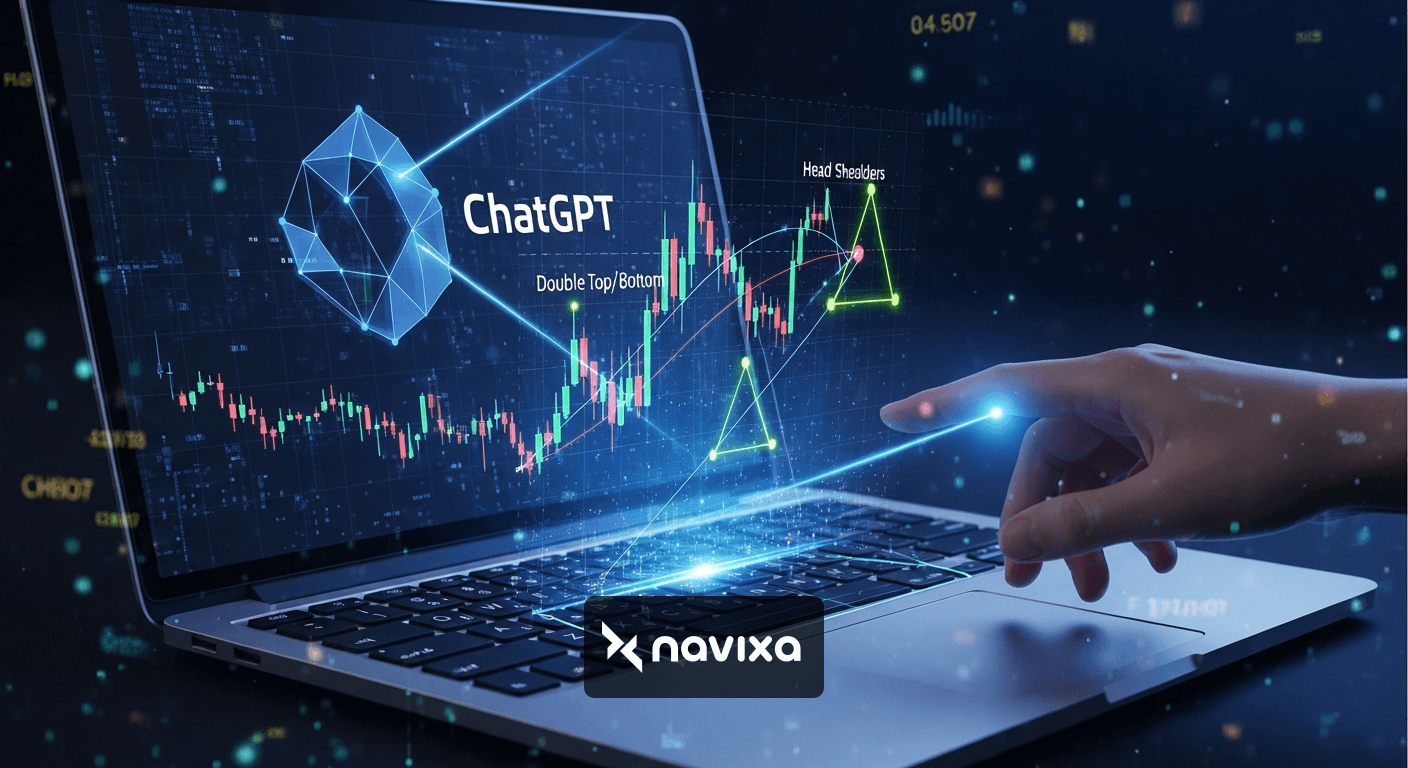
One of the most immediate applications of ChatGPT technical analysis is visual pattern recognition. Crypto charts are often messy, filled with wicks and noise that can obscure the bigger picture. By uploading a high-resolution screenshot of a chart (e.g., BTC/USD or ETH/USDT) to ChatGPT, you can prompt it to analyze specific structures.
Identifying Classic Patterns
You can ask the AI to look for standardized patterns that signal potential breakouts or reversals. Common examples include:
• Bull Flags and Pennants: Consolidation patterns that often precede a continuation of an upward trend.
• Head and Shoulders: A reliable reversal indicator that signals a trend might be ending.
• Double Bottoms/Tops: Key levels where price action has historically bounced or rejected.
However, accuracy relies heavily on your prompt. Instead of simply asking "What does this chart say?", try a detailed prompt like: "Analyze this 4-hour Bitcoin chart. Identify any potential bullish divergence in the RSI and highlight support levels based on the last three months of price action."
Generating Custom Indicators with Pine Script
Perhaps the most potent use case for ChatGPT in crypto is coding. TradingView, the world's most popular charting platform, uses a proprietary language called Pine Script. Many traders have great ideas for indicators but lack the coding skills to build them. ChatGPT bridges this gap.
You can describe a strategy in plain English, and the AI will generate the code. For example, you might ask:
"Write a Pine Script for TradingView that paints a 'Buy' label on the chart whenever the 50-day Exponential Moving Average (EMA) crosses above the 200-day EMA, and the RSI is below 50."
This capability allows non-coders to backtest strategies on historical data instantly. According to recent discussions on TradingView forums, while AI-generated code is about 90% accurate, it may sometimes require minor syntax tweaks—a small price to pay for custom tool creation.
ChatGPT vs. Human Analysis: A Comparison
Is AI ready to replace the veteran trader? Not quite. AI excels at speed and data processing, while humans excel at context and adapting to "black swan" events. The table below outlines the core differences between using an AI model and relying on traditional manual analysis.
| Feature | ChatGPT / AI Analysis | Human Expert Analysis |
|---|---|---|
| Speed | Instant (Seconds) | Slow (Minutes to Hours) |
| Data Capacity | Unlimited historical data processing | Limited by memory and focus |
| Emotional Bias | Zero (Purely logical/statistical) | High (Fear and Greed affect decisions) |
| Context Awareness | Low (May miss breaking news nuances) | High (Understands regulatory/macro shifts) |
| Pattern Recognition | High consistency, literal interpretation | Subjective, intuition-based |
Integrating Sentiment Analysis
Technical analysis does not exist in a vacuum. Crypto prices are heavily influenced by market sentiment—news, social media hype, and regulatory announcements. ChatGPT can assist here by processing textual data alongside your chart analysis.
You can feed the AI recent news headlines or transcripts from Federal Reserve meetings and ask it to correlate that information with the current chart setup. For instance: "Given the hawkish sentiment from today's FOMC meeting, does the current consolidation pattern on Bitcoin look more like accumulation or distribution?"
The Risk of Hallucinations
It is crucial to verify any factual claim made by an AI. LLMs can occasionally "hallucinate," creating plausible-sounding but incorrect data about price history or correlation. Always cross-reference critical data points with a reliable source like CoinMarketCap or your exchange's live feed before executing a trade based solely on AI advice.
Practical Steps to Start Using ChatGPT for TA
To effectively add ChatGPT technical analysis to your routine, follow these actionable steps:
1. Define Your Strategy: Don't ask generic questions. Tell the AI you are a "swing trader looking for 4-hour trend reversals."
2. Provide Context: When uploading a chart, explicitly state the timeframe (e.g., 1D, 4H) and the asset pair.
3. Iterate on Code: If the Pine Script generated gives an error, paste the error message back into ChatGPT. It is excellent at debugging its own work.
4. Combine with Manual Review: Use the AI's insights as a hypothesis, then verify it on your live chart using your own eyes.
Conclusion
The era of relying solely on manual charting is fading. ChatGPT technical analysis offers a hybrid approach—combining the raw processing power of AI with the strategic oversight of a human trader. By using these tools to identify patterns, generate custom indicators, and analyze sentiment, you can reduce analysis paralysis and make more data-driven decisions.
Start small. Try generating a simple Moving Average Crossover script or analyzing a single chart screenshot. As you become more comfortable with the prompts, you will find AI to be an indispensable assistant in your crypto trading journey.