
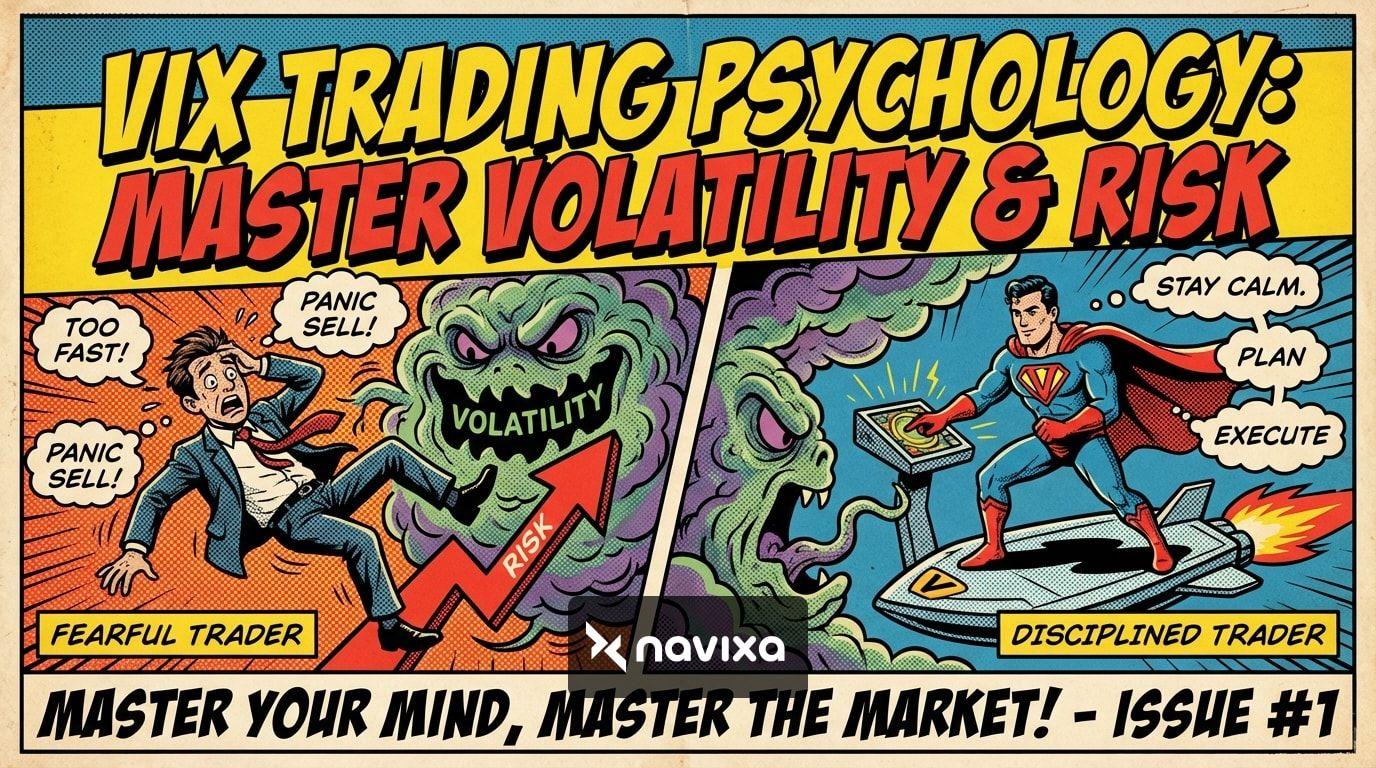
Volatility is the lifeblood of financial markets, but it is also the ultimate test of a trader's mental fortitude. For years, cryptocurrency traders operated in a somewhat isolated environment, largely ignoring traditional finance metrics under the assumption that digital assets were entirely decoupled from fiat systems. That era is definitively over. Today, understanding VIX trading psychology is no longer just a specialized skill for Wall Street equities traders—it is a mandatory, daily discipline for anyone participating in the global digital asset space.
The CBOE Volatility Index (VIX), universally recognized as Wall Street's "fear gauge," measures the stock market's expectation of short-term volatility based on S&P 500 index options. However, as massive waves of institutional adoption have bridged the gap between traditional equities and digital assets, the behavior of the VIX now sends powerful shockwaves through the crypto market. Traders must adapt their psychological frameworks to accommodate sudden, cross-asset liquidations and spikes in systemic fear. This comprehensive guide explores the mindset required to master volatility, how to leverage both the traditional VIX and the crypto-native volatility indices, and the strategic risk management protocols necessary to thrive when the fear gauge flashes red.
The Evolution of the Fear Gauge: Why the VIX Matters for Crypto
To understand the absolute necessity of mastering VIX trading psychology, we must first examine the radical shifts in modern market structures. In previous crypto cycles, Bitcoin's volatility was largely independent, acting on its own unique supply and demand mechanics. By early 2026, however, the correlation between Bitcoin's volatility and the VIX hit a staggering, unprecedented 0.88. This extraordinary figure mathematically signifies that digital assets now move almost in complete lockstep with stock market volatility.
This homogenization of market volatility is driven entirely by institutional risk management infrastructure. When the VIX surges due to macroeconomic shocks, automated trading algorithms mechanically sell off risk assets across the board—including Bitcoin, large-cap technology stocks, and commodities—to reduce overall portfolio volatility. In these moments, Bitcoin trades as a leveraged risk asset rather than a safe-haven "digital gold." In fact, during peak volatility events in 2026, the correlation between Bitcoin and physical gold actually turned negative, further cementing Bitcoin's status as an asset that moves inversely to risk appetite.
Consequently, retail traders who panic-sell during these rapid crashes are often falling victim to mechanical, algorithmic adjustments rather than fundamental shifts in cryptocurrency utility. Recognizing this structural change is half the psychological battle. A trader equipped with the right mindset understands that a sudden crypto crash coinciding with a massive VIX spike is a systemic liquidity event—a temporary mechanical dislocation—not an indictment of Bitcoin's long-term value.
Core Pillars of VIX Trading Psychology
Navigating highly volatile markets requires a total psychological reset. Human brains are evolutionarily hardwired to flee from uncertainty and financial danger, which is exactly what the VIX measures. To successfully trade based on volatility metrics, you must learn to invert your natural emotional responses.
"The greatest investors are those who can master their own psychological impulses. When the VIX flashes peak fear, the professional trader sees a strategic roadmap, not a warning sign to flee the market."
The Psychology of Fading Fear
When the VIX skyrockets, the broader market experiences acute, visceral distress. VIX trading psychology dictates that peak fear often represents peak financial opportunity. For instance, recent deep-market research from analytics firm Swissblock highlights that when the VIX spikes violently above the 40 threshold, it frequently presents prime, generational buying signals for Bitcoin and other digital assets.
The untrained retail trader sees a VIX reading of 45, watches their portfolio bleed, and sells their holdings in pure terror to prevent further losses. Conversely, the seasoned volatility trader sees extreme capitulation and begins methodically scaling into long positions. They understand that such high levels of fear are statistically unsustainable.
Overcoming the Illusion of Trend Continuation
One of the most dangerous psychological traps in volatility trading is the assumption that high fear will last indefinitely—a cognitive error known as recency bias. Volatility is historically and mathematically mean-reverting. Unlike underlying asset prices, which can fundamentally trend upward or downward for years on end, the VIX is tightly bounded by the strict mechanics of option pricing and the eventual exhaustion of human panic.
Adopting a mean-reversion mindset helps traders lock in profits during extreme market swings and avoid the urge to chase the market when volatility inevitably contracts. When everyone else believes the sky is falling forever, the volatility trader patiently waits for the algorithmic selling to subside.
Managing the Stress of Cross-Asset Contagion
In a highly correlated global financial world, watching your digital assets plummet simply because of an earnings miss in traditional tech stocks or unexpected macroeconomic policy shifts can be intensely frustrating. Mental resilience is actively built by accepting this harsh reality. By consistently monitoring the VIX, you shift your psychological burden from an emotional "Why is my favorite coin crashing?" to an analytical "How can I systematically exploit this temporary, algorithm-driven cross-asset contagion?".
Technical Analysis: Integrating Volatility Metrics
Understanding trading psychology is crucial, but flawlessly executing trades requires concrete, actionable technical tools. Today's successful crypto traders rely on a blend of both traditional metrics and decentralized equivalents to accurately measure and trade market fear.
The Crypto Volatility Index (CVI)
Recognizing the desperate need for a crypto-native fear gauge, the decentralized finance (DeFi) ecosystem introduced the Crypto Volatility Index (CVI). Developed in collaboration with Professor Dan Galai—the original creator of the traditional VIX—the CVI tracks the 30-day implied volatility of major assets like Bitcoin and Ethereum.
While the VIX focuses strictly on the S&P 500, the CVI relies on an adapted Black-Scholes option pricing model tailored for cryptocurrency option prices, operating on a fixed scale from 0 to 200. A high CVI reading vividly indicates that market participants anticipate massive, impending price fluctuations, while a low CVI implies expected market stability.
Psychologically, trading the CVI requires a firm understanding of directional neutrality. Because the CVI ecosystem enables you to trade the sheer magnitude of price movements rather than the specific direction, it entirely frees traders from the agonizing stress of guessing whether the crypto market will break bullish or bearish.
The BTC/VIX Z-Score Indicator
Advanced macro analysts frequently utilize the BTC/VIX Z-Score to scientifically identify local market tops and bottoms. This mathematical indicator specifically measures Bitcoin's relative strength against traditional volatility markets.
When the Z-Score drops below 0 (and especially when it approaches -2), it loudly signals that Bitcoin is deeply undervalued relative to the VIX, presenting a powerful psychological trigger to accumulate. Conversely, a Z-Score rising aggressively toward +2 often aligns with local market tops, indicating structural overvaluation and signaling a logical time to take profits. Relying on cold, hard mathematical data like the Z-Score effortlessly removes emotional guesswork from the trading equation.
Comparing Volatility Indices
To truly master market volatility, traders must understand the fundamental differences and similarities between traditional and crypto-native fear gauges.
| Feature | CBOE Volatility Index (VIX) | Crypto Volatility Index (CVI) |
|---|---|---|
| Underlying Assets | S&P 500 Index Options | Bitcoin and Ethereum Options |
| Origin / Creator | Introduced in 1993; Wall Street Standard | Developed by COTI & Prof. Dan Galai |
| Scale Range | Theoretically boundless, generally 10 to 80+ | Strictly bounded from 0 to 200 |
| Primary Use Case | Measuring systemic traditional market fear | Decentralized hedging against crypto volatility |
| Trading Psychology | Mean-reversion trading; contrarian buying | Directional neutrality; impermanent loss protection |
Actionable Risk Management Strategies
Cultivating the proper VIX trading psychology is entirely useless without strict, unforgiving risk management protocols. High-volatility environments are ruthlessly unforgiving to those who trade recklessly.
1. Dynamic Position Sizing: When the VIX or CVI is trading at historically low levels, the market is generally complacent, meaning sudden volatility expansions are imminent. In these deceptively quiet periods, traders should be highly cautious of taking on excessive leverage. When the VIX spikes violently, options premiums become highly expensive, and spot asset markets gap down. Always reduce your position sizes to accommodate wider, safer stop-loss margins. 2. Utilize Volatility Tokens for Hedging: The decentralized ecosystem brilliantly allows traders to purchase volatility tokens directly tied to indices like the CVI. If you hold a massive portfolio of digital assets and analytically anticipate a systemic macro shock, purchasing a position in the volatility index acts as a powerful insurance policy. If the market crashes and fear spikes, your volatility hedge becomes highly profitable, gracefully offsetting your spot asset losses. 3. Automate the Contrarian Instinct: Because raw human psychology naturally resists buying into terror, use limit orders placed at deep, pre-calculated discounts. If historical data proves that a VIX spike above 40 is a statistical buy signal, set your accumulation orders well in advance. This entirely removes the emotional burden of manually clicking "buy" when financial news networks are relentlessly declaring a market apocalypse. 4. Monitor Intermarket Divergences: Keep a very close eye on the inverse daily correlation between Bitcoin and the VIX. If the VIX begins to climb steadily but crypto assets momentarily remain stubbornly high, recognize this critical divergence as an early, flashing warning signal of an impending liquidity flush. Bitcoin historically acts as an advanced gauge for shifts in global risk appetite.
Practical Takeaways
* Acknowledge the Correlation: Accept that Bitcoin and broad digital assets are now heavily influenced by traditional volatility, evidenced by unprecedented 0.88 correlations to the VIX. * Embrace the Panic: Reprogram your mind to view extreme spikes in the VIX not as a reason to panic sell, but as clear institutional capitulation events that provide generational buying opportunities. * Hedge Smartly: Use crypto-native tools like the CVI to reliably hedge against impermanent loss and to seamlessly trade pure volatility, removing the acute stress of directional market bias. * Trust the Math: Rely heavily on data-driven metrics, such as the BTC/VIX Z-Score, to systematically identify undervalued and overvalued conditions without toxic emotional interference.
Conclusion
The nostalgic era of the isolated cryptocurrency market is completely behind us. Today's digital asset landscape is deeply, permanently intertwined with global macroeconomic forces. Mastering VIX trading psychology allows you to strip away the emotional chaos of terrifying market crashes and view volatility for what it truly is: a highly mechanical, algorithm-driven transfer of wealth.
By tracking both the traditional CBOE Volatility Index and the decentralized Crypto Volatility Index, you arm yourself with the ultimate contrarian roadmap. Stop fearing market turbulence. Instead, aggressively cultivate the psychological resilience required to fade the panic, safely hedge your downside risk, and perfectly execute logic-based strategies while the rest of the market acts purely on raw emotion. Volatility is not your enemy—it is the undeniable engine of your profitability. Take absolute control of your mindset, refine your risk management, and start trading the fear gauge to your advantage today.
Frequently Asked Questions
What does the VIX measure, and why is it called the "fear gauge"?
The CBOE Volatility Index (VIX) measures the broader market's expectation of 30-day forward-looking volatility, based entirely on S&P 500 index option prices. It is widely referred to as the "fear gauge" because it generally spikes violently during rapid market sell-offs when investors are frantically panic-buying options to protect their traditional portfolios. High VIX readings mathematically indicate intense fear and deep uncertainty in the financial system.
How does the VIX directly affect the cryptocurrency market?
Due to the massive influx of institutional capital, cryptocurrencies now share a highly elevated correlation with traditional equities. In early 2026, the direct correlation between Bitcoin's volatility and the VIX reached an all-time high of 0.88. When the VIX rises significantly, institutional algorithms automatically sell off risk assets across all classes simultaneously—including cryptocurrencies—leading to sharp, mechanical price drops.
What is the Crypto Volatility Index (CVI)?
The CVI is a decentralized, crypto-native counterpart to the traditional VIX, designed specifically for the digital asset market. Created in direct collaboration with Prof. Dan Galai (the original architect of the VIX), it accurately measures the 30-day implied volatility of Bitcoin and Ethereum on a bounded scale of 0 to 200. Forward-thinking traders use the CVI ecosystem to hedge their spot portfolios against severe price swings and DeFi impermanent loss.
How can traders use VIX spikes as distinct buying opportunities?
Psychologically, extreme fear in the global market almost always leads to drastically oversold conditions. Research from analytics firms like Swissblock has actively demonstrated that significant spikes in the VIX—such as crossing the crucial 40 threshold—frequently act as prime, highly profitable buying signals for Bitcoin. By stepping into the market when retail traders are panic-selling, systematic traders can easily accumulate assets at deep discounts before market volatility inevitably reverts to its historical mean.
What exactly is the BTC/VIX Z-Score?
The BTC/VIX Z-Score is an advanced macro-analytical metric that scientifically compares Bitcoin's price performance directly to the VIX index. When the Z-Score falls below zero (especially nearing -2), it strongly indicates that Bitcoin is undervalued relative to current market volatility, presenting a mathematically sound buy signal. Conversely, a Z-Score approaching +2 heavily suggests Bitcoin is structurally overvalued and may be due for an immediate market correction.