
Introduction to VCX Trading
Navigating modern financial markets requires a blend of traditional chart reading and a deep understanding of next-generation asset classes. Whether you are a seasoned cryptocurrency trader expanding your portfolio into traditional equities or an institutional investor seeking high-growth opportunities, mastering VCX stock technical analysis is an essential skill. Financial instruments that bridge the gap between retail investors and private tech unicorns require a unique approach to charting, volatility management, and entry-timing.
Before diving headfirst into candlestick patterns and oscillators, it is crucial to clarify what "VCX" represents in today's trading ecosystem, as the ticker frequently appears in both traditional stock markets and decentralized finance (DeFi). In the equity markets, VCX is the official ticker for the Fundrise Innovation Fund (NYSE: VCX), a publicly traded venture fund. This fund offers retail traders unprecedented access to top-tier private technology companies, including heavyweights in artificial intelligence (AI), data infrastructure, and aerospace such as OpenAI, Anthropic, Databricks, and SpaceX.
Conversely, in the cryptocurrency space, VCX is the native utility and governance token for VaultCraft, a DeFi yield-optimizing protocol. While this comprehensive guide focuses entirely on the technical analysis of the NYSE-listed VCX stock, many of the charting principles, momentum indicators, and risk management strategies discussed here are directly translatable from crypto trading. By applying these time-tested methodologies, traders can effectively navigate the volatility of a tech-heavy fund and uncover lucrative trading setups.
Understanding the Asset: What Drives VCX Stock?
Before you apply moving averages or momentum oscillators to your screen, you must understand the underlying catalysts that move the asset. Technical analysis does not exist in a vacuum; price action is simply the visual representation of market psychology, supply, and demand.
"In trading, the chart tells you what is happening, but fundamental context tells you why it matters. Fusing both is the hallmark of a master trader."
VCX stock is unique because it functions as a public gateway to private equity. Therefore, the price action and technical breakouts of VCX are highly correlated with specific macroeconomic and sector-specific catalysts:
1. AI and Tech Sentiment: Major breakthroughs, product launches, or regulatory shifts in the artificial intelligence sector often trigger volume spikes in VCX. Because the fund holds major AI players, hype in the private sector spills directly into the public VCX chart. 2. Private Market Valuations: When tech unicorns raise fresh venture capital at higher valuations, the Net Asset Value (NAV) of VCX adjusts. These adjustments often form the foundation of major technical breakouts. 3. Macroeconomic Indicators: Like high-growth crypto assets and tech stocks, venture funds are deeply sensitive to interest rates, inflation data, and global liquidity conditions. A dovish monetary policy usually injects volume into risk-on assets like VCX.
Understanding these factors will help you distinguish between a false breakout and a legitimate trend continuation when analyzing the VCX chart on your daily timeframe.
Core Principles of VCX Stock Technical Analysis
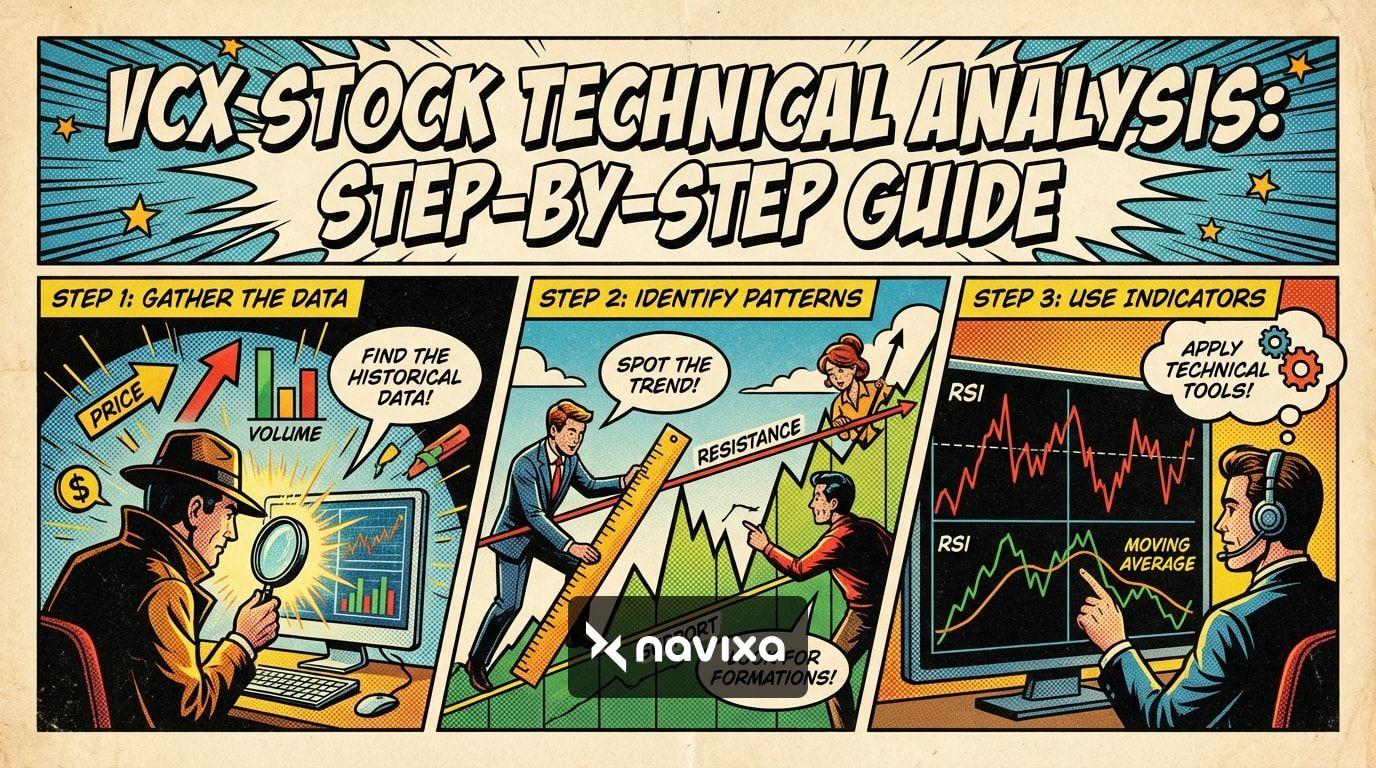
To build a robust and consistently profitable trading strategy, you need to rely on objective data points rather than emotion. Technical analysis provides the mathematical framework to identify entry and exit points systematically. Below are the core indicators every trader should utilize when performing VCX stock technical analysis.
Moving Averages (SMA and EMA)
Moving averages smooth out price data to create a single flowing line, making it significantly easier to identify the direction of the trend. For a tech-focused asset like VCX, traders typically look at:
* 50-Day Simple Moving Average (SMA): This acts as a short-to-medium-term trend indicator. When VCX crosses above the 50-day SMA, it often signals bullish momentum, attracting momentum traders and algorithmic bots. * 200-Day Simple Moving Average (SMA): This is the ultimate barometer for long-term health. A "Golden Cross" (when the 50-day SMA crosses above the 200-day SMA) is a highly monitored technical event that can bring massive institutional volume to the stock. * Exponential Moving Average (EMA): Crypto traders migrating to stocks often prefer the EMA (such as the 9-EMA or 21-EMA) because it reacts faster to recent price changes, making it ideal for swing trading the volatility of rapid AI-driven news cycles.
Relative Strength Index (RSI)
The Relative Strength Index (RSI) is a powerful momentum oscillator that measures the speed and change of price movements on a scale of 0 to 100. It is one of the most reliable tools for predicting short-term reversals in VCX.
* Overbought (Above 70): When VCX stock surges aggressively on a wave of AI hype, the RSI may spike above 70. This suggests the asset is overextended and a short-term pullback or period of consolidation is imminent. * Oversold (Below 30): During broader market corrections, VCX might experience panic selling. An RSI dipping below 30 often presents a high-probability buying opportunity for swing traders looking for a mean-reversion bounce.
MACD (Moving Average Convergence Divergence)
The MACD is a trend-following momentum indicator that shows the relationship between two moving averages of a security's price. When the MACD line crosses above the signal line, it generates a bullish signal, indicating that VCX's upward momentum is accelerating. Conversely, a cross below the signal line is a bearish warning. Professional traders look for "divergences"—for example, if VCX stock hits a new high but the MACD forms a lower high, a trend reversal could be looming.
Volume Profiles and Liquidity
Volume is the absolute lifeblood of any technical move. A breakout above a major resistance level is practically meaningless if it is not supported by strong trading volume. When monitoring a breakout, you want to see the volume surge to 1.5x or 2x the daily average. This confirms that institutional buyers or large-scale retail interest is actively driving the move, rather than a few isolated market orders. For deeper insights into how volume impacts market trends, you can explore comprehensive resources on Investopedia.
Advanced Chart Patterns for VCX
Beyond basic indicators, recognizing geometric shapes on the price chart can give you a predictive edge. VCX stock frequently forms classic chart patterns due to its blend of retail enthusiasm and institutional accumulation.
* The Bull Flag: After a massive surge in price (the "flagpole"), VCX will often consolidate downward in a tight parallel channel (the "flag"). A breakout above the upper resistance line of the flag, accompanied by volume, is a signal to buy. * Ascending Triangles: This bullish continuation pattern forms when VCX hits a horizontal resistance level multiple times while forming higher lows. The higher lows indicate that buyers are willing to step in at increasingly higher prices, eventually forcing a breakout through resistance. * Head and Shoulders: A classic reversal pattern. If VCX forms a peak (shoulder), a higher peak (head), and a lower peak (shoulder), a break below the "neckline" support signals a major bearish trend shift.
Actionable Step-By-Step Trading Strategies
Once you fully understand the indicators and chart patterns, the next vital step in VCX stock technical analysis is seamlessly applying them to structured, actionable trading strategies.
Strategy 1: The Volatility Breakout
Tech venture funds are highly prone to prolonged periods of consolidation followed by explosive, multi-day moves.
1. Identify the Range: Find a period where VCX is trading sideways within a tight, defined channel. 2. Wait for the Catalyst: Monitor the news for major updates on VCX's top holdings. 3. Execute on Confirmation: Buy the stock only when a full daily candlestick closes above the resistance line with above-average volume. 4. Set Profit Targets: Use the height of the previous consolidation channel to mathematically project your upside profit target.
Strategy 2: Moving Average Pullbacks
Trends rarely move in a straight, uninterrupted line. Even the strongest assets require healthy pullbacks.
1. Confirm the Uptrend: Ensure VCX is trading cleanly above the 200-day SMA. 2. Wait for the Dip: Let the price pull back and naturally "test" the 50-day SMA or 21-EMA. 3. Spot the Reversal: If the stock bounces off this moving average and prints a bullish reversal candlestick pattern (like a hammer or a bullish engulfing candle), enter the trade. 4. Manage Risk: Place a tight stop loss just beneath the moving average to protect against downside risk.
Comparison: Technical Analysis vs. Fundamental Analysis
To be a well-rounded and profitable trader, it drastically helps to understand how technical analysis contrasts with fundamental analysis when evaluating an innovative asset like VCX.
| Feature | VCX Technical Analysis | VCX Fundamental Analysis |
|---|---|---|
| Primary Focus | Price action, volume, and charting indicators | Private tech valuations, NAV, and sector growth |
| Time Horizon | Short to medium-term (Day/Swing trading) | Long-term (Months to Years) |
| Data Sources | Charting software, order books, and price history | Financial statements, venture rounds, macro data |
| Decision Trigger | Moving average crosses, RSI levels, breakouts | Changes in holding valuations, broad AI adoption |
| Best Used For | Timing precise entries/exits, managing risk | Selecting the asset, understanding long-term value |
Risk Management: Protecting Your Capital
No guide on VCX stock technical analysis would be considered complete without a heavy emphasis on risk management. The intersection of venture capital and public markets can lead to sudden price gaps, especially overnight when private market news drops unexpectedly.
* Strict Stop Losses: Never enter a trade without a predetermined exit point. A common professional practice is placing a hard stop loss 1% to 2% below the nearest major support level or key moving average. * Proper Position Sizing: Do not risk more than 1% to 2% of your total account equity on a single VCX trade. If your account size is $10,000, your absolute maximum risk (the amount you lose if your stop is hit) per trade should be strictly between $100 and $200. * Take Partial Profits: When VCX hits your first defined price target, heavily consider selling half of your position and moving your stop loss to your breakeven entry price on the remaining shares. This tactic guarantees a profitable trade overall while letting the rest of your position "run" risk-free.
If you prefer utilizing advanced charting tools to visually map out these crucial risk zones, platforms like TradingView provide excellent, institutional-grade infrastructure for plotting support, resistance, and dynamic trendlines.
Trading Psychology: The Hidden Edge
Even with the best technical analysis, poor psychology will destroy a trading account. Trading an asset tied to artificial intelligence and space exploration can evoke severe Fear Of Missing Out (FOMO). When VCX is surging 10% in a day, the temptation to buy at the absolute top is overwhelming.
Discipline is your ultimate edge. If a trade setup does not meet your specific technical criteria—for example, if the RSI is at 85 and volume is fading—do not take the trade. The market pays you to wait for the highest-probability setups. Embrace patience, strictly follow your trading plan, and never let short-term emotions override long-term statistical edges.
Practical Takeaways
1. Know Your Asset: Ensure you are trading the NYSE: VCX stock (Fundrise Innovation Fund) and not confusing it with the VaultCraft crypto token, though core technical charting principles apply remarkably well to both assets. 2. Use Indicator Confluence: Never rely on a single, isolated indicator. Wait for a moving average crossover to align perfectly with an RSI bounce and strong bullish volume before entering a long trade. 3. Respect the Macro Environment: Since VCX holds high-growth tech companies, its chart will naturally mimic the broader NASDAQ or crypto-adjacent tech sector. Always trade with the broader market trend, not against it.
Frequently Asked Questions
Is VCX a stock or a cryptocurrency?
VCX uniquely operates in both financial realms under completely different entities. On the New York Stock Exchange (NYSE), VCX is the ticker for the Fundrise Innovation Fund, a public venture capital fund holding private tech companies. In the cryptocurrency space, VCX is the utility token for VaultCraft, a decentralized finance protocol. This technical analysis guide primarily addresses the stock, though the charting concepts apply universally.
What are the best indicators for VCX stock technical analysis?
The absolute most reliable indicators for analyzing VCX include the 50-day and 200-day Simple Moving Averages (for determining overall trend direction), the Relative Strength Index (RSI) for efficiently spotting overbought or oversold conditions, and Volume profiles to confirm the sheer strength and validity of breakouts.
How does private market news affect VCX technical charts?
Because VCX holds substantial shares in massive private companies like SpaceX, Anthropic, and OpenAI, news regarding these companies (such as fresh multi-billion dollar funding rounds, revolutionary product launches, or IPO rumors) can act as sudden bullish catalysts. This often translates directly on the chart as high-volume gap-ups or sudden volatility breakouts that technically minded traders can quickly capitalize on.
Should I day trade or swing trade VCX stock?
Given its daily liquidity profile and its deep connection to larger macroeconomic tech trends, VCX is generally far better suited for swing trading (holding positions for a few days to several weeks) rather than hyper-active, minute-by-minute day trading. The wider bid-ask spreads and daily average price ranges vastly favor a slightly longer time horizon.
Conclusion
Mastering VCX stock technical analysis effectively bridges the gap between traditional equity trading methodologies and the fast-paced, high-upside world of tech and AI venture investments. By relying strictly on proven indicators like moving averages, RSI, and robust volume analysis, you can effectively strip the raw emotion out of your trading process and make objective, data-driven decisions.
Remember that the charts merely reflect the collective sentiment of the market at any given second. Your ultimate job as a trader is simply to read the story the candlesticks are telling, wait for your edge to present itself, and ruthlessly manage your risk accordingly. Ready to put these powerful strategies to the test? Open your preferred charting platform, plot your key levels on VCX, and start executing your next trade with ultimate confidence and precision.