
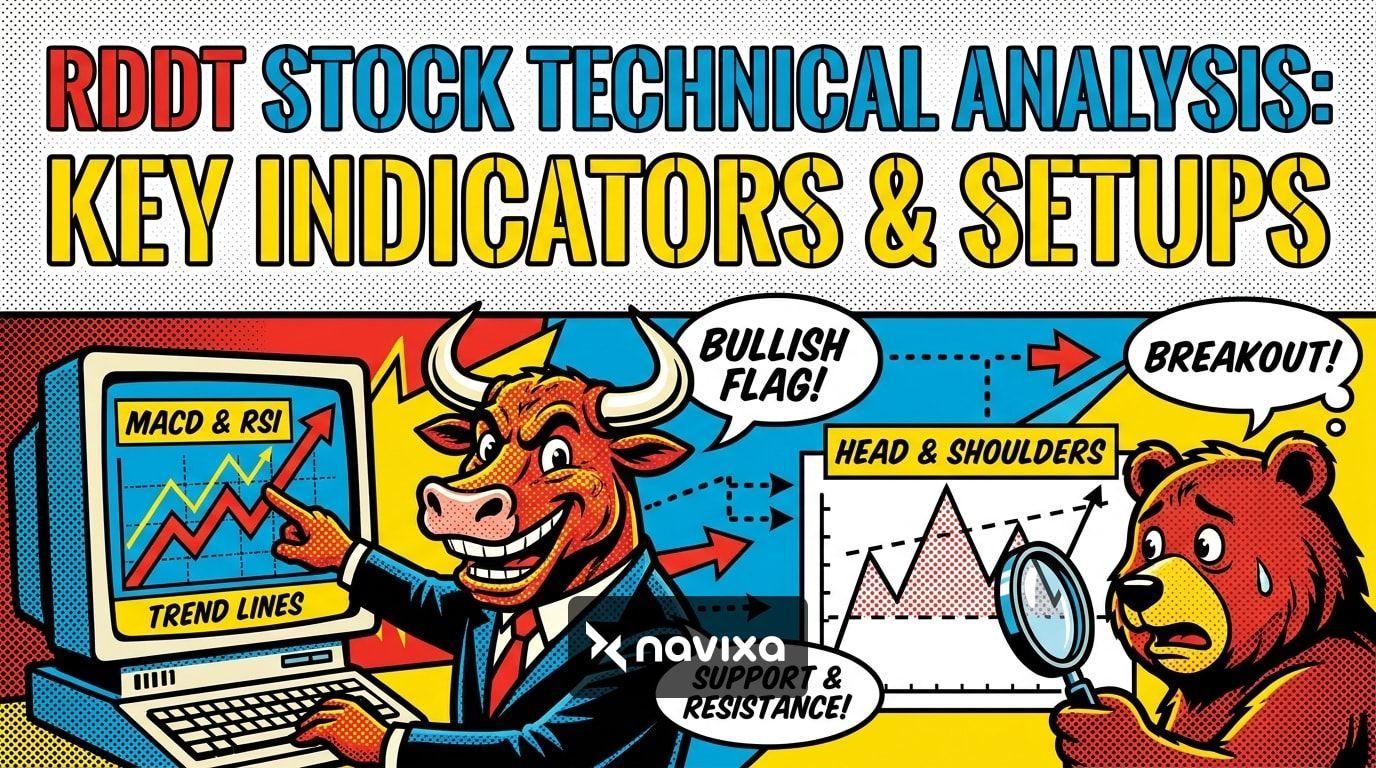
Navigating the fast-paced complexities of modern tech equities requires a systematic, data-driven approach to market mechanics. For traders and investors focusing on the interactive media landscape, mastering RDDT stock technical analysis provides the blueprint necessary to capitalize on price fluctuations and identify high-probability setups. By isolating crucial support and resistance zones, interpreting momentum indicators, and acknowledging the psychological cycles of the market, market participants can systematically extract value from a highly volatile asset.
- RDDT has established significant long-term volatility, requiring strict technical frameworks for safe entry and exit execution.
- Key support zones rest near the $130 to $141 range, providing historically reliable accumulation points during pullbacks.
- Heavy resistance clusters around $165 to $175, creating a critical threshold that must be broken to confirm broader upward momentum.
- Indicators like the RSI and MACD are essential for timing entries, while moving averages help filter out short-term market noise.

Fundamental Drivers vs. Technical Reality
Before diving strictly into charting mechanics, it is absolutely essential to understand the intersection of fundamental narratives and technical realities. Driven by highly lucrative AI data licensing agreements and surging digital advertising revenue, Reddit has established a profound data moat within the technology ecosystem. As we have documented in our comprehensive AI Job Market Outlook: Macro Trends in Tech Stocks, AI-driven data demands are reshaping entire market sectors, creating structural tailwinds for companies that hold massive repositories of human-generated text.
However, despite strong foundational growth and impressive gross margins, technical realities often diverge wildly from fundamental valuations. Following periods of rapid expansion and extreme retail hype, stock prices naturally regress toward their historical moving averages. A fundamentally sound company does not always guarantee an immediately profitable stock trade if the entry price is poorly timed.
Technical analysis steps into this gap. It acts as the bridge between acknowledging a company's long-term potential and pinpointing the optimal time to deploy capital. For those seeking foundational knowledge on how price action reflects broader economic behaviors, resources like the Investopedia's Guide to Technical Analysis offer excellent complementary insights to this guide.
Analyzing RDDT Chart Patterns: Support and Resistance
When reviewing the daily and weekly charts for RDDT, identifying horizontal support and resistance levels is the first and most critical priority. Historical price action naturally forms distinct zones where institutional buying or selling pressure overwhelmingly absorbs retail momentum.

Critical Support Zones and Demand Areas
Support levels act as a psychological and mechanical price floor. When the stock experiences heavy sell-offs, value investors and algorithmic buyers step in at these historical points. In the current market structure, primary support zones for RDDT have frequently clustered between $130.00 and $141.00.
When price action approaches these levels on declining volume, it often signals that selling pressure is exhausting itself. Conversely, should the price gap significantly below this region with heavy volume, it may signal a deeper structural breakdown, invalidating bullish setups.
Overhead Resistance and Supply Zones
Resistance levels represent both psychological ceilings and technical supply zones. For RDDT, major near-term resistance heavily clusters around the $165.00 to $175.00 range. This is the area where previous buyers who are currently holding at a loss look to sell at break-even, creating natural selling pressure.
Breaking above these resistance ceilings requires a catalyst accompanied by high trading volume. A low-volume breakout is frequently a "bull trap," rapidly reversing and catching eager breakout traders offside.
| Indicator | Purpose in RDDT Analysis | Common Interpretation |
|---|---|---|
| RSI (14) | Measures momentum and speed of price changes | >70 Overbought, <30 Oversold |
| MACD | Identifies trend direction and momentum shifts | Bullish cross signals upward momentum |
| 50-Day MA | Tracks short-to-medium term trend direction | Price above indicates short-term bullishness |
| 200-Day MA | Measures long-term market sentiment | Price below suggests a broader macro downtrend |
| ATR | Gauges daily average price volatility | Higher values dictate wider stop-loss placements |
Market Analysis & Trading Psychology
Conducting RDDT stock technical analysis without psychological awareness is an incomplete and dangerous strategy. High-beta equities inherently trigger intense emotional responses from both novice and veteran retail traders.
When reviewing RDDT, traders must remain relentlessly objective, avoiding the temptation to anchor their expectations to past all-time highs. This specific behavioral flaw—anchoring bias—can cause traders to hold onto losing positions far longer than technically justifiable. We explore the dangers of this mindset deeply in our analysis of Palantir Stock Price Target: Anchoring Bias & Risk.
Markets perpetually operate on alternating cycles of fear and greed. A significant, protracted pullback from peak valuations often shakes out weak, emotionally driven hands, leaving behind a structurally sound base for institutional smart money accumulation. Recognizing this subtle psychological transition—from widespread market capitulation to quiet accumulation—is precisely what separates consistently profitable traders from those who merely gamble on momentum.
High-volatility tech stocks require strict risk management protocols. Always deploy hard stop-loss orders below major structural support levels to protect against unexpected, catastrophic drawdowns in dynamic market conditions.
Key Technical Indicators and Momentum
Understanding price action alone is an excellent start, but incorporating momentum indicators provides the mathematical confirmation needed to execute trades with high conviction.

Moving Averages (MA) Dynamics
The dynamic relationship between the 50-day and 200-day Simple Moving Averages (SMA) offers immediate, actionable insight into the asset's trajectory. A convergence of these moving averages often precedes explosive volatility.
Traders heavily monitor these levels to gauge shifts from medium-term pullbacks to long-term downtrends. A "Death Cross" (when the 50-day crosses below the 200-day) suggests prolonged bearishness, while a "Golden Cross" signals robust long-term accumulation. Similar structural setups are thoroughly evaluated in our Visa Stock Technical Analysis: Key Charts & Patterns.
Relative Strength Index (RSI)
The RSI (14-day standard configuration) provides a real-time snapshot of overbought or oversold conditions. For a high-momentum stock like RDDT, a reading dipping near 30 or below historically flags absolute exhaustion among sellers, heavily hinting at an impending relief rally. Conversely, readings rapidly approaching or exceeding 70 serve as a glaring warning sign for impending profit-taking.
MACD and Bollinger Bands
The Moving Average Convergence Divergence (MACD) indicator is paramount for spotting early trend reversals. A bullish crossover on the MACD histogram below the zero line is often viewed as a premier buy signal for swing traders.
Meanwhile, Bollinger Bands help identify periods of historically low volatility. When the bands "squeeze" tightly together, it mathematically indicates that the stock is consolidating. In the context of RDDT, a tight Bollinger squeeze almost always precedes a violent, highly directional price movement.
Step-by-Step RDDT Trading Strategy
Executing a consistently profitable trade relies on strict rules and repeatable execution processes. Without a system, technical analysis is merely drawing lines on a screen. Here is a highly actionable framework for navigating RDDT's market mechanics:

1. Define the Macro Context: Before ever opening your charting software, consult official filings on the Securities and Exchange Commission (SEC) database. Ensure that there is no massive, unexpected insider selling or major corporate restructuring occurring that could suddenly invalidate your technical setups. 2. Identify Indicator Confluence: Never rely on a single indicator. Look for overlapping evidence. For example, a price candle bouncing precisely off the $140 fundamental support level while simultaneously printing a bullish MACD crossover and an RSI below 30 creates a phenomenally high-probability entry signal. 3. Set Precise Stop-Losses via ATR: Utilize the Average True Range (ATR) to size your stop-loss appropriately. If the ATR indicates normal daily swings of $6 to $8, setting a suffocatingly tight $2 stop-loss will result in premature liquidation before the trade ever has a chance to breathe. 4. Scale Out at Known Resistance: Never assume a breakout is guaranteed. Sell partial positions as the stock approaches major historical resistance zones (e.g., $165.00). This locks in realized profits, reduces psychological stress, and allows you to let the remainder of the position run "risk-free."
When trading heavy overnight gaps driven by fundamental news or earnings reports, always wait for the first 30 to 45 minutes of the trading session to close. This explicitly helps filter out erratic, algorithm-driven market open volatility before committing your capital to an entry.
Conclusion
Mastering RDDT stock technical analysis empowers traders to strip away deafening market noise and focus entirely on measurable, repeatable probabilities. By comprehensively understanding crucial support and resistance levels, moving average relationships, and the deep psychology driving market cycles, you can position yourself advantageously in both bullish and bearish environments.
Always remember that technical analysis is not a crystal ball—it is a sophisticated tool for risk management. Continue refining your edge, adhere strictly to your stop-loss protocols, and relentlessly adapt your strategy as new real-time chart data unfolds.
Frequently Asked Questions
What is the best timeframe for analyzing RDDT stock?
For swing traders looking to hold positions for days or weeks, the daily and weekly charts provide the most reliable signals and filter out intraday noise. Day traders and scalpers, however, should rely heavily on the 15-minute or 1-hour charts to capitalize on intense intraday volatility.
How does options activity affect RDDT's technical charts?
Extremely heavy call or put option volume can create artificial support or resistance zones. This occurs because market makers must continuously buy or sell the underlying stock to hedge their options exposure, frequently pulling the stock price directly toward strike prices that possess massive open interest.
Why do moving average crossovers matter so much?
Crossovers, such as the widely watched Golden Cross or Death Cross, mathematically highlight significant, long-term shifts in market momentum. Because these indicators are so universally recognized, they frequently prompt large algorithmic trading desks and institutional funds to aggressively adjust their positions, creating self-fulfilling price momentum.
Can fundamental news events invalidate technical setups?
Absolutely. Major, unexpected catalysts—such as massive earnings beats, abrupt regulatory changes, or macroeconomic data shocks—can completely override technical support and resistance levels. This unpredictable reality is exactly why maintaining strict, non-negotiable stop-losses is mandatory for long-term survival in the markets.