
Chipotle Mexican Grill (NYSE: CMG) has long been a darling of growth investors and momentum traders. Following its historic 50-for-1 stock split in mid-2024, the fast-casual giant entered a new era of retail accessibility and market dynamics. Today, understanding CMG stock technical analysis is more critical than ever, as increased liquidity and shifting macroeconomic headwinds have transformed its chart behavior. Whether you are an active day trader looking to capitalize on intraday volatility or a swing trader targeting multi-week trends, dissecting the price action of CMG stock offers a wealth of opportunities. This comprehensive guide will break down the essential charting indicators, psychological frameworks, and high-probability trading setups required to navigate Chipotle's post-split price action successfully.
- The historic 2024 stock split increased CMG's retail liquidity, fundamentally altering its intraday volatility profiles.
- Key technical support levels have been established in the lower $30s, acting as a critical foundation for long-term holders.
- Moving averages (specifically the 50-day and 200-day) are flashing vital momentum signals that dictate near-term trading biases.
- Incorporating macroeconomic trends and consumer traffic data is essential for validating pure technical breakouts.

The Post-Split Landscape: Fundamentals Meet Technicals
Before diving deep into the technical setups, it is crucial to understand the context of CMG's chart. When a high-flying stock undergoes a massive split—such as Chipotle's 50-for-1 event—the market capitalization remains unchanged, but the per-share price drops dramatically. Pre-split, CMG traded in the thousands of dollars, making it heavily dominated by institutional flow and algorithmic trading. Post-split, trading in the $30 to $40 range, the stock has invited a massive influx of retail capital.
This structural shift alters options pricing, tightens bid-ask spreads, and creates more pronounced technical patterns. Retail traders tend to respect classical chart patterns like bull flags, double bottoms, and horizontal support zones more rigidly. Consequently, mastering CMG stock technical analysis now means paying closer attention to retail sentiment and volume profiles, as the barrier to entry for accumulating shares or trading options has been significantly lowered.
CMG Stock Technical Analysis: Core Indicators
To build a robust trading strategy, you need to rely on a confluence of technical indicators. No single metric provides a perfect crystal ball, but when combined, they paint a highly accurate picture of supply and demand dynamics.

Moving Averages and Price Action
Moving averages are the bedrock of trend identification. For CMG, the two most critical moving averages to watch on the daily timeframe are the 50-day Simple Moving Average (SMA) and the 200-day SMA.
- The 50-Day SMA: This line acts as a barometer for intermediate-term momentum. When CMG trades above the 50-day SMA, the bulls are in control. Conversely, when the price breaks below it, the stock often enters a consolidation or corrective phase. - The 200-Day SMA: This is the ultimate institutional trendline. A stock trading above its 200-day SMA is considered to be in a macro uptrend. Interactions with this line often produce violent bounces or devastating breakdowns.
You can learn more about how to calculate and apply these moving averages on Investopedia's guide to Moving Averages.
Relative Strength Index (RSI)
The Relative Strength Index (RSI) measures the speed and change of price movements on a scale from 0 to 100. For CMG stock, an RSI above 70 typically indicates an "overbought" condition, suggesting the stock may be due for a pullback or consolidation. An RSI below 30 signals "oversold" conditions, often providing lucrative entry points for mean-reversion traders. Given Chipotle's historical resilience, buying dips when the daily RSI dips below 35 has proven to be a highly effective swing trading strategy.
Moving Average Convergence Divergence (MACD)
The MACD is a trend-following momentum indicator that shows the relationship between two moving averages of a stock's price. When analyzing CMG, traders look for the MACD line to cross above the signal line as a bullish trigger. If this crossover occurs while the stock is resting on a major support level, it creates a high-probability "buy" setup.
Mapping Key Support and Resistance Levels
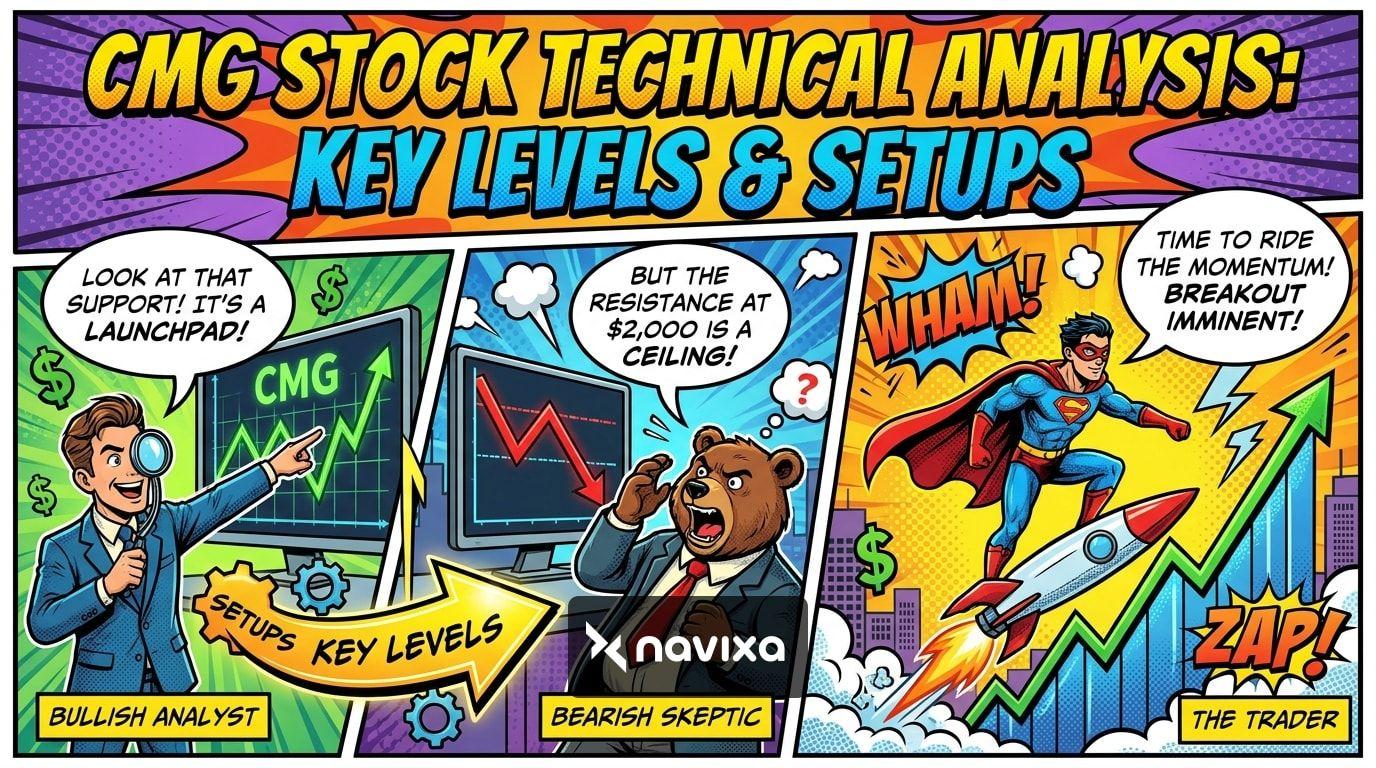
Identifying horizontal support and resistance is the most actionable component of CMG stock technical analysis. Support represents a price floor where buying interest is strong enough to overcome selling pressure. Resistance is the ceiling where sellers take control.
Recent market data places critical CMG support zones in the lower $30s—specifically the $31.50 to $32.00 range. This area has historically served as a strong accumulation zone for buyers. On the upside, heavy resistance sits around $34.50 (often aligning with the 50-day moving average) and $38.00, marking previous distribution tops.
| Indicator | Bullish Scenario | Bearish Scenario |
|---|---|---|
| Moving Averages | 50-day crosses above 200-day (Golden Cross) | 50-day crosses below 200-day (Death Cross) |
| RSI | Rebounds from 30 (Oversold) | Drops from 70 (Overbought) |
| MACD | MACD line crosses above Signal line | MACD line crosses below Signal line |
| Volume | High volume on green breakout days | High volume on red breakdown days |
Market Analysis & Trading Psychology
Technical analysis is only half the battle; the other half is entirely psychological. Many retail traders fail because they cannot manage their emotions during periods of high volatility or extended consolidation.
One of the most dangerous psychological traps in a post-split environment is "anchoring bias." Traders look at CMG trading at $33 and anchor their expectations to the pre-split prices of $3,000+, falsely assuming the stock is "cheap." In reality, the market capitalization is identical. If you are struggling with this concept, reviewing Palantir Stock Price Target: Anchoring Bias & Risk can help calibrate your mindset.
Furthermore, restaurant and fast-casual stocks are heavily impacted by consumer sentiment and macroeconomic traffic data. Just as we see when analyzing Master SBUX Stock Trading Psychology & Volatility Risk, these equities can experience severe momentum swings based on foot traffic reports and inflation metrics. Institutional algorithms know that retail traders place their stop-losses just below obvious support levels. A common market maker tactic is to temporarily drive the price below support (a "liquidity grab"), trigger those stop-losses, and then reverse the stock higher.
To combat this, traders must cultivate patience. Wait for the daily candle to close before confirming a breakdown, and never size a position so large that a normal intraday fluctuation causes you to panic sell.
**Earnings Gap Risk:** CMG is prone to massive price gaps during quarterly earnings reports. Never hold a short-term, unhedged leveraged position through an earnings announcement, as technical levels can be entirely ignored by institutional algorithms reacting to fundamental data.
Actionable Trading Strategies for CMG
Armed with the right indicators and a disciplined psychological framework, you can deploy specific trading strategies to capitalize on CMG's price action.

The Breakout Strategy
Breakout trading involves entering a position as soon as the stock price breaks above a major resistance level. For CMG, a breakout above the $34.50 resistance zone—especially if accompanied by higher-than-average volume—indicates that sellers have been exhausted. Identifying these momentum shifts is much like the setups detailed in our Bloom Energy Stock Technical Analysis: Chart Breakouts overview.
When trading a breakout, the previous resistance level should become your new support. If CMG breaks $34.50, traders will buy the initial surge and place a stop-loss just below $34.00 in case the breakout turns out to be a fake-out.
The Mean Reversion Setup
Mean reversion operates on the principle that extreme price movements will eventually return to the historical average. If CMG experiences a rapid, multi-day sell-off that pushes the RSI below 30, it triggers a mean reversion setup. Traders will step in to buy the "blood in the streets," anticipating a relief rally back to the 50-day moving average.
This strategy requires strict discipline. Similar to the principles found in our Master Your QCOM Stock Trading Strategy: Entry & Exit guide, defining precise entry rules and waiting for a reversal candlestick (like a hammer or bullish engulfing pattern) is non-negotiable before risking capital.
**Volume Confirmation:** When trading a breakout above a key resistance level, always look for higher-than-average trading volume. A breakout on low volume is often a "bull trap" that will quickly reverse, leaving eager buyers trapped at the top.
Risk Management & Stop-Loss Placement
The most elegant technical analysis in the world is useless without rigorous risk management. Your primary job as a trader is not to make money, but to protect your capital.
When executing a trade on CMG, always define your invalidation point before entering the position. If you buy the stock at $33.00 anticipating a bounce off support, your stop-loss might be placed at $31.80. This ensures that if the macro environment deteriorates or institutional sentiment shifts unexpectedly, your losses are strictly capped.
Position sizing is equally important. Never risk more than 1% to 2% of your total account equity on a single trade. Advanced charting platforms like TradingView allow you to set custom alerts and automatically calculate your position size based on your predetermined risk tolerance.

Conclusion
Mastering CMG stock technical analysis requires a blend of technical proficiency, market awareness, and emotional discipline. By tracking the 50-day and 200-day moving averages, identifying crucial support levels in the lower $30s, and utilizing momentum oscillators like the RSI and MACD, traders can build a massive edge in the market.
Remember that the post-split environment has fundamentally altered how retail flow interacts with Chipotle's chart. Respect the psychological barriers, prioritize risk management above all else, and never ignore the broader macroeconomic trends impacting the restaurant sector. Implement these strategies consistently, and you will be well-equipped to trade CMG's volatility with confidence.
Frequently Asked Questions
What impact did the 50-for-1 split have on CMG stock technical analysis?
The historic 50-for-1 split lowered the nominal share price from over $3,000 to the $30 range. While the company's market cap remained unchanged, the lower price significantly increased retail participation and options trading volume, making technical patterns like support/resistance zones and trendline breakouts more pronounced due to the influx of retail liquidity.
What are the key support levels to watch for CMG?
Currently, the critical support levels for CMG are established in the $31.50 to $32.00 range. This zone has historically attracted strong buying interest. If this level fails, the stock could see a deeper correction, making it a vital line in the sand for swing traders.
How does consumer traffic data affect the technical chart?
While technical analysis relies on price action, CMG is fundamentally a consumer-driven business. Softness in U.S. foot traffic or lower-than-expected same-store sales can cause sudden, violent breaks below established technical support levels. Traders must be aware of upcoming earnings reports and macro consumer spending data to avoid getting caught on the wrong side of a fundamental shift.
Which moving averages are best for swing trading CMG?
The 50-day Simple Moving Average (SMA) and the 200-day SMA are the gold standards for swing trading CMG. The 50-day SMA helps identify short-to-medium-term momentum, while the 200-day SMA acts as a macro trend indicator. Crosses between these two lines often dictate the overarching trend for the months ahead.