
Introduction: The Mental Game of Modern Trading
The financial markets are a relentless test of mental fortitude, and few assets challenge a trader's emotional control quite like high-momentum technology stocks. Mastering UBER trading psychology is no longer just about understanding basic support and resistance levels; it requires a deep, introspective look at how you process fundamental shifts, market noise, and extreme intraday volatility.
Whether you are a traditional equity investor or a cryptocurrency trader bridging the gap into tokenized stocks and high-beta tech assets, the psychological hurdles remain the same. Fear, greed, impatience, and cognitive bias are the silent account killers. In recent years, UBER has transformed from a simple asset-light ride-hailing application into a global logistics and autonomous vehicle powerhouse. This evolution brings intense price swings, making emotional regulation and strict risk management the defining factors between profitable traders and those who simply provide liquidity to the market.
In this comprehensive guide, we will dissect the core elements of UBER trading psychology. We will explore how recent fundamental shifts in the company's business model test your discipline, uncover the cognitive biases that sabotage profitability, and provide actionable, risk-averse strategies to keep you grounded when the market turns chaotic.
The Evolution of UBER: Why It Tests Trader Psychology
To understand the psychology required to trade UBER, you must first understand the fundamental environment driving its price action. Markets are forward-looking, and UBER's narrative is constantly shifting.
In the current landscape, UBER is no longer just competing with local taxi services; it is locked in a high-stakes race for the future of mobility. The company's massive, multi-billion-dollar commitments to autonomous vehicles (AVs), strategic equity stakes in EV manufacturers like Lucid, and partnerships with AI-driven autonomous tech firms like Wayve have fundamentally altered its risk profile.
This shift from an "asset-light" model to an "asset-heavy" autonomous fleet operator creates a breeding ground for psychological turbulence. When a company pivots this aggressively, it divides the market. Bulls see a dominant robotaxi monopoly forming, while bears see massive capital expenditures and execution risk.
For the trader, this polarization results in explosive volatility. When UBER shares surge 6% or 7% in a single trading session on the back of AV announcements, the psychological pressure intensifies. It is in these moments of rapid price expansion or contraction that trading psychology is truly tested.
Core Psychological Traps in UBER Trading
Even the most meticulously crafted trading strategy will fail if the trader executing it falls victim to their own mind. Recognizing the cognitive biases and emotional traps associated with UBER trading psychology is the first step toward overcoming them.
The Danger of FOMO (Fear of Missing Out)
FOMO is arguably the most destructive emotion in a trader's psychological arsenal. It occurs when a trader abandons their analytical framework because they see an asset's price skyrocketing and fear being left behind.
Imagine a scenario where UBER announces a groundbreaking new robotaxi partnership, and the stock immediately spikes from $72 to $78 within hours. The disciplined trader waits for a pullback or a confirmed breakout. The emotional trader, gripped by FOMO, buys the top at $78, convinced it is heading straight to its 52-week high of $102. When the initial euphoria fades and institutional algorithms begin taking profits, the stock retraces, leaving the FOMO trader trapped in a losing position.
FUD (Fear, Uncertainty, and Doubt)
Conversely, FUD is the psychological catalyst for panic selling. FUD often spreads rapidly through social media, financial news networks, and trading forums. For UBER, FUD might materialize as regulatory hurdles regarding gig-worker classifications, unexpected delays in autonomous vehicle rollouts, or missing quarterly earnings per share (EPS) estimates despite strong revenue growth.
When FUD takes hold, traders often abandon their long-term thesis or ignore perfectly valid technical support levels, selling their positions at the exact moment they should be looking for accumulation opportunities.
Loss Aversion and The Sunk Cost Fallacy
Behavioral economics teaches us that the psychological pain of losing money is twice as powerful as the joy of making it. This concept, known as Loss Aversion, causes traders to hold onto losing UBER positions for far too long. Instead of cutting a loss at a predetermined support level, they hold on, hoping the market will reverse and "make them whole."
This is often coupled with the Sunk Cost Fallacy—the irrational belief that because you have already invested significant capital and time into a position, you must see it through, even as the fundamental and technical data screams at you to exit.
Revenge Trading
Revenge trading happens when a trader takes a loss and immediately jumps back into the market with a larger position size to "win back" their money. If UBER's intraday volatility stops you out of a trade, the disciplined approach is to step away, reassess the chart, and wait for the next high-probability setup. The revenge trader, acting entirely on emotion, will force a suboptimal trade, usually compounding their initial loss.
Risk Management: The Ultimate Psychological Buffer
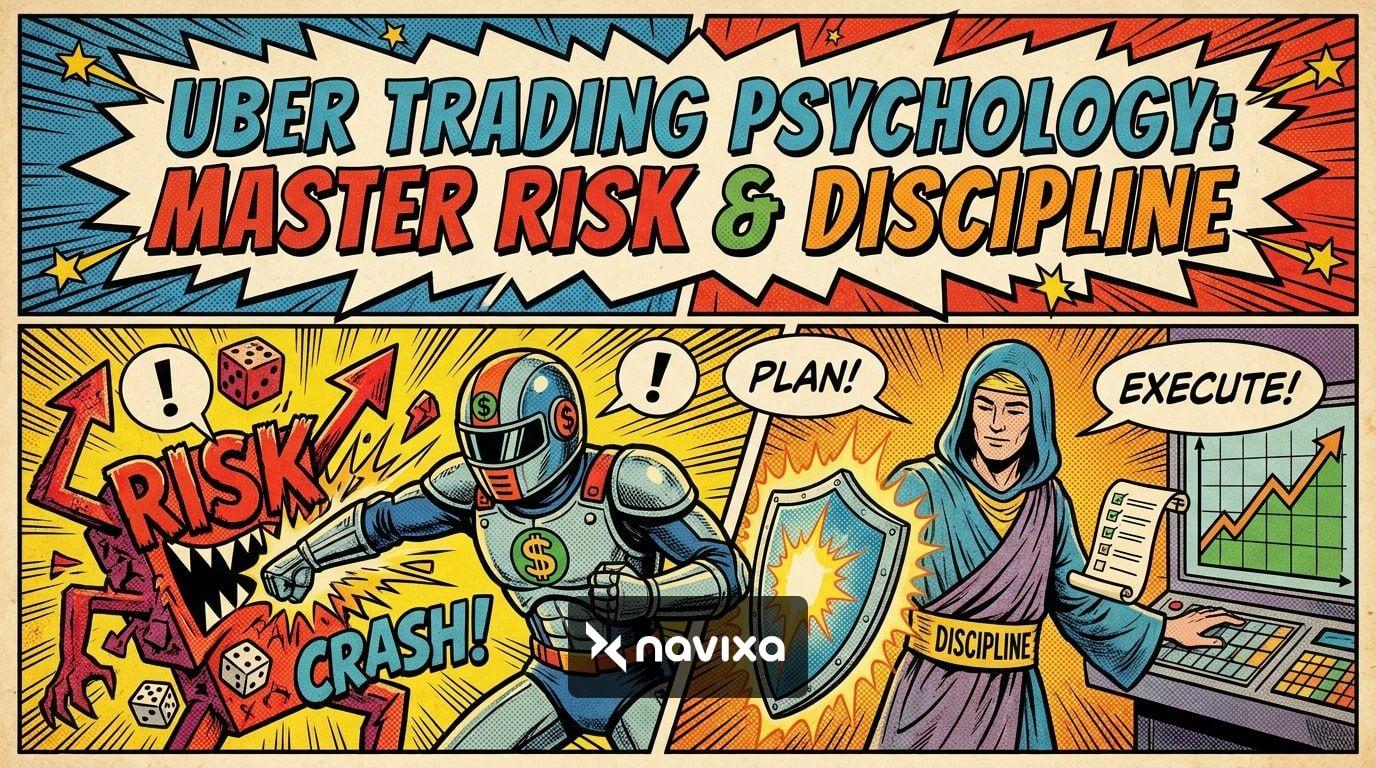
The most effective way to master UBER trading psychology is to remove the need for real-time emotional decision-making. You achieve this through ironclad risk management. When your risk is strictly defined before you enter a trade, the psychological weight of the outcome is drastically reduced.
Position Sizing and the 1% Rule
One of the golden rules of trading, whether you are dealing with cryptocurrency, forex, or equities like UBER, is proper position sizing. Professional traders rarely risk more than 1% to 2% of their total account capital on a single trade.
If you have a $10,000 trading account, your maximum risk on an UBER trade should be $100. This does not mean you only buy $100 worth of stock; it means your stop-loss should be placed at a level where, if triggered, your total capital loss is exactly $100. When you know that the absolute worst-case scenario is a minor 1% drawdown, the anxiety associated with holding the position evaporates.
Hard Stop-Losses vs. Mental Stop-Losses
In highly volatile markets, mental stop-losses are a recipe for disaster. A mental stop-loss relies on your willpower to execute a sell order when the price reaches a certain level. However, when the moment arrives, hope often replaces discipline.
Using hard stop-loss orders executed by your broker ensures that your risk management parameters are respected, regardless of how you feel in the moment. This protects you from sudden institutional dumps or unexpected macroeconomic news.
Taking Profits and Scaling Out
Just as traders struggle to cut losses, they also struggle to take profits. Greed can cause a trader to watch an UBER position go deep into the green, only to hold it until it retraces back to their breakeven point. Implementing a "scaling out" strategy—selling 50% of your position at your first target and moving your stop-loss to breakeven for the remainder—is a psychologically brilliant way to secure profits while keeping upside potential open.
Comparing Emotional vs. Disciplined Trading
To visualize the stark contrast between these two mindsets, review the table below, which highlights how different traders approach UBER's market dynamics.
| Psychological Trait | The Emotional UBER Trader | The Disciplined UBER Trader |
|---|---|---|
| Reaction to News | Buys aggressively on green headlines; panic sells on red headlines. | Cross-references news with [SEC filings](https://www.sec.gov/edgar/searchedgar/companysearch.html) and technical levels before acting. |
| Position Sizing | Goes "all-in" based on a strong gut feeling or social media hype. | Strictly adheres to risking only 1-2% of total account equity. |
| Handling Losses | Moves stop-losses lower to avoid taking a loss, resulting in larger drawdowns. | Accepts the loss immediately as a standard cost of doing business. |
| Market Analysis | Searches only for information that confirms their existing bias (Confirmation Bias). | Actively looks for data that could invalidate their trading thesis. |
| Post-Trade Routine | Celebrates wins loudly; ignores losses and moves to the next trade blindly. | Maintains a detailed trading journal to review both wins and losses objectively. |
Technical Analysis as an Emotional Anchor
Technical analysis is often viewed purely as a forecasting tool, but its most underappreciated value is its function as a psychological anchor. By relying on objective data points—price action, volume, and momentum indicators—you remove the subjectivity from your decision-making.
Identifying Key Zones
When trading UBER, understanding its broader historical context is vital. For example, knowing the asset's 52-week high and low establishes a macro framework for your trades. If UBER has strong historical support at $68 and heavy resistance near $102, you can build logical risk-reward parameters around these zones.
When the stock price approaches major resistance, the emotional trader might feel greedy and buy, expecting a breakout. The technically disciplined trader will look at the volume and momentum indicators (like the RSI or MACD) to gauge if the breakout has true strength, or if it is a high-probability zone to take profits.
Volume as the Ultimate Truth Teller
In the age of algorithmic trading, narrative can be easily manipulated, but volume cannot be hidden. Watching the daily trading volume—which for UBER often averages between 13 million and 20 million shares—can calm your nerves during intraday fluctuations. If the price is dropping on extremely low volume, it is often a retail-driven shakeout rather than a fundamental institutional exit. Relying on market volume data helps you distinguish between meaningful moves and temporary market noise.
Bridging the Gap: Crypto Mindset Meets Tech Stocks
As the lines between traditional finance (TradFi) and decentralized finance (DeFi) blur, we are seeing a massive influx of cryptocurrency traders entering the traditional tech stock arena. Many decentralized exchanges now offer tokenized versions of equities, allowing traders to gain exposure to UBER alongside Bitcoin and Ethereum.
Crypto traders bring a unique psychological edge to trading tech stocks. They are accustomed to 24/7 markets, 20% intraday swings, and highly speculative narratives. However, this crypto mindset can be a double-edged sword when applied to UBER.
"The market is a device for transferring money from the impatient to the patient." — Warren Buffett
While UBER exhibits higher volatility than a traditional utility stock, it still operates within the bounds of traditional market hours, quarterly earnings reports, and strict regulatory oversight. Crypto traders must adapt their psychology to respect macroeconomic data points—such as interest rate decisions and CPI data—which heavily influence institutional capital flows into growth and tech stocks. Patience is paramount; a stock like UBER may consolidate for weeks before making a decisive move, unlike the constant hyper-activity of the crypto markets.
Practical Takeaways for Immediate Implementation
To truly master UBER trading psychology, you must transition from passive reading to active implementation. Here are actionable steps you can integrate into your trading routine today:
1. Develop a Pre-Trade Checklist: Before executing an UBER trade, physically check off your criteria. What is the trend? What is the support/resistance level? What is the fundamental catalyst? Is your position size correct? 2. Maintain a Trading Journal: Document not just your entry and exit prices, but your emotional state. Were you anxious when you clicked buy? Did you close the trade early out of fear? Reviewing this journal weekly will highlight your psychological leaks. 3. Step Away After Streaks: Whether you have won three trades in a row or lost three in a row, your emotional baseline is compromised. Winning breeds overconfidence; losing breeds revenge trading. Enforce a mandatory 24-hour cooling-off period after a streak. 4. Automate Your Execution: Use bracket orders provided by your broker. Enter the market with a simultaneous profit target and stop-loss order attached. Once the trade is live, close your charting software and let the probabilities play out.
Conclusion
Mastering UBER trading psychology is a continuous journey of self-discovery and discipline. The market will always offer fundamental surprises—whether it is a multi-billion dollar autonomous vehicle investment, unexpected earnings guidance, or sweeping regulatory changes. You cannot control the news cycle, and you cannot control the institutional algorithms that drive intraday volatility.
The only variable you can control is yourself. By acknowledging cognitive biases, strictly enforcing risk management rules, and relying on objective technical data rather than emotional impulses, you build a psychological armor that protects your capital. Transform your mindset from that of a reactive gambler to a disciplined operator, and you will navigate the volatility of UBER—and the broader markets—with confidence and consistent profitability.
Frequently Asked Questions
Why is trading psychology so important when trading high-growth tech stocks like UBER?
High-growth tech stocks often trade on future potential and forward guidance rather than just current valuations. This creates speculative environments highly susceptible to narrative shifts, resulting in elevated volatility. Without strong trading psychology, traders are easily shaken out of good positions by normal market fluctuations or trapped in bad positions due to emotional attachments to the company's long-term vision.
How does UBER's pivot to autonomous vehicles affect market sentiment and trader emotions?
UBER's transition toward asset-heavy investments like robotaxi fleets and AI partnerships creates a polarizing market sentiment. It introduces massive future growth potential but also significant execution and capital risks. This dichotomy causes sharp price movements based on headlines, testing a trader's discipline and making them vulnerable to FOMO during positive announcements and FUD during developmental setbacks.
What is the most effective way to avoid "revenge trading" after a sudden loss?
The most effective way to avoid revenge trading is to implement a strict, pre-defined daily loss limit and use automated hard stop-losses. If your daily loss limit is hit, you must have an uncompromising rule to step away from the trading terminal for the rest of the day. Additionally, keeping a trading journal helps you process the loss logically rather than emotionally, breaking the cycle of impulsive retaliation against the market.
Can cryptocurrency trading strategies be applied to trading UBER?
Yes, many strategies overlap. Both crypto and high-beta tech stocks like UBER attract traders looking for momentum, volume breakouts, and narrative-driven price action. Risk management techniques like the 1% rule, scaling out of profits, and relying on technical analysis are universally applicable. However, crypto traders must adjust their psychological expectations regarding market hours and the impact of traditional financial earnings reports.