
Taiwan Semiconductor Manufacturing Company (TSM) has established itself as the beating heart of the global digital economy. As the world's leading pure-play semiconductor foundry, TSMC physically manufactures the most advanced chips designed by tech giants, artificial intelligence pioneers, and top-tier cryptocurrency mining firms. The unprecedented demand for advanced microchips has driven TSMC's financials to record-breaking levels; for example, the company recently reported a staggering 35.1% year-over-year revenue increase in the first quarter.
Given its massive market capitalization, liquidity, and cyclical volatility, developing a robust TSM stock trading strategy is essential. Traders who blindly buy and hold may suffer through steep pullbacks, but those who understand the rhythms of the semiconductor sector can extract consistent profits. In this comprehensive step-by-step guide, we will break down the fundamental drivers, technical setups, actionable execution steps, and risk management protocols necessary to trade TSM effectively.
Understanding the Core Drivers of TSM Stock
Before executing any trades, it is critical to understand the macroeconomic and sector-specific catalysts that influence TSM's price action. Unlike traditional software companies, TSMC is a capital-intensive manufacturer whose stock is driven by supply chain dynamics, capital expenditures, and next-generation technological breakthroughs.
The AI and Cryptocurrency Catalysts
TSMC's current dominance is heavily fueled by two major tech sectors: Artificial Intelligence (AI) and Cryptocurrency. High-performance AI accelerators require state-of-the-art silicon wafers and advanced packaging techniques like CoWoS (Chip on Wafer on Substrate). Simultaneously, the cryptocurrency mining industry relies heavily on Application-Specific Integrated Circuits (ASICs), which are highly optimized chips designed to compute hashing algorithms at blistering speeds. TSMC's foundries produce the vast majority of these cutting-edge components.
Furthermore, the transition to the 2-nanometer (N2) process node represents a monumental shift. The N2 node utilizes Gate-All-Around (GAA) transistors, offering a significant power reduction compared to previous generations. Because both AI data centers and Bitcoin mining farms are constrained by electricity costs, this energy efficiency is driving overwhelming demand for TSMC's newest silicon.
Capital Expenditures and Revenue Momentum
TSM is not a static business. The company is actively expanding its global footprint to mitigate geopolitical risks, constructing new fabrication plants (fabs) in the United States, Germany, and Japan. To maintain its undisputed technological lead, TSMC has committed to a massive capital expenditure (CapEx) budget, projected between $52 billion and $56 billion for a single fiscal year.
While high CapEx can temporarily squeeze profit margins, it secures long-term revenue growth. Traders must pay close attention to monthly revenue disclosures. Uniquely, TSMC reports its net revenues every month, allowing astute traders to front-run quarterly earnings expectations. Recently, the company posted a massive 45.2% year-over-year revenue growth for the month of March alone. Recognizing these early fundamental signals is the first pillar of our trading strategy.
The Anatomy of a TSM Stock Trading Strategy
An effective TSM stock trading strategy blends fundamental catalysts with strict technical analysis. Because TSM is a mega-cap technology stock, it tends to trend strongly during broad market rallies but can also be highly sensitive to geopolitical headlines regarding Taiwan.
Swing Trading the Semiconductor Cycle
Swing trading is arguably the most optimal approach for TSM. This involves holding positions for several days to a few weeks, aiming to capture the bulk of an intermediate-term price move. Swing traders can capitalize on the inherent cyclicality of semiconductor demand.
"The stock market is a device for transferring money from the impatient to the patient. By waiting for structural pullbacks to key moving averages, traders can enter TSM at optimal risk-to-reward ratios."
Key Technical Indicators for TSM
To time your entries and exits accurately, incorporate the following technical indicators into your charting software:
1. Moving Averages (EMA and SMA): The 50-day Exponential Moving Average (EMA) and the 200-day Simple Moving Average (SMA) are critical. TSM often uses the 50-day EMA as dynamic support during strong bullish phases. A breakdown below the 50-day EMA often signals a reversion to the 200-day SMA. 2. Relative Strength Index (RSI): The 14-period RSI is highly effective for spotting overbought and oversold conditions. Whenever TSM's RSI dips below 30 due to geopolitical fears, it historically presents a high-probability buying opportunity for swing traders. 3. Volume Profile: Because institutional investors heavily trade TSM, monitoring volume nodes helps identify where smart money is accumulating shares. Look for point-of-control (POC) zones to set your limit orders.
Step-by-Step Guide to Executing the Strategy
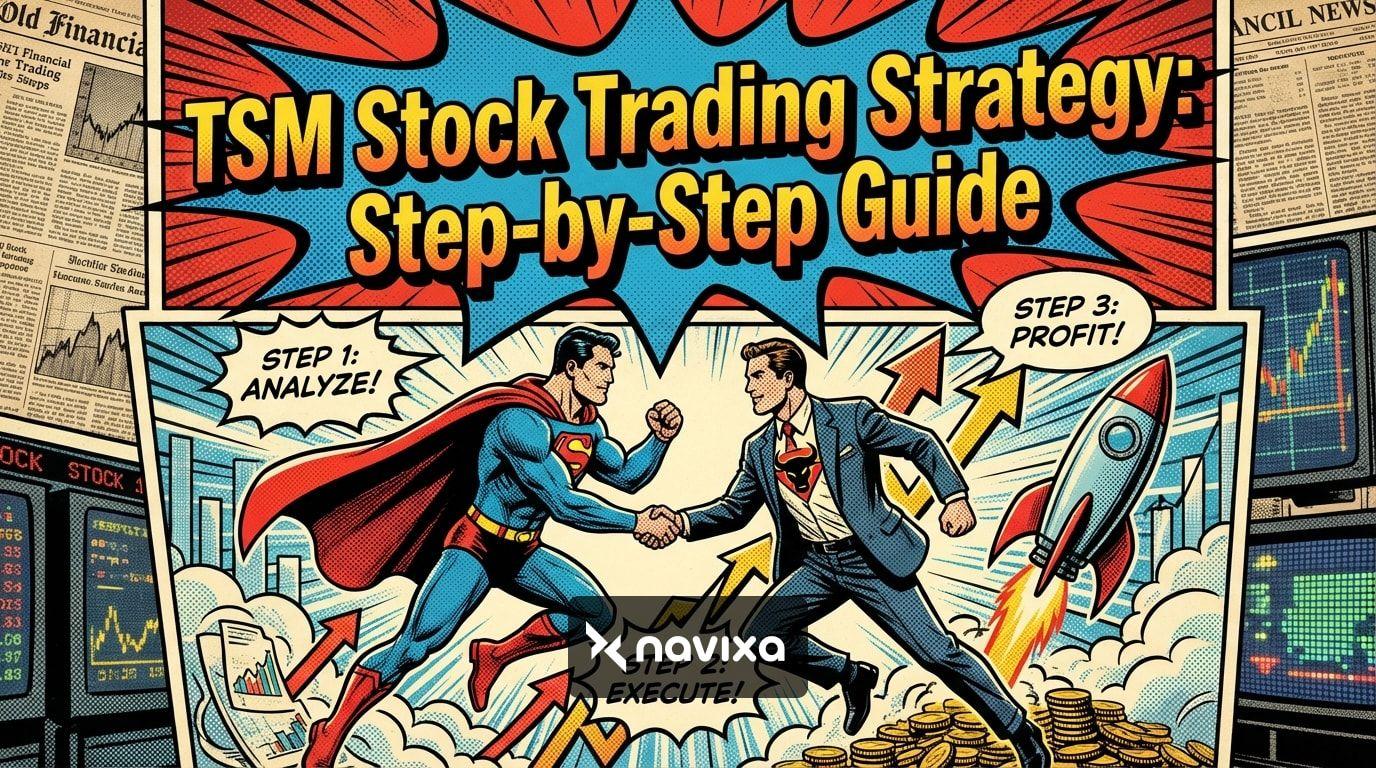
Now that we have established the theoretical framework, let's break down the practical application of the TSM stock trading strategy into actionable steps.
Step 1: Analyze the Macro Market Breadth
Never trade TSM in a vacuum. Start your trading week by evaluating the broader technology sector. Check the performance of major semiconductor ETFs (like the SMH) and the Nasdaq 100. If the broader market is experiencing a liquidity drain or rising interest rates, even a fundamentally strong stock like TSM will face headwinds. Ensure the macroeconomic environment aligns with your intended directional bias.
Step 2: Monitor Monthly Revenue Releases
Unlike most U.S. equities that only provide quarterly updates, TSMC files monthly revenue reports. You can track these on financial aggregators like Yahoo Finance or directly via the SEC EDGAR database.
If the monthly data shows unexpected acceleration (e.g., month-over-month growth exceeding 10%), prepare for institutional upgrades. Use this fundamental catalyst to justify entering a technical breakout.
Step 3: Identify Technical Entry Points
Open your charting platform and map out the structural highs and lows. Suppose TSM recently hit an all-time high of $390.20 and subsequently pulled back.
* The Pullback Entry: Wait for the stock to retrace to the 38.2% or 50% Fibonacci retracement level of the most recent bullish impulse wave. * The Breakout Entry: If the stock is consolidating in a horizontal channel, set an alert for a high-volume breakout above resistance. Enter the trade only when the daily candle closes above the resistance zone to avoid fake-outs.
Step 4: Define Profit Targets and Stop-Losses
Before executing the trade, calculate your exact exit parameters.
* Stop-Loss Placement: Place your stop-loss order slightly below the nearest swing low or just under the 50-day EMA. A standard rule of thumb is to risk no more than 1% to 2% of your total account equity on a single trade. * Taking Profits: Scale out of your position. Sell 50% of your shares when the stock reaches a 1:2 Risk/Reward ratio. Move your stop-loss to breakeven for the remaining shares, letting the "runner" capture any extended momentum toward previous all-time highs.
TSM vs. Broader Semiconductor Market
To fully appreciate why a specific TSM stock trading strategy is needed, we must compare it against alternative semiconductor trading vehicles.
| Asset / Ticker | Core Market Role | Volatility Level | Best Suited Trading Style |
|---|---|---|---|
| TSM (TSMC) | Manufacturer / Pure-play Foundry | Moderate to High | Swing Trading / Trend Following |
| NVDA (Nvidia) | Fabless Chip Designer | Very High | Momentum Trading / Options |
| SMH (ETF) | Diversified Semiconductor Basket | Moderate | Position Trading / Long-term holding |
| Bitcoin Miners | Direct Crypto Exposure (Hardware) | Extreme | Breakout Trading / Short-term flips |
As the table illustrates, TSM offers a balanced mix of high-beta growth (thanks to AI and crypto) and foundational stability, making it the premier choice for technical swing traders who want to avoid the extreme intra-day erraticism of fabless designers or purely crypto-correlated mining stocks.
Advanced Tactics: Options and Gap Trading
For more experienced market participants, plain vanilla stock trading can be augmented with options strategies.
Trading the Earnings Gap
TSMC frequently "gaps" up or down at the opening bell following its earnings announcements or monthly revenue updates. * Gap and Go: If the stock gaps up on overwhelming volume and holds the opening price for the first 30 minutes, momentum traders can buy the breakout, anticipating a "gap and go" continuation. * Fading the Gap: Conversely, if the stock gaps up but immediately faces heavy institutional selling (often a "sell the news" event), traders can initiate short positions or buy put options, targeting a fill of the gap.
Covered Calls for Income
If you find yourself inadvertently turning a swing trade into a longer-term investment due to a geopolitical pullback, you can employ a covered call strategy. By selling out-of-the-money call options against your core TSM position, you can generate continuous premium income, effectively lowering your average cost basis while you wait for the stock to recover.
Risk Management for TSM Traders
Even the most robust TSM stock trading strategy will fail without rigorous risk management. The "Sword of Damocles" hanging over TSMC is the ongoing geopolitical tension in the Taiwan Strait. Because the vast majority of TSMC's most advanced fabrication capacity remains physically located on the island of Taiwan, any escalation in military posturing by China can cause immediate, violent sell-offs in the stock.
To mitigate this catastrophic tail risk: 1. Never Overleverage: Avoid using excessive margin when holding TSM overnight or over the weekend. Geopolitical news frequently breaks when the U.S. markets are closed. 2. Respect Your Stops: Do not fall in love with the company's fundamentals. If the technical chart breaks critical support, accept the small loss and exit the trade. You can always re-enter when the chart repairs itself. 3. Portfolio Diversification: Do not allocate your entire semiconductor budget to TSM. Balance your exposure with equipment manufacturers (like ASML) or diversified tech ETFs to dampen the volatility of a single-point failure.
Practical Takeaways and Conclusion
Trading Taiwan Semiconductor Manufacturing Company offers an unparalleled opportunity to capitalize on the generational booms in artificial intelligence, supercomputing, and cryptocurrency mining. By combining an understanding of TSMC's capital expenditures and advanced N2 node development with disciplined technical analysis—such as EMA pullbacks and RSI oversold bounces—you can consistently locate high-probability trade setups.
Remember that consistency in the markets comes from process, not prediction. Follow the macro trend, monitor the monthly revenue reports closely, execute your entries based on volume and structural support, and always prioritize capital preservation through strict stop-loss management.
Ready to put this strategy to the test? Open your charting software today, plot your moving averages, and begin paper-trading TSM to build your confidence before deploying live capital.
---
Frequently Asked Questions
Why does TSM report revenue on a monthly basis?
Unlike U.S.-based corporations, TSMC is subject to the financial regulations of the Republic of China (Taiwan), which mandate that publicly traded companies disclose their monthly sales figures. This provides an excellent leading indicator for traders to gauge the company's performance before the official quarterly earnings release.
How do cryptocurrency and AI affect TSM stock?
Both industries demand massive amounts of computational power. AI models require advanced GPUs, while crypto mining relies on efficient ASICs. Because TSMC is the primary manufacturer capable of producing the cutting-edge 3nm and 2nm silicon required for these components, explosive growth in AI and crypto directly translates into massive order backlogs and revenue growth for TSM.
Is TSM a good stock for day trading?
While TSM possesses high liquidity, its intra-day volatility is generally lower than fabless tech stocks like Nvidia or AMD. TSM is traditionally better suited for swing trading (holding for days or weeks) rather than scalp trading on a 1-minute or 5-minute chart.
What are the biggest risks of trading TSM?
The primary risk is geopolitical tension between Taiwan and China, as an international incident could severely disrupt the global semiconductor supply chain. Secondary risks include the cyclical nature of the chip market, immense capital expenditure burdens, and potential delays in rolling out next-generation process nodes.
Can I use this strategy for other semiconductor stocks?
Yes, the foundational principles of this TSM stock trading strategy—combining macro analysis, technical moving averages, and strict risk management—can be effectively applied to other semiconductor stocks like AMD, Broadcom, or ASML. However, you must adjust your volatility expectations and stop-loss widths according to the specific behavior of each ticker.