
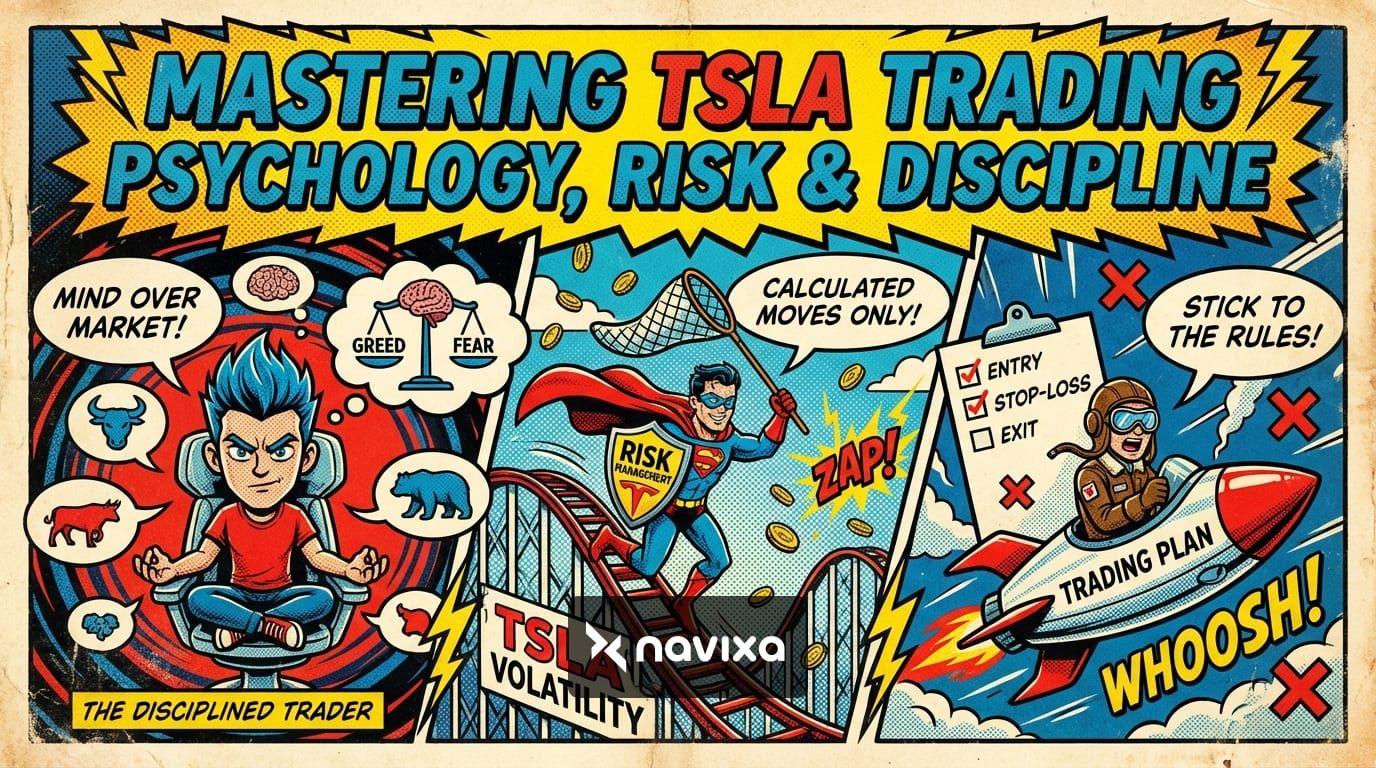
Trading Tesla (TSLA) stock is widely considered one of the ultimate tests of a trader's mental fortitude. Few assets in the global financial markets polarize investors quite like Tesla. Between soaring valuation metrics, unpredictable CEO announcements, and macroeconomic headwinds, mastering TSLA trading psychology is absolutely essential for anyone looking to generate consistent returns. In many ways, trading TSLA mirrors the extreme volatility of cryptocurrency markets, requiring a similar blend of mental resilience, strict risk parameters, and emotional discipline.
In this comprehensive guide, we will explore the nuances of TSLA trading psychology, diving deep into how emotional control and strict risk management can protect your portfolio from the stock's notorious price swings. Whether you are a day trader looking to capitalize on intraday volatility or a swing trader navigating quarterly earnings, developing a disciplined mindset is your most valuable edge.
The Unique Phenomenon of TSLA Stock
To understand the psychology behind trading Tesla, one must first recognize why the stock behaves the way it does. Tesla frequently trades with a high premium, pricing in futuristic technological advancements like full self-driving (FSD), robotaxis, and humanoid robots. When the company hits roadblocks, the market's reaction is swift and severe.
For instance, in early 2026, TSLA shares faced intense pressure, dropping over 20% year-to-date. This decline was largely driven by a disappointing Q1 delivery report, where the company delivered 358,023 vehicles, resulting in a record 50,363-unit inventory build. Furthermore, Tesla's energy storage deployments, previously a massive growth pillar, fell short of estimates at 8.8 GWh. When fundamental data clashes with lofty market expectations, volatility erupts, testing the psychological limits of retail and institutional traders alike.
Why TSLA Behaves Like a Crypto Asset
For years, veteran traders have noted the similarities between TSLA and major cryptocurrencies like Bitcoin. Both assets benefit from powerful narratives and fiercely loyal communities. This creates a hyper-reactive market environment. A single headline, a shift in government EV tariffs, or an unexpected earnings miss can trigger massive liquidations or parabolic short squeezes.
Many cryptocurrency traders migrate to TSLA during slow periods in the digital asset markets because the price action is remarkably similar. Traders in both arenas are accustomed to deep 20% corrections followed by massive, violent rallies. TSLA provides this exact type of environment. Consequently, the order book dynamics often reflect algorithmic crypto trading, with swift stop-hunts and rapid momentum ignition. Recognizing this correlation means you should apply the same rigorous risk frameworks you would use in a highly leveraged crypto environment. The psychological toll of watching a position drop rapidly requires a trader to be entirely desensitized to short-term noise, focusing instead on the larger macro structure of the chart.
Core Pillars of TSLA Trading Psychology
Achieving consistency when trading Tesla requires a rock-solid mental framework. Developing a profitable strategy is only a small part of the battle; the vast majority of trading success is purely psychological.
Conquering FOMO (Fear of Missing Out)
Fear of Missing Out is arguably the most destructive emotion for a TSLA trader. When Tesla announces a new AI breakthrough or a massive vehicle order, the stock can gap up aggressively. Retail traders, seeing the massive green candles, often abandon their trading plans and market-buy out of fear that the stock will run away without them. This is exactly how retail traders end up providing exit liquidity for institutional algorithms.
To combat FOMO, you must accept that the market offers endless opportunities. If you miss a breakout, wait for a natural pullback or consolidation phase.
Overcoming Panic and Loss Aversion
Conversely, panic is triggered when the stock experiences sudden, aggressive sell-offs. In early 2026, when analysts from firms like JPMorgan reiterated bearish downside targets of $145, many retail traders panic-sold near the yearly lows. Loss aversion—the psychological principle that the pain of losing money is twice as intense as the joy of making money—forces traders to close positions prematurely or, worse, freeze and let small losses spiral into account-ruining drawdowns.
Mastering TSLA trading psychology requires you to normalize losses as a standard business expense. The goal is not to win every trade, but to survive the volatility long enough to let your statistical edge play out over time.
Navigating the "Cult vs. Skeptic" Dynamic
The Tesla market is essentially an endless tug-of-war between two extremes: the hyper-bulls who believe the stock is perpetually undervalued, and the perma-bears who believe the company is simply an overvalued automaker. As a trader, you cannot afford to adopt either identity.
For example, in early 2026, bulls focused heavily on the upcoming robotaxi launches and the transition to a "physical AI company," pricing in massive future multiples. Meanwhile, skeptics fixated on the reality of the 358,023 Q1 vehicle deliveries and the alarming inventory build, calculating a deteriorating forward outlook. Becoming emotionally attached to either narrative clouds your judgment. Maintain absolute neutrality. Your job is to extract capital from price action, not to prove a philosophical point.
Risk Management: Your Shield Against Volatility
Psychology and risk management are deeply intertwined. It is impossible to trade with a clear mind if your position size is too large. When traders risk too much capital on a single TSLA trade, every minor tick of the chart triggers a physiological stress response.
Optimal Position Sizing
The golden rule of risk management is to never risk more than 1% to 2% of your total account equity on a single trade. Because TSLA's Average True Range (ATR) is exceptionally high, the stock routinely moves 3% to 5% in a single trading session. If you are trading TSLA options or using leverage, position sizing becomes even more critical. A smaller, well-managed position allows you to hold through intraday noise and adhere to your broader thesis without sweating every fluctuation.
Uncompromising Stop-Loss Execution
A stop-loss order is the ultimate tool for enforcing trading discipline. It serves as an objective boundary that protects your capital when your thesis is wrong. When trading TSLA, dynamic support and resistance levels can break rapidly. Relying on "mental stops" is a recipe for disaster. Always use hard stop-loss orders or strict alerts, and never move your stop-loss further away as the price approaches it.
The Role of Profit-Taking Strategies
Another crucial aspect of risk management and psychology is knowing when to take profits. Many traders let their winners turn into losers because of greed. When trading TSLA, implementing a scale-out strategy is highly effective. By selling 50% of your position at the first major resistance level, you secure capital and ensure the trade is a mathematical winner. You can then move your stop-loss to breakeven for the remaining 50%, allowing you to capture extended momentum stress-free.
Emotional vs. Disciplined Trading
To clearly illustrate the difference between an amateur and a professional mindset, review the comparison table below highlighting how both archetypes react to common TSLA market events.
| Market Event | Emotional Trader Reaction | Disciplined Trader Reaction |
|---|---|---|
| Massive Delivery Miss | Panic sells at market open, locking in the maximum loss. | Assesses pre-planned support levels; waits for a structural bounce. |
| Sudden Bullish News | Buys aggressively at the top of a massive green candle (FOMO). | Waits for the initial hype to settle and looks for a safe entry on a pullback. |
| Hitting a Stop-Loss | Cancels the stop-loss, hoping the stock will reverse course. | Accepts the small loss, preserves capital, and moves to the next setup. |
| Severe Monthly Drawdown | Revenge trades with higher leverage to win back money quickly. | Steps away from the desk, reviews the trading journal, and adjusts strategy. |
Aligning Technical Analysis with Mental Discipline
Technical analysis (TA) provides the objective data required to quiet the emotional mind. When trading TSLA, combining technical indicators with strict discipline yields the best results.
Moving Averages as Emotional Anchors
Traders frequently use moving averages—such as the 50-day and 200-day Simple Moving Averages (SMA)—to gauge the broader trend. In 2026, when TSLA slipped well below its 200-day moving average, it served as an objective signal that the macro trend had shifted. A disciplined trader respects the trend and avoids trying to catch a falling knife, waiting instead for structural confirmation of a reversal.
The Relative Strength Index (RSI) for Exhaustion
The RSI is a phenomenal tool for combating FOMO. If TSLA has rallied dramatically and the RSI is flashing a reading above 80 (overbought), the disciplined trader knows that the risk-to-reward ratio for a new long position is skewed heavily against them. Conversely, an RSI below 30 during a panic sell-off might indicate that the market has overreacted, presenting a calculated entry for a mean-reversion trade. You can learn more about RSI from Investopedia.
Actionable Steps for Consistent TSLA Trading
If you want to refine your TSLA trading psychology and elevate your performance, implement these actionable steps immediately:
1. Maintain a Trading Journal: Write down the thesis for every trade, the entry price, the stop-loss, and the target. More importantly, record your emotional state before, during, and after the trade. Reviewing this data helps identify destructive behavioral patterns. 2. Trade the Chart, Not the News: News headlines are designed to elicit emotion. By the time a news story breaks, institutional algorithms have usually already priced it in. Focus on how the price reacts to the news at key support and resistance levels. 3. Set Daily Loss Limits: Establish a rule that if you lose a certain percentage of your account in a single day, you shut down your trading platform. This prevents the catastrophic cycle of revenge trading. 4. Step Away from Social Media: Platforms like X (formerly Twitter) and Reddit are echo chambers of extreme bias. Limit your exposure to social media while in an active trade to prevent external opinions from swaying your predetermined plan. Read about the impact of social sentiment on trading at TradingView.
Conclusion
Mastering TSLA trading psychology is a journey of self-discovery and rigorous discipline. Tesla's stock will always be a battleground of intense volatility, driven by groundbreaking innovations, production hurdles, and passionate market participants. By conquering FOMO, eliminating panic, executing strict risk management, and relying on objective technical data, you can build an edge that withstands even the most turbulent market conditions. Remember, the market does not care about your opinions or emotions; it only rewards discipline, patience, and execution. Take control of your mindset today, and transform volatility into your greatest advantage.
Frequently Asked Questions
Why is TSLA trading psychology so difficult to master?
TSLA is exceptionally difficult to trade because its price is heavily influenced by retail sentiment, social media hype, and visionary CEO announcements, rather than purely traditional valuation metrics. This creates sudden, unpredictable price swings that easily trigger emotional responses like FOMO and panic.
How much of my portfolio should I risk on a single TSLA trade?
Professional traders generally recommend risking no more than 1% to 2% of your total account capital on a single trade. Because TSLA can experience massive intraday swings, keeping your position size small is crucial to maintaining emotional neutrality and adhering to your stop-loss.
How can I stop revenge trading after a big loss on Tesla?
The most effective way to prevent revenge trading is to enforce a "daily circuit breaker." If you hit a pre-defined maximum daily loss limit (e.g., 3% of your account), physically walk away from your computer. Additionally, keeping a detailed trading journal allows you to process the loss logically rather than emotionally.
Does technical analysis actually work on a stock as volatile as TSLA?
Yes. In fact, technical analysis is essential for navigating highly volatile stocks like TSLA. While news and fundamental data dictate the long-term trend, technical levels (like major moving averages, support/resistance, and volume profiles) dictate where institutional buyers and sellers are positioned, providing objective entry and exit points that strip emotion from the equation.
What impact do algorithmic traders have on TSLA's volatility?
Algorithmic trading accounts for a massive portion of TSLA's daily volume. These automated systems are designed to detect momentum and exploit emotional retail traders by triggering stop-losses at key technical levels. This is why TSLA often experiences sharp, momentary price spikes on the chart before reversing direction. Understanding this algorithmic presence reinforces the need for disciplined, pre-planned entries.