
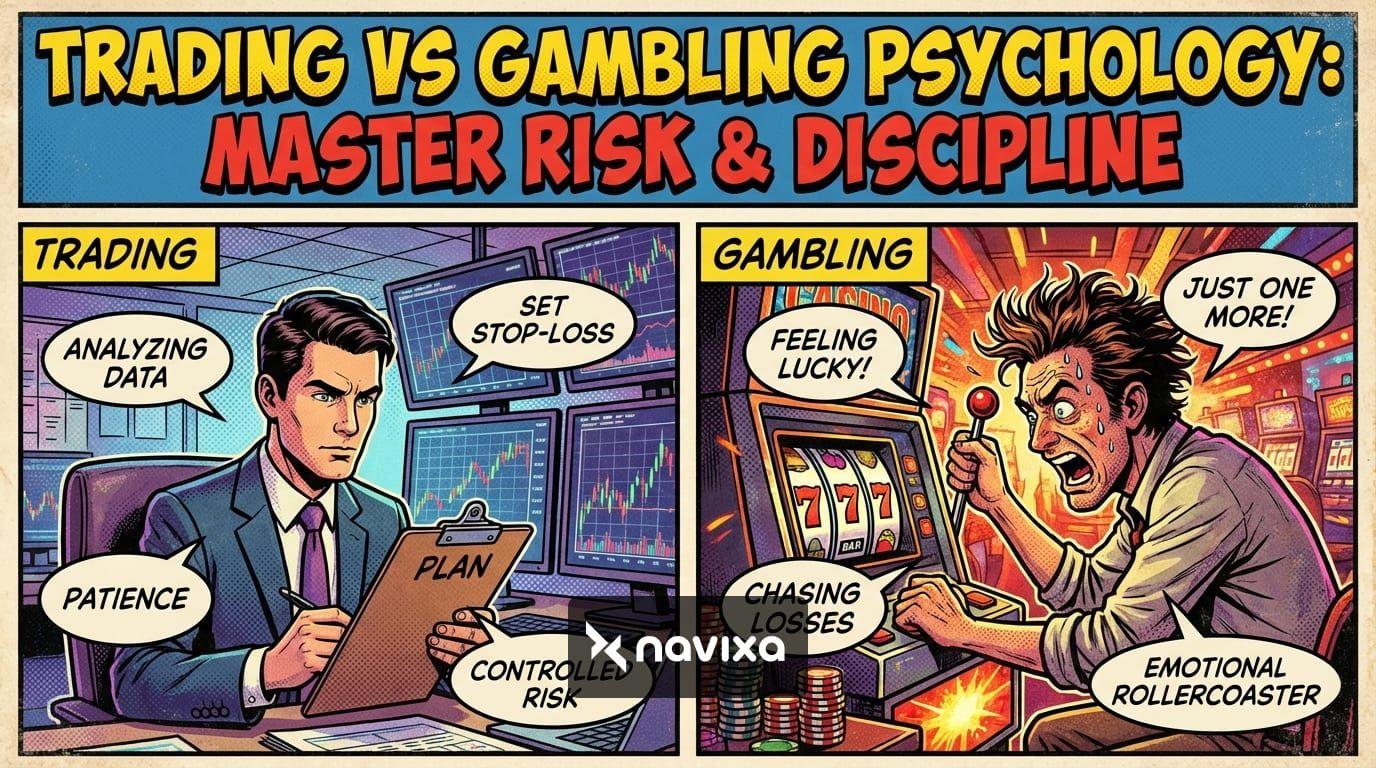
The cryptocurrency market is notorious for its blistering volatility and life-changing price swings. With Bitcoin navigating the $73,000 to $74,000 range in early 2026—recovering from its massive peak of $126,000 in October 2025—the allure of rapid wealth is stronger than ever. However, this environment often blurs the lines between calculated speculation and pure betting. Understanding trading vs gambling psychology is the single most important step a market participant can take to ensure long-term profitability.
Whether you are navigating high-cap assets like Bitcoin and Ethereum or exploring smaller altcoins, the mindset you bring to the charts determines your fate. Are you executing a well-researched trading strategy, or are you pulling a digital slot machine lever?
In this comprehensive guide, we will explore the intricate psychological traps that turn investors into gamblers, outline the differences between technical analysis and blind luck, and provide actionable risk management steps to master your discipline.
The Fine Line: Trading vs Gambling Psychology
At a fundamental level, both trading and gambling involve risking capital on an uncertain future outcome in hopes of generating a profit. The divergence lies entirely in the approach, the presence of a statistical edge, and the psychological state of the participant.
According to a comprehensive 2025 PubMed study on retail investors, approximately 15.6% of retail market participants fall into the category of "gambling-traders." This group exhibits high impulsivity, gambling-related cognitive biases, and a propensity to chase losses across highly speculative assets. Unlike systematic traders, these individuals view the financial markets as an extension of a casino.
The Illusion of Control
One of the defining characteristics of trading vs gambling psychology is the illusion of control. In a game of roulette, the odds are fixed mathematically by the house. You place your bet, the wheel spins, and the outcome is final. You cannot manage your risk halfway through the spin.
In financial trading, the market is fluid. You have the ultimate freedom to enter, exit, scale up, or cut losses at any given second. Ironically, this absolute freedom is what destroys undisciplined participants. Because a trader can exit at any time, emotional biases like fear and greed take the wheel. A losing trade is held too long because of the "hope" it will bounce back, while a winning trade is cut short out of fear that the market will reverse.
"The investor's chief problem, and even his worst enemy, is likely to be himself." — Benjamin Graham
Chasing the Dopamine Hit
Gambling psychology is driven by intermittent reinforcement—the same psychological principle that makes social media and slot machines addictive. When an undisciplined trader buys a meme coin or a volatile altcoin on a whim and makes a 300% return, their brain receives a massive dopamine spike.
They begin to associate the *action* of trading with this euphoric feeling, rather than the *process* of analysis. Consequently, they increase their trading frequency, abandon risk management, and eventually lose their capital to the market's natural variance.
Symptoms of a Gambling Mindset in Crypto
How do you know if you have crossed the line? Here are the hallmark symptoms of gambling psychology in the cryptocurrency market:
1. Trading Out of Boredom: Opening positions because you feel the need to be "in the market" rather than waiting for your trading strategy to present a valid setup. 2. Revenge Trading: Immediately re-entering the market after a painful loss with a larger position size, desperate to make the money back. 3. Ignoring Stop Losses: Moving or deleting your stop loss because you cannot accept the reality of a losing trade. 4. Obsessive Chart Checking: Losing sleep, experiencing physical anxiety, and constantly refreshing your portfolio balance. 5. Over-Leveraging: Using 50x or 100x leverage on platforms like Binance without a strict liquidation mitigation plan, treating the trade like an all-or-nothing lottery ticket.
Technical Analysis vs. Blind Luck
The antidote to a gambling mindset is a systematic approach rooted in data. Professional traders do not try to predict the future; they exploit probabilistic edges over a large sample size of trades.
Establishing a Statistical Edge
A trading edge is a measurable advantage that yields a positive expected value over time. In the crypto markets of 2026, where institutional presence is heavy and algorithmic trading dominates, relying on "gut feeling" is a guaranteed path to ruin.
Traders use technical analysis (TA) to map out market psychology. By analyzing historical price action, moving averages, and support/resistance zones, traders identify areas where the probability of a favorable move is higher than an unfavorable one.
For instance, consider the sharp drop in altcoin trading volume observed in early 2026. Daily volume outside the largest exchanges fell to roughly $18.8 billion. A gambler would blindly buy random altcoins hoping for a sudden "pump." A disciplined trader, analyzing the volume spread and Bitcoin dominance (hovering near 59%), would adapt their strategy to focus on high-liquidity assets or wait for a confirmed volume breakout before deploying capital.
The Role of Fundamental Analysis
Trading strategy also incorporates fundamentals. With the Spot Bitcoin ETFs holding over $91 billion in net assets and the anticipated "Clarity Act" shaping crypto regulations, professional traders align their technical setups with macroeconomic trends. Gamblers, conversely, buy based on social media hype or FOMO (Fear Of Missing Out) without understanding the underlying tokenomics or market structure.
A Clear Comparison: Trading vs Gambling
To solidify the difference, let us look at a direct comparison of the two mindsets.
| Feature | The Professional Trader | The Market Gambler |
|---|---|---|
| Primary Focus | Execution of a predefined system and process. | The thrill of the outcome and the monetary reward. |
| Risk Management | Uses strict stop losses; risks only 1-2% of capital per trade. | Trades without safety nets; risks large chunks of capital impulsively. |
| Reaction to Losses | Accepts losses as a statistical business expense. | Takes losses personally; engages in "revenge trading." |
| Market Analysis | Relies on backtested technical and fundamental data. | Relies on tips, hype, rumors, and gut feelings. |
| Time Horizon | Focuses on compounding returns over months and years. | Wants to get rich overnight on a single "moonshot." |
Actionable Steps: Master Risk & Discipline
Transitioning from a gambling mentality to a professional trading mindset requires deliberate effort. Here are actionable steps to build your discipline today.
1. Define a Strict Trading Strategy
You must have a written rulebook. Your trading strategy should explicitly define your entry criteria, your exit criteria for taking profits, and your invalidation point (where you cut your loss). If the market does not present a setup that meets your exact criteria, you do nothing. Cash is a valid position.
2. Implement Ruthless Risk Management
The golden rule of trading is capital preservation. If you lose 50% of your account, you need a 100% gain just to break even. * Position Sizing: Never risk more than 1% to 2% of your total account equity on a single trade. * Risk-to-Reward Ratio: Only take trades that offer at least a 1:2 risk-to-reward ratio. If you are risking $100, your realistic target should be at least $200.
3. Maintain a Trading Journal
A trading journal is your most powerful psychological mirror. Document every trade you take, including the setup, the position size, the outcome, and—most importantly—your emotional state at the time. Over time, you will spot patterns. You might realize that you always lose money when you trade right after waking up, or that you tend to over-leverage after a winning streak.
4. Separate Your Self-Worth from Your Net Worth
A losing trade does not make you a failure, and a winning trade does not make you a genius. The market is entirely neutral. By detaching your ego from your trading outcomes, you prevent emotional swings from hijacking your decision-making process.
Practical Takeaways for 2026 Markets
The crypto market has matured significantly. The era of easily multiplying capital by throwing darts at low-cap tokens is largely behind us. Institutional money flows dictate the trends, and market efficiency is increasing.
To survive and thrive: * Respect the Data: Track institutional ETF flows and broader macroeconomic indicators like inflation and interest rates. * Avoid Low-Liquidity Traps: With altcoin volumes experiencing massive shifts, do not gamble on illiquid tokens where a single large seller can destroy the chart. * Automate Your Edge: Use conditional orders (stop-limit, trailing stops) to remove the temptation of manually breaking your own rules in the heat of the moment.
Conclusion
The debate of trading vs gambling psychology ultimately comes down to intent and execution. The market will gladly act as a casino for those who treat it like one, providing the dizzying highs and devastating lows of a gambling addiction. However, for those willing to master their emotions, apply rigorous risk management, and stick to a tested trading strategy, the financial markets offer a legitimate path to wealth generation.
Mastering the market begins with mastering yourself. Stop chasing the dopamine hit of the next big pump, put in the work to build a statistical edge, and transform your approach from gambling into professional trading.
Frequently Asked Questions
What is the main difference between trading vs gambling psychology?
The primary difference is the presence of a statistical edge and risk management. A trader relies on data, probabilities, and strict capital preservation rules to generate consistent returns over time. A gambler relies on luck, trades impulsively based on emotions, and lacks a predefined exit strategy.
Can cryptocurrency trading become a gambling addiction?
Yes. Because crypto markets operate 24/7 and are highly volatile, they can trigger the same dopamine responses as traditional gambling. Studies show that retail participants who engage in high-risk, impulsive trading often exhibit classic problem-gambling behaviors, such as loss-chasing and obsessive monitoring.
How do I stop revenge trading after a big loss?
The best way to stop revenge trading is to implement a "cooling-off" rule. If you hit a certain drawdown limit (e.g., two consecutive losing trades or a 3% account loss in one day), force yourself to step away from the charts for 24 hours. Journal the loss and review your strategy when you are emotionally sober.
How much of my portfolio should I risk per trade?
Professional traders generally recommend risking no more than 1% to 2% of your total trading capital on any single setup. This ensures that even a string of consecutive losses will not significantly damage your account, keeping you in the game long enough for your edge to play out.
Is technical analysis just another form of gambling?
No. While technical analysis cannot predict the future with 100% certainty, it provides a framework for identifying high-probability setups based on historical market psychology and supply/demand imbalances. When combined with strict risk management, it creates a sustainable business model rather than a game of chance.