
Introduction
Trading TSLA stock has long been considered a rite of passage for modern traders. As one of the most polarizing and heavily traded equities in the global market, Tesla (NASDAQ: TSLA) frequently behaves less like a traditional automaker and more like a high-beta technology asset or even a cryptocurrency. The stakes are incredibly high, and the price action is notoriously unforgiving for those lacking a concrete strategy.
In the current market environment, Tesla is undergoing a massive fundamental pivot. The company is no longer judged solely on traditional electric vehicle (EV) deliveries; rather, it is being heavily evaluated as a physical AI, energy storage, and robotics powerhouse. Following the Q1 2026 earnings report—which featured a solid earnings per share (EPS) beat of $0.41 against Wall Street expectations of $0.38, despite slightly missing revenue targets at $22.38 billion—the stock's volatility remains a prime attraction for both day traders and swing traders alike.
However, capitalizing on these multi-percentage-point daily swings requires far more than blind luck. It requires strict discipline, advanced technical analysis, and unparalleled risk management. Whether you are day trading the opening bell or swing trading multi-week setups, navigating the turbulent waters of Tesla's price action demands a professional mindset. In this comprehensive guide, we will explore the core strategies, psychological frameworks, and risk management protocols necessary to succeed in trading TSLA stock.
The Unique Psychology of Trading TSLA Stock
Leaving Emotion at the Door
When trading TSLA stock, the first and most critical hurdle is overcoming your own psychological biases. Tesla possesses a massive, cult-like retail following that believes the company is destined to dominate global transportation and AI. Conversely, it also has an exceptionally vocal community of short-sellers who continually predict the company's downfall.
As a trader, you cannot afford to marry either of these narratives. Currently, Wall Street analyst price targets for Tesla highlight this extreme polarization, ranging from as low as $24.86 from deep bears to a bullish $600 from tech-focused analysts. If you trade based on ideology, you will eventually get crushed by the market's reality. Your objective is to trade the chart, the volume, and the immediate catalyst—not your personal feelings about CEO Elon Musk or the future of autonomous driving.
"The market does not care about your opinion of Tesla. It only cares about supply and demand. Discipline and strict risk parameters are your only defense against extreme volatility."
The Battle of Bulls and Bears
Because Tesla is heavily shorted and heavily defended by retail and institutional bulls, its price action frequently features massive short squeezes and aggressive panic sell-offs. Recognizing when one side is trapped is a core component of trading TSLA stock. When the stock breaks key resistance levels on high volume, bears are often forced to cover, creating a violent upward momentum that agile day traders can exploit.
Core Trading Strategies for TSLA
Momentum and Breakout Trading
TSLA is famous for its multi-day momentum runs. These runs are usually triggered by systemic catalysts, such as better-than-expected delivery numbers, a successful Robotaxi rollout, or breakthroughs in the Optimus robotics division.
When trading a breakout, wait for the stock to consolidate near a major resistance level. Instead of anticipating the breakout, let the stock push through the resistance on higher-than-average volume. Once the breakout is confirmed, enter the trade and use the previous resistance level as your new support (and your stop-loss area). This strategy allows you to ride the wave of institutional buying while keeping your downside strictly limited.
Mean Reversion in Ranging Markets
While TSLA can trend strongly, it also experiences periods of extreme overextension. Algorithms and retail FOMO (Fear Of Missing Out) often push the stock price far beyond its intrinsic technical levels. Mean reversion traders look for moments when TSLA becomes heavily overbought or oversold, anticipating a snapback to the mean—typically the 20-day or 50-day moving average.
To execute this, traders utilize oscillators like the Relative Strength Index (RSI). If TSLA's RSI drops below 30 on a broader market panic but no fundamental news has changed for the company, it often presents a high-probability bounce play. Conversely, an RSI soaring above 80 after a multi-day run usually signals exhaustion, offering a prime setup for short-sellers or long traders looking to take profits.
Options Trading and Hedging
For traders with smaller account sizes or those looking to leverage their capital, the options market provides incredible opportunities. TSLA options are among the most liquid in the entire stock market. However, because of the high implied volatility (IV), buying naked calls or puts can be incredibly risky, especially around earnings events.
Many professionals use spreads (like bull call spreads or bear put spreads) to define their risk while trading TSLA stock. This limits the maximum profit but critically caps the maximum loss, protecting the trader from sudden overnight gaps caused by unexpected news or macro-economic shifts.
Technical Analysis & Key Fundamentals
Indicator Mastery
To trade TSLA effectively, you need a clean chart with reliable technical indicators. The most essential tools include:
* Volume Weighted Average Price (VWAP): The ultimate tool for day traders. If TSLA is trading above the VWAP, intraday momentum is bullish. If it falls below, bears are in control. * Moving Averages: The 50-day and 200-day simple moving averages (SMA) are heavily respected by algorithmic trading bots. A "Golden Cross" (50-day crossing above the 200-day) often signals a long-term bullish trend, while a "Death Cross" signals the opposite. * MACD (Moving Average Convergence Divergence): Useful for spotting shifts in momentum before they fully manifest in the price action.
Fundamental Catalysts to Watch
Even if you are a pure technical trader, you must be aware of fundamental catalysts. In 2026, Tesla is highly sensitive to news regarding its FSD (Full Self-Driving) subscriptions, which recently surpassed 1.1 million users. Additionally, the energy segment has become a quiet powerhouse, deploying record GWh of battery storage.
Traders must continually monitor SEC filings and earnings releases. You can easily access official company reports through the SEC EDGAR database. Additionally, tracking real-time price action and charting is essential; resources like the Yahoo Finance TSLA chart provide excellent intraday and historical data for analysis.
Risk Management Rules You Can't Ignore
Strict Position Sizing
No single trade should have the power to destroy your portfolio. When trading TSLA stock, position sizing is your first line of defense. A standard professional rule is to never risk more than 1% to 2% of your total account capital on a single trade. Because TSLA can easily swing 5% to 8% in a single session, your position size must be adjusted accordingly. If you usually buy 100 shares of a low-volatility stock, you might only buy 30 or 40 shares of TSLA to maintain the same exact dollar-risk.
Dynamic Stop-Loss Orders
"Mental stops" do not work with Tesla. The stock moves too fast. If a major news headline drops intraday, the price can plummet dollars in a matter of seconds. Always use hard stop-loss orders entered directly into your broker's platform.
For swing trading TSLA stock, consider using a trailing stop. As the stock moves in your favor, the trailing stop automatically moves up with it, locking in profits while still giving the stock room to breathe during minor intraday pullbacks.
Asset Class Comparison: Understanding the Volatility
To truly respect Tesla's price action, it is helpful to compare it against other heavily traded assets. Below is a breakdown of how trading TSLA stock compares to trading broad market indices and high-volatility cryptocurrencies.
| Metric | Trading TSLA Stock | Trading Broad Market ETFs (e.g., SPY) | Trading Cryptocurrencies (e.g., BTC) |
|---|---|---|---|
| Volatility | High (Frequent 5-10% weekly swings) | Low to Moderate (Slow, steady trends) | Very High (Rapid, unpredictable swings) |
| News Sensitivity | Extreme (CEO remarks, earnings, AI news) | Moderate (Fed rates, macro events) | Extreme (Regulatory news, ETF flows) |
| Liquidity | Exceptionally High | Exceptionally High | High (Dependent on the exchange) |
| After-Hours Moves | Common and violent during earnings | Minimal outside of major macro data | 24/7 Continuous Trading |
Actionable Steps for Day and Swing Traders
If you want to incorporate TSLA into your daily or weekly trading routine, follow these actionable steps to ensure you are prepared:
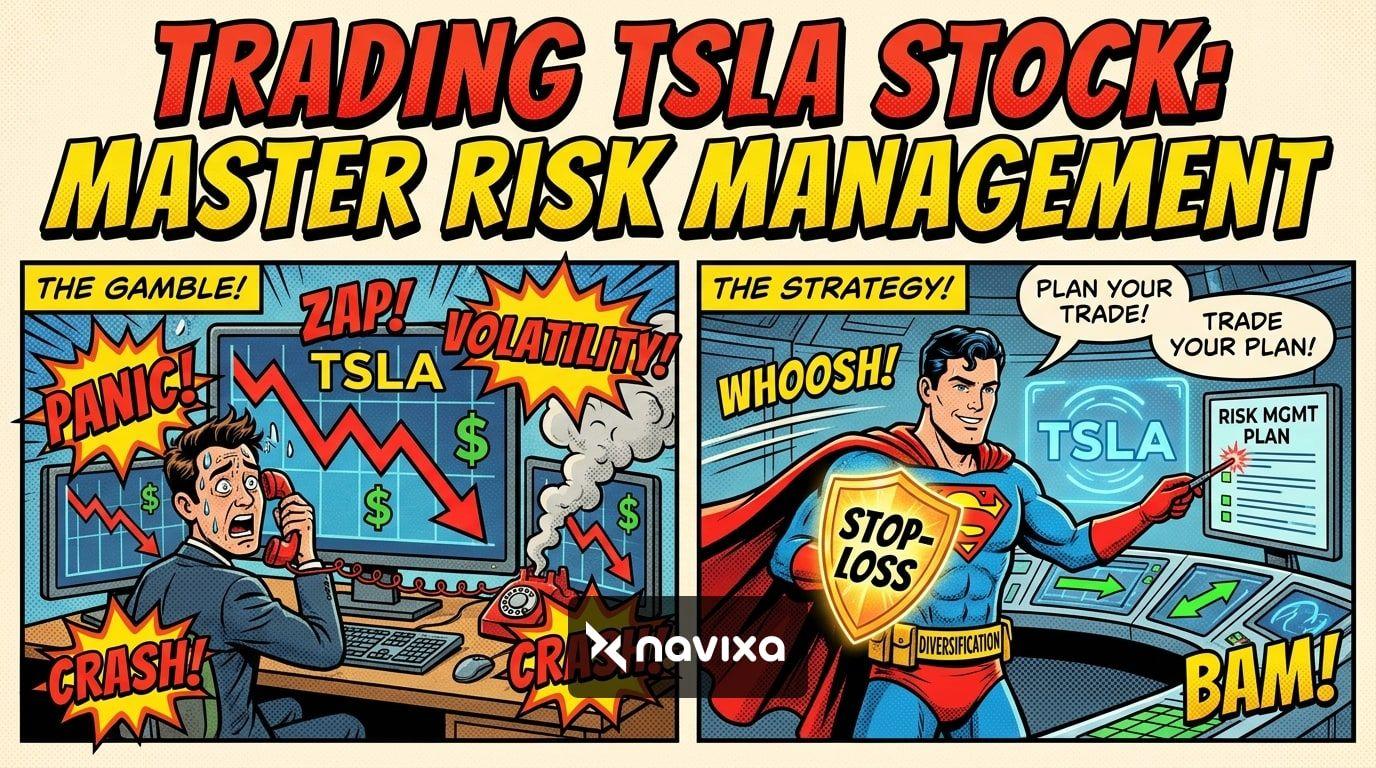
1. Pre-Market Preparation: Wake up at least an hour before the opening bell. Check the pre-market volume and look for any overnight news regarding EV tariffs, AI development, or global macro data that might affect the Nasdaq. 2. Define Key Levels: Draw your support and resistance lines based on the previous day's high, low, and closing prices. Identify where the VWAP is positioned. 3. Plan the Trade and Trade the Plan: Before executing an order, write down your entry price, your profit target, and your stop-loss. Calculate your Risk/Reward ratio. If the setup does not offer at least a 1:2 risk-to-reward ratio, do not take the trade. 4. Journal Your Trades: After the market closes, review your performance. Did you follow your stop-loss rules? Did you let your winners run? Journaling is the only way to refine your strategy over time.
Conclusion
Trading TSLA stock is not for the faint of heart, but it is incredibly rewarding for those who approach it with a professional framework. The transition of Tesla from an automotive pioneer to an AI and robotics giant ensures that its stock will remain a high-beta battleground for years to come. By mastering technical indicators, remaining agnostic to the bull-versus-bear noise, and adhering strictly to risk management principles, you can carve out consistent profitability.
Embrace the volatility, respect the price action, and always prioritize the preservation of your capital above the pursuit of a massive windfall.
Frequently Asked Questions
Is trading TSLA stock suitable for beginners?
While TSLA offers massive liquidity, making it easy to enter and exit positions, it is generally considered difficult for complete beginners. Its extreme volatility and sensitivity to news require quick decision-making and strict emotional control. Beginners should start with smaller position sizes or practice trading TSLA in a paper-trading simulator before risking real capital.
How do earnings reports impact Tesla's stock price?
Earnings reports are massive volatility catalysts for Tesla. Because the company's valuation is heavily based on future growth rather than just current revenues, forward-looking statements regarding Robotaxi timelines, AI infrastructure, and profit margins often cause extreme after-hours price swings. Holding short-term options or large equity positions through an earnings release is highly speculative and carries elevated risk.
What are the best technical indicators for trading TSLA?
For intraday day traders, the Volume Weighted Average Price (VWAP) is widely considered the most important indicator, acting as a dynamic support/resistance level. For swing traders, combining the 50-day Moving Average with momentum oscillators like the RSI (Relative Strength Index) and MACD provides a solid foundation for identifying trend reversals and continuations.