
Introduction
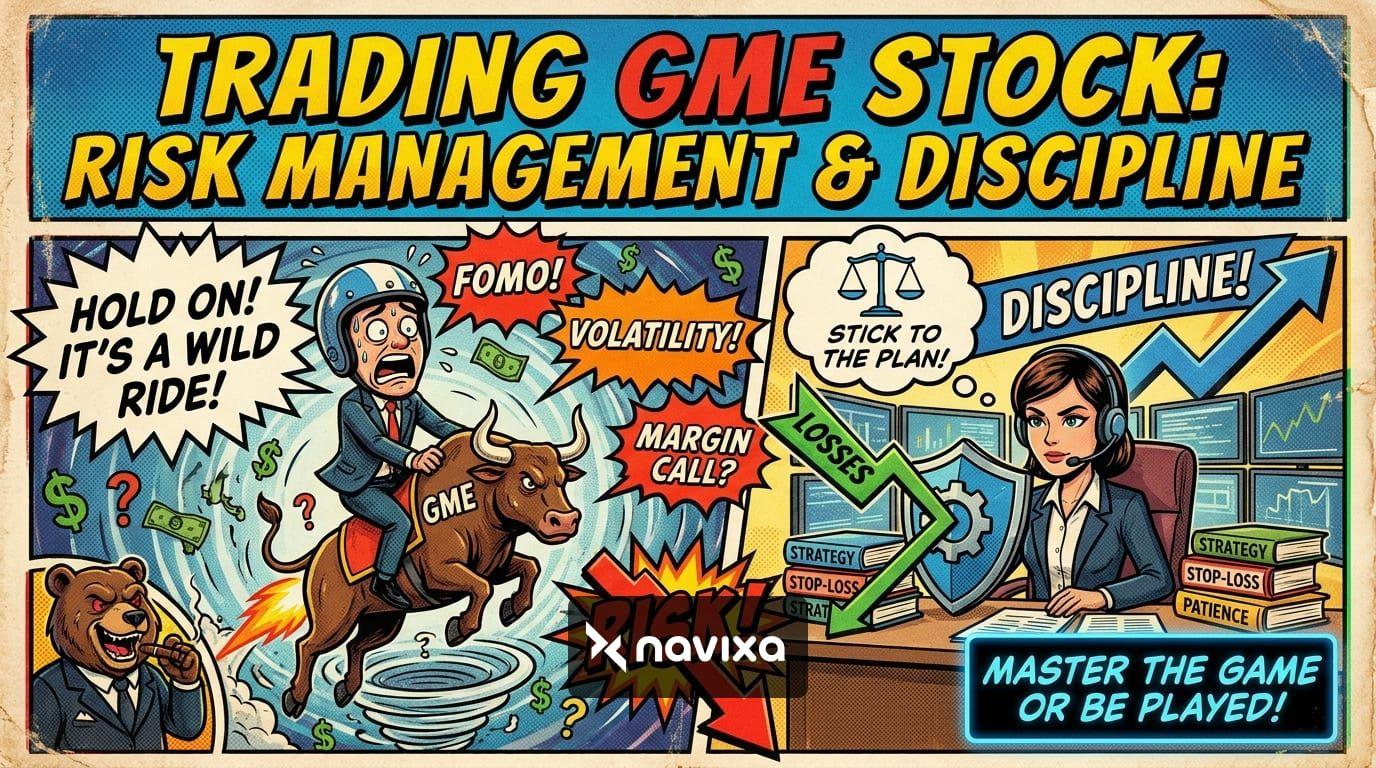
For retail and institutional investors alike, GME stock remains one of the most fascinating and highly scrutinized assets on the market. Evolving from its legendary meme-stock origins into a complex equity heavily traded by algorithms and day traders, GameStop (GME) continues to deliver extreme price action that can quickly reward—or ruthlessly punish—market participants. Successfully navigating this environment requires much more than simply buying into social media hype; it demands unwavering discipline, emotional control, and a bulletproof risk management strategy.
Whether you are watching the intraday chart for a sudden momentum breakout or positioning yourself ahead of earnings announcements, trading GME requires a clear, objective mindset. In this comprehensive guide, we will break down the essential technical analysis, advanced risk mitigation frameworks, and the psychological discipline required to trade GameStop shares effectively. By implementing these strategies, you can shift from gambling on unpredictable spikes to executing calculated, high-probability trades.
The Evolution of GME Stock: From Meme to Market Mainstay
To trade GME stock profitably today, traders must first understand the historical and structural forces driving its price. The trading landscape for GameStop has matured significantly since the historic short squeezes of previous years. Today, the stock does not just move on sheer retail enthusiasm; it is heavily influenced by algorithmic trading, complex options market dynamics, and high-profile institutional involvement.
For instance, notable moves by prominent investors—such as Michael Burry adding to his positions—or strategic announcements by CEO Ryan Cohen, routinely serve as massive catalysts for volatility. At current trading levels, with the stock frequently oscillating in the mid-$20 to $30 range, the battle between fundamental valuation models and technical momentum creates a highly volatile, highly lucrative battleground for day traders and swing traders alike.
Understanding that GME often trades completely divorced from traditional fundamental metrics is the first step toward disciplined trading. If you try to short the stock purely because it is "overvalued" on paper, you risk being caught in a violent short squeeze fueled by retail volume and options dealers hedging their exposure.
Core Trading Strategies for GameStop
Because traditional value investing principles frequently fail to predict GameStop's erratic price movements, technical analysis becomes an absolute necessity. Traders must rely heavily on charting tools to identify where institutional buyers are quietly stepping in and where algorithmic sellers are taking profits.
Moving Averages and Trend Alignment
Trend alignment is critical when dealing with momentum-driven equities. Traders frequently utilize the 20-day and 100-day Simple Moving Averages (SMAs) to gauge short-term and medium-term sentiment. When GME stock sustains price action above these moving averages, it typically signals that bulls are in control, making long setups far more reliable. Conversely, a definitive break below these levels can trigger rapid, cascading sell-offs as stop-losses are hit.
Additionally, the Moving Average Convergence Divergence (MACD) is a vital tool for spotting momentum shifts before they are overtly visible in the broader price action. A positive MACD crossover, paired with expanding histogram bars, can validate a breakout, giving traders the statistical confidence required to hold their positions through intraday chop.
Support and Resistance Zones
Historically, GameStop establishes very rigid "lines in the sand" on its daily charts. For example, the $20 to $22 region has repeatedly served as a psychological and technical support base, where buyers consistently step in to defend the price. On the upside, heavy resistance levels often form around $26 to $30, acting as brick walls where rallies violently stall. Disciplined traders buy as close to verified support as possible and take their profits at established resistance, completely avoiding the trap of holding and hoping for astronomical, unrealistic gains.
Advanced Technical Indicators: RSI and Bollinger Bands
Beyond basic moving averages, the Relative Strength Index (RSI) and Bollinger Bands are incredible assets for trading GME.
* Relative Strength Index (RSI): The RSI measures the speed and change of price movements. When GME pushes above an RSI of 70, it enters "overbought" territory. While a stock can stay overbought during a strong squeeze, bearish divergence (where the price makes a higher high, but the RSI makes a lower high) is often a highly accurate warning sign of an impending crash. * Bollinger Bands: These bands measure market volatility. Because GME goes through phases of tight consolidation followed by explosive moves, a "Bollinger Band Squeeze" (where the upper and lower bands contract tightly around the price) is a classic precursor to a massive directional breakout.
The Impact of the Options Market (Gamma Squeezes)
You cannot trade GME effectively without understanding how the options market influences its underlying stock price. GameStop is notorious for "gamma squeezes." This phenomenon occurs when retail and institutional traders buy massive amounts of out-of-the-money call options.
Market makers who sell these options must hedge their risk by buying the underlying GME stock. As the stock price rises closer to the strike price of those options, market makers are forced to buy even more shares, creating an aggressive feedback loop that drives the price up exponentially. Monitoring options chain volume and open interest is a pro-level tactic that can give you a massive edge over traders who only look at basic stock volume.
Ironclad Risk Management Rules
The intense allure of massive overnight gains can easily blind inexperienced traders to the severe downside risks. Without a strict, mathematically sound risk management protocol, a single bad trade on GME stock can effortlessly wipe out weeks or even months of steady profits.
1. Dynamic Position Sizing
Never allocate an oversized percentage of your portfolio to a single highly volatile asset. For a stock like GameStop, professional traders rarely risk more than 1% to 2% of their total account equity on any given setup. By keeping position sizes small, you ensure that even a catastrophic gap-down will not decimate your trading account. Position sizing is the ultimate defense mechanism against unpredictability.
2. Hard Stop-Loss Orders and Trailing Stops
Mental stop-losses are entirely useless when a stock starts moving $2 or $3 in a matter of seconds. You must always place hard stop-loss orders in the market the exact moment your trade is executed. If you are buying a bounce off a verified support level, placing a hard stop-loss just below that zone ensures you are automatically taken out of the trade if the setup invalidates. As the trade moves in your favor, utilize trailing stops to lock in profits while giving the asset room to run.
3. Scaling Out to Secure Profits
Because GME is highly prone to sudden, aggressive reversals, waiting stubbornly for a final, lofty price target can be disastrous. Instead, practice the art of "scaling out." If the stock pushes deeply into your profit zone, sell a portion of your position (e.g., 30% or 50%) to lock in realized gains. Immediately move your stop-loss to breakeven on the remainder of the shares. This creates a risk-free trade scenario.
"In high-volatility assets like GameStop, hope is absolutely not a trading strategy. Your long-term edge comes from flawless mathematical execution at predetermined levels."
Mastering Trading Psychology
Perhaps the most challenging aspect of trading GameStop is mastering your own psychology. The stock is a breeding ground for emotional trading errors.
* FOMO (Fear of Missing Out): When GME is up 15% on the day and social media is going wild, the urge to buy at the top is overwhelming. Professional traders wait for pullbacks; amateurs chase green candles. * Revenge Trading: If you get stopped out of a GME trade, the immediate temptation is to double your position size and jump back in to "win back" your money. This is the fastest way to blow up an account. If a setup fails, walk away and wait for the chart to present a new, high-probability opportunity.
Fundamental vs. Technical Perspectives
To fully grasp the complexity of trading GameStop, it is highly beneficial to compare the traditional fundamental view against the technical reality that modern active day traders exploit.
| Metric / Perspective | Fundamental Analysis | Technical / Momentum Trading |
|---|---|---|
| Valuation Approach | Intrinsic value, cash flow, forward earnings (P/E). | Price action, trading volume, algorithmic market sentiment. |
| Price Targets | Often heavily bearish (e.g., analyst targets near $13.50). | Highly dynamic, based entirely on chart resistance (e.g., $26 - $35+). |
| Primary Market Drivers | Core retail business health, earnings reports, insider selling. | Short volume, options gamma exposure, social media buzz. |
| Typical Time Horizon | Long-term value investment (Years). | Short-term swing or day trades (Minutes to Weeks). |
For an in-depth look at how traditional intrinsic value is calculated and why it often differs from market pricing, you can explore excellent resources like Investopedia's Guide to Intrinsic Value. Additionally, staying updated on broader macroeconomic conditions via platforms like Bloomberg Markets provides essential context for overall market sentiment.
Actionable Takeaways for Traders
If you are planning to add GameStop to your active trading watchlist, keep these actionable, definitive steps at the forefront of your strategy:
* Trade the Chart, Not the News Feed: While news catalysts—like a recent promotional event or an insider filing—create necessary trading volume, your exact entry and exit must be dictated by technical support and resistance levels. * Monitor Short Interest and Volume Spikes: Sudden spikes in short volume can precede explosive short squeezes. Understanding how to read Level 2 data and tracking current short float percentages gives you a proactive advantage. * Respect the Power of the Trend: Do not try to catch falling knives. If GME is in a verified daily downtrend, stepping in front of the selling pressure is a massive gamble. Wait for a confirmed technical reversal before risking your capital.
Conclusion
Trading GME stock offers unparalleled opportunities for those who approach the market with a highly structured, distinctly professional mindset. While the stock's meme-driven legacy will always add an element of chaotic unpredictability, applying rigorous technical analysis and uncompromising risk management allows you to trade it just like any other high-beta asset.
Remember that the ultimate goal is not to catch the exact top or bottom of every swing, but to consistently extract profits from the volatility while aggressively protecting your core capital. Stay disciplined, respect your predetermined stop-losses, avoid emotional pitfalls, and never let social media hype dictate your financial decisions. With the right systems in place, navigating the turbulent waters of GameStop can be a highly rewarding endeavor.
Frequently Asked Questions
What primarily makes GME stock so exceptionally volatile?
GME is heavily influenced by a unique combination of intense retail trader sentiment, historically high institutional short interest, and rapid social media trends. This combination creates explosive market scenarios where immediate demand can suddenly outstrip supply, leading to rapid and aggressive price fluctuations that are completely disconnected from the company's traditional retail fundamentals.
Is GME stock considered a safe long-term investment?
This depends entirely on your specific investment philosophy and risk tolerance. Traditional value investors and Wall Street analysts often view GameStop as heavily overvalued based on its core retail earnings and standard value metrics. However, speculative investors who firmly believe in CEO Ryan Cohen's strategic turnaround efforts and the company's substantial cash reserves often view it as a high-risk, high-reward long-term hold.
How should I effectively set a stop-loss for GameStop trades?
Because GameStop can experience incredibly wide intraday price swings, placing a stop-loss too tight might result in getting prematurely "whipsawed" out of an otherwise excellent trade. It is generally best to place your stop-loss just slightly below a major technical support level, a key moving average, or a recent swing low. This ensures your trade has enough room to breathe through normal volatility while still definitively protecting your account against catastrophic drawdowns.
Can traditional technical analysis actually predict GME's price action?
While absolutely no tool or indicator can predict the future with 100% certainty, technical analysis is highly effective for trading GME. Because a massive amount of algorithmic trading bots and active retail traders watch the exact same moving averages, RSI levels, and support/resistance zones, these technical levels frequently become self-fulfilling prophecies during active trading hours.