
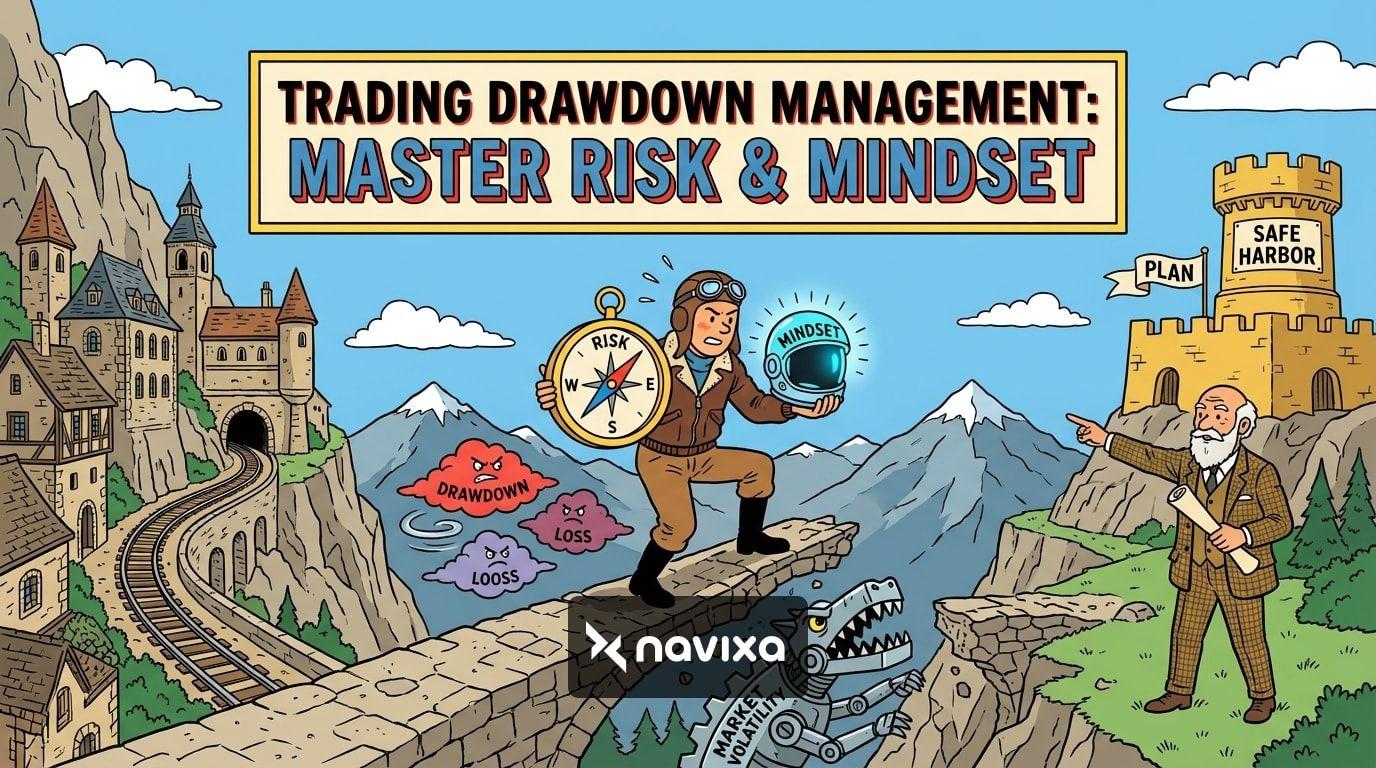
The financial markets are unforgiving, and the cryptocurrency sector is perhaps the most ruthless arena of them all. Every trader, regardless of their experience level, will eventually face a losing streak. The difference between a professional who thrives over the long term and an amateur who blows up their account lies in one critical concept: trading drawdown management.
When the market is in a euphoric bull run, risk management is often ignored in favor of chasing parabolic gains. However, when the trend reverses, the lack of a defensive strategy becomes catastrophically apparent. For example, between October 2025 and February 2026, Bitcoin plummeted from its peak of over $126,000 to lows near $63,000, wiping nearly $2 trillion off the global crypto market cap. Traders who lacked a proper drawdown protocol saw their entire portfolios decimated. Those who utilized strict trading drawdown management survived the volatility and positioned themselves to capitalize on the subsequent recovery.
In this comprehensive guide, we will explore the mathematical realities of drawdowns, the most effective strategies for protecting your capital, and the psychological discipline required to navigate the inevitable dark valleys of trading.
What is a Trading Drawdown?
In finance, a drawdown is defined as the peak-to-trough decline of an investment or trading account during a specific period. It is usually expressed as a percentage of the peak equity. If your trading account reaches a high of $100,000 and subsequently drops to $80,000 before making a new high, you have experienced a 20% drawdown.
While a 20% decline might sound manageable, the reality of recovering from drawdowns is bound by the unforgiving laws of asymmetrical mathematics. When you lose capital, you have less money available to generate the returns needed to get back to breakeven. Therefore, the percentage gain required to recover from a loss is always greater than the percentage of the loss itself.
Consider the following recovery math: * A 10% loss requires an 11.1% gain to recover. * A 20% loss requires a 25% gain to recover. * A 30% loss requires a 42.8% gain to recover. * A 50% loss requires a 100% gain to recover. * A 75% loss requires a 300% gain to recover. * A 90% loss requires a 900% gain to recover.
As the drawdown deepens, the effort required to recover grows exponentially. This mathematical reality is exactly why professional institutional analysis prioritizes the management of peak-to-trough declines as the primary indicator of a strategy's viability. If you allow a 50% drawdown, you must double your remaining account balance just to get back to zero—a feat that can force traders into taking wildly inappropriate risks, further compounding their losses.
You can learn more about the formal definitions and historical context of these metrics from resources like Investopedia's Drawdown Guide.
The Crypto Context: Why Drawdown Management is Mandatory
The cryptocurrency market presents unique challenges for trading drawdown management. Unlike traditional equities, crypto markets trade 24/7, meaning risk is ever-present. Furthermore, the baseline volatility of assets like Bitcoin and Ethereum dwarfs that of fiat currencies or blue-chip stocks.
Recent market events underscore this volatility. The early 2026 market chaos, driven by macroeconomic factors like oil-driven inflation and shifting monetary policies, created what experts called one of the most volatile periods in recent history. A trader utilizing excessive leverage without a drawdown limit during a sudden 15% intraday drop is virtually guaranteed to be liquidated.
In this environment, trading drawdown management is not just a tool for optimizing returns; it is the ultimate survival mechanism. By establishing rigid boundaries around how much capital you are willing to risk during any given day, week, or month, you insulate your portfolio from black swan events and systemic market shocks.
Core Trading Drawdown Management Strategies
Mastering your equity curve requires the implementation of systemic, rules-based strategies. Below are the most effective techniques used by professional traders and proprietary trading firms to control risk.
1. The Antimartingale Approach to Position Sizing
One of the most destructive habits of retail traders is doubling down on losing positions—a concept known as the Martingale strategy. They assume that a reversal is "due," and by doubling their position size, they can recover all their losses with a small bounce. In trending markets, this strategy leads directly to account liquidation.
Professional trading drawdown management relies on the Antimartingale approach. This strategy dictates that you should decrease your position size or risk per trade after a loss, and only increase it after a winning streak.
If your standard risk is 1% of your account per trade, and you suffer three consecutive losses, an Antimartingale approach would require you to reduce your risk to 0.5% or even 0.25% per trade. This immediately flattens your equity curve during a strategy drawdown, ensuring that prolonged losing streaks result in minor capital erosion rather than catastrophic ruin.
2. Establishing Hard Circuit Breakers
In traditional finance, stock exchanges utilize circuit breakers to halt trading when markets drop too fast. Individual traders must implement their own personal circuit breakers to protect themselves from emotional tilt.
A highly effective trading drawdown management technique is the implementation of a Daily Loss Limit (DLL) and a Maximum Drawdown Limit (MDL). Many modern proprietary trading firms enforce these rules strictly. * Daily Loss Limit (DLL): If your account drops by a specified percentage (e.g., 2% or 3%) in a single day, you must immediately close all open positions and stop trading for the next 24 hours. This prevents the classic "revenge trading" spiral where a trader tries to win back their morning losses in the afternoon. * Maximum Drawdown Limit (MDL): If your account falls by an absolute percentage from its peak (e.g., 10%), you must stop live trading entirely. At this point, you move back to a simulator or vastly reduce your position size until you can prove that your strategy is back in sync with the market.
3. Strict Stop-Loss Execution and Invalidation Points
Every trade must have a predefined invalidation point before execution. This is the exact price level where the technical thesis for the trade is proven wrong.
Effective trading drawdown management means setting a hard stop-loss at this invalidation point and never moving it further away as the price approaches. Moving a stop-loss to give the trade "more room to breathe" is a fundamental violation of risk management. If the thesis is invalidated, the trade must be cut immediately. Preserving capital for the next high-probability setup is always more important than avoiding the ego bruise of a single losing trade.
Comparing Risk Sizing Models
To fully understand the impact of your sizing choices on your overall trading drawdown management, we can compare the three most common position sizing models.
| Risk Sizing Model | Methodology | Drawdown Impact | Verdict |
|---|---|---|---|
| Fixed Fractional | Risking a set percentage (e.g., 1%) of current equity per trade. | Capital decreases proportionately. Drawdowns are slowed naturally. | Highly Recommended for consistent, stable growth. |
| Antimartingale | Halving risk after losses; increasing risk after wins. | Aggressively flattens equity curve during losing streaks. | Best for Drawdown Management and capital preservation. |
| Martingale | Doubling position size after every loss to force a breakeven. | Leads to exponential, catastrophic drawdowns. | Extremely Dangerous. Avoid at all costs. |
The Psychology of Drawdowns: Maintaining Mental Discipline
Even with the best mathematical models in place, trading drawdown management ultimately comes down to mental discipline. A drawdown tests a trader's psychological fortitude more than any other aspect of the profession.
Overcoming the Urge to Revenge Trade
When equity drops, the emotional brain perceives the loss of capital as a physical threat. The natural fight-or-flight response kicks in, prompting traders to "fight" the market by jumping into low-probability trades with oversized leverage. This is known as revenge trading.
Revenge trading is the antithesis of trading drawdown management. The most effective way to combat this psychological trap is to physically walk away from your trading desk. When a predefined loss threshold is hit, shut down your charting software. The market will still be there tomorrow.
Trusting Your Backtested Data
Every profitable trading strategy experiences periods where it falls out of sync with current market conditions. Trend-following strategies will suffer drawdowns during choppy, range-bound markets. Mean-reversion strategies will take losses during massive, unannounced breakouts. This is normal variance.
If you have rigorously backtested your strategy, you should already know its historical maximum drawdown. If your current drawdown is within the bounds of your historical data, there is no need to panic or completely overhaul your system. Trust the edge, continue executing your plan with reduced position sizes, and wait for market conditions to realign with your strategy.
For further reading on how market psychology impacts large-scale asset volatility, you can review institutional research from platforms like S&P Global.
Practical Takeaways to Implement Today
To immediately improve your trading drawdown management, integrate the following actionable steps into your daily routine:
1. Calculate Your Ruin Point: Map out exactly how many consecutive losses it would take to blow up your account at your current risk per trade. Adjust your sizing until that number is comfortably high (e.g., 50+ trades). 2. Mandate a Trading Journal: Log every single trade, including your emotional state at execution. A journal will quickly reveal if your drawdowns are caused by strategy failure or by emotional indiscipline. 3. Automate Your Defense: If you struggle with discipline, use platform tools that physically lock you out of your account once your daily loss limit is reached. 4. Separate Capital: Never keep your entire net worth on a single crypto exchange. Maintain strict separation between your long-term holding portfolio and your active trading capital to limit your overall exposure.
"The elements of good trading are: 1. Cutting losses, 2. Cutting losses, and 3. Cutting losses. If you can follow these three rules, you may have a chance." – Ed Seykota
Frequently Asked Questions
What is a normal or acceptable trading drawdown?
A "normal" drawdown depends entirely on your specific trading strategy, win rate, and risk-to-reward ratio. However, for a standard retail swing or day trading system, a maximum historical drawdown of 10% to 15% is generally considered acceptable. Institutional funds often aim to keep drawdowns in the single digits. Any strategy that consistently draws down more than 20% to 25% requires immediate reevaluation.
How long does it usually take to recover from a drawdown?
Recovery time is dictated by your strategy's positive expectancy, your trade frequency, and the depth of the drawdown. A minor 5% drawdown can often be recovered in a few successful trading sessions. A severe 20% drawdown could take weeks or even months of disciplined, systematic execution to rebuild, especially since you should be trading with reduced size during the recovery phase.
Does trading drawdown management guarantee profitability?
No. Trading drawdown management is a defensive protocol designed to protect your capital and ensure your survival in the markets. It prevents you from blowing up your account during losing streaks. However, to achieve long-term profitability, you must still pair this defensive management with an offensive trading strategy that possesses a genuine statistical edge in the market.
Should I change my strategy during a severe drawdown?
If your drawdown exceeds the maximum historical drawdown observed during your rigorous backtesting phase, your strategy may be fundamentally broken or heavily misaligned with the current market regime. In this scenario, you should stop live trading and return to paper trading to diagnose the issue. If the drawdown is well within historical norms, you should maintain the strategy but aggressively reduce your position sizing until performance improves.
Conclusion
The mark of a seasoned trader is not how much money they make during a bull market, but how little they lose during a bear market. Mastering trading drawdown management is the foundation of long-term wealth building in the cryptocurrency space. By understanding the unforgiving math of recovery, implementing strict daily loss limits, adhering to the Antimartingale sizing principles, and maintaining ironclad emotional discipline, you transition from gambling to professional speculation.
Stop viewing losses as failures and start viewing them as business expenses. Protect your capital with absolute ruthlessness, respect the volatility of the crypto markets, and ensure that a temporary setback never turns into a permanent exit. Start refining your risk parameters today, and secure your place in the markets for years to come.