
The allure of generating outsized returns in the financial markets consistently drives investors toward high-leverage instruments. While cryptocurrency traders are no strangers to wild price swings, traditional equity markets offer their own version of extreme volatility. Enter the ProShares UltraPro QQQ ETF (ticker: TQQQ). If you are looking to amplify your exposure to the technology sector, mastering a reliable TQQQ trading strategy is essential.
Leveraged exchange-traded funds (LETFs) like TQQQ are not designed for the faint of heart. They are built for short-term tactical trading rather than passive, "buy-and-hold" retirement portfolios. Without a disciplined approach, the very mechanics that make TQQQ so profitable during bull runs can quickly decimate your capital during choppy or bearish markets.
In this comprehensive guide, we will break down the mechanics of TQQQ, explain the hidden risks of volatility decay, and provide a step-by-step TQQQ trading strategy that you can implement to navigate the markets effectively.
Understanding the TQQQ ETF
Before diving into trading tactics, you must understand what you are actually trading. The ProShares UltraPro QQQ (TQQQ) is a leveraged ETF designed to deliver three times (3x) the daily performance of the Nasdaq-100 Index, before fees and expenses.
If the Nasdaq-100 (tracked by the unleveraged QQQ ETF) goes up 1% in a single day, TQQQ is engineered to go up approximately 3%. Conversely, if the Nasdaq-100 falls by 1%, TQQQ will drop by roughly 3%.
As of early 2026, TQQQ remains a behemoth in the leveraged ETF space, boasting over $25 billion in Assets Under Management (AUM) and an expense ratio of 0.97%. Its underlying index is heavily weighted toward mega-cap technology and growth companies, including giants like Apple, Microsoft, NVIDIA, and Amazon. Because of this concentration, TQQQ offers pure, unadulterated exposure to the tech sector's momentum.
Why Cryptocurrency Traders are Drawn to TQQQ
Interestingly, the extreme volatility of TQQQ makes it highly appealing to cryptocurrency traders. In the crypto space, daily moves of 5% to 10% are standard. Traditional stock market indices rarely move with such velocity. However, by applying a 3x multiplier to the Nasdaq-100, TQQQ frequently experiences daily swings that rival major altcoins. For crypto veterans who are already accustomed to managing deep drawdowns and utilizing strict momentum-based indicators, adapting to a TQQQ trading strategy feels incredibly natural. The principles of liquidity, rapid execution, and technical analysis translate perfectly from crypto exchanges to traditional brokerage accounts.
The Danger of Volatility Decay (Beta Slippage)
The most critical concept any trader must grasp before executing a TQQQ trading strategy is "volatility decay," also known as beta slippage or the math of daily rebalancing.
TQQQ resets its leverage at the end of *every single trading day*. This daily reset means that over periods longer than one day, the fund's returns can deviate significantly from the 3x target of the underlying index.
Consider the market conditions in early 2026. The Nasdaq-100 experienced a choppy, downward-trending start to the year. By late March 2026, the unleveraged QQQ ETF was down approximately 4.3% year-to-date, while TQQQ plummeted by over 15%. Because of the daily rebalancing and volatility drag in a choppy market, TQQQ did not just drop 12.9% (which would be exactly 3x).
The math becomes even more brutal during prolonged bear markets. During the 2022 tech sell-off, the Nasdaq-100 fell roughly 35.6%, and TQQQ was wiped out by 81.7%. When an asset drops by 80%, it requires a 400% gain just to break even. Therefore, a successful TQQQ trading strategy must explicitly prioritize capital preservation and strict exit rules over blind holding.
Core TQQQ Trading Strategies
To trade TQQQ successfully, you must abandon the "diamond hands" mentality often popularized in crypto communities. Instead, you need a systematic, rules-based approach. Here are three proven frameworks for trading this leveraged asset.
1. The Moving Average Trend-Following Strategy
One of the most popular and historically resilient ways to trade TQQQ is by using a long-term moving average on the *underlying QQQ index* as a risk-on/risk-off toggle.
Because TQQQ is so heavily impacted by volatility decay, you only want to hold it when the broader market is in a confirmed uptrend.
The Rules: * The Indicator: Plot a 161-day or 200-day Simple Moving Average (SMA) on the daily chart of QQQ (not TQQQ). Some traders prefer the 161-day MA, as backtests have shown it reduces false signals (whipsaws) compared to the traditional 200-day MA. * Entry Signal: When the price of QQQ closes consistently above the moving average, the market is in a macro uptrend. This is your "risk-on" signal to buy TQQQ. * Exit Signal: When the price of QQQ crosses and closes below the moving average, the uptrend is broken. You immediately sell all TQQQ positions and rotate your capital into cash or short-term treasury ETFs (like SGOV) to protect against bear market wipeouts.
This strategy will not catch the absolute bottom or sell at the exact top, but it prevents you from holding a 3x leveraged ETF during a devastating 80% drawdown.
2. Swing Trading with Momentum Oscillators
If you prefer shorter holding periods (days to weeks), swing trading TQQQ using momentum indicators like the Relative Strength Index (RSI) and the MACD (Moving Average Convergence Divergence) can be highly effective.
The Rules: * Timeframe: Daily or 4-hour charts. * The Setup: Wait for the QQQ to experience a short-term pullback within a broader macro uptrend. * Entry: Look for the daily RSI on QQQ to dip below 30 (oversold) and then cross back above it. Combine this with a bullish MACD crossover. * Exit: Because TQQQ amplifies gains, you don't need to wait long to hit profitability. Take partial profits at 10% to 15% gains, and trail your stop-loss for the remainder of the position. If the RSI approaches 70 (overbought), exit the trade entirely.
3. Tactical Dollar-Cost Averaging (DCA) with a Cash Buffer
For investors who insist on a longer-term accumulation strategy, a modified Dollar-Cost Averaging (DCA) approach can work, provided it includes a heavy cash buffer to buy extreme dips.
Instead of buying blindly every month, a tactical DCA approach involves holding a significant portion of your portfolio in cash or broad-market unleveraged ETFs (like the S&P 500). When the Nasdaq-100 corrects by specific thresholds (e.g., -5%, -10%, -15%), you deploy predefined tranches of capital into TQQQ.
*Caution:* If the market enters a confirmed bear market (a drop greater than 20%), you halt all TQQQ purchases until a macro reversal is confirmed. This prevents you from catching a falling knife when the leverage decay is at its worst.
Step-by-Step Guide to Executing Your Strategy
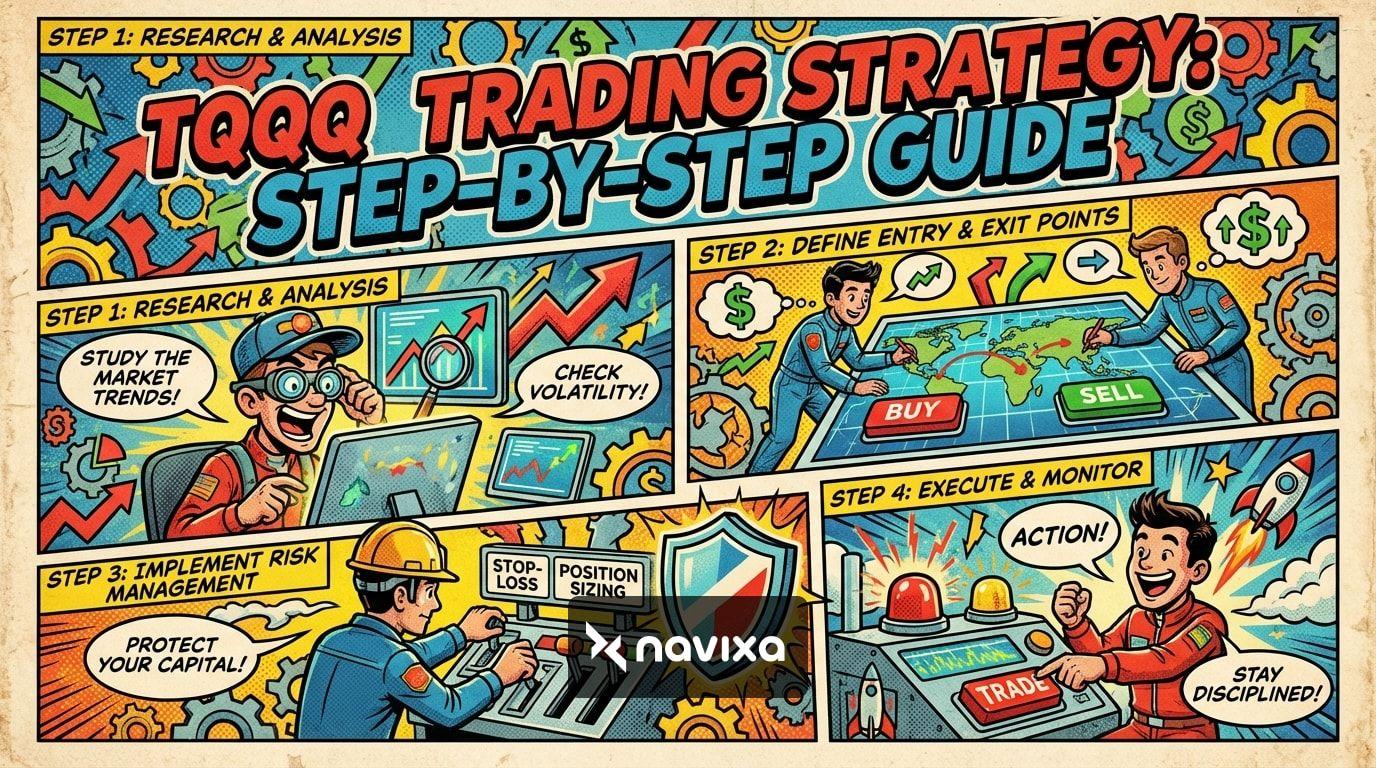
Ready to put theory into practice? Follow these actionable steps to set up your TQQQ trading strategy today.
Step 1: Analyze the Underlying Index (QQQ)
Never perform your primary technical analysis on the TQQQ chart itself. Because of the daily price resets, TQQQ's historical chart is distorted over long periods. Always draw your trendlines, support/resistance levels, and moving averages on the unleveraged Nasdaq-100 tracking QQQ ETF. When QQQ hits a key support level, you execute your buy order on TQQQ. You can use charting platforms to overlay the moving averages and momentum oscillators directly onto the QQQ chart while keeping a separate execution window open for your TQQQ trades.
Step 2: Define Your Position Sizing
Leverage is a double-edged sword. A common rule of thumb is that a 3x leveraged ETF should occupy no more than 5% to 10% of your total trading portfolio.
If you are using TQQQ to boost overall portfolio returns, treat it as a satellite holding rather than your core foundation. Over-allocating to a leveraged asset can lead to emotional decision-making and catastrophic account wipeouts during unexpected market crashes.
Step 3: Implement Hard Stop-Losses
Mental stops do not work when trading leveraged assets. The market can gap down overnight, and a 2% drop in the Nasdaq will instantly translate to a 6% loss in your account. Set automated stop-loss orders. For trend-following strategies, this might be a daily close below your chosen moving average. For swing trades, placing a stop-loss 1% below the recent swing low on QQQ will keep your risk defined.
Step 4: Monitor Macroeconomic Triggers
TQQQ is hypersensitive to macroeconomic data. Because the Nasdaq-100 is dominated by growth stocks, it is extremely vulnerable to rising interest rates. Keep a close eye on the 10-year Treasury yield and the CBOE Volatility Index (VIX). If the VIX spikes above 25 or treasury yields surge, volatility decay will accelerate, making it a terrible time to hold TQQQ. If inflation data surprises the market, tech stocks usually take the brunt of the sell-off. Because TQQQ is essentially a concentrated bet on the future earnings of tech giants, you must respect the macroeconomic environment.
TQQQ vs. QQQ: A Quick Comparison
To further illustrate why your strategy must be tailored specifically to leveraged ETFs, let us compare TQQQ directly with its unleveraged counterpart, QQQ.
| Feature | QQQ (Invesco QQQ Trust) | TQQQ (ProShares UltraPro QQQ) |
|---|---|---|
| Leverage | 1x (Unleveraged) | 3x Daily Target |
| Expense Ratio | 0.20% | 0.97% |
| Ideal Holding Period | Years to Decades | Days to Months |
| Market Condition | All Markets | Strong Bull Markets |
| Volatility Drag | None | Extremely High |
| Risk of Wipeout | Very Low | High (in prolonged bear markets) |
Practical Takeaways and Risk Management
To summarize the core tenets of a successful TQQQ trading strategy, keep the following rules etched into your trading plan:
1. Do not marry the asset: TQQQ is a trading vehicle, not a long-term investment. The daily rebalancing mechanism guarantees that sideways markets will slowly bleed your capital dry. 2. Cash is a position: If the market is choppy or trending downward, the best trade is often no trade. Sitting in cash or a 5% yielding Treasury ETF is vastly superior to losing 15% to volatility decay. 3. Take profits aggressively: Because TQQQ moves so fast, a 20% gain can materialize in a matter of days. Do not get greedy. Scale out of your winning positions into strength. 4. Emotions are the enemy: Fear and greed are amplified when your P&L is moving three times faster than normal. A rules-based system (like moving average crossovers) removes the need for predictive guesswork and minimizes emotional trading.
Conclusion
Developing a profitable TQQQ trading strategy requires a fundamental shift in how you view the market. You cannot afford to be a passive observer when utilizing 3x daily leverage. Whether you choose a moving average trend-following system, a momentum-based swing trading setup, or a tactical dip-buying approach, the key to surviving and thriving is strict risk management.
By analyzing the underlying QQQ index, respecting the destructive power of volatility decay, and executing your entry and exit rules without hesitation, you can harness the incredible compounding power of TQQQ while protecting yourself against catastrophic drawdowns. Take the time to backtest your chosen rules, start with small position sizes, and trade with unshakeable discipline.
Frequently Asked Questions
Can I hold TQQQ long-term?
While some investors do hold TQQQ for years, it is highly discouraged unless paired with a strict risk-management system. Due to daily rebalancing, sideways or declining markets cause "volatility decay," which can erode the fund's value significantly over time, even if the underlying index eventually recovers.
What is the best technical indicator for trading TQQQ?
Many successful traders rely on long-term Simple Moving Averages (like the 161-day or 200-day SMA) applied to the unleveraged QQQ chart. This helps identify macro market trends and keeps you out of the market during prolonged, devastating downtrends.
Why is TQQQ down more than 3x the Nasdaq in certain periods?
This is due to the mathematics of daily compounding and beta slippage. In a choppy market where prices swing up and down daily, the fund constantly rebalances its exposure. This friction, combined with high expense ratios, causes the leveraged ETF to underperform its exact 3x mandate over longer periods.
Should I buy the dip on TQQQ during a bear market?
Buying the dip in a confirmed bear market with a 3x leveraged ETF is extremely dangerous. Because TQQQ can suffer 80% to 90% drawdowns during severe recessions, you risk catching a falling knife. It is safer to wait for the broader market to establish a confirmed uptrend before deploying capital into leveraged funds.