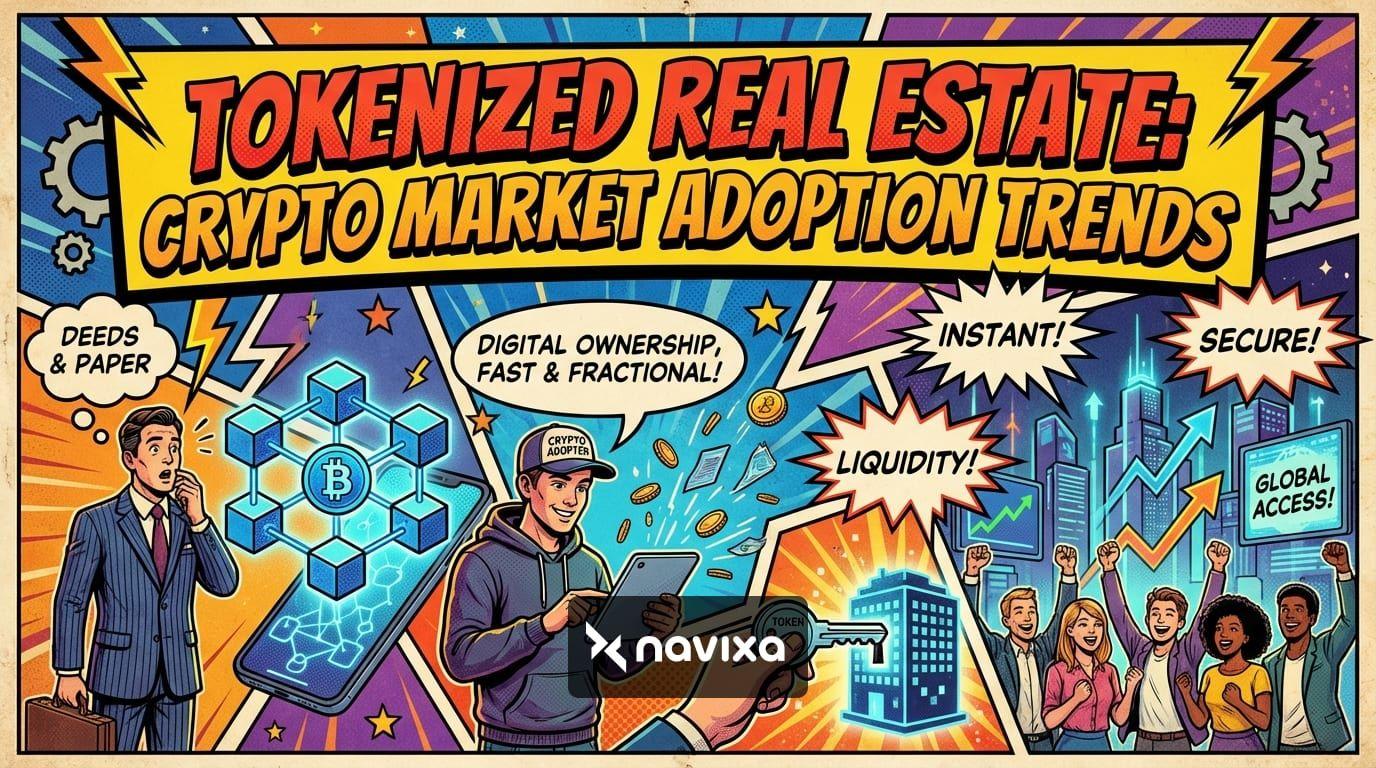
The convergence of traditional finance and blockchain technology has birthed one of the most transformative investment sectors of our era: tokenized real estate. Real estate has long been the world's premier asset class, prized for its stability, inflation-hedging properties, and reliable cash-flow generation. However, it is also notoriously illiquid, burdened by massive capital barriers, rent-seeking intermediaries, and sluggish settlement times. Enter blockchain technology, which is systematically dismantling these legacy hurdles. What began as an experimental niche in decentralized finance (DeFi) has rapidly evolved into a multi-billion-dollar cornerstone of the broader Real-World Asset (RWA) revolution.
The Macro Transformation of Property Markets
To understand the current crypto market adoption trends, investors must first recognize the sheer scale of the disruption happening under the surface of the global economy. According to specialized market statistics, the total value of tokenized real-world assets—heavily anchored by real estate and private credit—exceeded $24 billion globally in 2025. Looking forward, consulting giant Deloitte projects that the volume of tokenized real estate could approach a staggering $4 trillion by 2035, reflecting an estimated compound annual growth rate (CAGR) of 27%.
This explosive growth is not occurring in a vacuum. The global Commercial Real Estate (CRE) sector is currently facing a massive, looming refinancing wall, with hundreds of billions in loans maturing through the 2026–2029 period amidst tighter bank lending standards and elevated interest rates. Tokenization offers an elegant, programmatic mechanism to source global liquidity, allowing property owners to fractionalize equity or debt structures and offer them directly to a worldwide base of yield-hungry investors on-chain.
Tokenized Real Estate: Core Crypto Market Adoption Trends
Regulatory Clarity Unlocking Institutional Capital
For years, regulatory ambiguity and compliance fears kept institutional capital securely on the sidelines. However, a sweeping legislative shift between 2024 and 2026 has established the vital "rules of the road" for digital assets. In Europe, the implementation of the Markets in Crypto-Assets (MiCA) framework alongside the EU DLT Pilot Regime has created a robust, legally compliant playbook for digital securities issuance, secondary trading, and custody.
Meanwhile, in the United States, the passage of the GENIUS Act in 2025 stabilized the stablecoin infrastructure critical for seamless on-chain dividend payouts, while the highly anticipated Clarity Act of 2026 has provided much-needed definitive guidance distinguishing digital commodities from securities. This trans-Atlantic alignment has fundamentally de-risked the tokenization sector, signaling to legacy institutions that the ecosystem is finally safe for deployment.
Multi-Chain Interoperability and Scalability
By early 2026, the technology underpinning real estate tokenization has matured far beyond early-stage experimentation. More than 60% of new tokenization platforms are now specifically architected for multi-chain interoperability. While the Ethereum network remains the undisputed global leader for overall institutional liquidity, holding billions in real asset value, its high gas fees during network congestion make it highly impractical for retail investors purchasing fractional property shares.
Consequently, Layer-2 scaling solutions like Polygon have become the go-to digital infrastructure for retail-focused real estate platforms, enabling high-frequency token transactions that cost mere fractions of a cent. Simultaneously, enterprise-grade Layer-1 blockchains like Avalanche are dominating complex institutional infrastructure plays. A prime example occurred when Bergen County, New Jersey, migrated 370,000 property deeds—worth a collective $240 billion—onto the Avalanche network, slashing archaic deed settlement times from up to 90 days down to just a single day.
The Shift from Issuance to On-Chain Productivity
Perhaps the most crucial paradigm shift in the 2026 tokenized asset landscape is the pivot from mere digital token issuance to deep DeFi composability. A landmark market survey conducted by Centrifuge in early 2026 revealed that an overwhelming 86% of infrastructure operators believe scaling distribution and market liquidity matters far more than simply launching new tokenized real estate products.
"Tokenization is step one: it opens the door. Making those assets productive on-chain is step two, where the real value gets unlocked."
Modern crypto investors no longer want to just passively hold a digital property token in cold storage; they want to utilize that tokenized real estate as prime collateral in decentralized lending protocols. This allows for the creation of structured financial strategies where the physical property acts as an active financial instrument rather than just a slow-moving asset generating passive rental yield.
Leading Platforms Revolutionizing Tokenized Real Estate
As the total addressable market expands rapidly, several key platforms are carving out distinct competitive advantages in the tokenized property space:
- Zoniqx: This Silicon Valley-based fintech leader has become a powerhouse in Tokenized Asset Lifecycle Management (TALM). Emphasizing scalable, AI-driven compliance and dynamic smart contracts, Zoniqx has set aggressive targets to capture a 10% share of the $500 billion tokenized commercial real estate market by 2026, heavily leveraging its robust multi-chain expansions. - Centrifuge: Operating at the precise intersection of traditional high finance and decentralized protocols, Centrifuge allows real estate asset originators to convert properties into NFTs used as collateral for DeFi liquidity. In March 2026, Centrifuge captured intense institutional spotlight, surging over 60% in price across a single day and exhibiting a massive volume-to-market-cap ratio of 1.53x—a rare metric that historically indicates severe institutional OTC accumulation rather than thin, retail-driven speculation. - RealT: Focused primarily on the democratization of residential properties, RealT allows global retail investors to purchase fractional shares of US-based real estate for as little as $50. The platform automates daily rental payouts via digital stablecoins directly to users' non-custodial crypto wallets, making property ownership as frictionless as buying a standard cryptocurrency.
Comparing Traditional and Tokenized Real Estate
Understanding the core advantages of the digital approach requires a direct comparison. Here is how legacy real estate investment stacks up against the modernized tokenized framework:
| Feature | Traditional Real Estate | Tokenized Real Estate |
|---|---|---|
| Barrier to Entry | Extremely High (tens to hundreds of thousands of dollars) | Extremely Low (often $25 to $50 for fractional shares) |
| Liquidity Constraints | Highly illiquid (property sales often take 30-180 days) | Highly liquid (24/7 secondary market trading on digital exchanges) |
| Settlement Time | 30 to 90 days involving heavy legal paperwork | Instant or under 24 hours executed autonomously via smart contracts |
| Transaction Costs | High (brokerages, legal fees, title insurance, and registries) | Low (often a fraction of a cent on efficient Layer-2 networks) |
| Global Accessibility | Geographically restricted and heavily siloed by local laws | Universally accessible (subject to streamlined, digital KYC/AML checks) |
Actionable Trading and Investment Strategies
The advent of tokenized real estate requires modern investors to rethink their traditional portfolio construction. Here are several actionable strategies for capitalizing on this macro trend:
1. Diversifying with Fractional Property Portfolios
Instead of locking vast amounts of illiquid capital into a single physical property, investors can use tokenized real estate platforms to build highly diversified, global property portfolios. A modern trader can simultaneously hold fractional shares of a commercial skyscraper in Dubai, a residential duplex in Ohio, and an industrial logistics center in Europe. This intense geographic and sector diversification dramatically lowers a portfolio's exposure to localized economic downturns or regional housing market crashes.
2. Yield Farming and DeFi Composability
Tokenized properties are increasingly acting as the base layer collateral for decentralized finance. Advanced crypto investors can deposit their income-producing real estate tokens into decentralized lending protocols to borrow stablecoins. Those stablecoins can then be deployed into higher-yielding DeFi liquidity pools, effectively allowing the investor to earn a compound double yield—collecting the underlying property rent while simultaneously farming variable crypto rewards.
3. Investing in RWA Infrastructure Tokens
For traders who prefer a higher beta investment and do not wish to buy the physical property tokens directly, investing in the infrastructure protocols powering the ecosystem presents an asymmetric growth opportunity. As more Total Value Locked (TVL) flows onto networks like Avalanche, Polygon, or Centrifuge, the utility, network fees, and structural demand for their underlying native governance tokens historically increases in tandem.
Risk Management and Technical Analysis in RWAs
As with any fast-moving cryptocurrency sector, the tokenized real estate space is not without its inherent risks. Prudent risk management and specialized technical analysis are absolutely essential.
Navigating Smart Contract and Oracle Risks
While blockchain technology beautifully mitigates traditional intermediary risks, it introduces unique technological vulnerabilities. A critical flaw in the smart contract code managing a tokenized property's rental distribution or ownership registry could theoretically lead to a permanent loss of funds. Furthermore, properties tokenized as collateral in DeFi rely on decentralized "oracles" to feed real-world property valuations on-chain. If an oracle is manipulated or fails to update accurately during a market crash, it could trigger unwarranted liquidations in algorithmic lending markets.
Analyzing On-Chain RWA Metrics
Trading tokenized real estate governance or infrastructure tokens requires a completely different analytical framework than trading volatile meme coins or standard Layer-1 protocols. Analysts must look closely at deep metrics like Represented Asset Value, Monthly Active Addresses, and the velocity of asset transfers. Massive volume spikes relative to market capitalization in mid-cap RWA protocols often signal genuine institutional OTC accumulation. Tracking these specific on-chain metrics allows intelligent traders to separate long-term fundamental adoption from fleeting retail hype.
Practical Takeaways for Investors
- Start Small and Scale: Utilize platforms offering low-minimum investments to intimately familiarize yourself with how smart contracts handle ownership transfers and on-chain dividend distributions before allocating major capital. - Prioritize Stringent Compliance: Only allocate capital to asset tokenization platforms that enforce strict Know Your Customer (KYC) and Anti-Money Laundering (AML) standards. Tight regulatory alignment ensures your digital assets will not be frozen by sudden government interventions. - Monitor Layer-2 Ecosystems: Keep an active eye on networks like Polygon, Base, and Avalanche, which are rapidly capturing the lion's share of high-velocity tokenized real estate transaction volume. - Understand Tax Implications: Realize that rental yields paid out in stablecoins or crypto are considered taxable events in most jurisdictions globally. Maintain meticulous on-chain transaction records for year-end reporting purposes.
Conclusion
Tokenized real estate has officially evolved from a theoretical blockchain use case into a functional cornerstone of the modernized global financial system. Driven by critical regulatory breakthroughs in 2025 and 2026, the convergence of deep institutional capital with decentralized infrastructure is creating unprecedented financial opportunities. By drastically lowering the barrier to entry, enabling continuous 24/7 global liquidity, and integrating physical properties into the borderless realm of DeFi, tokenization is truly democratizing an asset class historically reserved for the ultra-wealthy. As platforms continue to prioritize composability, secondary distribution, and cross-chain functionality, early investors who master the intersection of real-world assets and on-chain mechanics stand to reap significant generational rewards.
Frequently Asked Questions
What is tokenized real estate?
Tokenized real estate involves converting the economic rights, equity, or debt of a physical property into digital tokens issued on a secure blockchain. Each token represents a fractional share of the underlying asset, allowing multiple investors to co-own a property transparently, securely, and with drastically reduced intermediary friction.
How do I earn returns from tokenized property?
Investors typically earn returns in two distinct ways: through proportional rental income distributed automatically to their crypto wallets (often paid in stablecoins like USDC) and through the capital appreciation of the digital token's value if the underlying physical property increases in local market value.
Is investing in tokenized real estate legal and regulated?
Yes, but the exact regulatory framework heavily depends on your specific jurisdiction. Recent major frameworks like the EU's MiCA and the US Clarity Act have established distinct, legal rails for these digital assets. Reputable global platforms require stringent KYC/AML verification and issue tokens strictly as compliant digital securities under relevant national financial laws.
Can I sell my real estate tokens instantly?
While tokenization significantly enhances secondary liquidity compared to traditional real estate, instant sales depend entirely on secondary market demand. Robust platforms offer 24/7 automated market makers (AMMs) or decentralized exchange (DEX) liquidity pools to facilitate rapid peer-to-peer trading, reducing settlement times from months to mere seconds.
Which blockchains are most popular for property tokenization?
The Ethereum mainnet remains the gold standard for high-value institutional real estate assets due to its unparalleled security, battle-tested history, and deep liquidity. However, due to periodic gas fee constraints, Layer-2 scaling solutions like Polygon and enterprise-focused networks like Avalanche have become incredibly popular for retail platforms and massive civic registry migrations.