
The convergence of traditional finance (TradFi) and decentralized finance (DeFi) has sparked a global financial revolution, redefining how we access and trade macroeconomic assets. At the forefront of this evolution are tokenized commodities, a massive leap forward that enables investors to trade real-world physical goods on blockchain networks. Among these diverse assets, crude oil stands out as one of the most liquid, volatile, and globally impactful markets.
Trading tokenized crude oil in DeFi allows crypto-native investors and traditional macro traders alike to capitalize on global supply chain trends without relying on legacy brokers. With the ability to trade 24/7, deploy self-custodial capital, and leverage highly efficient synthetic assets, the barriers to entry have been permanently dismantled.
This comprehensive guide breaks down the underlying mechanisms of tokenized commodities, highlights core trading strategies specifically for crude oil, explores actionable steps for market entry, and provides essential risk management frameworks to successfully navigate this high-stakes ecosystem.
The Evolution of Tokenized Commodities
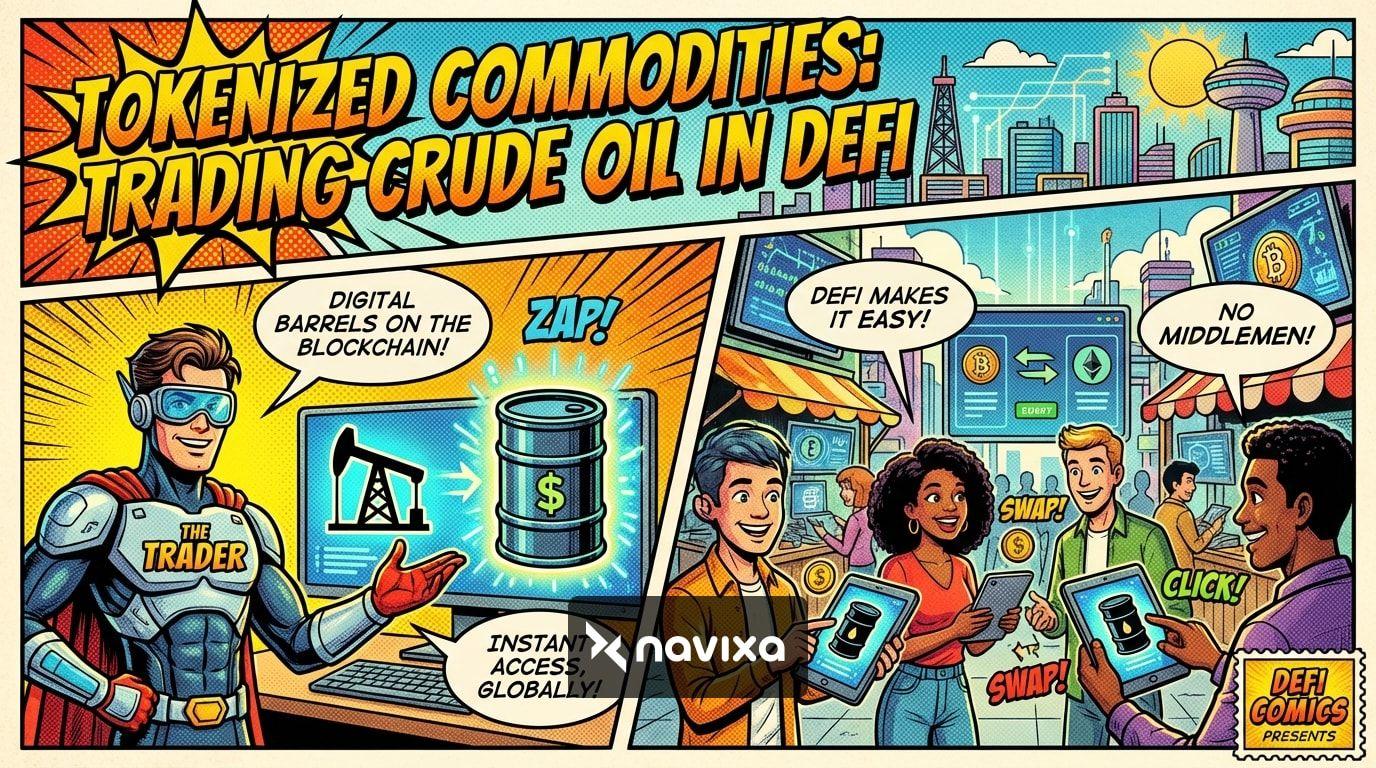
For decades, accessing the global crude oil market required dealing with complex futures contracts on centralized exchanges, navigating high capital requirements, and strictly adhering to rigid trading hours. Tokenized commodities have completely flipped this antiquated model. By leveraging self-executing smart contracts and robust blockchain oracles, DeFi platforms now offer synthetic representations or directly backed tokens of physical commodities like West Texas Intermediate (WTI) and Brent crude oil.
Why Crude Oil is Thriving in DeFi
The crude oil market is heavily driven by rapid geopolitical events, supply chain disruptions, and global macroeconomic data releases. In traditional markets, if news of a major supply disruption breaks over the weekend, traders are locked out of their brokerages until legacy markets open on Monday. This delay often results in massive, unmanageable price gaps that can devastate a portfolio.
Tokenized crude oil on decentralized platforms operates continuously. This uninterrupted market allows traders to react instantly to breaking news, providing a massive advantage over TradFi counterparts. Recently, this unique capability was highlighted when weekend geopolitical tensions drove over $1.2 billion in daily volume for decentralized crude oil perpetuals, effectively making oil one of the most traded assets in the DeFi landscape.
The Technological Backbone: How Tokenization Works
To fully appreciate the disruptive nature of tokenized commodities, traders must understand the underlying technology powering these next-generation financial assets. The seamless integration of real-world assets into decentralized finance relies on three critical components:
1. Blockchain Oracles
Oracles act as the vital bridge between the off-chain physical world and the on-chain digital environment. Because blockchains are isolated networks, they cannot inherently detect the spot price of traditional assets. Oracle networks like Chainlink fetch price data from multiple traditional financial institutions, aggregate it to prevent market manipulation, and feed it into the decentralized exchange's smart contracts in real-time. This ensures the tokenized asset mirrors the exact price movements of the legacy market.
2. Smart Contracts and Synthetic Assets
While some tokenized commodities are backed one-to-one by physical assets stored in a secure vault, tokenized crude oil largely operates through synthetic assets and perpetual swaps. Smart contracts automatically execute trades, calculate funding rates, and manage collateral health without requiring a centralized human clearinghouse. These self-executing contracts allow traders to take long or short positions utilizing stablecoins as margin, bypassing the logistical nightmare of storing physical barrels of oil.
3. Layer 2 Scaling Solutions
Historically, high transaction fees on foundational networks made high-frequency commodity trading impossible. The emergence of Layer 2 solutions and dedicated application-specific blockchains has completely solved this issue. These networks process thousands of transactions per second at a fraction of a cent, allowing DeFi platforms to offer sub-second execution speeds that rival traditional centralized exchanges.
Top Trading Strategies for Tokenized Crude Oil
Trading crude oil on-chain requires a unique blend of traditional commodity market knowledge and an intimate understanding of decentralized exchange mechanics.
Macro Hedging and Geopolitical Arbitrage
Crude oil is the lifeblood of the global economy, meaning its price is extremely sensitive to global events.
* Supply-Side Shocks: Traders must aggressively monitor production quotas, geopolitical conflicts in oil-rich regions, and infrastructure disruptions. In a tokenized environment, you can instantly execute long positions via perpetual swaps when a supply shock occurs, without waiting for the Monday open. * Weekend Arbitrage: Because tokenized commodity markets remain open while TradFi markets close, astute traders can predict how the legacy markets will react upon opening. By taking calculated positions on-chain over the weekend, traders can capitalize on the arbitrage premium once legacy prices sync with the 24/7 DeFi order books.
Technical Analysis in DeFi Markets
While macro drivers dictate long-term trends, technical analysis (TA) remains vital for timing precise entries and exits in tokenized markets.
* Funding Rates: When trading tokenized perpetuals, funding rates become a crucial, real-time indicator. A consistently high positive funding rate indicates aggressive long positioning in the market. Contrarian traders often use extreme funding rates to anticipate price reversals or potential short-squeezes. * Volume Profiles: Because DeFi platforms operate on transparent, public ledgers, traders can analyze on-chain volume profiles far more accurately than in TradFi. A sudden surge in stablecoin deposits to an exchange's smart contract often precedes high-volatility price moves.
"The opening of the 24/7 commodity trading window has shifted the narrative. Traders are increasingly utilizing decentralized infrastructure for price discovery and macro hedging when Wall Street is closed."
Yield Farming and Liquidity Provision
Unlike traditional markets where market-making is exclusively reserved for large financial institutions, DeFi allows retail users to act as the liquidity provider. By providing stablecoin liquidity to tokenized crude oil pools, traders can earn a lucrative share of the trading fees generated by the platform. If volume spikes during a macroeconomic event, the fees accrued by liquidity providers can generate substantial annual percentage yields.
Traditional Crude Oil vs. Tokenized Crude Oil
To fully grasp the massive advantages of DeFi commodities, it helps to compare them side-by-side with their traditional finance equivalents.
| Feature | Traditional Crude Oil (TradFi) | Tokenized Crude Oil (DeFi) |
|---|---|---|
| Trading Hours | 5 Days a week, closed weekends | 24/7/365 continuous trading |
| Asset Custody | Held by centralized brokerages | Self-custodial via Web3 crypto wallets |
| Minimum Capital | Extremely high (Large contract sizes) | Low (Fractionalization allows micro-trades) |
| Settlement Speed | T+1 or T+2 business days | Instant, verifiable on-chain settlement |
| Market Transparency | Opaque, delayed institutional reporting | 100% visible on public blockchain ledgers |
Actionable Steps to Start Trading
Entering the world of tokenized crude oil is vastly different from opening a standard brokerage account. Here is a definitive step-by-step framework to get started securely.
1. Secure a Self-Custodial Wallet
To interact with decentralized platforms, you need a highly secure self-custodial Web3 wallet. Ensure that you safely back up your seed phrase offline, as you are solely responsible for the protection of your funds.
2. Fund Your Wallet with Stablecoins
Most decentralized commodity exchanges denominate their trading pairs in stablecoins. USDC is the universally accepted industry standard for perpetual swaps. You will need to acquire USDC and transfer it to your Web3 wallet via a low-cost scaling network.
3. Choose the Right Decentralized Exchange
Not all decentralized exchanges offer real-world assets. You need to identify a robust platform that specifically supports tokenized commodities. Protocols like Ostium Labs natively specialize in traditional assets (commodities, FX) using highly optimized oracle infrastructures. Alternatively, high-performance perpetual platforms like Hyperliquid offer massive liquidity for tokenized crude oil markets.
4. Execute and Monitor
Once connected to the exchange, select the tokenized crude oil trading pair. Decide your directional bias, select your leverage cautiously, and execute the trade. You must continuously monitor your margin health via the platform's decentralized dashboard to prevent liquidations.
Risk Management in Tokenized Commodities
While the upside of trading tokenized crude oil is immense, the inherent risks are equally severe. The dangerous combination of raw commodity volatility and cryptocurrency leverage can be completely unforgiving.
Strict Leverage Control
DeFi platforms frequently offer massive leverage on tokenized assets. High leverage drastically tightens your liquidation threshold. A standard best practice is to strictly cap leverage at a low multiple for volatile commodities, ensuring that intraday market noise does not maliciously wipe out your trading position.
Understanding Oracle Latency
Unlike centralized exchanges where trades match internal order books, decentralized platforms rely on external oracles to feed prices on-chain. During moments of extreme global volatility, slight oracle delays or price discrepancies can occur. Professional traders must deeply understand how their chosen platform aggregates price data and handles liquidations during potential oracle latency.
Smart Contract Vulnerabilities
Whenever you interact with a decentralized protocol, you face smart contract risk. Even heavily audited, institutional-grade protocols can harbor undiscovered vulnerabilities. To actively mitigate this risk, never allocate your entire trading portfolio to a single platform. Diversify your capital across multiple reputable decentralized exchanges and always keep your excess capital in offline cold storage.
Practical Takeaways
* Embrace 24/7 Markets: Actively use the continuous trading capabilities of DeFi to front-run traditional markets during breaking geopolitical news cycles over the weekend. * Monitor On-Chain Funding Rates: Decentralized funding rates are a phenomenal real-time sentiment gauge. Use them strictly to manage your trade carry costs and accurately spot potential market reversals. * Prioritize Protocol Security: Only deposit capital onto platforms with proven liquidity, highly transparent oracle mechanisms, and comprehensive, publicly verifiable smart contract audits.
Conclusion
The active tokenization of commodities represents a monumental paradigm shift in how global macroeconomic markets operate. By bringing crude oil directly into the DeFi ecosystem, innovative blockchain technology has successfully democratized access, erased archaic trading hours, and empowered traders with absolute self-custodial control. Whether you are actively macro-hedging a massive digital asset portfolio or executing precision day trades based on technical analysis, tokenized crude oil offers an unparalleled new frontier of financial opportunity.
As the historical lines between traditional finance and decentralized finance continue to blur rapidly, the traders who seamlessly adapt to these on-chain mechanisms will secure a definitive market edge. Take the time to explore decentralized perpetual markets, master your critical risk management, and take uncompromising control of your trading future in the newly tokenized economy.
Frequently Asked Questions
What are tokenized commodities?
Tokenized commodities are digital representations of real-world physical goods, such as gold, silver, or crude oil, securely recorded on a blockchain network. They empower traders to gain direct price exposure to these assets via smart contracts, offering massive benefits like 24/7 trading, fractional asset ownership, and instant settlement without requiring legacy brokers.
How is tokenized crude oil priced in DeFi?
Decentralized platforms utilize sophisticated blockchain oracles—secure data feeds—to aggregate real-time price data directly from traditional legacy commodity markets. This accurate data is constantly fed to the smart contracts, ensuring the tokenized digital asset reliably mirrors the real-world futures price.
Do I actually own physical barrels of oil when trading tokenized crude oil?
In the vast majority of DeFi applications focusing on perpetual swaps or synthetic assets, you do not own the physical oil. Instead, you are actively trading digital contracts that purely track the real-time price of crude oil. While some specialized real-world asset platforms offer physical redemption for assets like gold, this remains logistically impractical and exceedingly rare for crude oil.
What happens if the traditional oil market closes for the weekend?
This remains one of the greatest strategic advantages of tokenized commodities. While traditional legacy markets heavily halt trading over the weekend, decentralized exchanges remain fully open 24/7. The live price of the tokenized asset during these times is dynamically driven by on-chain supply and demand, allowing traders to seamlessly react to weekend geopolitical news before legacy markets gap open on Monday.
Is trading tokenized commodities completely safe?
Trading tokenized commodities carries distinct market and technical risks. While blockchain architecture offers immense transparency and self-custodial ownership, users remain highly exposed to raw price volatility, potential oracle manipulation, and unforeseen smart contract vulnerabilities. Strict, calculated risk management and thorough platform research remain absolutely essential.