
Introduction
Tesla, Inc. (TSLA) is widely recognized as one of the most volatile and heavily traded large-cap equities in the global financial markets. Between groundbreaking advancements in artificial intelligence, robotics, and energy storage, the company's valuation often swings dramatically based on news catalysts and market sentiment. For traders and investors alike, relying solely on fundamental data is rarely enough. This is where Tesla stock technical analysis becomes an indispensable tool.
By studying historical price action, trading volumes, and momentum indicators, market participants can identify actionable chart patterns that dictate future price movements. Whether TSLA is breaking out toward all-time highs or consolidating in a descending channel, mastering these technical setups allows traders to manage risk effectively and pinpoint high-probability entry and exit zones.
In this comprehensive guide, we will break down the essential components of Tesla stock technical analysis, explore the most reliable chart patterns, and provide actionable strategies to help you navigate TSLA's legendary price swings.
The Market Psychology Behind Tesla's Volatility
Before diving into specific chart patterns, it is crucial to understand the unique market psychology that drives TSLA's price action. Unlike traditional legacy automakers, Tesla trades more like a high-growth technology stock. Its price movements are heavily influenced by retail investor enthusiasm, institutional positioning, and broader macroeconomic factors such as bond yields and currency fluctuations.
High Beta and Sentiment-Driven Swings
Tesla is a "high-beta" stock, meaning it tends to move more aggressively than the broader market indices like the S&P 500 or the Nasdaq Composite. When the broader market rallies, Tesla often outpaces the indices; conversely, when fear dominates the market, TSLA can experience accelerated sell-offs.
Recent market conditions—such as shifts in Federal Reserve interest rate policies and fluctuating electric vehicle (EV) delivery metrics—have anchored TSLA in a dynamic trading environment. For instance, after reaching impressive highs near $500 in late 2025, the stock experienced a significant technical correction, pulling back toward the $350–$380 range by early 2026. This type of massive retracement creates a playground for technical analysts looking for oversold bounce opportunities or trend continuation signals.
Core Principles of Tesla Stock Technical Analysis
To successfully trade TSLA, you must build a foundation on the core pillars of technical analysis: support and resistance, moving averages, and volume analysis.
Support and Resistance Levels
Support and resistance are the invisible floors and ceilings that dictate price action. * Support: A price level where buying interest is strong enough to overcome selling pressure, preventing the stock from falling further. For Tesla, psychological round numbers (like $350 or $400) often act as strong support. * Resistance: A price level where selling pressure overwhelms buying demand, capping the stock's upward movement.
When conducting Tesla stock technical analysis, identifying these key liquidity zones is step one. If TSLA approaches a major resistance level at $420, traders will watch for either a breakout confirmed by high volume or a sharp rejection.
Moving Averages
Moving averages smooth out price data to identify the broader trend. The two most critical moving averages for TSLA are: 1. 50-Day Simple Moving Average (SMA): Acts as a short-to-medium-term trendline. When TSLA is trading above its 50-day SMA, the near-term sentiment is generally bullish. 2. 200-Day Exponential Moving Average (EMA): Represents the long-term macroeconomic trend. In 2026, the 200-day EMA near the $340–$350 range has proven to be a massive technical floor for the stock. A break below this level often triggers algorithmic selling, while holding above it keeps the long-term bullish thesis intact.
"The trend is your friend until the bend at the end. For high-growth stocks like Tesla, moving averages provide the ultimate roadmap for navigating market turbulence."
Essential Chart Patterns for Trading TSLA
Chart patterns are visual representations of market psychology. By recognizing these formations, traders can anticipate potential price movements. Here are the most prominent patterns observed in Tesla stock technical analysis.
The Descending Channel and Bear Flags
During periods of market correction or sector-wide pullbacks, TSLA frequently forms descending channels. This pattern is characterized by a series of lower highs and lower lows, bound by two parallel downward-sloping trendlines.
Traders approach a descending channel in two ways: * Trading the Range: Buying at the bottom trendline (support) and selling at the top trendline (resistance). * Trading the Breakout: Waiting for the stock to break above the upper resistance line with heavy volume, signaling a potential trend reversal.
Similarly, "bear flags" are short-term consolidation patterns that occur after a steep drop. They resemble a small upward channel that eventually breaks downward, continuing the prevailing bearish trend. Identifying these early can save traders from catching a falling knife.
Bullish Breakouts: Consolidations and Pennants
When Tesla prepares for a massive run—often ahead of an earnings report, a new product launch like the Cybercab, or an AI Day—the stock typically consolidates in a pennant or a symmetrical triangle.
These patterns show a tightening of price action, with lower highs and higher lows converging toward an apex. The eventual breakout (or breakdown) is usually explosive. In Tesla's case, a bullish breakout from a multi-week pennant, combined with above-average trading volume, is one of the highest-probability long setups available.
Head and Shoulders Formations
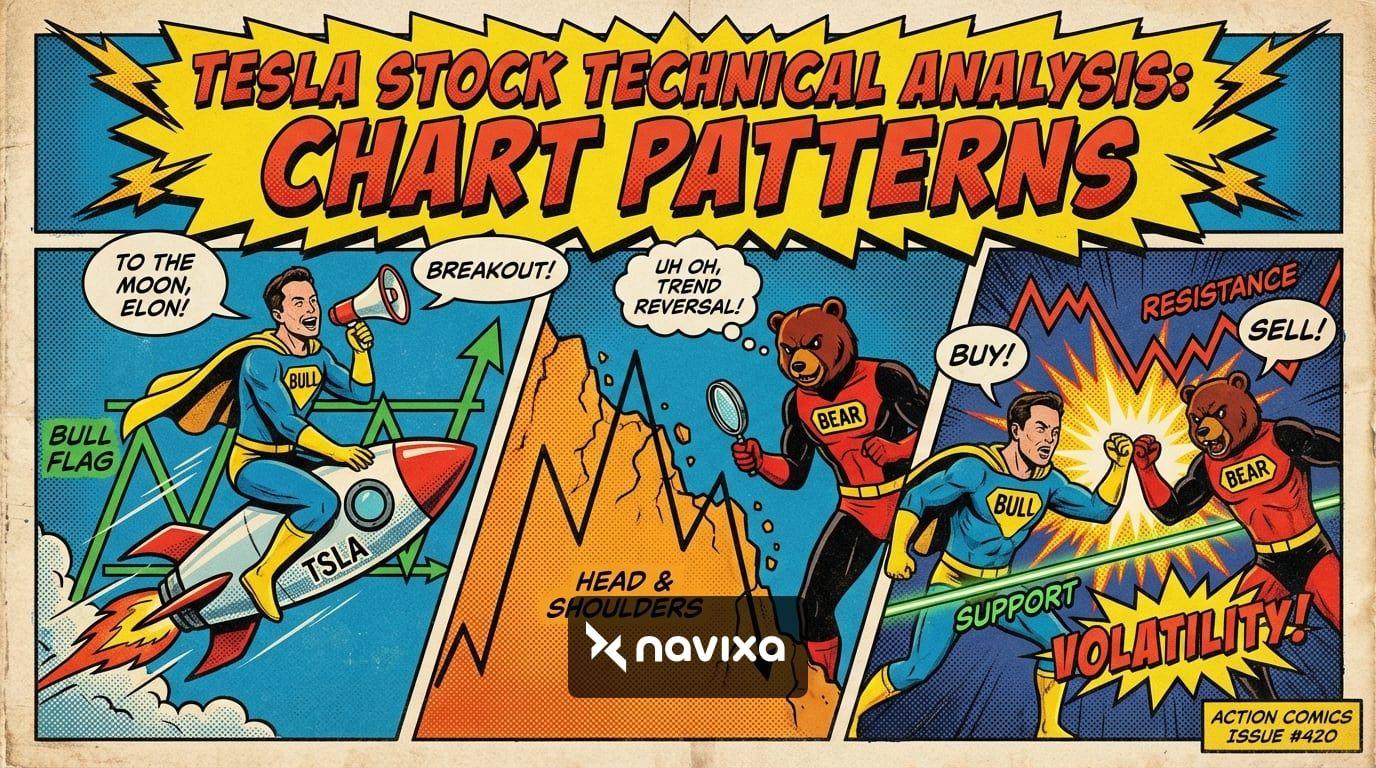
The Head and Shoulders pattern is a classic reversal setup. * Standard Head and Shoulders: Indicates a bullish-to-bearish reversal. It consists of three peaks, with the middle peak (the head) being the highest. A break below the "neckline" support confirms the downtrend. * Inverted Head and Shoulders: Indicates a bearish-to-bullish reversal. TSLA often forms this pattern at the bottom of a massive sell-off, signaling that sellers are exhausted and buyers are stepping back in.
Momentum Indicators: RSI and MACD
While chart patterns provide the structure of a trade, momentum indicators confirm the strength of the move.
Relative Strength Index (RSI)
The RSI is a momentum oscillator that measures the speed and change of price movements on a scale of 0 to 100. * Overbought (Above 70): Indicates that TSLA may have rallied too fast and is due for a pullback. * Oversold (Below 30): Suggests that the selling has been overdone. TSLA is notorious for experiencing "V-shaped" recoveries when its daily RSI dips into the extreme fear territory (around the 30 level).
Moving Average Convergence Divergence (MACD)
The MACD is a trend-following momentum indicator that shows the relationship between two moving averages of a stock's price. Traders watch for MACD crossovers. When the MACD line crosses above the signal line—especially while below the zero line—it generates a strong buy signal. Conversely, a bearish crossover indicates that negative momentum is accelerating. By monitoring MACD histogram compression, traders can spot early signs that a bearish trend is losing steam.
Technical vs. Fundamental Analysis for TSLA
To better understand how Tesla stock technical analysis fits into the broader investment landscape, consider how it contrasts with fundamental analysis.
| Feature | Technical Analysis | Fundamental Analysis |
|---|---|---|
| Primary Focus | Price action, volume, and chart patterns | Earnings, revenue, margins, and intrinsic value |
| Time Horizon | Short-term to medium-term (Intraday to swing trading) | Long-term (Years to decades) |
| Key Metrics | RSI, MACD, Moving Averages, Support/Resistance | P/E Ratio, Free Cash Flow, Vehicle Deliveries |
| Market Psychology | Highly integrated; capitalizes on market fear and greed | Tends to ignore short-term market sentiment |
| Best Used For | Timing entries and exits, managing portfolio risk | Identifying undervalued or overvalued companies |
While fundamentals tell you *what* to buy, technicals tell you *when* to buy. Successful Tesla traders often blend both disciplines—using fundamental catalysts (like full-self-driving advancements) to build conviction, and technical analysis to optimize their entry prices. For more broad market data, platforms like Yahoo Finance offer excellent fundamental overviews, while charting software like TradingView provides advanced technical tools.
Developing a Trading Strategy for Tesla
Knowing the patterns and indicators is only half the battle. Executing a profitable strategy requires discipline and strict risk management.
Actionable Trading Steps
1. Define the Broader Trend: Before taking a position, zoom out to the daily or weekly chart. Is TSLA in a macro uptrend or downtrend? Trade in the direction of the dominant trend unless you have a confirmed reversal signal. 2. Identify Key Zones: Map out your support and resistance levels. If TSLA is trading in the middle of a range (e.g., between $360 and $400), it is often better to wait for the price to reach an extreme before acting. 3. Wait for Confirmation: Never anticipate a breakout. Wait for a daily close above resistance or below support. Volume is the ultimate validator; a breakout on low volume is often a "fake-out" or bull trap.
Risk Management Techniques
Trading TSLA without a stop-loss is extremely dangerous due to its high volatility. * Position Sizing: Never risk more than 1% to 2% of your total trading capital on a single TSLA trade. * Stop-Loss Placement: Place your stop-loss just below a major support level or moving average. For example, if you buy TSLA on a bounce off the 200-day EMA at $345, setting a stop-loss at $338 protects you from a catastrophic gap-down. * Take-Profit Targets: Establish clear profit targets based on upcoming resistance levels. Scaling out of a position (selling half your shares at target one and letting the rest ride with a trailing stop) is an effective way to secure profits while capturing upside.
Practical Takeaways
* Respect the Volatility: Tesla's high beta means it requires wider stop-losses and smaller position sizes compared to traditional blue-chip stocks. * Monitor the Moving Averages: The 50-day and 200-day moving averages act as the ultimate arbiters of Tesla's medium and long-term trends. * Combine Indicators: Never rely on a single indicator. A bullish setup is far more reliable when a breakout is confirmed by both an oversold RSI and a bullish MACD crossover. * Stay Updated on Catalysts: Earnings reports, delivery numbers, and macroeconomic data can instantly invalidate a technical setup. Always be aware of the economic calendar.
Conclusion
Mastering Tesla stock technical analysis is a continuous journey that requires patience, emotional control, and a deep understanding of market mechanics. By learning to identify descending channels, monitor crucial momentum indicators like the RSI and MACD, and respect major support zones, traders can turn Tesla's notorious volatility into a profound advantage.
Whether you are an active day trader or a long-term investor looking to optimize your cost basis, integrating these technical charting principles will undoubtedly elevate your market proficiency. Start applying these concepts today on your preferred charting platform, refine your risk management strategies, and take control of your trading journey.
Frequently Asked Questions
What is the best timeframe for Tesla stock technical analysis?
The optimal timeframe depends entirely on your trading style. Day traders rely heavily on the 5-minute and 15-minute charts to capture intraday volatility. Swing traders looking to hold positions for days or weeks should focus on the 1-hour and 4-hour charts. For long-term investors aiming to identify macro trends, the daily and weekly charts are the most reliable.
How does volatility affect TSLA chart patterns?
High volatility can cause "wicks" or "tails" on candlesticks, where the price temporarily breaks a support or resistance level before sharply snapping back. This makes strict adherence to closing prices more important than intraday spikes. Traders must use wider stop-loss margins to avoid being stopped out prematurely by normal market noise.
Can technical analysis predict Tesla's future price accurately?
No analytical method can guarantee future price movements with 100% accuracy. Technical analysis deals in probabilities, not certainties. It provides a framework to identify high-reward, low-risk setups based on historical human psychology and market data, but unexpected news catalysts can instantly alter a stock's trajectory.
What are the most reliable indicators for trading TSLA?
For Tesla specifically, volume-weighted average price (VWAP) is excellent for day trading, while the 200-day Exponential Moving Average (EMA) and the Relative Strength Index (RSI) are highly respected for swing trading. Additionally, because TSLA is deeply retail-driven, psychological support and resistance levels (every $50 increment) act as highly reliable indicators.
Why do gaps often appear on the Tesla stock chart?
Gaps occur when TSLA opens significantly higher or lower than its previous day's closing price. This usually happens over the weekend or overnight in response to major news, such as vehicle delivery reports, earnings releases, or macroeconomic shifts. Technical analysts often watch for "gap fills," a common phenomenon where the stock eventually retraces to trade within the price range of the previous gap.