
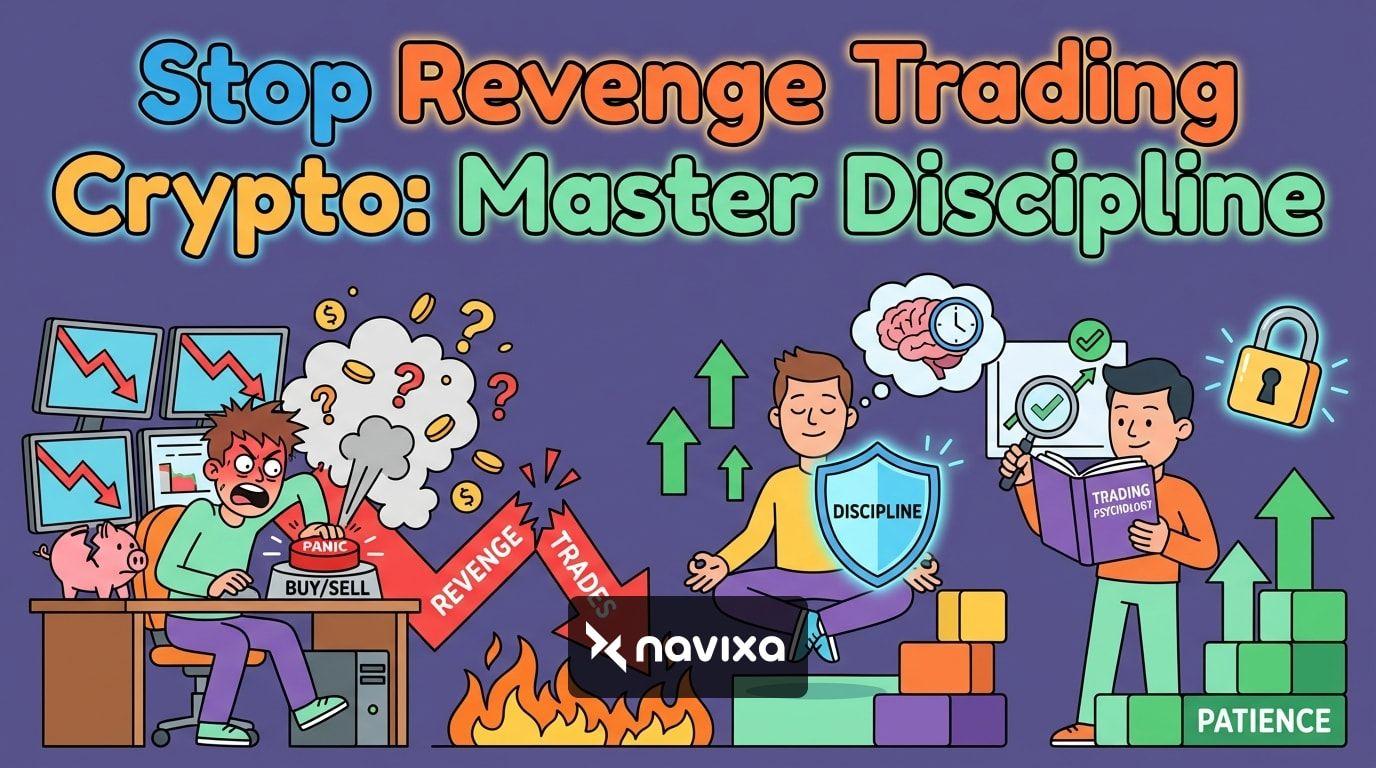
The Trap of Revenge Trading Crypto
You have just watched a sudden red candle slice through your perfectly planned support level. Your stop-loss triggers, and you are officially out of the trade, taking a painful hit to your portfolio. Instantly, a flush of heat hits your face, followed by an overwhelming urge to jump right back into the market—often with higher leverage—to win back exactly what you just lost. If you have experienced this intense, visceral reaction, you are not alone. You have just come face-to-face with one of the most destructive psychological traps in the digital asset market: revenge trading crypto.
In the fast-paced, high-volatility world of cryptocurrency, price action moves at lightning speed. Assets can easily swing double-digit percentages in a single afternoon due to macroeconomic shifts, institutional options expiry, or unexpected regulatory news. For example, when Bitcoin consolidates heavily around major resistance zones like the $74,000 to $75,000 mark, the market is prone to sudden, violent fake-outs that hunt stop-losses. While this extreme volatility provides massive opportunities for profit, it also creates the perfect storm for emotional decision-making.
Mastering your psychological response to losses is the single most important skill you can develop as a trader. In this comprehensive guide, we will break down the mechanics of revenge trading, the psychological triggers behind it, and the actionable strategies you need to master your discipline and protect your capital.
What Exactly is Revenge Trading?
Revenge trading occurs when a trader executes an impulsive, emotionally driven trade immediately following a significant loss, with the sole intention of making their money back.
It is crucial to differentiate a revenge trade from a legitimate re-entry. A legitimate re-entry happens when your stop-loss is hit, but the market subsequently reclaims a key technical level, and your pre-defined trading plan explicitly dictates that you should enter the trade again. In contrast, a revenge trade ignores technical analysis, abandons risk management protocols, and is entirely fueled by anger, frustration, and a bruised ego.
When you are revenge trading crypto, you are no longer trading the chart in front of you; you are trading your PnL (Profit and Loss). You are fighting the market, trying to force it to return the capital it 'stole' from you.
The Psychological Drivers Behind the Urge
To effectively stop revenge trading crypto, you must first understand the psychological forces that hijack your rational brain after a losing trade.
1. Loss Aversion
Behavioral economics teaches us about a concept known as loss aversion. Studies show that the psychological pain of losing money is roughly twice as intense as the joy of making the same amount. When a crypto trader takes a hit, the brain perceives this loss as an immediate threat. The natural fight-or-flight response kicks in, urging the trader to 'fight' the market to eliminate the source of the pain.
2. The Ego and the Need to Be 'Right'
Many traders tie their self-worth to their win rate. If you spend hours analyzing a chart, mapping out Fibonacci retracements, and reading macroeconomic data, only to watch the trade immediately invalidate, your ego takes a severe blow. The urge to revenge trade is often an attempt to prove to yourself—and the market—that your original thesis was correct all along.
3. The Gambler's Fallacy
This is the irrational belief that because you have experienced a string of losses, you are mathematically 'due' for a win. In reality, the cryptocurrency market has no memory of your previous trades. Each tick on the chart is an independent event. Believing that the market owes you a winning trade leads to reckless position sizing and devastating drawdowns.
How the 24/7 Crypto Market Exacerbates the Problem
Unlike traditional equity markets that close at a specific time each day, the cryptocurrency market never sleeps. This 24/7, 365-day accessibility is a double-edged sword.
In traditional finance, the closing bell forces traders to step away from their screens, naturally breaking the cycle of emotional trading. They have an entire evening to cool down, review their trades, and approach the next day with a clear head. Crypto traders do not have this luxury. After a painful liquidation at 2:00 AM, the exchange is still open, the flashing lights are still moving, and the temptation to immediately over-leverage to win it back is always just one click away. This lack of friction makes strict personal discipline absolutely mandatory.
The Devastating Consequences on Your Portfolio
The most dangerous aspect of revenge trading crypto is how quickly it can drain a healthy portfolio. When traders are tilted, they routinely commit cardinal sins of risk management:
* Overleveraging: To make back a $1,000 loss on a smaller market move, a trader might increase their leverage from 5x to 50x. This exponentially increases the risk of complete account liquidation. * Ignoring Market Regimes: A trader might try to forcefully long a market that has clearly transitioned into a bearish downtrend, simply because they refuse to accept the shifting momentum. * Mental Capital Depletion: Financial losses are painful, but the psychological burnout caused by revenge trading is far worse. A trader who loses their composure will often enter a downward spiral, making increasingly erratic decisions until their account balance reaches zero.
To understand broader market dynamics and how volatility impacts trader psychology, you can review the extensive educational resources available through Investopedia's guide to trading psychology.
Revenge Trading vs. Disciplined Trading
Understanding the stark contrast between an emotional trader and a professional trader is essential for long-term survival in the crypto markets.
| Feature | Revenge Trading | Disciplined Trading |
|---|---|---|
| Primary Motivation | Recovering lost capital immediately | Executing a pre-defined strategy |
| Risk Management | Ignored; often uses excessive leverage | Strictly adhered to (e.g., 1-2% risk per trade) |
| Entry Trigger | Emotion, anger, and FOMO | Technical alignment and clear confluence |
| Order Types Used | Aggressive Market Orders | Strategic Limit and Stop-Limit Orders |
| Response to a Loss | Immediate re-entry to 'fight' the market | Reviewing the journal and stepping away |
Actionable Strategies to Stop Revenge Trading Crypto
Recognizing the problem is only the first step. To truly master your discipline, you must implement systemic friction into your daily trading routine.
1. Implement a Strict 'Circuit Breaker' Rule
Professional proprietary trading firms use hard daily loss limits. If a trader loses a specific percentage of their account in a single day, their trading terminal is automatically locked. You must enforce a similar 'circuit breaker' on yourself.
Decide in advance what your maximum daily drawdown is—for example, 3% of your total capital. If you hit that limit, you must physically step away from your computer. Close the exchange app on your phone. Do not look at CoinMarketCap or Twitter for the rest of the day. The market will still be there tomorrow.
2. Shift from Market Orders to Limit Orders
Market orders are the tool of the impatient. When you are emotionally triggered, smashing the 'Buy Market' button guarantees instant gratification, but it also guarantees slippage and poor entry prices.
Force yourself to use only limit orders or conditional buy-stops. By setting a limit order, you are forcing the market to come to your price. If the asset pumps without hitting your limit, you simply miss the trade. This practice artificially slows down your execution speed and effectively blocks impulsive revenge trades.
3. Reduce Position Sizing After a Loss
When you suffer a loss, your confidence is shaken and your market read is temporarily out of sync. The worst thing you can do is increase your position size to make the money back faster.
Instead, adopt the strategy of professional risk managers: cut your size in half. If you normally risk $500 per trade, risk only $250 on the trade following a loss. This allows you to stay engaged with the market while dramatically reducing the financial impact if your losing streak continues. It helps rebuild your confidence without risking ruin.
4. Maintain an Emotional Trading Journal
Most crypto traders log their entries, exits, and position sizes. However, professional traders also log their psychological state.
Create a dedicated column in your trading journal for 'Emotions.' Write down exactly how you felt before, during, and after the trade. Did you feel anxious? Were you experiencing FOMO because Bitcoin rallied without you? By documenting these feelings, you will quickly identify the emotional patterns that precede your revenge trades, allowing you to catch the behavior before it destroys your capital.
Frequently Asked Questions
What is revenge trading in crypto?
Revenge trading in cryptocurrency refers to the act of executing impulsive, emotionally driven trades immediately after suffering a loss. The primary goal of a revenge trade is not to follow a logical strategy, but to forcefully win back the lost capital from the market as quickly as possible.
Why is revenge trading so common in cryptocurrency?
The crypto market operates 24/7 without traditional closing hours, meaning traders never get a forced break to cool down. Combined with the availability of extreme leverage and high baseline volatility, the digital asset market creates an environment where emotional, tilt-driven trading is exceptionally easy to execute.
How long should I wait before trading after a big loss?
It is highly recommended to wait at least 24 hours after a significant or unexpected loss before placing another trade. This 'circuit breaker' period allows your cortisol levels to drop, your emotional baseline to stabilize, and your rational brain to take back control of your decision-making process.
Can automated trading bots prevent revenge trading?
Yes, automated algorithmic trading bots execute trades purely based on pre-programmed logic, entirely removing human emotion from the equation. However, bots require strict oversight, and the human trader must still exercise discipline to avoid manually overriding the bot's parameters after a string of losses.
How do I know if I am revenge trading or just taking a valid setup?
Ask yourself one simple question: 'Was this exact trade setup written in my trading plan before the session started?' If the answer is no, and you are entering the market simply because you just took a loss and feel an urgent need to be in a position, you are revenge trading.
Conclusion: Discipline is Your Greatest Asset
In the unpredictable landscape of digital assets, your trading strategy and technical analysis will only take you so far. The true differentiator between traders who lose their capital and those who achieve long-term profitability is emotional control.
When you stop revenge trading crypto, you stop bleeding unnecessary capital. Accept that losses are simply the cost of doing business in the market. Embrace strict risk management, utilize limit orders, and never hesitate to walk away from the screens when your emotions run high. Master your discipline today, and you will secure your portfolio for the bull runs of tomorrow.